Why This Camera & Lens Are Great for Panoramas
If you’re wondering how to shoot panorama with Sony a7R V & Sigma 14-24mm f/2.8 DG DN Art, you’re pairing one of the sharpest full-frame ultrawide zooms with a flagship 61MP mirrorless body. The a7R V’s 35.7 × 23.8 mm full-frame sensor delivers extremely high resolving power and excellent base-ISO dynamic range (about 14.7 EV at ISO 100), which is ideal for 360 photos and large multi-row stitches. Its in-body stabilization is helpful for handheld frames, though for tripod-based panoramas you’ll typically disable IBIS to eliminate any micro-shifts during rotation.
The Sigma 14-24mm f/2.8 DG DN Art is a rectilinear ultra-wide zoom, not a fisheye. Rectilinear lenses preserve straight lines and avoid the fisheye “bulge” aesthetic, making them perfect for architectural and real estate panoramas. The tradeoff compared to fisheyes is that you’ll capture more frames to cover a full 360×180° sphere. Wide open at f/2.8 the lens is excellent, but for panoramas you’ll usually stop down to f/8–f/11 for corner-to-corner sharpness. Distortion is very low and well-corrected with lens profiles, and longitudinal/transverse CA are well-controlled. Note the bulbous front element: there’s no front filter thread; the DG DN variant supports a rear filter holder if needed.
Mount-wise, the Sigma DG DN Art is made for mirrorless and is available in Sony E-mount, so compatibility is native. Autofocus is fast, but for panoramic heads you’ll lock to manual focus and manual exposure to keep every frame consistent for stitching.
Quick Setup Overview
- Camera: Sony a7R V — Full Frame 61MP BSI sensor, approx. 3.76 µm pixel pitch; excellent base ISO DR and color depth.
- Lens: Sigma 14-24mm f/2.8 DG DN Art — rectilinear ultra-wide zoom; very sharp at f/5.6–f/11; low distortion and well-controlled CA.
- Estimated shots & overlap (field-tested, rectilinear lens needs more coverage):
- At 14mm: 3 rows × 8 around (24) + zenith + nadir ≈ 26 shots, 30% horizontal overlap, ~25% vertical overlap.
- At 18mm: 3 rows × 10 around (30) + Z + N ≈ 32 shots.
- At 24mm: 4 rows × 12 around (48) + Z + N ≈ 50+ shots (great for gigapixel detail).
- Difficulty: Intermediate — requires nodal alignment and multi-row technique.
Planning & On-Site Preparation
Evaluate Shooting Environment
Walk the location first. Note the light direction, high-contrast areas (windows, the sun), moving subjects (people, cars, trees in wind), and reflective surfaces (glass, polished floors). If shooting through glass, place the lens hood nearly flush with the surface and shoot at a slight angle to reduce reflections. Keep at least a few centimeters gap to avoid touching and vibrating the glass; turn off IBIS on a tripod to prevent sensor shift artifacts.
Match Gear to Scene Goals
The a7R V’s high resolution makes it ideal for virtual tours and large-format prints. You can confidently stay at ISO 100–400 for maximum dynamic range; ISO 800 is still clean for interiors. The Sigma 14-24mm rectilinear perspective preserves straight lines, perfect for real estate and architecture. If you need fewer shots and don’t mind the fisheye look, a fisheye alternative would reduce the frame count—but with this lens you get minimal distortion and more detail per angle.
Pre-shoot Checklist
- Fully charge batteries; the a7R V can chew through power when bracketing many frames. Bring spares.
- Use large, fast cards (CFexpress Type A and/or UHS-II SD). Consider writing to both slots simultaneously for redundancy.
- Clean lens and sensor; dust becomes obvious when you clone out the tripod in the nadir.
- Level your tripod and verify pano head calibration to the lens’s entrance pupil (nodal point).
- Safety: On rooftops and windy areas, tether your gear, keep a low profile, and mind railings and bystanders.
- Backup workflow: If time allows, shoot a second, safety pass (especially for client work).
Essential Gear & Setup
Core Gear
- Panoramic head: A proper multi-row panoramic head lets you rotate around the entrance pupil to eliminate parallax. This keeps foreground and background alignment consistent between frames, which is critical for clean stitching.
- Stable tripod with leveling base: A leveling base helps you level once, then rotate without re-adjusting legs. It speeds up workflow and minimizes horizon errors.
- Remote trigger or app: Use Sony Imaging Edge Mobile or a simple remote to avoid touching the camera. Self-timer works too, but slows you down.
Optional Add-ons
- Pole or car mount: Great for elevated viewpoints or drive-by capture. Always tether gear; beware wind and vibration. Avoid crowds below and check local laws.
- Lighting aids: Portable LED panels can fill shadowy interiors without changing the overall ambiance. Keep lighting consistent across frames.
- Weather gear: Rain covers, lens cloths, and a microfiber towel for dew. The Sigma is weather-sealed, but wipe off moisture frequently.
Step-by-Step Shooting Guide
Standard Static Scenes
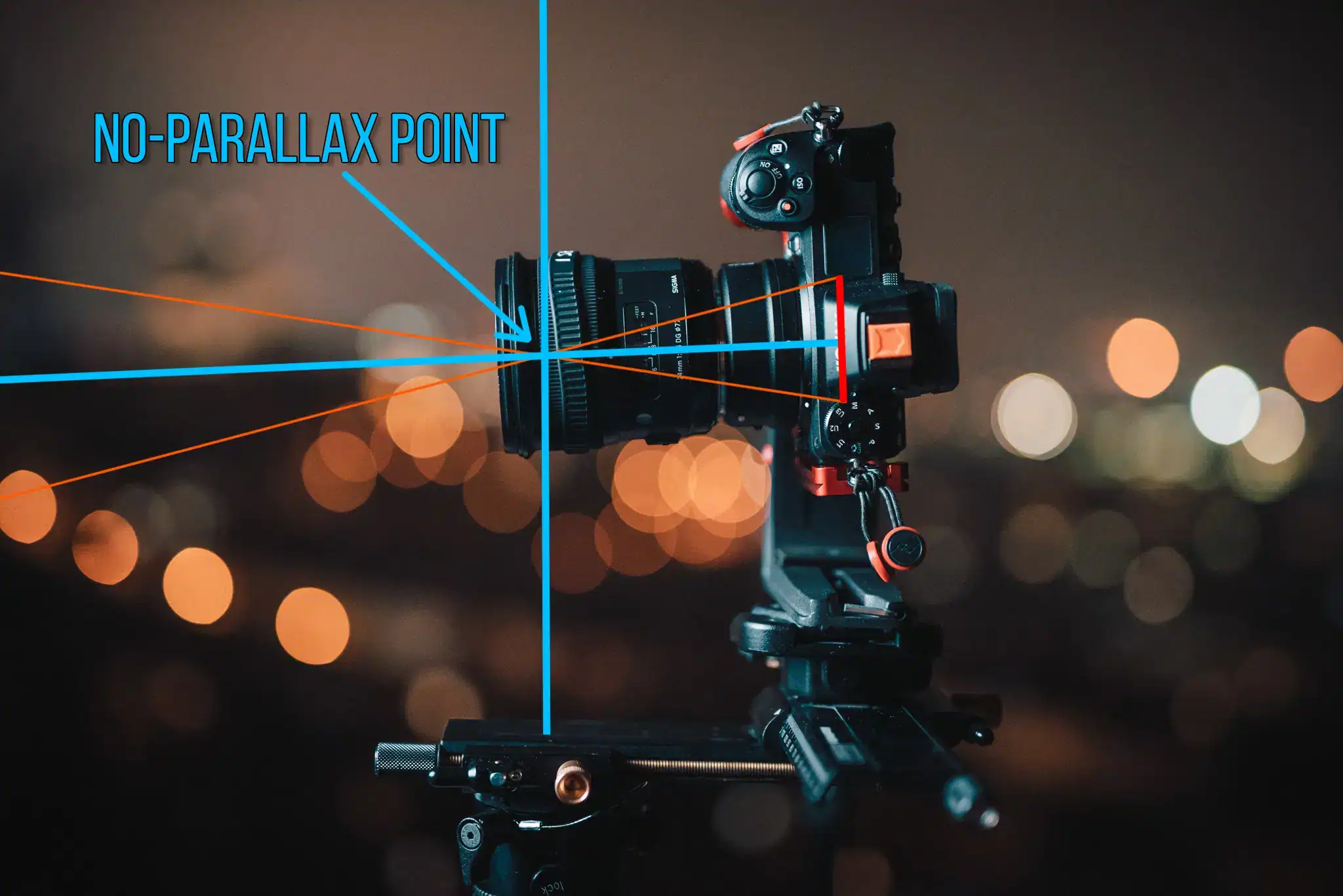
- Level the tripod and align the nodal point: Mount the a7R V on the panoramic head with the Sigma set to your chosen focal length (14, 18, or 24mm). Slide the rail until foreground and background elements do not shift relative to each other when you pan left/right. Mark this rail position with tape for each focal length you use.
- Manual exposure and white balance: Set manual mode and fix white balance (Kelvin or a preset) to avoid color and exposure shifts across frames. For daylight, start at ISO 100, f/8–f/11, and adjust shutter for proper exposure.
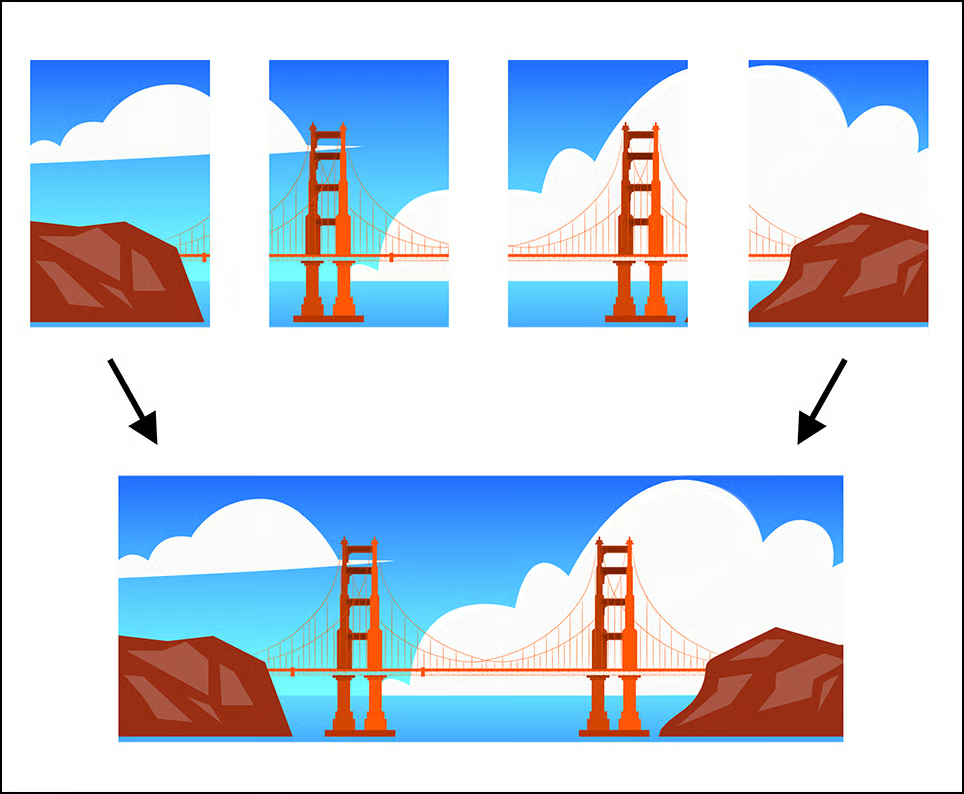
- Capture with proper overlap: At 14mm, use three rows (e.g., pitch +45°, 0°, −45°) with eight shots per row, rotating ~45° each shot. Then shoot a zenith (+90°) and a nadir (−90°). Use consistent rotation angles—many heads have click-stops.
- Nadir shot: After the main rows, tilt down to shoot the ground for tripod removal. If the tripod obstructs, move the camera off-center for a separate nadir capture and use viewpoint correction in PTGui.
HDR / High Dynamic Range Interiors
- Bracketed exposure: Use 3–5 frames at ±2 EV to preserve bright windows and interior shadows. The a7R V supports extensive bracketing; 3 frames ±2 EV often suffice.
- Lock WB and focus: Keep white balance fixed and focus manual. Consider using AEB with a 2-second timer or remote to reduce vibration.
- Maintain cadence: For each angle, capture the full bracket set before rotating to prevent mixing exposures between viewpoints.
Low-Light / Night Scenes
- Long exposures: Start around ISO 100–400, f/4–f/5.6, and let shutter go long (1–15s) depending on light. The a7R V’s base ISO yields cleaner shadows; avoid pushing ISO unless necessary (800 is a reasonable ceiling for critical work).
- Stability: Turn IBIS off on the tripod to avoid sensor micro-movements. Use a remote or 2s timer. Consider EFCS (Electronic First Curtain Shutter) to minimize shutter shock.
- Consistent lighting: If city lights flicker or change color, work swiftly and maintain your sequence to avoid patchy stitches.
Crowded Events
- Two passes: Do a fast pass to capture the structure, then a second pass to catch gaps in the crowd. You’ll blend in post by masking moving people.
- Faster shutter: Aim for 1/200s or faster to freeze motion if light allows, accepting a slightly higher ISO (400–800).
- Masking plan: Keep notes on problem sectors (e.g., frame 3/row 2) to speed up masking later.
Special Setups (Pole / Car / Elevated)
- Secure everything: Use a safety tether for pole work and a robust clamp for car mounts. Balance the rig and keep center of gravity low.
- Wind and vibration: Rotate more slowly; increase shutter speed to fight micro-shakes. Consider shooting at 14mm to reduce the number of frames aloft.
- Legal and safety: Check permissions, avoid public hazards, and never mount gear where it could fall onto people or traffic.
Recommended Settings & Pro Tips
Exposure & Focus
| Scenario | Aperture | Shutter | ISO | Notes |
|---|---|---|---|---|
| Daylight outdoor | f/8–f/11 | 1/100–1/250 | 100–200 | Lock WB (Daylight or 5600K). EFCS on tripod. |
| Low light/night | f/4–f/5.6 | 1/30 to multi-second | 100–800 | Tripod + remote; prefer lower ISO for cleaner shadows. |
| Interior HDR | f/8 | Bracket ±2 EV | 100–400 | Balance bright windows and interior lamps; keep WB fixed. |
| Action / moving subjects | f/5.6–f/8 | 1/200+ | 400–800 | Freeze motion; consider two-pass capture for masking. |
Critical Tips
- Manual focus at hyperfocal: At 14mm and f/8, hyperfocal distance is roughly 0.8–1.0 m. Prefocus around 1 m and switch to MF to keep everything sharp.
- Nodal point calibration: Because entrance pupil position changes with focal length and focus distance, mark rail positions for 14, 18, and 24mm during a home test. Re-check if you change focus significantly.
- White balance lock: Mixed lighting can cause stitching seams. Set Kelvin (e.g., 5600K daylight, 3200K tungsten) or use a custom WB card.
- RAW over JPEG: Shoot 14-bit RAW (lossless compressed) to preserve DR and color for HDR merges and exposure fusion.
- IBIS and stabilization: Turn off IBIS and any lens stabilization on a tripod to avoid micro-drift during rotation.
- Shutter mode: EFCS is recommended on tripod; avoid full electronic if LED lighting causes banding.
- File management: A 61MP multi-row HDR pano can exceed several gigabytes. Organize into folders per row and angle, and mirror to both cards when possible.
Stitching & Post-Processing
Software Workflow
Recommended tools include PTGui (fast and robust), Hugin (free, powerful), Lightroom/Photoshop (good for linear panos), and Affinity Photo. In PTGui or Hugin, set lens type to rectilinear with the correct focal length and sensor. For rectilinear lenses like the Sigma 14-24mm, use ~30% horizontal overlap and ~25% vertical as a baseline. Add control points where needed, then run optimization and check for parallax issues or seam errors. For nadir cleanup, use viewpoint correction or patch with a separate off-tripod shot. For a thorough PTGui overview, the Fstoppers review is a solid reference at the end of this paragraph. Read the PTGui deep-dive and why it excels for complex panos.
Cleanup & Enhancement
- Tripod/nadir patch: Use viewpoint correction in PTGui or clone in Photoshop. AI tools can speed up floor texture reconstruction.
- Color consistency: Balance WB and tint across the panorama. Use graduated masks to even out exposure variations if the sun moved between rows.
- Noise reduction: Apply gentle NR to shadow areas, especially for night/HDR frames. Avoid over-smoothing textures.
- Horizon level: Use roll/yaw/pitch adjustments and grid overlays to ensure a level horizon.
- Export: For VR viewers, export equirectangular 2:1 (e.g., 12000×6000 or 16000×8000 for higher detail). The a7R V’s 61MP sensor supports extremely large, detailed outputs when multi-row stitched. See resolution planning notes at the end of this sentence. Understand spherical resolution and final output size planning.
For fundamentals of panoramic head setup and technique, this is an excellent guide: Set up a panoramic head to shoot high-end 360 photos.
Useful Tools & Resources
Software
- PTGui panorama stitching
- Hugin (open source)
- Lightroom / Photoshop / Affinity Photo
- AI tripod removal and generative fill tools
Hardware
- Panoramic heads (Nodal Ninja, Leofoto, Fanotec)
- Carbon fiber tripods with leveling bases
- Wireless remote shutters and L-brackets
- Pole extensions / car clamps with safety tethers
Disclaimer: Names provided for research; confirm current specs and compatibility on official sites.
For fundamentals and practical buying/usage advice, this panoramic head tutorial is also valuable: Comprehensive panoramic head tutorial.
Real-World Scenarios & Field Advice
Indoor Real Estate
Set the Sigma to 14mm or 18mm to minimize the frame count while keeping straight lines. Use a tripod and a multi-row head. Shoot 3–5 exposure brackets at ±2 EV to retain window detail. Lock WB around 3200–4000K inside tungsten-lit rooms. Avoid pushing ISO; 100–400 keeps the a7R V’s shadows clean for bright, natural interiors.
Outdoor Sunset
Arrive early to set nodal alignment and shoot a baseline set at golden hour. As the sun dips, do a second HDR pass (±2 EV). Wind can cause movement in grass and trees—use a slightly faster shutter (1/100–1/200) and accept a slightly higher ISO (200–400) to keep frames consistent.
Crowd-Heavy Events
Go wider (14mm) to reduce total frames. Do two passes, quickly. The first captures structure and placement; the second waits for gaps. In PTGui, use masking to select the cleanest subjects per frame. Keep the camera height consistent so head sizes and perspective remain believable.
Rooftop / Pole Shooting
Tether the camera and weigh the tripod. Limit the number of frames (14mm, single EV if possible). Rotate slower to minimize vibration. If the pole flexes, increase shutter speed and clamp down the rig’s loose points.
Car-Mounted Capture
Only shoot in safe, controlled environments. Use a robust suction/clamp system with backup cords. Stop-and-shoot works better than rolling shots for stitching consistency. Choose 14mm, higher shutter speed (1/500s+), and shoot shorter sequences.
Common Mistakes & How to Avoid Them
- Parallax error → Always align to the entrance pupil; re-check after changing focal length or focus.
- Exposure flicker → Manual exposure and fixed WB; avoid auto ISO and auto WB across frames.
- Tripod shadows → Capture a nadir frame and patch in post; reposition slightly if needed.
- Ghosting from motion → Two-pass capture and layer masking in post.
- High ISO noise → Prefer longer shutter on tripod rather than pushing ISO; a7R V shines at base ISO.
- Inconsistent row overlaps → Use click-stops or a marked angle scale; keep around 30% overlap.
Frequently Asked Questions
- Can I shoot handheld panoramas with the Sony a7R V?
Yes, for simple linear panos and quick 180° views. The a7R V’s stabilization helps, but for full 360×180° with minimal parallax, a tripod and panoramic head are strongly recommended. Handheld multi-row 360s often suffer alignment and parallax issues, especially with nearby foreground objects.
- Is the Sigma 14-24mm f/2.8 DG DN Art wide enough for a single-row 360?
No. It’s rectilinear, not fisheye. Expect multi-row capture for a full sphere. At 14mm, plan on three rows of eight around, plus zenith and nadir (≈26 frames). The benefit is straighter lines and superb detail.
- Do I need HDR for interiors with bright windows?
Often yes. Bracket ±2 EV (3–5 frames per angle) to hold highlights outside and shadows inside. The a7R V’s DR is excellent, but HDR ensures clean windows and natural interiors without pushing shadows too hard.
- How do I avoid parallax issues with this lens?
Use a multi-row panoramic head and align rotation to the lens’s entrance pupil. Calibrate at your chosen focal length and focus distance, and mark those rail positions. Reconfirm if you change zoom or focus.
- What ISO range is safe on the a7R V for low light panoramas?
For critical work, ISO 100–400 keeps dynamic range high. ISO 800 remains very usable; beyond that, expect reduced DR and more noise. Prefer longer exposures on a tripod over pushing ISO.
- Can I set up Custom Modes for pano on the a7R V?
Yes. Save manual exposure, fixed WB, MF, drive/bracketing preferences, EFCS, IBIS off, and self-timer/remote settings to a custom mode (e.g., MR1). It speeds up setup dramatically on location.
- How do I reduce flare when shooting ultrawide panoramas?
Shield the front element with your hand just outside the frame, avoid pointing directly at strong backlights when possible, and clean the bulbous front element diligently. Slightly adjust camera yaw to place the sun near a seam you can later mask.
- What’s the best tripod head for this setup?
A multi-row panoramic head with fore-aft and lateral rails, degree markings, and sturdy clamps. Options from Nodal Ninja/Fanotec and Leofoto are proven. Ensure payload capacity comfortably exceeds the a7R V + Sigma 14-24mm weight.
Final Notes, Safety & References
Respect the environment and people around you. Keep a secure stance when working near edges, in crowds, or with elevated poles, and always tether your gear when there’s any chance it could fall. For deeper technique guidance, these resources are concise and authoritative: Set up a panoramic head for high-end 360 photos and why PTGui excels for complex panoramas. For broader pano fundamentals and hardware tips, see this DSLR/mirrorless 360 FAQ.