Why This Camera & Lens Are Great for Panoramas
This guide shows you how to shoot panorama with Sony a7R V & Samyang 8mm f/3.5 UMC Fish-Eye CS II, a powerful combo for immersive 360° photos. The Sony a7R V is a 61MP full-frame mirrorless body (sensor size 35.7 × 23.8 mm, pixel pitch ~3.76 µm) with excellent base-ISO dynamic range (~14.5–15 EV at ISO 100), robust 5-axis IBIS, and reliable manual focus aids (peaking, magnification). The Samyang 8mm f/3.5 CS II is a manual, diagonal fisheye designed for APS-C. On the a7R V you can:
- Use APS-C crop mode (approx. 26MP output) for a clean, diagonal 180° fisheye without heavy vignetting—ideal for straightforward stitching with consistent coverage.
- Or use the lens on full-frame with the removable hood (CS II) shaved/removed to get a near circular fisheye projection. This can reduce the number of shots needed for a full sphere, but requires careful handling of edge vignetting and coverage.
The fisheye’s extreme field of view means you’ll need fewer frames than with rectilinear lenses, saving time on location. The a7R V’s high resolution still delivers excellent detail even in APS-C crop mode, and its manual focus aids make dialing hyperfocal focus quick and repeatable. Distortion is inherent to fisheye, but modern stitchers (PTGui, Hugin) expect fisheye input and model it precisely, so your sphere stitches cleanly when you manage parallax properly.
Quick Setup Overview
- Camera: Sony a7R V — Full-frame, 61MP, ~14.5–15 EV DR at base ISO, excellent manual focus aids; in-body stabilization (turn off on tripod).
- Lens: Samyang 8mm f/3.5 UMC Fish-Eye CS II — Manual focus fisheye for APS-C; sharp from f/5.6–f/8; moderate lateral CA at edges; removable hood on CS II version (some users shave for circular fisheye on FF).
- Estimated shots & overlap:
- APS-C crop mode (diagonal fisheye): 6 around at 60° yaw + zenith + nadir (30–35% overlap). For interiors or safety, 8 around works too.
- Full-frame circular fisheye (hood shaved/removed): 4 around at 90° + zenith + nadir is safe; skilled users can do 3 around at 120° + N/Z in open scenes.
- Difficulty: Easy–Intermediate (fisheye reduces shot count; nodal alignment still critical).
Planning & On-Site Preparation
Evaluate Shooting Environment
Before you set up, check light direction, moving elements (people, cars, trees), and reflective surfaces (glass, polished floors). If shooting through glass, place the front element close to the glass (1–2 cm) and shade it to reduce reflections. For sunsets and high-contrast scenes, plan for HDR bracketing so windows/sky and interiors are balanced later. Avoid placing the tripod too close to complex foreground objects; fisheyes exaggerate parallax with near subjects.
Match Gear to Scene Goals
The a7R V’s robust dynamic range and clean ISO 100–400 files keep gradients smooth and highlights intact. Indoors, ISO 200–800 is still very usable when tripod-mounted. The Samyang 8mm fisheye reduces the total number of shots, speeding up capture in moving environments (events, streets) but introduces typical fisheye edge stretching—no problem for PTGui/Hugin, but mind your composition relative to the sun or bright lights to minimize flare. Use APS-C crop mode for predictable coverage (great for real estate). Use circular fisheye on full-frame for fast outdoor spheres when you can manage the lens hood/vignetting.
Pre-shoot Checklist
- Charge batteries, clear memory cards; the a7R V’s 61MP RAWs are large even in crop mode—carry spares.
- Clean both lens and sensor; fisheye sees everything—dust becomes obvious against bright skies.
- Level the tripod and verify pano head calibration (nodal point alignment) before critical work.
- Safety: tether your camera in wind, use a weighted tripod; on rooftops/poles/car mounts, use a secondary safety strap.
- Backup workflow: shoot two complete rounds if time allows—invaluable when dealing with moving people or stitching anomalies.
Essential Gear & Setup
Core Gear
- Panoramic head with nodal slider: Aligning the lens entrance pupil (often called nodal point) over the rotation axis removes parallax between frames, which greatly improves stitch reliability and sharpness across overlaps.
- Stable tripod with a leveling base: Leveling at the base keeps your yaw rotations true; it’s faster than leveling the head and improves horizon consistency.
- Remote trigger or Sony Imaging Edge Mobile: Fire the shutter without touching the camera to avoid micro-shake, especially at slower speeds or HDR brackets.
Optional Add-ons
- Pole or car mount: Great for elevated views and moving rigs. Use a guy line and safety tether; watch wind loads and vibrations, especially with fisheye frontal area.
- LED panels or flashes with bounce for dark interiors; keep lighting consistent across all frames and brackets.
- Rain cover, lens hood/flag: Fisheyes are flare-prone; shade the lens when the sun is near the frame.
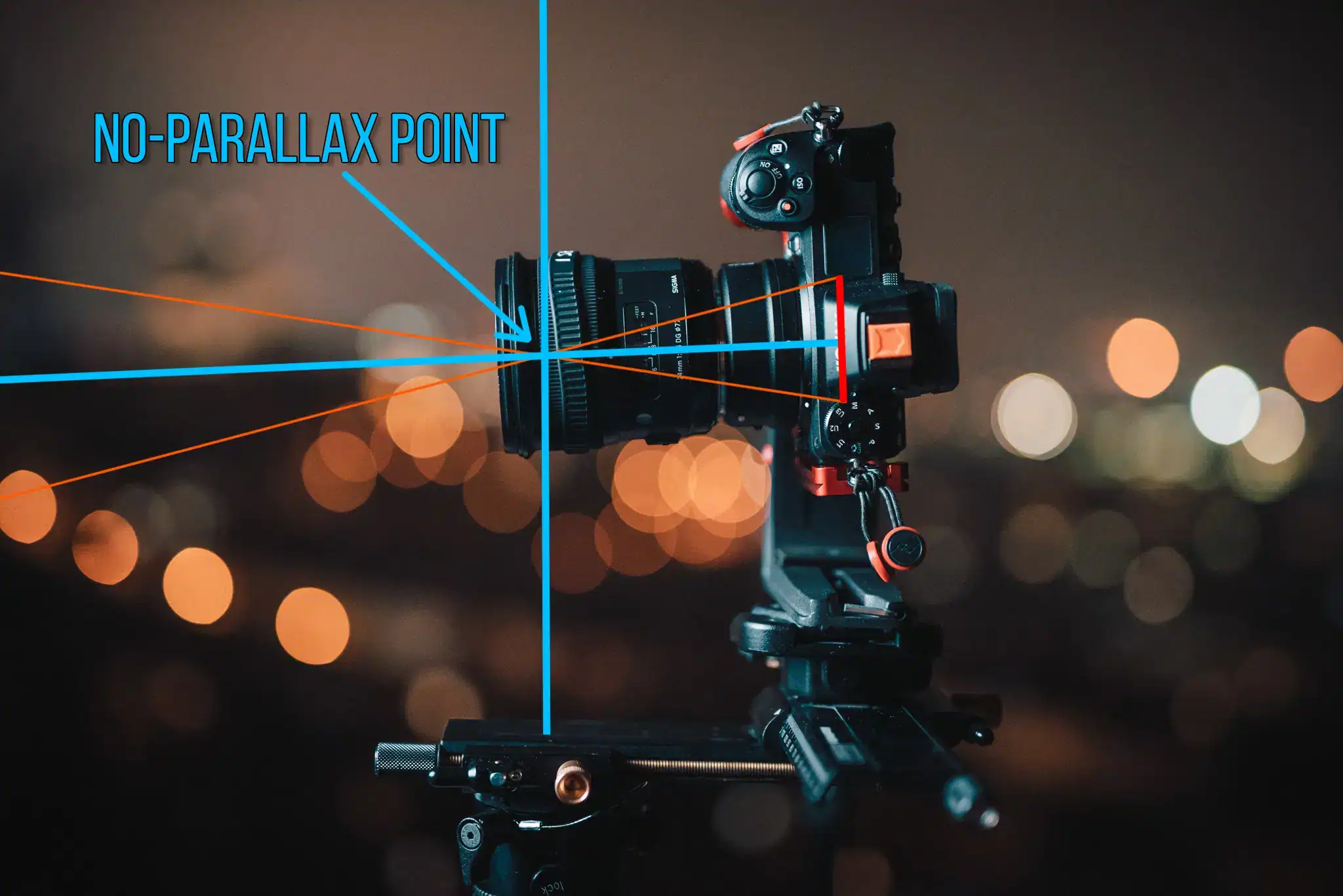
If you’re new to panoramic heads and entrance pupil alignment, this step-by-step primer is excellent for visualizing the process. Learn how to set up a panoramic head to shoot high‑end 360 photos.
Step-by-Step Shooting Guide
Standard Static Scenes
- Level and align
- Level the tripod using the leveling base bubble. Set your panoramic head so the yaw axis is truly vertical.
- Align the entrance pupil: place a near object and a far object in overlap and rotate the camera; adjust the fore-aft slider until their relative position doesn’t shift. Typical starting point for 8mm fisheyes is around the front group; expect a setting in the ~40–55 mm range forward from the sensor plane, then fine-tune.
- Manual exposure and WB
- Switch to Manual exposure (M). Meter for the midtones and protect highlights. For high-contrast scenes, plan HDR bracketing instead.
- Lock White Balance (Daylight/shade/tungsten) to avoid color shifts across frames. Avoid Auto WB for panos.
- Focus
- Use manual focus. On a fisheye, set f/8 and focus a bit past the hyperfocal guide (around 0.7–1 m) to keep everything sharp. Confirm with focus magnification.
- Capture sequence
- APS-C crop mode: 6 shots around at 60° increments, then zenith and nadir. Overlap ~30–35%.
- Circular fisheye on full-frame: 4 shots around at 90° (safe), then zenith and nadir. In open areas, 3 around at 120° can work, but check coverage near the horizon.
Use a remote and a 2 s self-timer to avoid vibration. Turn off IBIS when on a tripod.
- Nadir (ground) shot
- After the main round(s), offset the tripod slightly or hand‑hold the lens over the tripod hole and capture a clean ground plate for tripod removal in post.
HDR / High Dynamic Range Interiors
- Bracket ±2 EV (3 to 5 frames) to preserve both window highlights and interior shadows. Keep the same aperture and ISO; vary shutter speed only.
- Lock WB to a fixed preset; mixed lighting can be corrected later, but inconsistent WB across the bracket is hard to blend.
- Use the a7R V’s bracketing drive mode for rapid, consistent capture; ensure no movement during brackets.
Low-Light / Night Scenes
- Use slower shutter speeds on tripod (1/10–2 s if needed), keep ISO as low as possible (ISO 100–400 ideal; 800 is still clean on the a7R V for panos).
- Open up to f/4–f/5.6 if you need to; DOF on fisheye remains generous.
- Turn off IBIS on tripod, use remote triggering, and consider electronic first curtain or silent shooting to minimize vibration.
Crowded Events
- Do two passes around: first for base geometry, second timed to catch gaps in the crowd for patching.
- Use higher shutter (1/200–1/500) and ISO 400–800 to freeze motion. Mask moving people in post using PTGui’s masks.
Special Setups (Pole / Car / Drone)
- Pole: Use a lightweight panoramic head and secure a safety tether. Keep exposures short (1/250+) to fight sway; consider 4 around + N/Z for speed.
- Car: Use vibration-damping mounts. Avoid long exposures; shoot at 1/500+ and plan for selective masking in post.
- Drone: This lens/camera combo is too heavy for consumer drones; use native drone pano modes instead.
Recommended Settings & Pro Tips
Exposure & Focus
| Scenario | Aperture | Shutter | ISO | Notes |
|---|---|---|---|---|
| Daylight outdoor | f/8–f/11 | 1/100–1/250 | 100–200 | Lock WB (Daylight); watch for sun flare with fisheye |
| Low light/night | f/4–f/5.6 | 1/10–1/60 | 200–800 | Tripod + remote; IBIS off; consider ETTR at base ISO |
| Interior HDR | f/8 | Bracket ±2 EV | 100–400 | Keep aperture constant; vary shutter only |
| Action / moving subjects | f/5.6–f/8 | 1/200+ | 400–800 | Two-pass strategy; mask movement in PTGui |
Critical Tips
- Manual focus at hyperfocal: At f/8 on an 8mm fisheye, set focus around 0.7–1 m and you’ll cover from near foreground to infinity.
- Nodal calibration: Start with the fore-aft slider such that rotation shows minimal foreground/background shift; note the final mark for repeatability. Mark your pano rail for this combo.
- White balance lock: Use a fixed preset or custom WB; avoid Auto WB to prevent visible seams.
- RAW over JPEG: 14-bit RAW on the a7R V preserves highlight detail and makes HDR blends cleaner.
- IBIS off on tripod: Stabilization can introduce micro-shift when locked down; turn it off for consistent stitching.
- Custom modes: Save pano settings (manual exposure, MF, WB preset, drive/bracket) to MR1/MR2 for instant recall.
Stitching & Post-Processing
Software Workflow
Import RAWs into Lightroom or Capture One, apply basic corrections (lens CA/defringing, consistent WB), then export 16-bit TIFFs or hand off RAWs directly to PTGui for more control. Fisheye input is straightforward in PTGui/Hugin—set lens type to fisheye and let the optimizer solve for FOV. Industry guidance suggests ~25–35% overlap for fisheye and ~20–25% for rectilinear; stick to the higher end when shooting interiors or complex foregrounds. PTGui’s masking tools help remove moving objects and patch tripod areas. For an overview of why PTGui is a favorite among pano pros, see this review. PTGui: one of the best tools for creating panoramas.
Cleanup & Enhancement
- Nadir patch: Export a nadir viewpoint, remove the tripod in Photoshop using Content-Aware Fill or a logo patch, and re-import to PTGui or your editor.
- Color and noise: Apply subtle noise reduction for high-ISO interiors; match color across frames with synchronized adjustments.
- Horizon and leveling: Use the stitching software’s horizon/verticals tools to correct roll/pitch/yaw for natural viewing.
- Export: For VR/players, export equirectangular at 8K–16K JPEG/TIFF. Keep a 16-bit master TIFF for archival and future edits.
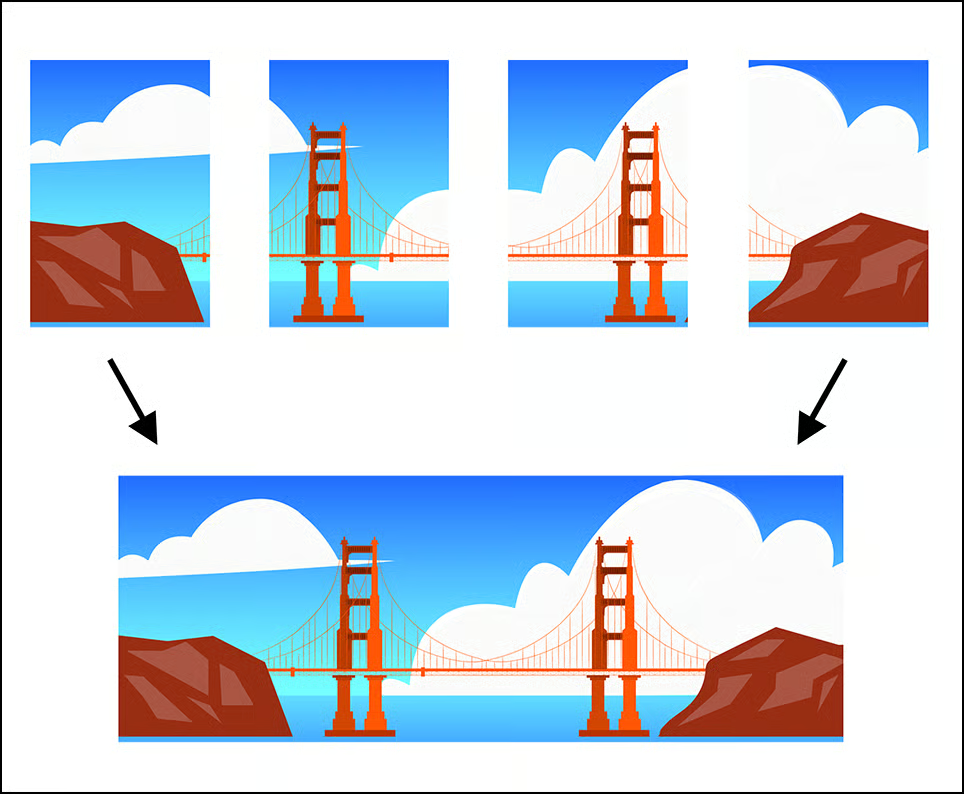
If you’re new to classic pano theory (coverage, resolution vs focal length), these community resources are a great knowledge base. Understanding DSLR spherical resolution. For a broader primer and gear recommendations: DSLR/mirrorless 360 virtual tour guide.
Useful Tools & Resources
Software
- PTGui panorama stitching
- Hugin (open source)
- Lightroom / Photoshop (RAW workflow, nadir patching)
- AI tools for tripod removal and people cleanup
Hardware
- Panoramic heads (Nodal Ninja, Leofoto, Sunwayfoto)
- Carbon fiber tripods with leveling bases
- Wireless remote shutters or phone app
- Pole extensions / car suction mounts with safety tethers
Disclaimer: Product names are for reference only. Verify compatibility (mount/adapters for the Samyang) and specs with official sources.
Want a fundamentals refresher on what a pano head does and how to use it? Panoramic head tutorial and tips.
Common Mistakes & How to Avoid Them
- Parallax error: Not aligning the entrance pupil over the rotation axis. Solution: Calibrate your nodal rail; repeat checks when changing adapters or tightening clamps.
- Exposure flicker: Auto exposure or Auto WB between frames. Solution: Manual exposure and locked WB for the entire set (and each HDR bracket sequence).
- Tripod shadows and missing ground: Always shoot a nadir patch; rotate the rig or hand-hold the lens over the tripod footprint to capture a clean plate.
- Ghosting from movement: Do two passes and use masking in PTGui. Increase shutter speed if practical.
- Night noise and blur: Keep ISO modest (100–800 on a7R V), stabilize, and use a remote. Avoid IBIS on tripods.
- Flare with fisheye: Shade the lens with your hand/flag out of frame; avoid point light sources near the edge, or bracket and mask the flare-affected frame.
Frequently Asked Questions
- Can I shoot handheld panoramas with the Sony a7R V?
Yes, for casual 360s in bright light. Use fast shutter speeds (1/250+), enable IBIS, and keep consistent overlap. However, for professional stitching—especially indoors or with near foreground—use a tripod and panoramic head to eliminate parallax and ensure clean seams.
- Is the Samyang 8mm f/3.5 UMC Fish-Eye CS II wide enough for a single-row 360?
In APS-C crop mode, yes: 6 shots around at 60° + zenith + nadir is a reliable single-row solution. On full-frame with hood removed/shaved (circular fisheye), you can do 4 around + N/Z (or 3 around in open scenes) for very fast capture. Verify coverage in your stitcher after your first sequence.
- Do I need HDR for interiors with bright windows?
Usually. Bracket ±2 EV (3 to 5 frames) to preserve both window detail and interior shadows. The a7R V’s base-ISO dynamic range is strong, but windows are frequently 6–10 stops brighter than interiors—HDR saves highlights and avoids muddy shadows.
- How do I avoid parallax issues with this lens?
Mount a panoramic head with a nodal slider and align the entrance pupil. For the 8mm fisheye, the entrance pupil is near the front optical group; start with the rail around the mid-range (roughly 40–55 mm forward from the sensor plane) and fine-tune by rotating while watching foreground/background alignment. Once set, mark your rail for repeatable setup.
- What ISO range is safe on the a7R V in low light?
Tripod-mounted panos look excellent at ISO 100–400. ISO 800 is still very usable, especially if you expose to the right and apply modest noise reduction. For night cityscapes, prefer longer shutters at ISO 100–200 if there’s no subject motion.
- Can I save a “pano preset” on the a7R V?
Yes. Store your settings (Manual exposure, Manual focus, WB preset, drive/bracket, IBIS off) to a Memory Recall slot (MR1/MR2). It speeds up setup and reduces mistakes on location.
- How do I reduce flare when using a fisheye?
Avoid placing the sun or strong lamps near the edge of the frame; use your hand, a small flag, or a lens hood (if it doesn’t vignette) to shield the front element. Consider a second pass for the flare-affected angle and blend in post.
- What tripod head should I choose for this setup?
Look for a compact panoramic head with a vertical rotator and nodal rail (e.g., Nodal Ninja/Leofoto). Add a leveling base under the head. If you plan pole work, choose a lighter head and a clamp system that locks securely with indexed clicks.
Field Notes & Real-World Use Cases
Indoor Real Estate
Switch to APS-C crop mode to avoid vignetting and get a predictable diagonal fisheye. Shoot 6 around + N/Z at f/8, ISO 100–200. Bracket ±2 EV for windows. Keep the tripod away from furniture edges to minimize parallax. Mask moving curtains or ceiling fans in PTGui if needed.
Outdoor Sunset Overlook
Use full-frame circular fisheye (if you’ve removed the hood) to reduce shot count to 4 around + N/Z, which minimizes time and exposure variation as the light changes rapidly. Keep WB fixed to Daylight, meter for the sky, and bracket if the foreground is much darker. Watch for flare—shade the sun if it’s near an edge.
Event Crowds
Fisheye helps you work fast: 6 around + N/Z, higher shutter (1/200–1/500) and ISO 400–800. Do two passes to capture cleaner plates for masking. If people are close to the camera, parallax is more visible; shoot a second set when the nearest subjects step back.
Rooftop or Pole Shooting
Wind is your main enemy. Use a compact head, tighten clamps, tether the pole, and keep exposures short. Circular fisheye workflow (4 around + N/Z) is terrific here. Always perform a safety check before raising gear over people.
Technical Notes & Limitations
- Mount compatibility: The Samyang 8mm f/3.5 CS II is a DSLR/SLR lens made in several mounts (Canon EF, Nikon F, Sony A, etc.). On the Sony a7R V (E mount), you’ll typically need a mechanical adapter. Aperture and focus are manual; EXIF may not record focal length/aperture.
- Full-frame use: On full-frame without hood modification, expect strong vignetting. The CS II’s removable hood lets some users shave it for circular fisheye coverage, but this is at your own risk and may reduce resale value and weather protection.
- Pixel Shift Multi Shooting: The a7R V’s pixel shift can increase per-frame detail, but it’s impractical for multi-image panos unless the scene is absolutely static and the head is rock-solid. Most 360 workflows skip pixel shift.
- Dynamic range: Base ISO files have excellent highlight latitude; prioritize ISO 100–200 for maximum quality and rely on tripod and bracketing rather than pushing ISO.
If you want a deeper conceptual overview of DSLR/mirrorless 360 capture and stitching considerations, this platform guide is succinct and practical. Using a DSLR or mirrorless camera to shoot and stitch a 360 photo.
Safety & Care: Always secure your camera on rooftops, poles, and car mounts with a secondary tether. Protect the fisheye front element—its bulbous glass is exposed and scratches easily. In rain or sea spray, use a cover and wipe frequently with a clean microfiber cloth.