Why This Camera & Lens Are Great for Panoramas
If you want to know how to shoot panorama with Sony a7R V & Samyang 12mm f/2.8 ED AS NCS Fish-Eye, this guide walks you through a proven, field-tested workflow. The Sony a7R V brings a 61MP full-frame BSI CMOS sensor (approx. 9504 × 6336) with exceptional detail, wide dynamic range around base ISO, and 5-axis IBIS rated up to 8 stops. The pixel pitch is about 3.76 µm, which means superb resolving power for large 360° outputs or high-quality virtual tours. Pairing it with the Samyang 12mm f/2.8 ED AS NCS Fish-Eye (full-frame diagonal fisheye, 180° diagonal field of view) reduces the total number of shots needed per panorama—ideal for speed, consistency, and reliability in busy or changing scenes.
The Samyang is a fully manual fisheye lens with an aperture ring and manual focus, known for solid center sharpness from f/4–f/8, moderate chromatic aberrations, and predictable fisheye mapping that stitches easily in PTGui/Hugin. As a diagonal fisheye, it covers the entire frame (not circular) and typically delivers approximately 124° horizontal and 87° vertical FOV on full frame. On the a7R V, this gives you a practical balance: fewer shots than a rectilinear ultra-wide, but far more resolution than a dedicated 360 camera.
Quick Setup Overview
- Camera: Sony a7R V — Full-frame 35.7 × 23.8 mm, 61MP BSI CMOS, ~14+ stops DR at base ISO, excellent detail.
- Lens: Samyang 12mm f/2.8 ED AS NCS Fish-Eye — diagonal fisheye, 180° diag FOV, sharpest around f/5.6–f/8, moderate CA, fully manual.
- Estimated shots & overlap:
- Single-row 360 with pano head: 6 around at 60° yaw steps, plus 1 zenith + 1 nadir (8 shots total). Use 30–35% overlap.
- Handheld backup: 8 around for safety, plus zenith/nadir if possible.
- Difficulty: Easy–Intermediate (fisheye reduces shot count; nodal alignment still required for seamless results).
Planning & On-Site Preparation
Evaluate Shooting Environment
Walk your location and look for light extremes, reflective surfaces (glass, glossy floors), and moving elements (people, flags, cars). Reflections can cause ghosting during stitching—when photographing near glass, shoot at a slight angle and keep the front element as close to the glass as safely possible to reduce double reflections and flare. Avoid direct strong backlight into the fisheye if possible; shade the lens with your hand or body to reduce veiling flare.
Match Gear to Scene Goals
The a7R V’s high resolution and dynamic range help keep highlight detail and shadow recovery clean, especially at ISO 100–400. Indoors, it can comfortably deliver clean files up to ISO 800–1600 if you need shorter shutter speeds; beyond ISO 3200, noise reduction becomes more noticeable in fine textures. The Samyang 12mm fisheye’s wide coverage means fewer shots, which is great when crowds move or clouds shift. The trade-off is fisheye distortion—solved in stitching—so keep good overlap (30–35%).
Pre-shoot Checklist
- Charge batteries, format high-speed cards, clean the lens and sensor.
- Level the tripod; verify your panoramic head’s nodal point settings for this lens.
- Safety checks: strong wind on rooftops or poles? Use tethers, sandbags, and avoid working near edges without protection.
- Backup workflow: after one full rotation, do a second safety round. If HDR, repeat the bracket set.
Essential Gear & Setup
Core Gear
- Panoramic head: This lets you rotate around the lens’s entrance pupil (nodal point) to eliminate parallax between foreground and background, enabling perfect stitches.
- Stable tripod with a leveling base: Quick, accurate leveling reduces stitching corrections later.
- Remote trigger or Sony Imaging Edge app: Fire the shutter without touching the camera to avoid micro-shake.
Optional Add-ons
- Pole or car mount: Useful for elevated or moving perspectives. Always add a safety tether; test for vibration and wind before full-height deployment.
- Lighting aids: Small LED panels to gently fill dark interiors; keep the light consistent across frames.
- Weather gear: Lens rain covers, microfiber cloths, and silica packets to prevent fogging and protect electronics.
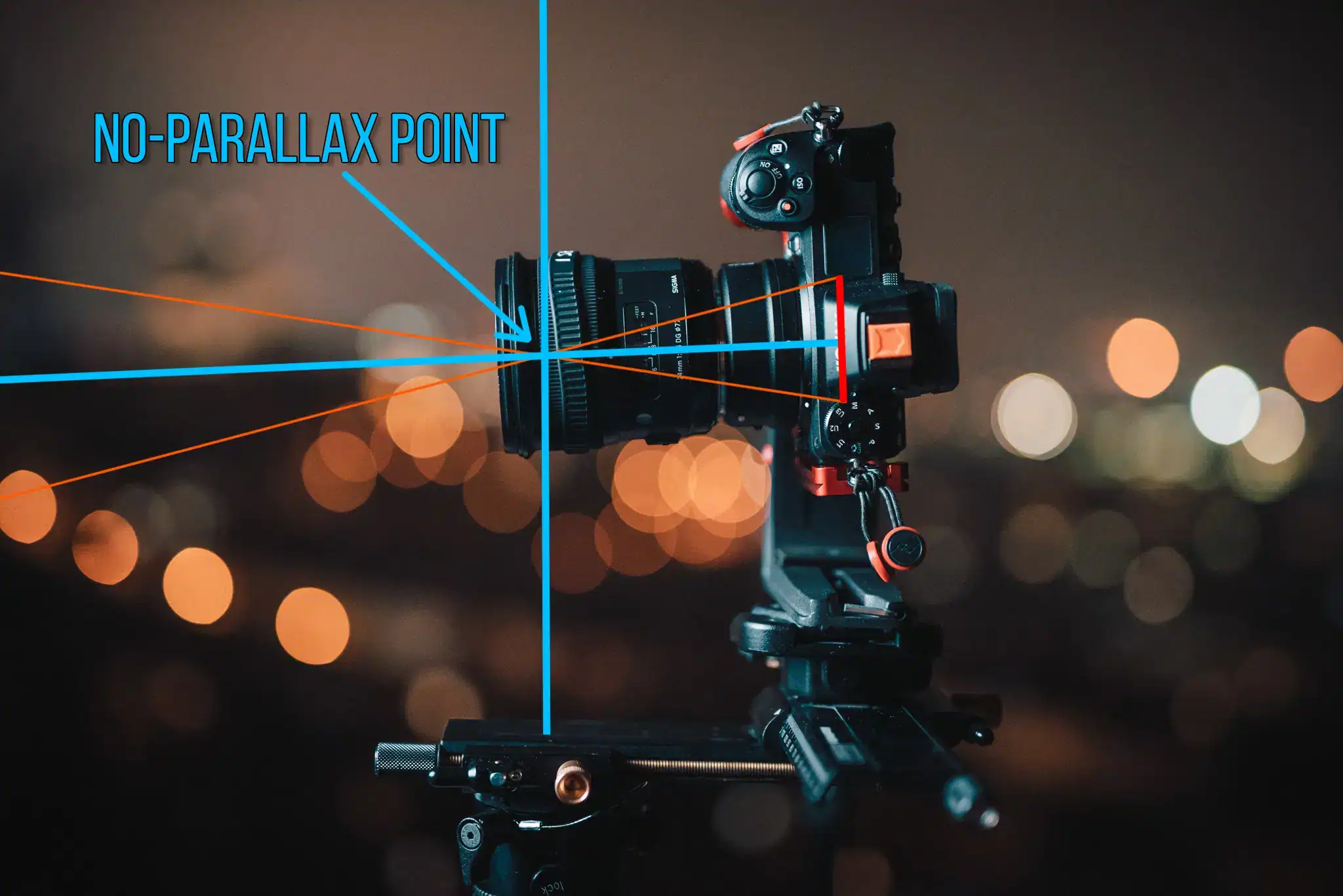
For deeper background on panoramic heads and alignment best practices, see this panoramic head tutorial. Learn more about panoramic head setup
Step-by-Step Shooting Guide
Standard Static Scenes
- Level and Align:
- Level the tripod first, then fine-tune with a leveling base. A level horizon avoids heavy corrections later.
- Align the panoramic head so the rotation axis passes through the lens’s entrance pupil. For the Samyang 12mm, a practical starting point is roughly 6.5–7.5 cm forward of the sensor plane, but always calibrate (see below).
- Manual Exposure and WB:
- Switch to Manual (M). Meter the brightest panel (e.g., toward the sun or a bright window) and expose to protect highlights while keeping shadows liftable.
- Lock white balance (Daylight or a fixed Kelvin) to prevent color shifts between frames.
- Disable Auto ISO; set ISO to 100–200 for daylight, 400–800 for dimmer scenes.
- Focus:
- Set manual focus near the hyperfocal distance. At f/8 with a 12mm lens on full-frame, hyperfocal is roughly 0.6 m (about 2 ft), delivering sharpness from ~0.3 m to infinity.
- Turn off IBIS when on a locked tripod; it can introduce micro-blur during long exposures.
- Capture:
- Shoot 6 images around at 60° yaw steps with 30–35% overlap. Keep the camera in portrait orientation if your pano head supports it for a taller FOV coverage.
- Take a zenith shot (tilt up 60–90°) and a nadir shot (tilt down 60–90°) for clean ceiling and floor coverage.
- Optionally take an offset handheld nadir after moving the tripod, to patch out the tripod in post.
HDR / High Dynamic Range Interiors
- Bracket: Use ±2 EV (3 or 5 frames as needed). The a7R V files are flexible; stick to ISO 100–200 when possible for maximum DR.
- Consistency: Lock WB and keep the same aperture and focus across brackets and yaw positions.
- Batching: Shoot in a consistent pattern (e.g., Around 1–6, then Zenith, then Nadir) to simplify later sorting.
Low-Light / Night Scenes
- Exposure: Use f/4–f/5.6, shutter 1–10 s depending on ambient, ISO 100–800. Longer shutter with low ISO beats high ISO noise on static scenes.
- Stability: Use a remote trigger or 2 s self-timer; turn off IBIS on a solid tripod and disable long exposure NR if bracketing.
- Extra overlap: In very dark scenes, add a little more overlap (35–40%) to help the stitcher find control points.
Crowded Events
- Two-Pass Method: First pass quickly to capture overall coverage; second pass waiting for gaps to get cleaner plates for masking.
- Shutter Speed: If freezing people is important, aim for 1/200 s or faster and raise ISO to 800–1600 as needed.
- Masking in Post: Use the second pass to patch moving elements via masks during stitching.
Special Setups (Pole / Car / Drone)
- Pole: Use a rigid carbon pole, secure with a guy-line. Keep yaw rotations slow to avoid whip. Always tether your camera.
- Car Mount: Rigid suction mounts on clean glass, avoid high speeds. Consider multiple passes at consistent speed; beware vibrations.
- Drone (if using a separate rig): Ensure legal compliance; lock exposure, WB, and focus. Beware of prop-induced vibration and wind gusts.
Recommended Settings & Pro Tips
Exposure & Focus
| Scenario | Aperture | Shutter | ISO | Notes |
|---|---|---|---|---|
| Daylight outdoor | f/8–f/11 | 1/100–1/250 | 100–200 | Lock WB (Daylight or 5600K), turn off IBIS on tripod |
| Low light/night | f/4–f/5.6 | 1/2–10 s | 100–800 | Use remote; avoid high ISO unless freezing motion is essential |
| Interior HDR | f/8 | Bracket ±2 EV | 100–400 | Balance windows and lamps; keep WB fixed |
| Action / moving subjects | f/5.6–f/8 | 1/200+ | 400–1600 | Two-pass method for masking moving people |
Critical Tips
- Manual focus at hyperfocal: at f/8, set around 0.6 m; at f/5.6, ~0.85 m. Tape the ring once set.
- Nodal calibration: Place a near object (~0.5–1 m) and a far object aligned in frame. Rotate the head; if alignment shifts, slide the lens forward/back until parallax disappears. Mark this setting on your rail for the Samyang 12mm.
- White balance lock: Mixed lighting can vary per frame; pick a single WB and correct globally in RAW later.
- RAW capture: Shoot 14-bit RAW for maximum DR; JPEG can work for speed, but leaves less room for color and highlight recovery.
- IBIS: Off on tripod; on only if handholding a quick emergency panorama.
For a deep-dive on setting up a panoramic head and shot discipline, see this step-by-step from Oculus on high-end 360 photos. Set up a panoramic head for perfect 360s
Stitching & Post-Processing
Software Workflow
With a fisheye like the Samyang 12mm, stitching in PTGui or Hugin is straightforward. Import the images (or HDR-merged brackets), specify lens type as “full-frame fisheye,” and use about 30–35% overlap. PTGui’s “Align Images” often nails control points automatically; otherwise add a few manual points on edges, railings, or high-contrast details. Industry guidance is ~25–30% overlap for fisheye and ~20–25% for rectilinear lenses; err on the higher side for tricky lighting or low-detail scenes.
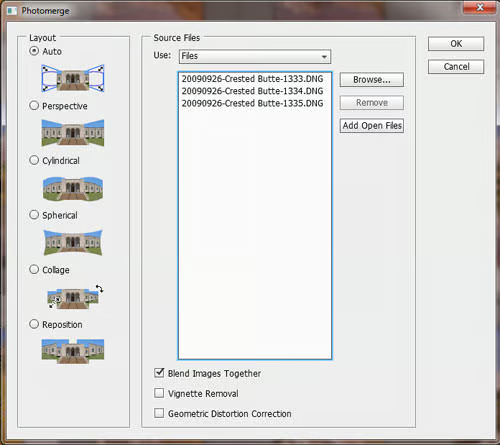
PTGui is an industry favorite for speed and control; Fstoppers offers a good overview of why many pros choose it. Why PTGui is a top choice for panoramas
Cleanup & Enhancement
- Nadir patch: After stitching, export a layered file and clone the tripod out, or use a logo patch. Some AI tools can smart-fill the tripod area.
- Color and noise: Apply a global WB correction; perform targeted noise reduction in shadows for night scenes. De-vignette if needed.
- Horizon leveling: Most stitchers let you set the horizon by three points or with automatic vertical alignment; verify roll/pitch/yaw are neutral.
- Export: For VR viewers, export an 8-bit or 16-bit equirectangular TIFF/JPEG at the desired width (e.g., 12k–16k). The a7R V + 12mm fisheye with 6-around typically yields a 120–160 MP equirectangular, depending on overlap and cropping.
Note: Workflows evolve—always check the latest documentation for PTGui, Hugin, or your preferred editor.
Field Case Studies with This Kit
Indoor Real Estate
Use a tripod, f/8, ISO 100–200, and bracket ±2 EV for each yaw position to handle bright windows. Keep lights either all on or all off to avoid flicker. The 12mm fisheye reduces total shots per room (6-around + Z/N), saving time while maintaining consistency across multiple rooms. Batch-merge HDR (if used) before stitching.
Outdoor Sunset
To capture sunset color and foreground detail, expose for highlights first, then bracket. Lock WB around 5200–5600K to keep color continuity as the sky changes. Shoot the sky frames first (westward) to catch peak color, then rotate through the rest. The a7R V files recover shadows well at ISO 100–200.
Event Crowds
For a clean 360 at a busy festival: first round at 1/200 s, f/5.6, ISO 400–800, capturing motion crisply; a second, slower pass captures “empty” plates as people move. In PTGui, mask in the cleaner areas from the second pass.
Rooftop / Pole Shooting
A carbon pole can lift the viewpoint above railings for a cleaner skyline. Keep the camera in burst or quick-fire mode and rotate slowly to minimize motion blur. Wind is the main risk—use a safety tether and avoid gusty days. Overlap a bit more (35–40%) because of micro-movements.
Car-Mounted Capture
Mount on a multi-suction cup plate, tie a safety leash to a structural point, and keep speeds modest. Lock exposure/WB, and favor faster shutter (1/250–1/500) to reduce motion blur. Expect more retouching to remove the mount/nadir.
If you’re new to this, here’s a practical video walkthrough of panoramic shooting principles that complements the steps above:
Useful Tools & Resources
Software
- PTGui panorama stitching
- Hugin (open source)
- Lightroom / Photoshop / Affinity Photo
- AI tripod removal tools (Content-Aware Fill, generative tools)
Hardware
- Panoramic heads (Nodal Ninja, Leofoto) with precise entrance pupil adjustment
- Carbon fiber tripods for rigidity with less weight
- Leveling bases to speed setup
- Wireless remote shutters or the Sony Imaging Edge app
- Pole extensions / car mounts with safety tethers
Curious how sensor resolution and lens FOV affect final 360 output size? The PanoTools Wiki dives into spherical resolution fundamentals. Understand DSLR spherical resolution
Disclaimer: software/hardware names provided for search reference; check official sites for details.
Common Mistakes & How to Avoid Them
- Parallax error → Always align the entrance pupil; verify with near/far object alignment tests.
- Exposure flicker → Use Manual mode, fixed ISO, fixed WB, and consistent bracketing.
- Tripod shadows and cluttered nadir → Shoot a dedicated nadir and patch it in post.
- Ghosting from moving subjects → Use the two-pass method and mask in post.
- High ISO noise at night → Favor longer shutter at low ISO on a stable tripod; a7R V looks best ≤ ISO 800–1600 for critical work.
- Flare with fisheye → Avoid bright light sources just off-frame; use your hand or a flag to shield the lens.
Safety, Limitations & Trustworthy Practice
The a7R V and Samyang 12mm combo excels in resolution and speed, but there are limits: fisheye edges compress detail, IBIS should be off on locked tripod shots, and the Samyang’s manual-only control requires disciplined focus and aperture handling. In harsh weather or on rooftops/poles, use tethers and avoid risky positions—no image is worth injury. Keep a simple backup workflow: after one full set, capture a quick second set for safety. For a structured DSLR/mirrorless 360 capture overview that aligns with industry standards, see the Oculus Creator guide. Shooting and stitching a 360 photo with a mirrorless camera
Frequently Asked Questions
- Can I shoot handheld panoramas with the Sony a7R V?
Yes, in a pinch. Use high shutter speeds (≥1/200 s), fixed exposure/WB, and take extra frames (8–10 around) for overlap. Expect more stitching cleanup vs. a tripod with a panoramic head.
- Is the Samyang 12mm f/2.8 wide enough for single-row 360?
Yes. A reliable pattern is 6 shots around at 60° steps plus zenith and nadir. You can attempt 5 around in simple scenes, but overlap becomes marginal, so 6-around is safer.
- Do I need HDR for interiors with bright windows?
Often, yes. Bracket ±2 EV (3 or 5 frames) to hold window highlights and interior shadows. Merge HDR before stitching, or let PTGui handle exposure fusion.
- How do I avoid parallax issues with this lens?
Use a panoramic head and calibrate the entrance pupil. With a near object (0.5–1 m) and a far object aligned in the frame, rotate the camera; adjust the lens position until the alignment doesn’t shift. Mark that rail setting for the Samyang 12mm to speed future setups.
- What ISO range is safe on the a7R V in low light?
For critical quality, ISO 100–800 on a tripod is ideal. ISO 1600–3200 is usable with good noise reduction; above that, expect more visible grain and reduced micro-contrast.
- Can I set up Custom Modes for pano?
Yes—assign C1 to Manual exposure with fixed WB/ISO and manual focus at hyperfocal. Assign C2 to an HDR-bracketing preset. This speeds repeatable setups on location.
- How do I reduce flare when using a fisheye?
Avoid framing bright light just outside the image edge; if shooting toward the sun or a lamp, shield the lens with your hand (keeping it out of frame) and consider a slightly different yaw starting position.
- What tripod head is best for this setup?
A dedicated panoramic head with precise fore–aft and lateral adjustments (e.g., Nodal Ninja or a similar two-rail head) ensures accurate entrance pupil alignment and repeatability.
Visual Walkthroughs
Here’s an additional expert discussion of 360 DSLR/mirrorless workflows and gear considerations, including lens choice and stitcher tips. DSLR/Mirrorless 360 virtual tour FAQ