Why This Camera & Lens Are Great for Panoramas
If you want to learn how to shoot panorama with Sony a7R V & Peleng 8mm f/3.5, this combo is a powerhouse for 360° capture. The Sony a7R V is a full-frame, 61MP mirrorless camera (approx. 9504 × 6336), delivering superb detail for high-quality equirectangular outputs. Its pixel pitch is about 3.76 µm, offering excellent base-ISO dynamic range (circa ~15 stops at ISO 100) and clean tones up to ISO 800–1600 when needed. In-body image stabilization (IBIS) is rated up to 8 stops for general shooting—but you should disable IBIS on a tripod to avoid micro-jitters in long exposures.
The Peleng 8mm f/3.5 is a manual, circular fisheye lens that covers a 180° field in all directions. On full frame, it produces a near-circular image with massive coverage, making it ideal for 360° panoramas with very few frames (efficient in tight interiors or crowded places). Being fully manual, it has a preset aperture ring and manual focus, which are great for locking repeatable settings during a pano sweep. Expect some chromatic aberration, strong fisheye distortion (by design), and a high flare tendency if the sun or bright lights are in frame—manageable in post and with smart shooting angles.
Mount compatibility note: the Peleng 8mm f/3.5 exists in several mounts (often M42, Nikon F, Canon EF). For Sony E-mount, use a simple mechanical adapter. Because it’s a manual lens, enable “Release w/o Lens” in the a7R V menu. If shooting handheld with stabilization, set the SteadyShot focal length to 8mm. For tripod work, turn IBIS off.
Quick Setup Overview
- Camera: Sony a7R V — Full Frame 35mm, 61MP, ~3.76 µm pixel pitch, excellent DR at base ISO, 5-axis IBIS (disable on tripod).
- Lens: Peleng 8mm f/3.5 — circular fisheye, 180° coverage, fully manual focus and aperture, notable CA and flare if carelessly backlit.
- Estimated shots & overlap: At 8mm FF (circular fisheye): 3 shots around (120° apart) + zenith + nadir is reliable. For extra safety: 4 around + nadir. Aim 30–40% overlap.
- Difficulty: Easy to moderate — few frames to capture, but requires careful nodal alignment and flare control.
Planning & On-Site Preparation
Evaluate Shooting Environment
Fisheyes see everything. Scan for bright point lights, direct sun, and reflective surfaces that can cause flare or ghosting. Indoors, watch for mirrors, glossy tiles, and chrome fixtures. If photographing through glass, keep your front element very close (1–3 cm) and shoot at a slight angle to reduce reflections. Outdoors, check wind and tripod placement (avoid soft ground), and plan your rotation so the sun hits the least critical frames (you can mask flares later).
Match Gear to Scene Goals
The a7R V’s dynamic range helps recover windows in interiors (HDR still recommended), and its clean low-ISO files produce crisp textures for large equirectangular exports. The Peleng 8mm f/3.5 minimizes shot count, which is ideal in tight rooms, fast event environments, or rooftop pole work. ISO 100–200 is your baseline; ISO 400–800 is safe indoors; ISO 1600 is workable in a pinch with noise reduction. Fisheye optics mean extreme distortion—that’s expected and leveraged by pano software, but you’ll need accurate nodal alignment to avoid parallax seams.
Pre-shoot Checklist
- Charge batteries, clear cards, clean front element (fisheye fronts get fingerprints easily).
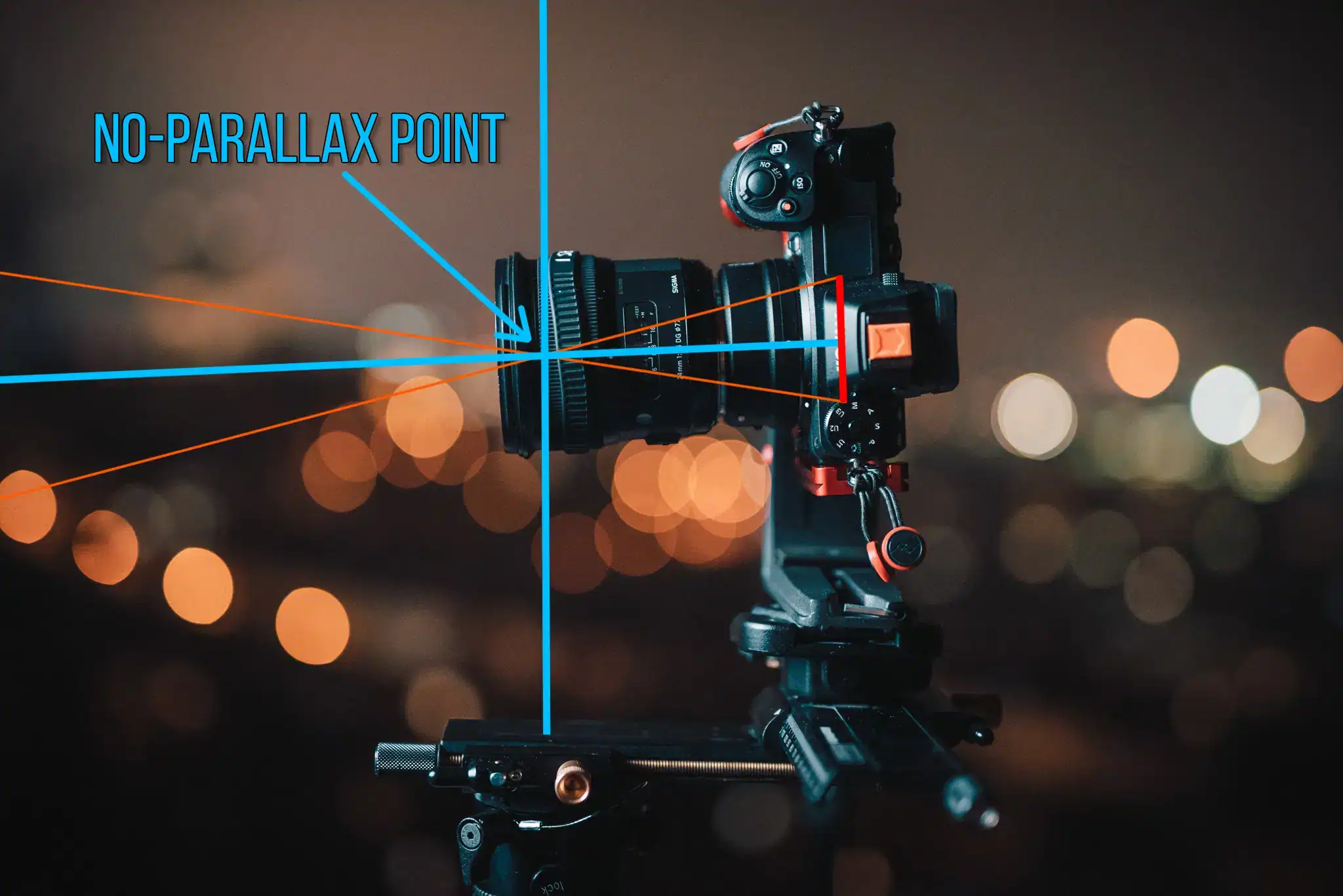
- Level the tripod; calibrate the panoramic head for the Peleng’s entrance pupil (no-parallax point).
- Safety: assess wind, ensure the center column is low, tether on rooftops, and double-check any car/pole mounts.
- Backup workflow: shoot a second safety round, especially for client work or changing light.
Essential Gear & Setup
Core Gear
- Panoramic head: This lets you rotate around the lens’s entrance pupil (nodal point) to eliminate parallax. With an 8mm circular fisheye, precise nodal alignment is crucial for clean stitching, especially near the tripod legs and nearby objects.
- Stable tripod with leveling base: A leveling base speeds up alignment and keeps frames consistent, reducing stitching corrections later.
- Remote trigger or smartphone app: Use a cable release or Sony Imaging Edge Mobile to avoid touching the camera during exposure.
Optional Add-ons
- Vertical pole or car mount: Always use safety tethers, watch wind loads, avoid overextending poles, and respect traffic and bystanders.
- Portable LED panels: Helpful for low-light interiors to fill deep shadows when HDR is not feasible.
- Weather covers and lens hooding: Shield the fisheye from drizzle and stray light; be mindful that most fisheyes have limited hood options.
Step-by-Step Shooting Guide
Standard Static Scenes
- Level and align: Level the tripod using the leveling base. Mount the panoramic head and set the fore-aft rail so rotation happens at the lens’s entrance pupil. For the Peleng 8mm, expect the entrance pupil to sit not far behind the front element; many users land in the 55–70 mm range forward of the sensor plane, but calibrate precisely for your adapter/head.
- Manual exposure and WB: Set Manual mode. Start at ISO 100–200, f/8, and adjust shutter for a bright mid-tone exposure without clipping highlights. Lock white balance (Daylight outdoors; custom Kelvin indoors) to keep color consistent across frames.
- Capture sequence: With a circular 8mm, shoot 3 frames around at 120° intervals (yaw), plus 1 zenith (tilt up) and 1 nadir (tilt down). For safety, you can shoot 4 around (90°) or an extra overlap near the sun/bright windows.
- Nadir shot: After the around and zenith shots, tilt down for the ground shot to later remove the tripod. If needed, offset the camera horizontally to capture a clean floor patch for easier retouching.
HDR / High Dynamic Range Interiors
- Bracket ±2 EV (3–5 frames): The a7R V files are robust, but bright windows can exceed single-exposure DR. Bracket to retain window detail and clean shadows.
- Lock WB: Maintain fixed WB across brackets to avoid color shifts during merging and stitching.
Low-Light / Night Scenes
- Use a tripod and remote trigger: Turn IBIS off. Start at f/4–f/5.6, ISO 400–800, with slow shutter speeds as needed (1–10 seconds for night). The a7R V handles long exposures well; use a 2-second self-timer if you don’t have a remote.
- Noise and hot pixels: Long Exposure NR is optional; many prefer to apply noise reduction in post for better control.
Crowded Events
- Two-pass method: First pass quickly captures the whole sphere. Second pass repeats problem sectors, waiting for gaps in foot traffic. You’ll mask between passes during stitching.
- Short shutter: Use 1/200 s or faster with ISO 400–800 to freeze people when needed, especially for key frames that will be prominent in the pano.
Special Setups (Pole / Car / Drone)
- Secure everything: Use safety tethers, lock all clamps, and never exceed the pole’s rated height in strong winds. If car-mounted, plan a quiet route, respect laws, and keep speeds low to minimize vibration.
- Rotate slower, shoot extras: On poles or vehicles, take more overlap (e.g., 4 around) and multiple takes of each frame to pick the sharpest shot later.
Recommended Settings & Pro Tips
Exposure & Focus
| Scenario | Aperture | Shutter | ISO | Notes |
|---|---|---|---|---|
| Daylight outdoor | f/8–f/11 | 1/100–1/250 | 100–200 | Lock WB (Daylight) and shoot 3 around + zenith + nadir |
| Low light/night | f/4–f/5.6 | 1/30–8s | 400–800 | Tripod, remote trigger, IBIS off; longer exposures okay |
| Interior HDR | f/8 | Bracket ±2 EV | 100–400 | Merge brackets before stitching or within PTGui |
| Action / moving subjects | f/5.6–f/8 | 1/200+ | 400–800 | Freeze motion; double-pass for clean masks |
Critical Tips
- Manual focus at hyperfocal: With 8mm at f/8, set focus around 1 m; you’ll cover from ~0.5 m to infinity. Test on your copy—Peleng focus scales can be approximate.
- Nodal calibration: Place near and far verticals in the frame and rotate the head; adjust the rail until foreground objects don’t shift against the background. Mark the rail for repeatability with your adapter.
- White balance lock: Avoid mixed auto WB. Use Daylight outdoors; set a custom Kelvin (e.g., 3200–4000 K) indoors. Consistent color makes stitching seams vanish.
- RAW over JPEG: Shoot RAW for maximum DR and better CA correction. The a7R V’s 14-bit RAWs grade cleanly.
- IBIS policy: Turn stabilization off on tripod to prevent micro-movements during exposure and rotation.
Stitching & Post-Processing
Software Workflow
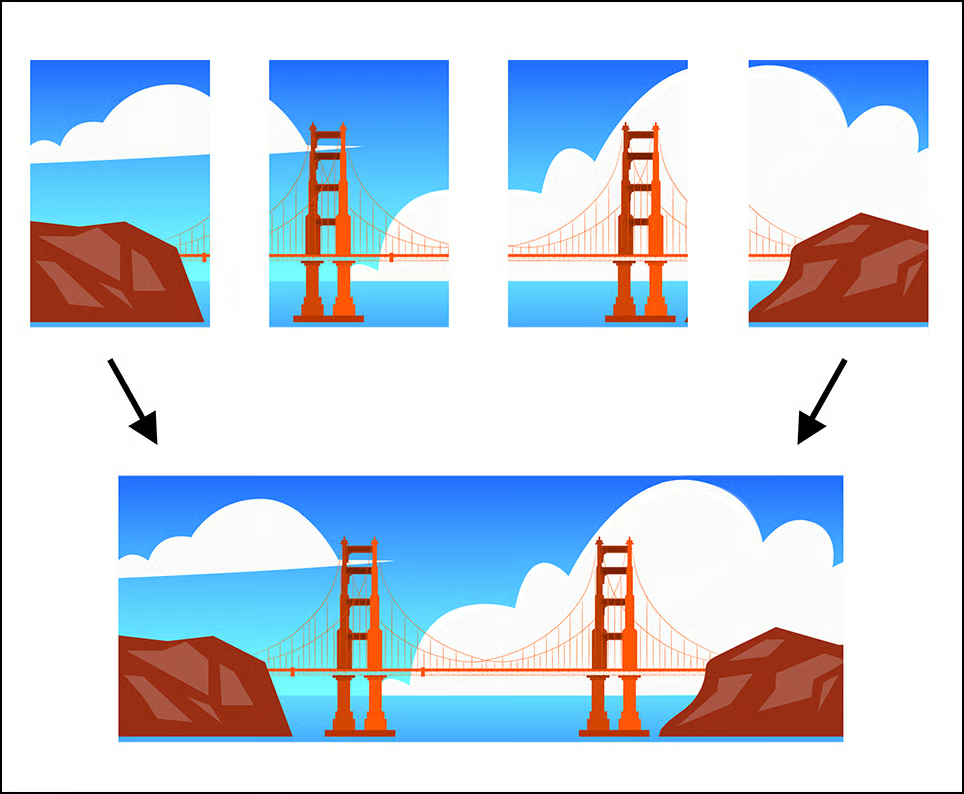
Import RAWs and apply basic corrections (lens chromatic aberration, white balance consistency, highlight recovery). For 360° stitching, PTGui and Hugin are industry staples. With a circular fisheye, set lens type to “Circular Fisheye,” focal length 8 mm, and approximate FOV 180°. Typical overlap for fisheye is ~30–40%. Rectilinear lenses need more frames and slightly less overlap (20–25%), but with your Peleng you’ll enjoy faster, simpler stitch sets. For deeper how-tos, see the panoramic head and capture best practices described by Oculus and 360Rumors at the end of this section.
Cleanup & Enhancement
- Tripod/nadir patch: Capture an offset floor patch and patch it in Photoshop, or use AI tools to remove your tripod.
- Color and noise: Match color between brackets, apply noise reduction for higher ISO or long exposure night shots, and maintain natural contrast.
- Level and straighten: Use the horizon/vertical lines in PTGui’s panorama editor to correct roll, pitch, and yaw.
- Export: For VR platforms, export equirectangular 2:1 JPEGs (8-bit) at 8K–12K wide for typical use. With 61MP source frames, 12K–16K can be achievable depending on overlap and sharpness. For more on spherical resolution math, see the Panotools reference linked below.
Video: A practical walkthrough of panoramic head setup and capture flow.
Further reading: Learn how to set up a panoramic head step-by-step with this professional guide from Meta’s Creator resources, and explore a panoramic head tutorial that covers real-world pitfalls and solutions. Set up a panoramic head to shoot high-end 360 photos. Panoramic head tutorial with tips. For expected pano resolution from various lens/camera combos, see the Panotools discussion: DSLR spherical resolution.
Useful Tools & Resources
Software
- PTGui panorama stitching (robust fisheye handling and masking)
- Hugin open source (control points and projection flexibility)
- Lightroom / Photoshop (RAW prep, nadir patching, retouching)
- AI tripod removal tools (for fast nadir cleanup)
Hardware
- Panoramic heads: Nodal Ninja, Leofoto, or other two-rail heads
- Carbon fiber tripods for stability-to-weight ratio
- Leveling bases and rotators with click-stops (e.g., 90°, 120°)
- Wireless remotes or intervalometers
- Pole extensions / suction cup car mounts with tethers
Disclaimer: product names are for reference; verify specifications and compatibility on official sites.
Common Mistakes & How to Avoid Them
- Parallax error: Always align to the entrance pupil; test with near/far objects and adjust the rail.
- Exposure flicker: Use full manual exposure and manual white balance across all frames.
- Tripod shadows and clutter: Shoot a dedicated nadir and offset patch for easier retouching.
- Ghosting from moving subjects: Use two-pass capture and mask in post; take extra overlaps.
- Night noise and blur: Keep ISO moderate, lengthen shutter on tripod, and trigger remotely with IBIS off.
Real-World Scenarios & Field Notes
Indoor Real Estate
Use ISO 100–200, f/8, and bracket ±2 EV to tame window highlights. The Peleng’s wide coverage reduces frame count—3 around + zenith + nadir is often enough. Watch for mirrors and glossy kitchens; stand slightly off-center to minimize your reflection, and use the nadir patch to hide the tripod.
Outdoor Sunset
For sunsets, place the sun in one of the “around” frames and slightly underexpose that shot to retain color. Shoot an extra overlap near the sun to help PTGui choose the cleanest seam. ISO 100, f/8, and a shutter from 1/60–1/250 in golden light works well.
Event Crowds
Move fast: 3 around in quick succession, then zenith, then nadir. Use 1/200 s or faster and ISO 400–800. If someone stands too close, take an extra frame and plan to mask later. The few-frame workflow of the Peleng shines here.
Rooftop or Pole Shooting
Keep the camera low on the pole to reduce leverage in wind. Use 4 around for extra overlap. Take multiple exposures per position and pick the sharpest. Tether with a safety line and avoid gusty conditions.
Car-Mounted Capture
Park safely or drive very slowly in controlled environments. Use a rigid mount with redundancy straps. Shoot at faster shutter speeds (1/500 s if handheld/pole) and increase ISO to 800–1600 as needed to prevent motion blur. Capture extra overlaps to hedge against vibration.
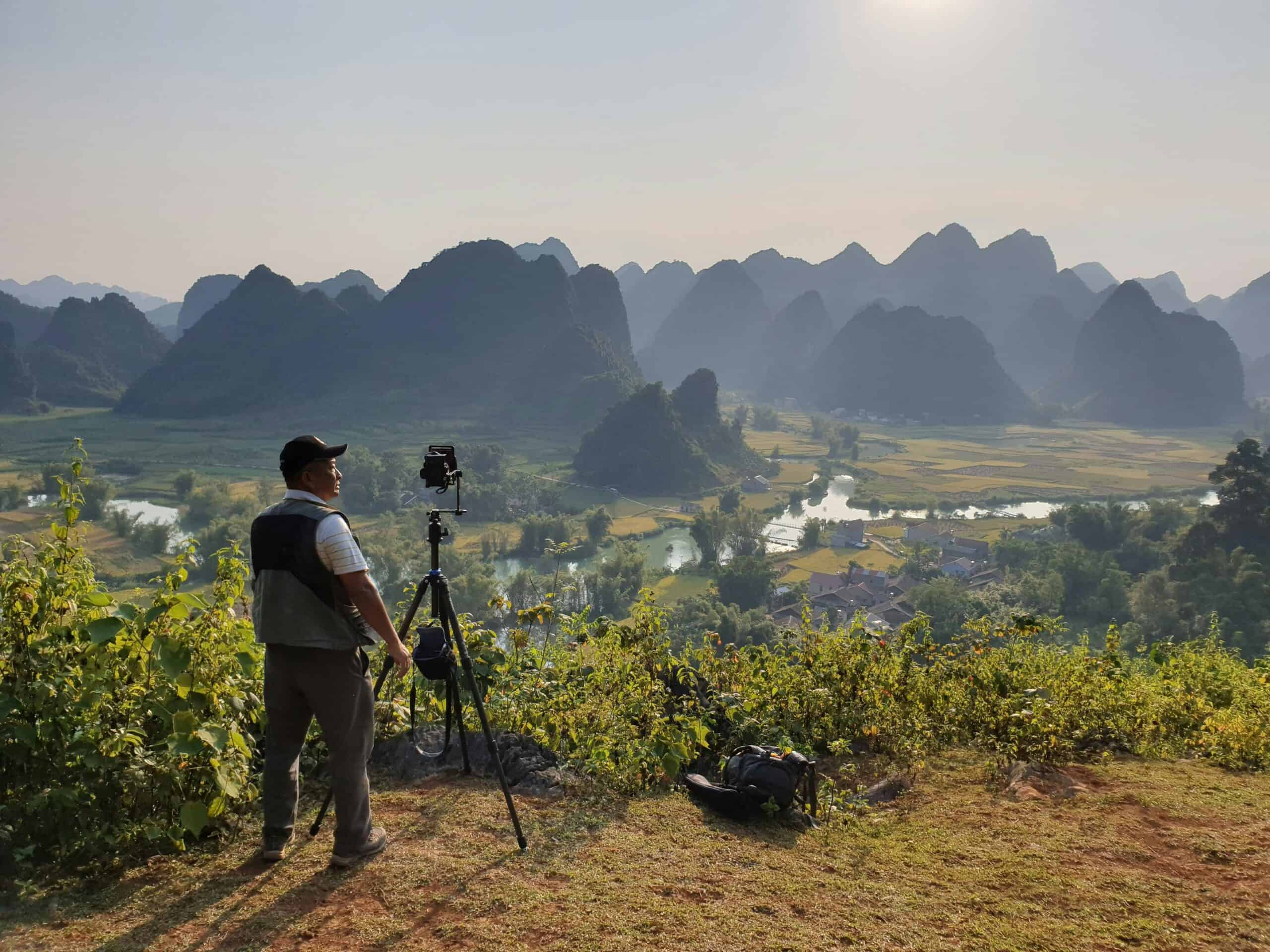
Frequently Asked Questions
-
Can I shoot handheld panoramas with the Sony a7R V?
Yes, but it’s risky for 360° work. The a7R V stabilization helps for general shooting, but for precise 360s, a tripod and panoramic head are strongly recommended. Handheld can work outdoors with distant subjects (less parallax risk). Keep shutter fast (1/250+), lock WB and exposure, and overshoot overlaps.
-
Is the Peleng 8mm f/3.5 wide enough for single-row 360?
Yes. As a circular fisheye on full frame, it covers 180° in all directions. Three shots around + zenith + nadir typically complete the sphere. Many shooters add a fourth around for safety and cleaner seams.
-
Do I need HDR for interiors with bright windows?
Often yes. The a7R V has excellent DR, but bright windows can exceed a single exposure. Bracket ±2 EV (3–5 frames), merge, and stitch. It keeps windows clean and interiors natural.
-
How do I avoid parallax issues with this lens?
Calibrate the entrance pupil. Use near/far verticals and adjust the fore-aft rail until there is no relative shift during yaw rotation. Mark that position for your Peleng + adapter combo and re-use it every time.
-
What ISO range is safe on the a7R V in low light?
For tripod work, stay at ISO 100–400 and lengthen shutter. Indoors hand-held or when freezing motion, ISO 800 is still very clean; ISO 1600 is workable with noise reduction.
-
Can I set up Custom Shooting Modes for pano?
Yes. Save a “Pano” setup (Manual exposure, fixed WB, RAW, IBIS off, 2 s timer or remote) to a custom slot. It speeds up field work and prevents setting drift.
-
How do I reduce fisheye flare?
Avoid direct light sources near the frame edge, shield the lens with your hand when practical (keep your hand out of the frame), and shoot an extra overlap to mask flared zones during stitching.
-
What tripod head is best for this setup?
A two-rail panoramic head with a click-stop rotator is ideal. Choose one that allows precise fore-aft adjustment and vertical tilt for zenith/nadir shots, and that supports your camera weight with an adapter.
Safety, Limitations & Backup Practices
Fisheyes make front glass vulnerable. Always use a lens cap when not shooting, and be careful near walls and railings. On rooftops and poles, tether everything. In wind, lower the center column and add weight to the tripod. Avoid wet weather without covers, and never leave the gear unattended when elevated.
Limitations: The Peleng 8mm can show notable CA, flare, and inconsistent sharpness across copies—shoot tests and stop to f/8 for best results. The a7R V’s 61MP files are large; bring high-speed cards and plenty of storage. For commercial work, shoot an extra full round and mirror your card as soon as possible.
Authoritative References
Explore practical, field-tested guidance and software tips here: Using a mirrorless camera to shoot and stitch a 360 photo. For panoramic head setup and capture technique, see 360Rumors panoramic head tutorial. Resolution expectations by format are summarized at Panotools: DSLR spherical resolution.