Why This Camera & Lens Are Great for Panoramas
If you’re wondering how to shoot panorama with Sony a7R V & Nikon AF-S 8-15mm f/3.5-4.5E ED Fisheye, you’re pairing one of the highest-resolution full-frame mirrorless cameras with a professional fisheye zoom that can cover both circular and diagonal 180° fields of view. The Sony a7R V’s 61MP full-frame sensor (35.7 × 23.8 mm, ~3.76 µm pixel pitch) delivers exceptional detail for gigapixel crops and clean sky gradients. Its base ISO 100 dynamic range is excellent (around 14–15 EV), giving you strong latitude for HDR panoramas and recovery in high-contrast interiors.
The Nikon AF-S 8–15mm f/3.5–4.5E ED Fisheye is a specialty zoom: at 8mm on full-frame it renders a circular fisheye with 180° FOV in all directions; at 15mm it becomes a diagonal fisheye with 180° across the frame’s diagonal. This versatility is perfect for 360° capture because you can choose between ultra-fast 3–4-shot captures (circular fisheye) or slightly more shots with higher usable pixel density across the sphere (diagonal fisheye).
Compatibility note: this is a Nikon F-mount lens on a Sony E-mount body, so you need an electronic Nikon F-to-Sony E adapter that supports E-type electronic aperture control (e.g., Commlite CM-ENF-E1 Pro, MonsterAdapter LA-FE1). AF may be unreliable; plan to shoot manual focus. At 8mm you must remove the lens hood to avoid vignetting. Regardless, the combo shines on a panoramic head: few shots, reliable stitching, and class-leading detail from the a7R V.
Quick Setup Overview
- Camera: Sony a7R V — Full-frame 61MP BSI sensor (~3.76 µm pixels), excellent DR at base ISO, 5-axis IBIS (up to ~8 stops), 10-bit HEIF/JPEG and robust RAW.
- Lens: Nikon AF-S 8–15mm f/3.5–4.5E ED Fisheye — circular/diagonal fisheye zoom; very sharp stopped to f/8; moderate CA typical for fisheye, correctable in post. Requires electronic Nikon F to Sony E adapter for aperture control.
- Estimated shots & overlap (tested):
- 8mm circular fisheye: 3 shots around at 120° + nadir; add zenith in complex ceilings. Overlap target ~30–35%.
- 8mm robust option: 4 shots around at 90° spacing + nadir (safer for crowds/texture-poor skies).
- 15mm diagonal fisheye: 6 shots around at 60° spacing + zenith + nadir (25–30% overlap). In tight interiors consider 8 around.
- Difficulty: Moderate — straightforward with a calibrated panoramic head; adapter adds a small setup learning curve.
Planning & On-Site Preparation
Evaluate Shooting Environment
Scan the space for potential stitching issues: moving people, trees/leaves in wind, repeating patterns, glass reflections, and strong backlight. If shooting near glass, keep the lens at least 30–50 cm away to minimize reflections and ghosting from the bulbous fisheye front element. For interiors, note the contrast between windows and interior shadows — you’ll likely bracket ±2 EV. Outdoors at sunset, watch for flare; plan your rotation so the sun falls in a seam where overlap gives you masking options.
Match Gear to Scene Goals
The Sony a7R V’s dynamic range and high resolution make it ideal for both real estate and landscape panoramas. Indoors, you can comfortably use ISO 100–400 for clean files; even ISO 800–1600 is usable, especially when stitched (noise averages down). The Nikon 8–15mm fisheye minimizes shot count — great for time-sensitive environments like events or rooftop shoots. Just remember: fewer shots mean more stretch of each pixel in the equirectangular output, so use 15mm diagonal fisheye when you want denser detail and cleaner edges.
Pre-shoot Checklist
- Power & storage: 2+ batteries, high-speed UHS-II cards; clear space for RAW brackets.
- Clean optics: fisheye fronts flare easily; carry a microfiber and blower.
- Tripod & head: leveler, calibrated panoramic head, and properly set entrance pupil (no-parallax) distance.
- Adapter sanity check: verify aperture control, focus response, and EXIF reporting before the job.
- Safety: weigh tripod in wind, tether gear on rooftops/poles, use safety cables on car mounts.
- Backup workflow: if time allows, shoot a second pass or an extra nadir for patching.
Essential Gear & Setup
Core Gear
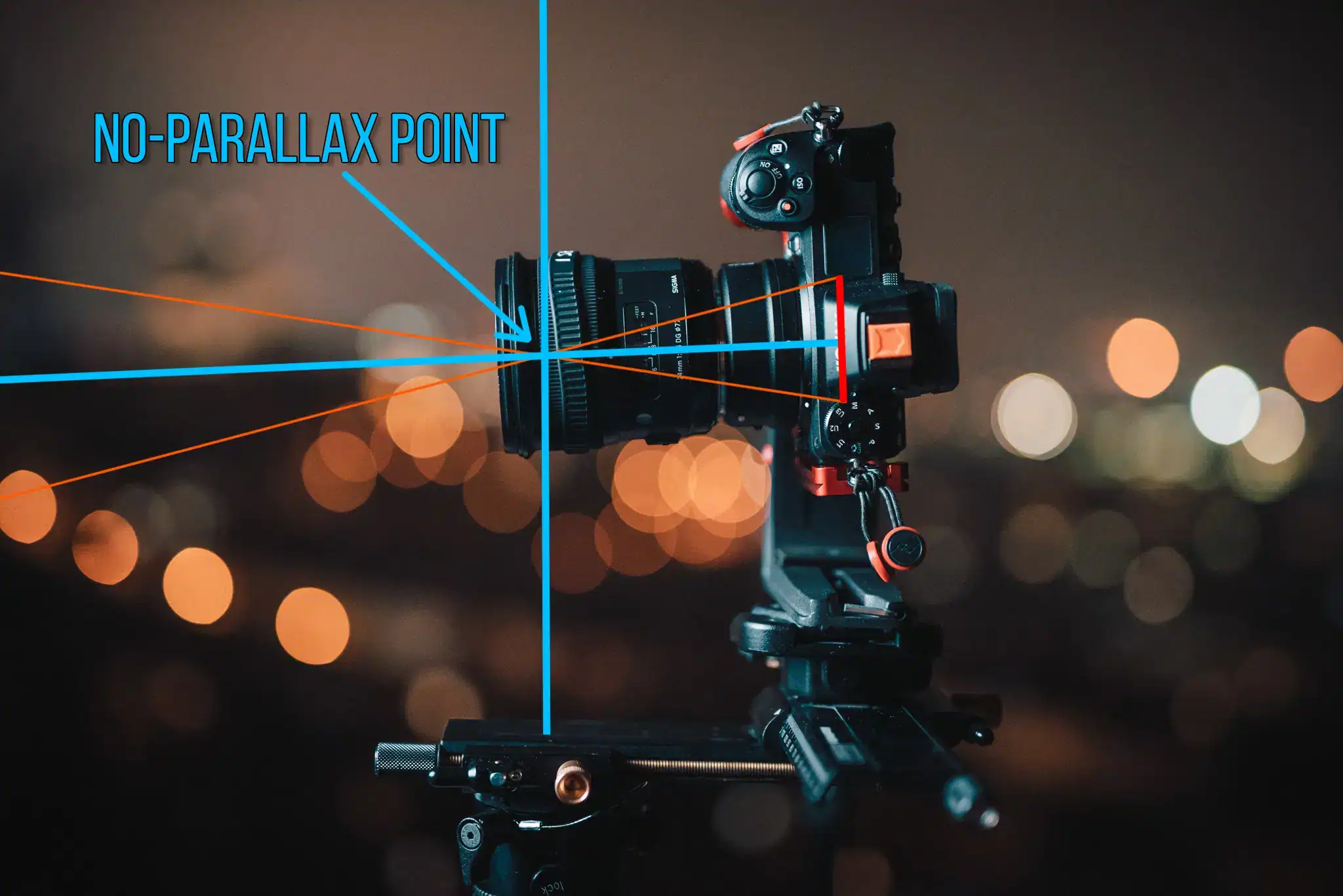
- Panoramic head: Align camera/lens so rotation occurs around the lens’s entrance pupil (nodal point). This removes parallax, making stitching near-seamless.
- Stable tripod with leveling base: A leveling base speeds setup and keeps your horizon stable.
- Remote trigger/app: Use the Sony Imaging Edge app or a cable release for vibration-free exposures.
Optional Add-ons
- Pole or car mount: Use safety tethers and mind wind loads; avoid high speeds or gusty roofs.
- Lighting aids: Small LED panels for dark interiors; avoid mixed color temperatures when possible.
- Weather protection: Rain covers, lens cap on the bulbous fisheye between rotations in dusty/windy conditions.
Step-by-Step Shooting Guide
Standard Static Scenes
- Level the tripod and set the panoramic head’s yaw to zero. Adjust fore-aft on the rail until foreground/background alignment stays fixed while panning — that’s your nodal alignment for this combo.
- Set manual exposure and lock white balance. Meter the brightest frame you expect, then expose so highlights aren’t clipped; lock that shutter, aperture, and ISO. Set WB to Daylight/Custom to avoid stitching color shifts.
- Select a focal length strategy:
- 8mm circular: 3 around at 120°, then a nadir; add a zenith if overhead features are important.
- 15mm diagonal: 6 around at 60°, plus zenith and nadir. Overlap 25–30%.
- Capture the nadir by tilting the head down or by moving the tripod slightly and shooting a handheld nadir; you’ll patch the tripod later.
HDR / High Dynamic Range Interiors
- Bracket ±2 EV (3 or 5 frames) to balance bright windows and interior shadows. With 61MP files you’ll benefit from the extra tonal depth.
- Lock WB. Mixed lighting will still require color correction, but consistent WB across brackets prevents merge artifacts.
- Use a 2-second timer or remote; let IBIS off when on tripod to avoid micro-corrections during long exposures.
Low-Light / Night Scenes
- Use f/4–f/5.6 and longer shutter speeds; keep ISO 100–800 for best quality. The a7R V handles ISO 1600–3200 fine if needed, especially with stacking and noise reduction.
- Enable Long Exposure NR off (you’ll handle noise in post) to avoid delays mid-rotation, or plan for the dark-frame wait time.
- Use a remote; shield the lens from stray light sources to reduce flare.
Crowded Events
- Shoot two passes: first for coverage, second to capture cleaner frames as gaps appear.
- Use 15mm and 6-around to gain more overlap for masking moving subjects in post.
- Consider a slightly faster shutter (1/200+) and ISO 400–800 to freeze people.
Special Setups (Pole / Car / Rooftop)
- Secure every connection. Use a tether line from camera to pole/car roof. Keep rotations slow; wind amplifies vibration on poles.
- Turn IBIS on for handheld/pole to mitigate micro-shake; off when fully locked on tripod.
- Use 8mm circular for fewer shots and faster rotations, reducing blur risk.
Real-World Mini Case Studies
Indoor Real Estate
At 15mm, shoot 6-around + Z + N at f/8, ISO 100–200 with ±2 EV brackets. Keep the camera ~1.4 m high for natural perspective; turn off ceiling fans to avoid ghosting; watch mirrors and glass — capture an extra frame to patch your reflection if needed.
Outdoor Sunset Landscape
At 8mm circular, do 4-around + N at f/8, ISO 100. Take a separate exposure set for the sun with a faster shutter for flare control. Mask in post where the overlap gives you options.
Event Crowd
Choose 15mm for more overlap and detail. Two passes: one fast for coverage, one slower waiting for gaps. Later, mask the clean parts of the second pass over the first to eliminate motion ghosts.
Recommended Settings & Pro Tips
Exposure & Focus
| Scenario | Aperture | Shutter | ISO | Notes |
|---|---|---|---|---|
| Daylight outdoor | f/8–f/11 | 1/100–1/250 | 100–200 | Lock WB (Daylight or Custom) |
| Low light/night | f/4–f/5.6 | 1/30–multi-sec | 100–800 (1600–3200 if needed) | Tripod & remote; IBIS off on tripod |
| Interior HDR | f/8 | Bracket ±2 EV | 100–400 | Windows vs interior balance |
| Action / moving subjects | f/5.6–f/8 | 1/200+ | 400–800 | Freeze motion; shoot two passes |
Critical Tips
- Manual focus: set to hyperfocal. Approximate: at 8mm f/8, focus ~0.3–0.4 m; at 15mm f/8, focus ~1 m. Then switch AF off to avoid focus shifts between frames.
- Nodal calibration: put a near object (~1 m) and far object in the frame; pan and adjust the rail until they don’t shift relative to each other. Mark this rail setting for 8mm and 15mm separately.
- White balance lock: prevents stitched seams from showing color shifts under mixed lighting.
- Shoot RAW: you’ll need the latitude for defishing, CA correction, and HDR merging.
- IBIS behavior: turn off on a tripod; leave on when handheld or on a pole/car to offset vibrations.
- Lens hood: remove for 8mm on full-frame to prevent hood intrusion; use care to avoid bumping the exposed front element.
- Adapter reliability: test aperture control before fieldwork; if the adapter glitches, shoot at a fixed aperture and power-cycle as needed.
Stitching & Post-Processing
Software Workflow
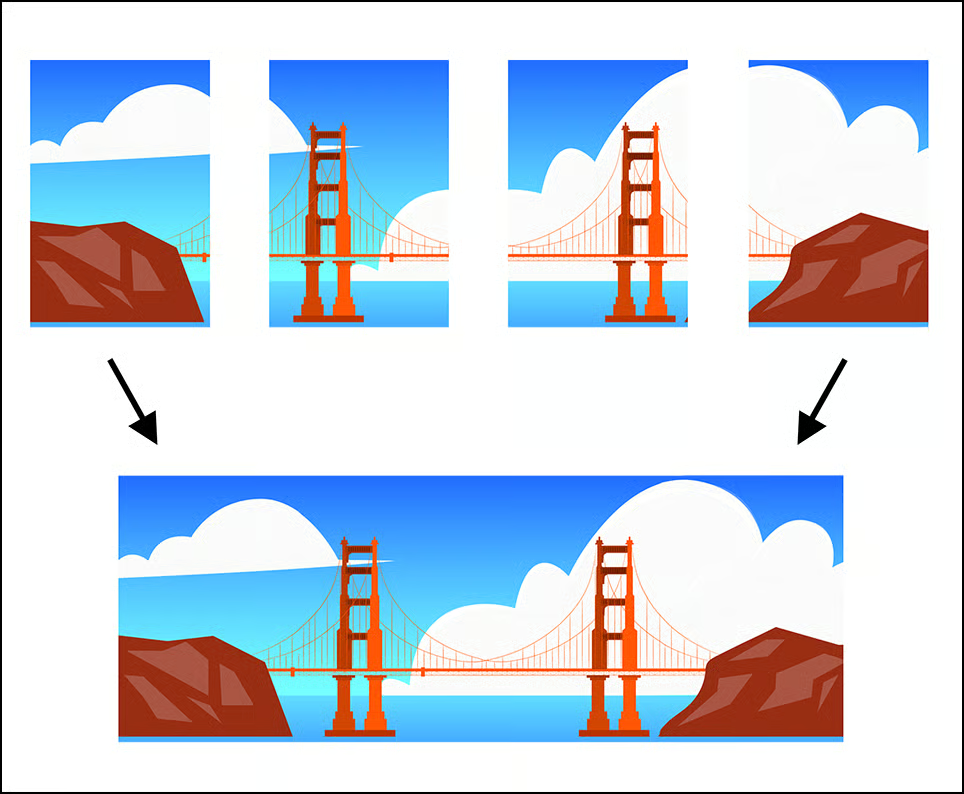
PTGui is the gold standard for speed and control; Hugin is a capable open-source alternative. With fisheye images, specify the lens type correctly: “full-frame circular fisheye (8mm)” or “diagonal fisheye (15mm).” Fisheye pano sets require fewer shots and often stitch faster; rectilinear lenses need more shots and careful overlap but can reduce edge distortion. Aim for ~25–30% overlap with fisheye, ~20–25% with rectilinear. After stitching, export an equirectangular projection (usually 2:1 ratio) for web/VR platforms.
For HDR: either pre-merge each viewpoint to HDR (Photomatix, Lightroom HDR) then stitch, or use PTGui’s built-in HDR merge during stitching. Keep consistency across the entire sphere in tone mapping to avoid seams.
Cleanup & Enhancement
- Tripod/nadir patch: use a dedicated nadir shot, AI remove tools, or a cloned floor/photo of a logo disc.
- Color correction: fix mixed lighting by tweaking white balance selectively; reduce fisheye CA/fringing before stitch when possible.
- Horizon leveling: use PTGui’s vertical line control points and horizon tool to fix roll/yaw/pitch.
- Noise reduction: apply luminance NR sparingly; the stitched panorama’s downsampling already reduces noise.
- Export: JPEG 8–12 quality for web or 16-bit TIFF for archival/gigapixel work. Typical equirect sizes: 12k–16k on the long side for 61MP source sets, depending on focal length and overlap.
Disclaimer: always check the latest documentation for your stitching software; interfaces and features evolve.
Further learning on why PTGui is favored for professional panoramas can be found in this in-depth review by Fstoppers.
Why PTGui is often the best tool for complex panoramas
For a deeper dive into spherical resolution and coverage with different focal lengths, the Panotools wiki is a classic reference.
Understanding spherical resolution and coverage
Useful Tools & Resources
Software
- PTGui panorama stitching
- Hugin (open source)
- Lightroom / Photoshop for RAW and retouching
- AI tripod removal and inpainting tools
Hardware
- Panoramic heads (Nodal Ninja, Leofoto, Fanotec)
- Carbon fiber tripods and leveling bases
- Wireless remotes (Sony or third-party)
- Pole extensions / car mounts with safety tethers
New to panoramic head setup? This practical tutorial explains entrance pupil alignment and workflow.
Panoramic head setup and alignment tutorial
Disclaimer: product names are provided as search references. Verify compatibility on manufacturers’ sites.
Common Mistakes & How to Avoid Them
- Parallax error → Calibrate and lock the entrance pupil on your panoramic head.
- Exposure flicker → Shoot full manual exposure; lock WB to a fixed Kelvin or preset.
- Tripod shadows/footprint → Capture a dedicated nadir shot and patch later.
- Ghosting from moving subjects → Shoot multiple passes and mask in post.
- Night noise → Keep ISO moderate, use longer shutter with a solid mount, and apply noise reduction in post.
- Adapter hiccups → Test aperture control at home; carry a backup plan (fixed aperture if necessary).
Frequently Asked Questions
- Can I shoot handheld panoramas with the Sony a7R V?
Yes, especially at 8mm circular. Use higher shutter speeds (1/200+) and IBIS on. However, for perfect seams near foreground objects, a leveled tripod and panoramic head are strongly recommended.
- Is the Nikon AF-S 8–15mm wide enough for single-row 360°?
Absolutely. At 8mm circular you can cover a full sphere with 3–4 shots around plus a nadir (and optional zenith). At 15mm, a single row of 6 shots around plus zenith/nadir works well for most scenes.
- Do I need HDR for interiors with bright windows?
Most real estate scenes benefit from ±2 EV bracketing. The a7R V’s DR is excellent, but HDR keeps window detail and clean interior shadows, reducing halos and color noise in post.
- How do I avoid parallax issues with this setup?
Mount the a7R V on a panoramic rail and calibrate the entrance pupil for both 8mm and 15mm positions. Once set, mark the rail for quick repeatability. Keep the camera height and rail settings consistent across shoots.
- What ISO range is safe on the a7R V in low light?
For tripod work, aim for ISO 100–800. ISO 1600–3200 is usable if motion requires it or if you’re handheld/pole-mounted; the large stitch area helps average noise.
- Can I create custom shooting modes for panorama?
Yes. Assign a Custom mode with manual exposure, manual focus, IBIS off (tripod), WB fixed, drive set to bracket if needed, and your preferred file format/quality for fast on-site setup.
- How do I reduce flare with a fisheye?
Avoid pointing directly at the sun; rotate so the sun falls at an overlap seam. Shade the lens with your hand or a flag outside the FOV. Clean the front element frequently.
- Which tripod head is best for this combo?
A two-axis panoramic head with fore-aft and lateral adjustment (e.g., Nodal Ninja/Leofoto) is ideal. Add a leveling base for speed and repeatability.
Extra Notes on This Specific Combo
Because the Nikon AF-S 8–15mm is an E-type lens with electronic aperture, ensure your F-to-E adapter can control aperture reliably. Aperture “hunting” mid-bracket will ruin HDR consistency. If AF hunts or fails, switch to manual focus and use focus magnification. For metadata, some adapters don’t relay exact focal length/aperture — in PTGui, manually set lens type and focal length for best optimization. Finally, always remove the hood at 8mm to prevent vignetting in the circular image circle, and handle the exposed front element with care between rotations.
Want an industry overview of DSLR/mirrorless 360 techniques and practical pitfalls? The Oculus creator guide offers a concise foundation for capture and stitching pipelines.