Why This Camera & Lens Are Great for Panoramas
If you’re learning how to shoot panorama with Sony a7R V & 7Artisans 10mm f/2.8 II Fish-Eye, you’ve picked a powerful, affordable combination that can produce clean, ultra-high-resolution 360 photos with fewer shots and fast on-site workflow. The Sony a7R V is a 61MP full-frame mirrorless body (approx. 9504 × 6336 px) using a back-illuminated Exmor R sensor paired with a BIONZ XR processor. It delivers excellent base ISO dynamic range (~15 stops), reliable color, and 14‑bit RAW capture. Pixel pitch is about 3.76 µm—fine enough to hold intricate detail when stitched. In-body image stabilization (IBIS) up to ~8 stops is useful for handheld scouting, though you’ll turn it off when using a tripod.
The 7Artisans 10mm f/2.8 II is a full-frame diagonal fisheye lens with an extreme field of view (around 178° diagonal). It’s manual focus and manual aperture, which is ideal for consistent exposure and focus in panoramas. Fisheye lenses reduce the number of frames needed for a full 360×180 capture compared to rectilinear lenses, saving time and minimizing stitching seams. Expect some edge softness and lateral chromatic aberration wide open at f/2.8; stop down to f/5.6–f/8 for best corner-to-corner sharpness. On Sony E-mount, the pairing is compact and well-balanced on a panoramic head, and the simple manual controls make repeatable results straightforward.
Quick Setup Overview
- Camera: Sony a7R V — Full Frame (35.7 × 23.8 mm), 61MP BSI sensor, 14-bit RAW, native ISO 100–32,000 (expandable 50–102,400), ~15 stops DR at base ISO, IBIS up to ~8 stops.
- Lens: 7Artisans 10mm f/2.8 II Fish-Eye — diagonal fisheye (~178° diagonal FOV), manual focus/aperture, best sharpness around f/5.6–f/8, moderate lateral CA (fixable in post).
- Estimated shots & overlap (tested):
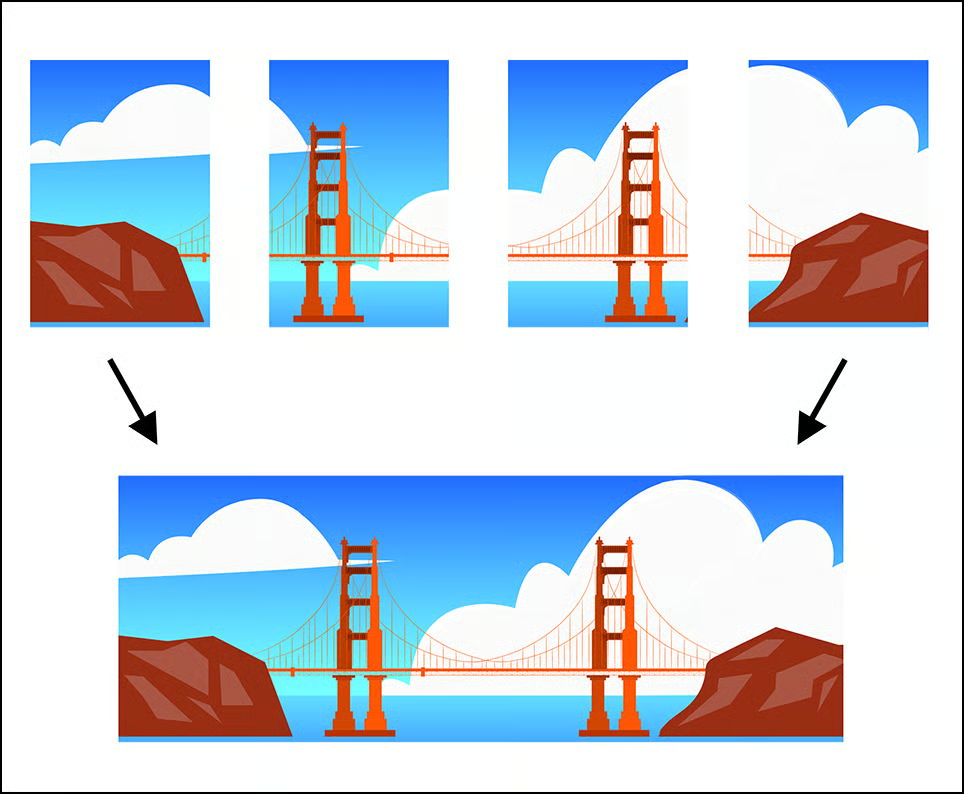
- Reliable: 6 shots around at 0° tilt (every 60°) + 1 zenith + 1 nadir; 30–35% overlap.
- Speed exterior: 4 shots around + optional nadir (risky indoors; okay for open skies).
- Difficulty: Moderate — easy capture with fisheye, but nodal calibration and clean nadir handling still matter.
Planning & On-Site Preparation
Evaluate Shooting Environment
Look for moving subjects, wind, reflective surfaces (glass, polished floors), and dynamic lighting (backlit windows, flickering LEDs). For glass, get close—ideally within a few centimeters—and shoot at a slight angle to reduce reflections and ghosting. Be mindful of the sun’s position with fisheye lenses; a light source close to frame edges can produce strong flare and hotspots.
Match Gear to Scene Goals
The a7R V’s high resolution and robust base ISO dynamic range are perfect for large, clean equirectangular outputs (often 120–180MP after stitching). Indoors, the camera comfortably holds ISO 100–800 for critical quality; ISO 1600 remains usable with noise reduction when needed. The fisheye’s huge FOV lets you cover a full sphere with fewer frames, which helps in fast-changing light or crowds. The trade-off is fisheye distortion—lines curve—so be intentional about camera height and rotation to minimize awkward bends near the horizon.
Pre-shoot Checklist
- Charge batteries, bring spares; format fast UHS-II/CFexpress cards; clean lens and sensor.
- Level the tripod and pre-calibrate your panoramic head for this camera/lens combo.
- Safety: watch wind gusts, rooftop edges, and vehicle mounts; use a tether/secondary strap.
- Backup workflow: shoot an extra safety round, especially for interiors or client jobs.
Essential Gear & Setup
Core Gear
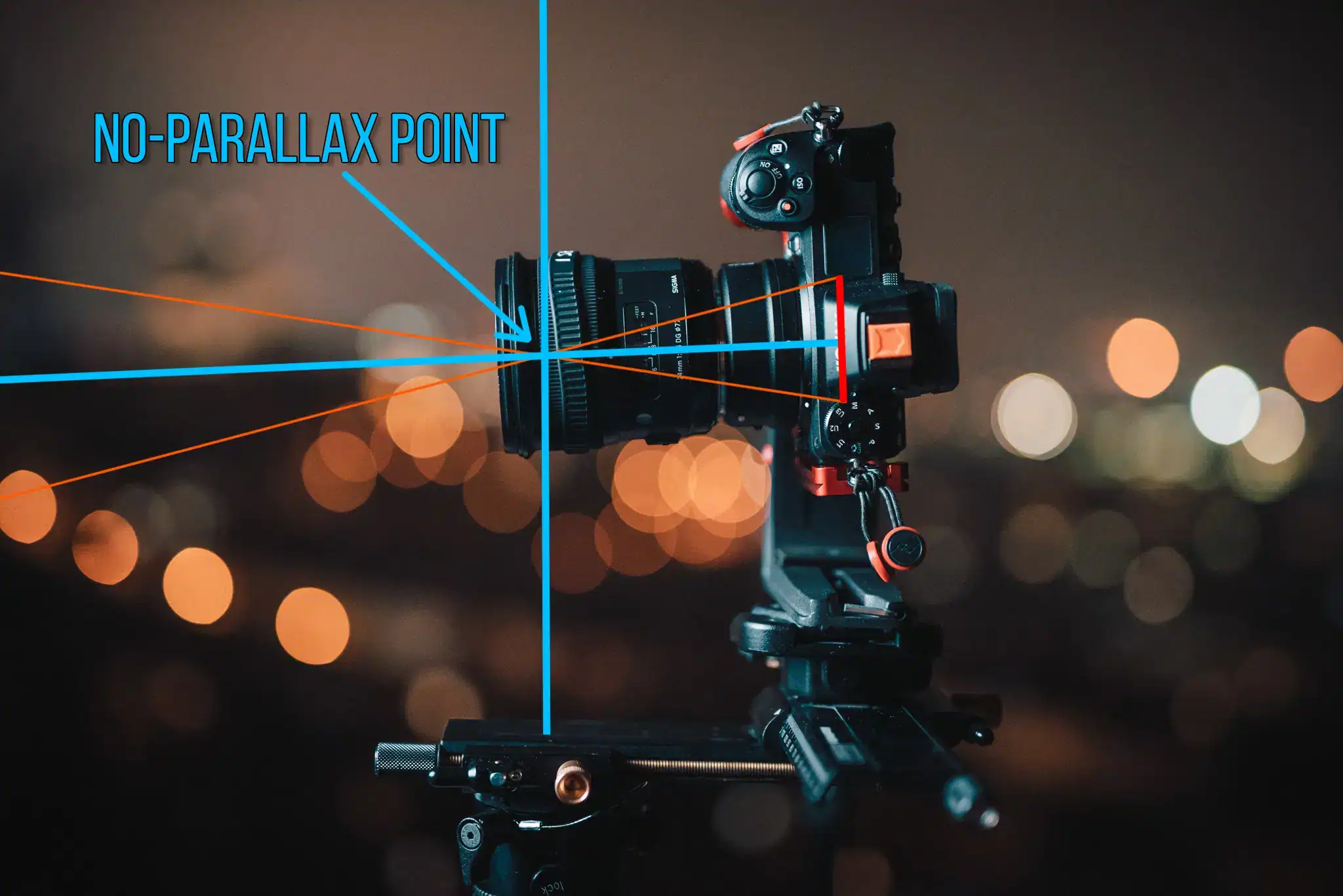
- Panoramic head: Lets you rotate around the lens’s entrance pupil (nodal point) to avoid parallax. Proper alignment is critical when objects are close to the camera.
- Stable tripod with leveling base: A leveling base speeds up setup and keeps yaw rotation flat, easing stitching and horizon leveling.
- Remote trigger or app: Use Sony’s Imaging Edge Mobile or a Bluetooth remote to avoid touching the camera and introducing blur.
Optional Add-ons
- Pole or car mount: Great for elevated or moving perspectives. Use lanyards/tethers. Consider wind load and vibrations; shoot multiple passes to hedge against motion blur.
- Lighting tools: Small LED panels or strobes for dark interiors; keep lighting consistent across frames.
- Weather covers: Rain/wind protection; a small microfiber cloth is essential for the fisheye’s large front element.
Step-by-Step Shooting Guide
Standard Static Scenes
- Level & align: Level the tripod using the leveling base. Mount the a7R V on your pano head pre-calibrated for the 7Artisans 10mm. A practical starting fore-aft value for the entrance pupil is about 70–75 mm forward from the vertical rotation axis on many compact rails (fine-tune with the method below).
- Practical nodal calibration: Place a light stand or pole ~1 m from the lens and a background object tens of meters away. Rotate the camera—adjust the rail until the near object stays aligned with the far object throughout the rotation. Mark the rail so you can set it instantly next time.
- Lock exposure & white balance: Use full manual exposure. Lock WB (e.g., 5600K daylight outdoors; a custom Kelvin for interiors). Shoot RAW, 14-bit lossless compressed for speed and quality.
- Focus: Use manual focus with peaking. For the 10mm at f/8, a hyperfocal of roughly 0.4–0.5 m keeps from ~0.2–∞ sharp; set and forget.
- Capture sequence: For reliability, take 6 shots around at 0° tilt (60° yaw steps). Add 1 zenith (tilt up) and 1 nadir (tilt down or offset the tripod and shoot a patch). Use a 2 s self-timer or remote for each shot.
- Nadir cleanup: After the main set, shift the tripod slightly, keep the nodal alignment, and capture a clean ground plate to patch the tripod in post.
HDR / High Dynamic Range Interiors
- Bracketing: Use ±2 EV with 3 frames per position for speed. If windows are extremely bright, use 5 frames at ±1 EV. The a7R V supports extensive bracketing options—set continuous bracket shooting with a 2 s timer.
- Consistency: Keep aperture and ISO constant; vary shutter only. White balance must be locked to prevent color shifts across brackets.
- Noise strategy: Disable Long Exposure NR (it doubles capture time); denoise in post for consistent results across the panorama.
Low-Light / Night Scenes
- Stability first: Use a sturdy tripod, turn OFF IBIS on the a7R V when on a tripod, and trigger remotely. Typical settings: f/4–f/5.6, 1/30–1/60 s, ISO 400–800. Go slower if wind is calm; use the 2 s timer.
- ISO guidance: For critical 360s, ISO 100–800 is “safe”; ISO 1600 is workable with mild NR; avoid 3200+ unless you must capture fast-moving scenes.
Crowded Events
- Two passes: Make a fast first pass to lock framing, then a second pass waiting for clear gaps at each yaw angle.
- Post blend: In PTGui or Photoshop, use masks to keep the clean bits from each pass and remove ghosted people.
Special Setups (Pole / Car / Drone)
- Pole shots: Keep total weight low; use a rotator with hard 60° stops. Take 6 around quickly, then a zenith if possible. Tether your rig and mind wind gusts.
- Car-mounted: Choose smooth pavement, keep speeds low, and shoot multiple rounds to minimize blur. Expect to mask moving elements during stitching.
- Drone: If you must use the a7R V from a drone platform, verify payload and safety; most will prefer a dedicated 360 action cam for aerials.
Recommended Settings & Pro Tips
Exposure & Focus
| Scenario | Aperture | Shutter | ISO | Notes |
|---|---|---|---|---|
| Daylight outdoor | f/8–f/11 | 1/100–1/250 | 100–200 | Lock WB to Daylight or custom Kelvin |
| Low light/night | f/4–f/5.6 | 1/30–1/60 | 400–800 | Tripod, remote trigger; IBIS OFF on tripod |
| Interior HDR | f/8 | Bracket ±2 EV | 100–400 | Balance windows and interior lamps |
| Action / moving subjects | f/5.6–f/8 | 1/200+ | 400–800 | Freeze motion; consider two-pass capture |
Critical Tips
- Manual focus at hyperfocal: With the 10mm at f/8, set focus around 0.4–0.5 m for near-to-infinity sharpness. Use focus peaking for confidence.
- Nodal calibration: Start with ~70–75 mm fore-aft on your rail (varies by head). Align a near object with distant background while panning; adjust until there’s no relative shift.
- White balance lock: Avoid Auto WB. Mixed lighting is fine—just be consistent across all frames and brackets.
- RAW over JPEG: 14‑bit RAW preserves color and dynamic range for HDR and heavy corrections. Lossless compressed saves card space without visible loss.
- IBIS usage: ON for handheld scouting and exterior single frames; OFF on tripod to prevent micro-jitters during long exposures.
- Rotator clicks: Use 60° detents for 6-around workflow; it speeds capture and ensures consistent overlap.
Stitching & Post-Processing
Software Workflow
Import RAWs to Lightroom or Capture One for baseline adjustments (color, exposure sync), then stitch in PTGui or Hugin. Fisheye frames are actually easier to stitch because they overlap generously; you don’t need to “defish” first—let PTGui/Hugin handle the fisheye projection and lens model. Industry norms are ~25–35% overlap for fisheye panos and ~20–25% for rectilinear. PTGui’s control points, lens parameter optimization, and masking tools make it an industry favorite for complex interiors and multi-row panos. For a deeper look at PTGui’s strengths for professional panoramas, see this review on Fstoppers. PTGui reviewed as a top tool for panoramas.
Want a foundational walkthrough on setting up a panoramic head and capturing perfect high-end 360 photos? This official guide from Meta is a solid reference for process and quality standards. Set up a panoramic head: best practices.
Cleanup & Enhancement
- Nadir patch: Use PTGui’s Viewpoint correction or export to Photoshop. You can clone manually or paste a photographed floor plate.
- Color & noise: Apply global color balance and gentle noise reduction (especially if ISO ≥ 800). Keep a consistent tone across brackets.
- Horizon & leveling: Use the panorama editor (level horizon, adjust yaw/pitch/roll). The a7R V’s electronic level helps reduce corrections later.
- Export: For VR platforms, export 16‑bit TIFF or high-quality JPEG equirectangular (2:1 aspect). Common sizes are 12k × 6k or 16k × 8k depending on your overlap and stitch quality.
For deeper techniques on pano heads and optimizing shooting patterns, this primer is helpful. Panoramic head tutorial and tips. Also see the spherical resolution discussion when planning final output sizes. DSLR spherical resolution reference.
Useful Tools & Resources
Software
- PTGui panorama stitching
- Hugin (open source)
- Lightroom / Capture One (RAW) and Photoshop/Affinity (patch/retouch)
- AI tripod removal tools or content-aware fill for nadir cleanup
Hardware
- Panoramic heads: Nodal Ninja, Leofoto, and similar compact rail systems
- Carbon fiber tripods with leveling bases
- Wireless remotes: Sony RMT-P1BT or app-based trigger
- Pole extensions / suction car mounts with safety tethers
Disclaimer: product names are for search reference; check official documentation for the latest specs and workflows.
Field-Proven Setups & Scenarios
Indoor Real Estate
Shoot at f/8, ISO 100–200, bracket ±2 EV (3 frames). Use 6-around + zenith, then a nadir patch. Keep the camera at about 150–160 cm height to reduce curvature of furniture lines. Lock white balance (e.g., 4000–4500K) so mixed daylight/tungsten can be corrected consistently in post.
Outdoor Sunset
Work fast: expose for midtones at ISO 100, f/8, adjust shutter. If the sky is changing rapidly, consider a 4-around capture with generous overlap, then a zenith. The a7R V’s dynamic range lets you recover highlights, but bracket if the sun is in frame. Watch for flare—use your hand or a flag just out of frame to block direct sun in the frame where it’s worst.
Event Crowds
Use 6-around at 1/200 s, f/5.6–f/8, ISO 400–800. Make two passes and mask people who move between frames. This keeps faces natural and reduces ghosting.
Rooftop / Pole Shooting
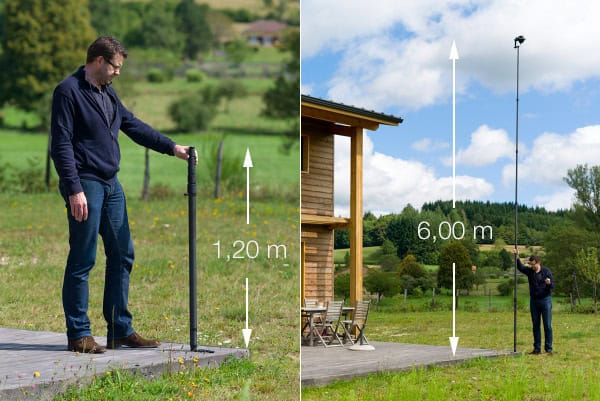
At the edge of a roof, tether the rig to a fixed anchor, keep a low profile, and shoot multiple rounds in case of wind. With a pole, keep the lens above head height to reduce tripod presence in the nadir area and improve immersion.
Safety, Reliability & Backup
The a7R V and 7Artisans combo is rugged, but fisheye front elements are exposed; always use a lens cap when moving. On rooftops or near traffic, use a secondary tether and never leave the rig unattended. In wind, lower the center column, widen the tripod stance, and add a weight bag. For mission-critical work, shoot a second panorama from the same position as a backup; it’s the cheapest insurance you can buy on location.
Common Mistakes & How to Avoid Them
- Parallax error → Align the entrance pupil on your pano head; test with near/far objects before shooting.
- Exposure flicker → Manual exposure and locked WB; never use Auto WB or Auto ISO during a pano.
- Tripod shadows/footprint → Capture a nadir patch or use content-aware fill in post.
- Ghosting from moving subjects → Shoot two passes, mask in PTGui or Photoshop.
- Night noise & blur → Keep ISO low, use remote trigger, turn off IBIS on tripod, and consider multiple rounds to pick the sharpest files.
Frequently Asked Questions
- Can I shoot handheld panoramas with the Sony a7R V?
Yes for quick tests or outdoor scenes with distant subjects. Use IBIS ON, high shutter (1/250 s+), and 4–6 shots around. However, for professional 360×180 results—especially indoors with near objects—use a tripod and panoramic head to eliminate parallax.
- Is the 7Artisans 10mm f/2.8 II wide enough for a single-row 360?
Yes, a single row of 6 shots around plus a zenith and nadir is reliable. Outdoors, you can push to 4 around if the scene is forgiving (open skies), but interiors stitch more cleanly with 6-around due to complex geometry.
- Do I need HDR for interiors with bright windows?
Usually. Bracket ±2 EV (3 frames) or use 5×1 EV if the contrast is extreme. The a7R V has excellent DR, but windows typically require bracketing for natural rendering without clipping or muddy shadows.
- How do I avoid parallax issues with this fisheye?
Calibrate the entrance pupil on your pano head: start with ~70–75 mm fore-aft rail position as a baseline and fine-tune with near/far alignment tests. Always level the tripod and keep the lens centered over the rotation axis.
- What ISO range is safe on the a7R V for low-light panos?
For client-grade results, ISO 100–800 is the sweet spot. ISO 1600 is acceptable with careful noise reduction; try to avoid 3200+ unless you’re forced to use fast shutter speeds in dynamic scenes.
- Can I set up custom modes for pano on the a7R V?
Yes. Save your manual exposure, WB, drive mode (bracket sequence), and IBIS OFF settings to a custom recall (e.g., MR on the mode dial). It speeds setup and prevents missed steps.
- How can I reduce flare with a fisheye?
Avoid placing the sun at the edge of the frame. Shade the lens with your hand or a small flag just outside the field of view. Clean the front element often—dust glints amplify flare and veiling glare.
- What’s the best panoramic head for this setup?
A compact two-rail head with a 60° click-stop rotator is ideal. Look for precise fore-aft adjustment, solid clamps, and clear scales. Brands like Nodal Ninja and Leofoto offer lightweight yet rigid options.
Final Thoughts
Mastering how to shoot panorama with Sony a7R V & 7Artisans 10mm f/2.8 II Fish-Eye comes down to three things: rock-solid nodal alignment, consistent exposure/white balance, and a deliberate capture pattern. This combo rewards you with fast capture, dependable stitching, and superb resolution that stands up to professional delivery—whether for real estate, outdoor venues, or creative VR scenes.