Why This Camera & Lens Are Great for Panoramas
The Sony A7R IV (ILCE‑7RM4) paired with the Tokina ATX‑i 11–20mm f/2.8 can be a powerful and cost‑effective setup for 360° and ultra‑wide panoramas—if you use it smartly. The A7R IV’s 61MP full‑frame sensor (pixel pitch ~3.76 µm) delivers class‑leading detail and dynamic range (up to ~14.5 EV at base ISO), which preserves fine textures in architecture and landscapes. In-body image stabilization (IBIS) aids handheld frames, while precise manual controls and focus magnification make tripod work easy. The Tokina ATX‑i 11–20mm f/2.8 is a rectilinear ultra‑wide zoom originally designed for APS‑C. On the A7R IV, the best practice is to enable APS‑C/Super 35 crop mode, which yields ~26MP files with a full, clean image circle, minimal vignetting, and excellent corner sharpness. This provides reliable overlap and alignment for seamless stitching.
Because the Tokina is a rectilinear—not fisheye—lens, you’ll typically shoot more frames than a fisheye user would, but you gain natural‑looking lines and reduced distortion across the frame. At 11mm APS‑C (~16.5mm full‑frame equivalent), the field of view is generous for single‑ or dual‑row panoramas. Zooming toward 20mm APS‑C (~30mm FF eq.) will demand additional rows and overlap but can increase overall stitched resolution dramatically, useful for virtual tours and large prints.
Quick Setup Overview
- Camera: Sony A7R IV — 35mm full-frame, 61MP (26MP in APS‑C crop), ~14.5 EV dynamic range at base ISO, 5‑axis IBIS.
- Lens: Tokina ATX‑i 11–20mm f/2.8 — rectilinear UWA zoom for APS‑C; sharpest around f/5.6–f/8; well‑controlled distortion; some lateral CA at edges (fixable in post).
- Estimated shots & overlap (APS‑C crop mode):
- At 11mm (≈16.5mm FF eq.): 2 rows of 10 shots each (±30° pitch) + zenith + nadir → ~22 frames @ ~30% overlap.
- At 14–16mm (≈21–24mm FF eq.): 2–3 rows of 10–12 shots + zenith + nadir → ~24–38 frames.
- At 20mm (≈30mm FF eq.): 3 rows of 12 shots + zenith + nadir → ~38–38+ frames for higher resolution.
- Difficulty: Intermediate (rectilinear UWA requires careful nodal alignment and consistent overlap).
Planning & On-Site Preparation
Evaluate Shooting Environment
Before you set up, assess light direction and contrast, moving subjects, tight spaces, reflective surfaces (glass, polished floors), and wind. If shooting near glass, keep the front element as close to the pane as possible without touching (1–3 cm) to minimize reflections and ghosting. For interiors with mixed lighting, plan for manual white balance and, if needed, bracketing. Outdoors, note the sun’s path—backlight can lower contrast and reveal sensor dust or flare.
Match Gear to Scene Goals
For real estate and interiors, the A7R IV’s dynamic range helps retain window detail when bracketing, and the Tokina at 11–14mm APS‑C crop covers small rooms with fewer shots. For sunset landscapes, stay near base ISO (100–200) to maximize DR. The A7R IV’s noise is well‑controlled up to ISO 800; ISO 1600 is usable for events, but expect to apply noise reduction. Since the Tokina is rectilinear, you’ll capture more frames than a fisheye would—but your verticals remain straighter, and you avoid fisheye defishing compromises.
Pre-shoot Checklist
- Charge batteries and carry spares; format fast UHS‑II SD cards.
- Clean lens front/rear and the sensor; dirt multiplies across a 360° stitch.
- Enable APS‑C/Super 35 crop mode on the A7R IV when using the Tokina ATX‑i 11–20mm to avoid heavy vignetting.
- Level tripod; verify panoramic head calibration (entrance pupil/no‑parallax point).
- Set manual exposure and white balance before shooting the set.
- Safety: secure straps/tethers on rooftops, check wind, avoid soft ground; use sandbags if necessary.
- Backup workflow: shoot a second full pass if time allows, especially in dynamic scenes.
Essential Gear & Setup
Core Gear
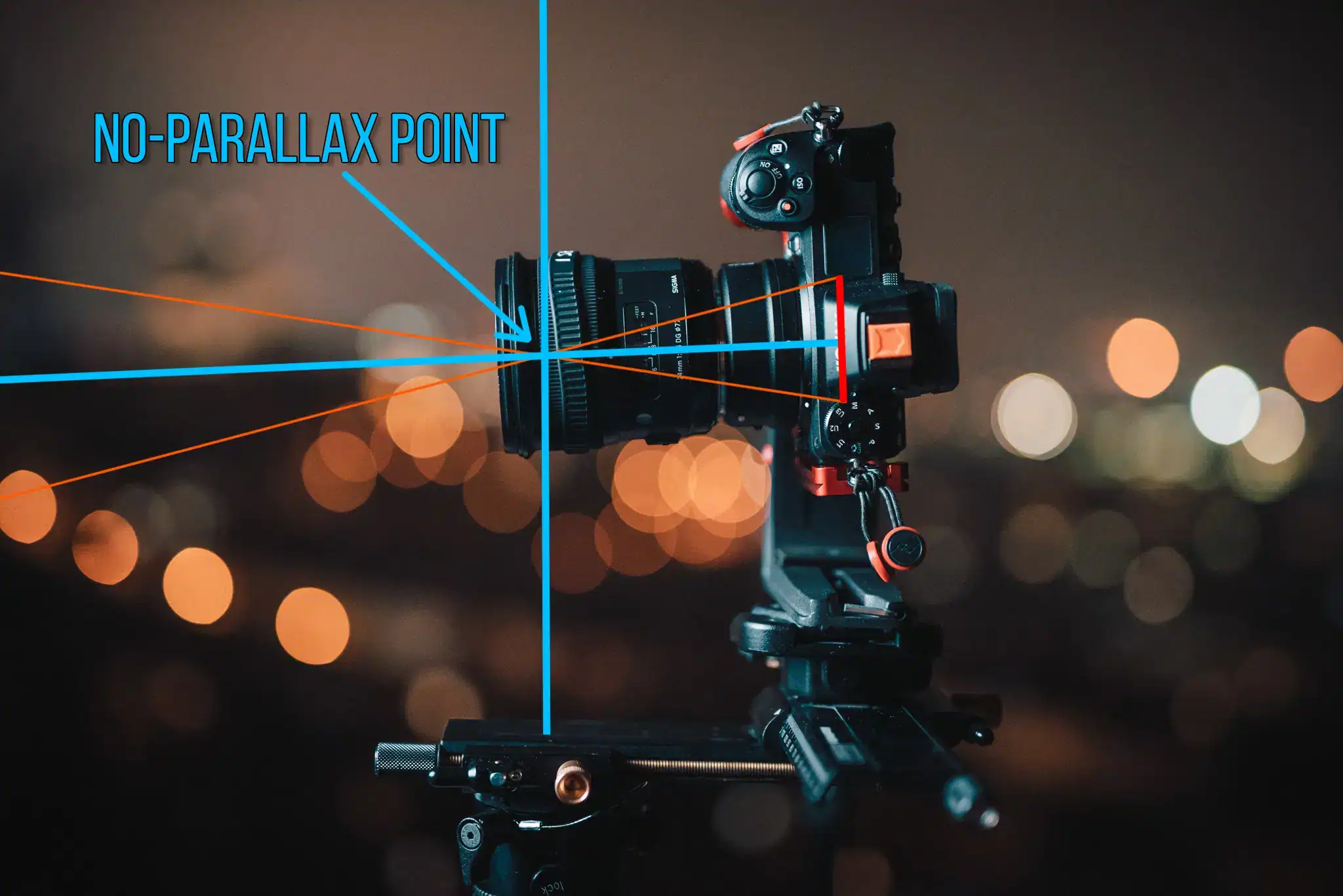
- Panoramic head: Lets you rotate around the entrance pupil (nodal point) to eliminate parallax between foreground and background. Calibrate once, then mark your rail settings for 11mm and 20mm.
- Stable tripod with leveling base: A bubble or half‑ball leveling base speeds setup and ensures consistent horizons.
- Remote trigger or app: Use Sony Imaging Edge Mobile or a cable release to avoid vibrations and keep your hands off the camera.
Optional Add-ons
- Pole or car mount: For elevated or vehicle‑based 360s. Use a safety tether, avoid overhead lines, and respect wind limits.
- Lighting for interiors: Small LED panels or bounced flash to brighten dark corners (keep lighting consistent across frames).
- Weather protection: Rain cover and microfiber cloths. Moisture on the front element causes flare and stitching issues.
For an in‑depth panoramic head primer, see this practical guide to panoramic heads and no‑parallax alignment. Panoramic head setup tutorial
Step-by-Step Shooting Guide
Standard Static Scenes
- Level & align: Level the tripod, then set the panoramic head to your calibrated entrance pupil position for the Tokina. As a starting estimate, at 11mm the entrance pupil sits roughly 7.5–8.5 cm forward of the sensor plane; at 20mm, closer to 6–7 cm. Fine‑tune using two vertical objects—pan the camera and adjust until there’s no relative shift.
- Manual exposure & WB: Switch to M mode. Meter the scene, then lock shutter, aperture, and ISO for the full sequence. Set white balance to a fixed preset (e.g., Daylight 5500K outdoors; 3200–4000K indoors) or a manual Kelvin to prevent color shifts across frames.
- Focus: Use manual focus with focus magnification. At 11mm, setting hyperfocal at f/8 is about 0.8 m; everything from ~0.4 m to infinity will be acceptably sharp.
- Capture sequence: At 11mm APS‑C, shoot two rows at ±30° pitch with 10 frames per row, yaw every 36°, plus one zenith (+90°) and one nadir (−90° or offset nadir). Ensure 25–35% overlap. Consider a slow, consistent cadence.
- Nadir frame: Take an extra ground shot after moving the tripod slightly or using an offset to ease tripod removal in post.
HDR / High Dynamic Range Interiors
- Bracket for windows: Use ±2 EV (3 frames) as a baseline. In extreme contrast, use 5–7 frames spaced 1–2 EV apart. The A7R IV supports bracketed sequences; a remote helps automate.
- Keep WB locked: Do not let auto white balance vary across brackets; it complicates stitching and blending.
- De‑ghost strategy: Minimize moving elements (fans, curtains). If people move, shoot a second pass to mask later.
Low-Light / Night Scenes
- Lower ISO first: Aim for ISO 100–400 on tripod. The A7R IV remains clean to ISO ~800; 1600 is usable with noise reduction.
- Shutter stability: Use 2‑sec self‑timer or remote. Turn IBIS off on tripod to avoid micro‑jitters. Prefer mechanical or first‑curtain shutter to avoid potential rolling artifacts.
- Watch for banding: Avoid silent (electronic) shutter under LED/fluorescent lights; use mechanical.
Crowded Events
- Two passes: First for coverage, second waiting for gaps in foot traffic. You’ll blend frames in post to remove ghosts.
- Faster shutter: 1/200s+ reduces motion blur. Raise ISO to 800–1600 if needed; noise is preferable to smear.
- Overlap generously: 35% overlap gives the stitcher more options for picking consistent control points around moving subjects.
Special Setups (Pole / Car / Drone)
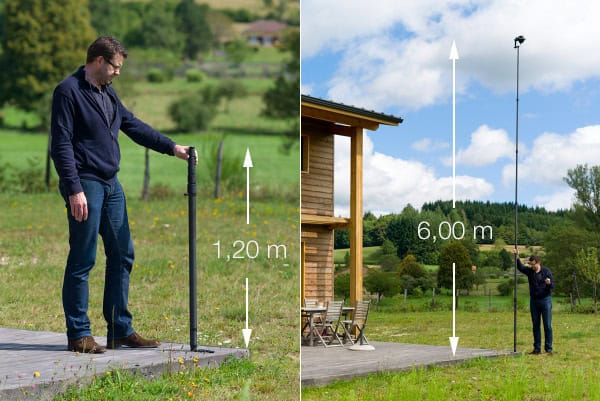
- Pole safety: Use a rigid pole with guy lines and a safety tether. Mind wind loads—long poles amplify vibrations and can damage mounts.
- Car mount: Use suction mounts rated for your gear’s weight; add tethers. Park safely. Consider faster shutter (1/500s) and shoot when wind is mild.
- Rotation cadence: On poles, rotate slower and let vibrations settle 1–2 seconds before each shot.
Recommended Settings & Pro Tips
Exposure & Focus
| Scenario | Aperture | Shutter | ISO | Notes |
|---|---|---|---|---|
| Daylight outdoor | f/8–f/11 | 1/100–1/250 | 100–200 | Lock WB (Daylight or custom Kelvin) |
| Low light/night | f/4–f/5.6 | 1/30–1/60 (longer if needed) | 100–800 | Tripod + remote; IBIS off on tripod |
| Interior HDR | f/8 | Bracket ±2 EV | 100–400 | Blend for windows and lamps |
| Action / moving subjects | f/5.6–f/8 | 1/200+ | 400–1600 | Freeze motion; consider two-pass capture |
Critical Tips
- Manual focus at hyperfocal: At 11mm APS‑C, f/8 hyperfocal ≈ 0.8 m. Mark a repeatable focus point.
- Nodal calibration: Use two vertical objects (near/far). Pan and adjust the rail until there’s no relative shift. Record rail positions for 11mm and 20mm on tape.
- White balance lock: Mixed lighting can vary drastically shot‑to‑shot; a fixed Kelvin keeps skin tones and walls consistent.
- RAW over JPEG: The A7R IV’s RAW files hold more DR and color depth—critical for HDR merges and shadow recovery.
- IBIS off on tripod: Stabilization can introduce micro‑blur during long exposures; disable it when the camera is solidly mounted.
- Dual‑gain behavior: The A7R IV’s shadow performance improves slightly past ISO ~320, but highlight headroom drops. For panoramas, keep ISO low and bracket if needed.
Stitching & Post-Processing
Software Workflow
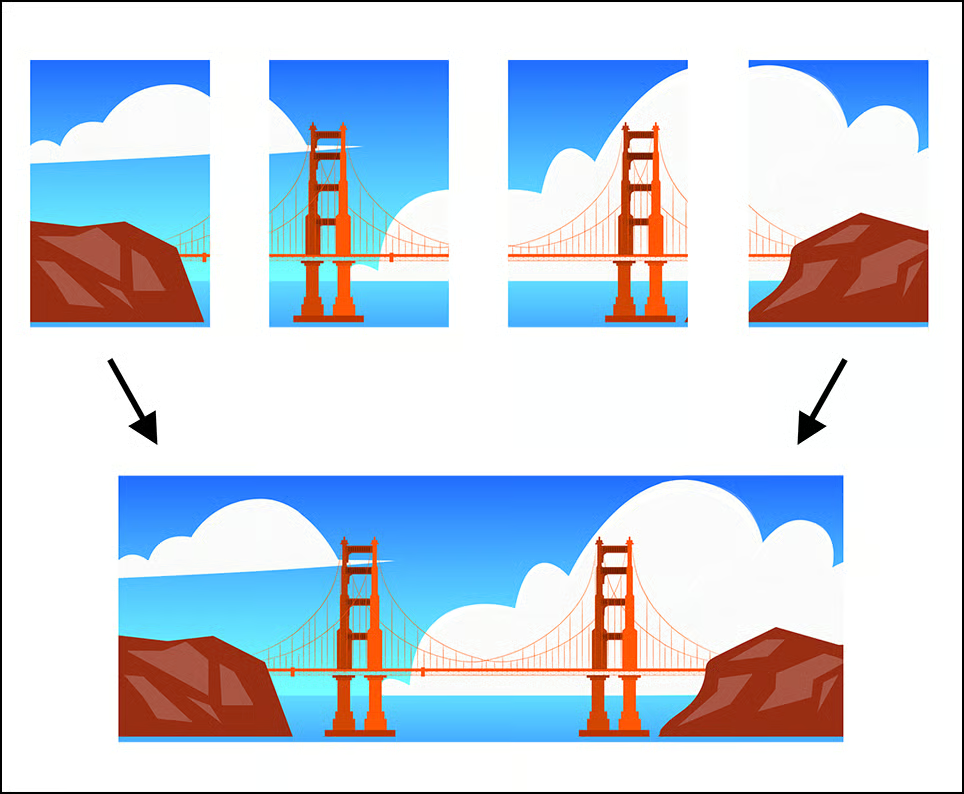
Import RAWs into Lightroom or Capture One for basic color and exposure normalization. If you bracketed, batch‑merge to HDR DNGs before stitching to keep dynamic range intact. Stitch in PTGui (fast, robust for complex sets), Hugin (free), or Photoshop (OK for simple single‑row panos). With a rectilinear UWA lens, aim for 25–35% overlap; consistent exposure/WB ensures cleaner control points. PTGui’s “Viewpoint” and “Mask” tools help fix nadirs and moving subjects. For industry guidance and tool comparisons, see this PTGui review for professional panoramas. Why PTGui excels for complex panoramas
Cleanup & Enhancement
- Nadir patch: Use PTGui Viewpoint correction, generative fill, or manual cloning to remove the tripod. Capture an offset nadir to make this easier.
- Color consistency: Match white balance and tint across rows. Use HSL to tame mixed lighting casts (green/magenta from LEDs).
- Noise reduction: Apply luminance NR sparingly; mask it to shadows. A7R IV files tolerate moderate NR well, especially at ISO ≤800.
- Leveling: In an equirectangular projection, adjust pitch/roll/yaw to level horizons and verticals; PTGui has horizon tools.
- Export: For VR viewers, export 2:1 equirectangular JPEG or 16‑bit TIFF. 8–12K width is common for high‑quality tours; balance against platform limits.
Want a structured, end‑to‑end DSLR 360 workflow? This guide covers setup, shooting, and stitching best practices. DSLR/Mirrorless 360 shooting & stitching overview
For additional perspective on pano techniques and field tips, see this Q&A compilation from seasoned photographers. Best techniques to take 360 panoramas
Video: See the Process
Watch a clear walkthrough of shooting and stitching panoramas. Apply the same principles here with the A7R IV and Tokina 11–20mm.
Useful Tools & Resources
Software
- PTGui panorama stitching
- Hugin (open source)
- Lightroom / Photoshop for RAW and retouch
- AI tripod removal tools (generative fill)
Hardware
- Panoramic heads (Nodal Ninja, Leofoto, Sunwayfoto)
- Carbon fiber tripods with leveling base
- Wireless remote shutters or phone app control
- Pole extensions / vehicle mounts with safety tethers
Disclaimer: Product names are for research reference; confirm specs/compatibility on official sites.
Common Mistakes & How to Avoid Them
- Parallax error: Not aligning the entrance pupil causes stitching seams. Calibrate and mark your rail settings.
- Exposure flicker: Auto exposure or auto WB between frames creates visible seams. Use manual settings and fixed WB.
- Tripod shadows and footprints: Shoot a dedicated nadir and/or patch in post.
- Ghosting from motion: Use masking in PTGui and capture a second pass when crowds ebb.
- High ISO noise: Prefer longer exposures on tripod over raising ISO. Bracket instead of pushing shadows excessively.
- IBIS on tripod: Can create micro‑blur. Turn it off when the camera is locked down.
Real-World Scenarios with the A7R IV & Tokina 11–20mm
Indoor Real Estate (Small Rooms)
Use APS‑C crop mode, 11–12mm, f/8, ISO 100–200. Two rows at ±30° with 10 frames each plus zenith and nadir produces a clean, fast‑to‑stitch 360 with straight walls. Bracket ±2 EV for windows. Keep the lens 1–3 cm from glass to reduce reflections when shooting balconies or interior glass partitions.
Outdoor Sunset Landscape
At 14–16mm, f/8, ISO 100–200, expose for highlights and bracket a +2 EV set for shadows. Avoid shooting directly into the sun unless necessary; shade the front element with your hand or a flag to limit flare. The A7R IV’s DR lets you hold subtle sky color and foreground texture without banding when processed from RAW.
Crowded Event or Market
At 11–14mm, increase shutter to 1/250–1/500s. Shoot two full passes—one continuous, one patient—and later mask to keep the best moments from each frame. Overlap more generously (35%) to help the stitcher find consistent control points despite moving people.
Rooftop or Pole Capture
Mount on a rated pole with a light panoramic head. Use 11mm for fewer, faster frames aloft. Wait for vibrations to settle, then shoot. Secure everything with a tether, and do not deploy in strong winds. Consider a helmet and spotter for safety.
Frequently Asked Questions
- Can I shoot handheld panoramas with the Sony A7R IV?
Yes, for single‑row panoramas with generous overlap (40%+). IBIS helps, but for full 360° spheres—especially multi‑row—use a tripod and panoramic head to avoid parallax and alignment errors.
- Is the Tokina ATX‑i 11–20mm f/2.8 wide enough for a single‑row 360?
At 11mm APS‑C (~16.5mm FF eq.), you can sometimes manage a single row outdoors with a separate zenith/nadir, but two rows are more reliable for full coverage and better stitch quality. Rectilinear UWA lenses need more frames than fisheyes.
- Do I need HDR for interiors with bright windows?
Usually, yes. Bracket ±2 EV (3 frames) at minimum; 5–7 frames if contrast is extreme. Merge to HDR before stitching to keep color and contrast consistent across the panorama.
- How do I avoid parallax issues with this combo?
Use a calibrated panoramic head. In APS‑C crop mode, start with the rail roughly 7.5–8.5 cm forward of the sensor plane at 11mm and fine‑tune using near/far alignment. Mark your final numbers on the rail for repeatability.
- What ISO range is safe on the A7R IV in low light?
Aim for ISO 100–400 on tripod for maximum dynamic range. ISO 800 is still very clean; 1600 is usable with light noise reduction. Prefer longer shutters or bracketing over pushing ISO high.
Further Learning
To see a complete pro setup flow from head alignment to capture and stitch, this step‑by‑step training is excellent. Set up a panoramic head for high‑end 360 photos
Safety, Limitations & Trustworthy Workflow
Be honest about the Tokina 11–20mm on the A7R IV: it’s an APS‑C lens, so enable APS‑C/Super 35 crop for clean coverage. If you attempt full‑frame mode at the long end, expect strong vignetting; it’s generally not recommended for panos. Always secure gear on rooftops or poles with a tether and avoid windy conditions. Back up your cards on-site (dual cards, portable SSD) and keep a second full pass when possible. Document your panoramic head calibration and camera settings so you can reproduce successful results across shoots.