Why This Camera & Lens Are Great for Panoramas
The Sony A7R IV paired with the Sony FE 12–24mm f/4 G is a powerhouse for 360 photo and panoramic work. The A7R IV’s 61MP full-frame sensor (35.7 × 23.8 mm) delivers extremely high resolution (9504 × 6336 px), excellent dynamic range at base ISO (around 14.7 EV), and robust 14‑bit RAW color for clean blending and stitching. Its pixel pitch is ~3.76 µm, which means fine detail capture—especially important when you need to crop or correct seams during stitching. The body’s 5.5‑stop in-body image stabilization (IBIS) helps for handheld flats, but for tripod-based 360° capture we’ll switch IBIS off to avoid micro-vibrations.
The FE 12–24mm f/4 G is an ultra‑wide rectilinear zoom (not fisheye). Rectilinear rendering keeps straight lines straight, which is ideal for architectural and real-estate panoramas. At 12mm you get a massive field of view (approx. 112° horizontal, ~90° vertical on full frame), allowing fewer shots for full coverage. Stopped to f/5.6–f/8, it’s sharp across the frame with manageable chromatic aberration and distortion that stitching software handles well. The lens’s bulbous front element lacks traditional front filter threads, so mind flare and front-element protection; but for panoramas you typically won’t need ND or polarizers (which can introduce uneven skies anyway).
Quick Setup Overview
- Camera: Sony A7R IV — Full-frame 61MP, ~14.7 EV DR at ISO 100, 14‑bit RAW, 5.5‑stop IBIS.
- Lens: Sony FE 12–24mm f/4 G — Rectilinear UWA zoom; best sharpness around f/5.6–f/8; low CA; bulbous front element.
- Estimated shots & overlap (tested ranges for 360×180):
- At 12mm: 3 rows × 6 around (yaw 60°) at +60°, 0°, −60° pitch + zenith + nadir = ~20 shots (30–35% overlap).
- Efficiency option at 12mm: 2 rows × 8 around (yaw 45°) at +45°, −45° + zenith + nadir = ~18 shots (safe for complex scenes).
- At 16–18mm: 3 rows × 8 around + zenith + nadir = ~26 shots (higher resolution).
- At 24mm: 4–5 rows × 8–10 around + zenith + nadir = 40–52 shots (gigapixel potential).
- Difficulty: Moderate — rectilinear ultra‑wide requires careful nodal alignment; stitching is reliable with good overlap.
Planning & On-Site Preparation
Evaluate Shooting Environment
Assess light direction and contrast. Large windows, shiny floors, mirrors, and glass railings can cause glare and ghosting. If shooting against glass, keep the front element close (1–3 cm) and slightly angled to reduce reflections; use a black cloth behind the camera to block rear reflections if needed. Outdoors, avoid the sun skimming directly into the bulbous element to minimize flare. Watch for moving elements (people, cars, trees in wind, water) that could cause stitching ghosts.
Match Gear to Scene Goals
Why the A7R IV & 12–24 G work: the A7R IV’s DR lets you hold highlights while lifting shadows during golden hour. Indoors, ISO 100–400 maintains stellar detail; ISO 800–1600 is still usable with good noise reduction for night exteriors. The 12mm end minimizes shot count for fast 360 capture; zooming to 16–24mm increases resolution but needs more shots and steadier technique.
Pre-shoot Checklist
- Charge batteries; carry spares and high-speed, high-capacity SD cards (UHS‑II recommended).
- Clean the sensor and lens (front element especially) to prevent dust smears across the panorama.
- Level tripod and verify panoramic head alignment and nodal calibration for your chosen focal length.
- Safety: weigh down tripod in wind; use tethers on rooftops or when using a pole/car mount; protect the front element with the hood cap when moving.
- Backup plan: if the light is changing or people are moving, shoot a second safety round.
Essential Gear & Setup
Core Gear
- Panoramic head: Allows rotation around the lens’s entrance pupil (nodal point) to eliminate parallax. Calibrate for 12mm and mark your rails.
- Stable tripod with a leveling base: Faster setup and a level horizon for smooth multi-row capture.
- Remote trigger or the Sony Imaging Edge Mobile app: Fire the shutter without touching the camera.
Optional Add-ons
- Pole or car mount: Use a safety tether; beware of vibration and wind gusts. Avoid crowded areas and overhead lines.
- Lighting aids: Portable LEDs for interiors; keep color temperatures consistent to avoid WB mismatches.
- Weather protection: Rain covers and microfiber cloths for mist/sea spray; lens hood cap for transit.

Step-by-Step Shooting Guide
Standard Static Scenes
- Level the tripod and align the nodal point. Use two light stands (one near, one far) and rotate the camera; adjust fore-aft on the rail until the stands don’t shift relative to each other in the frame. Mark the rail position for 12mm and for 16–24mm.
- Set manual exposure and lock white balance. Use ISO 100 for maximum dynamic range; set WB to Daylight or a Kelvin value (e.g., 5600K outdoors, 3200–4000K indoors) to avoid color shifts across frames.
- Focus manually at the hyperfocal distance. At 12mm f/8 on full frame, hyperfocal is ~0.6 m; focusing there yields depth of field from ~0.3 m to infinity. Use focus magnification to confirm.
- Capture frames with tested overlap. For 12mm: 3 rows × 6 around (yaw 60°) at +60°, 0°, −60°. If vertical coverage gaps appear at the zenith, add one or two top shots.
- Shoot a dedicated nadir shot. Tilt the head to clear the tripod or take an offset handheld nadir frame (keep nodal alignment as close as possible) for easier tripod removal in post.
HDR / High Dynamic Range Interiors
- Bracket exposures ±2 EV (3 or 5 frames). For extremely bright windows, ±3 EV can help. Use manual mode for the base exposure and AEB for consistency across the row.
- Lock WB and keep aperture constant (e.g., f/8). Change exposure with shutter speed only to maintain consistent DOF.
- Use 2‑s timer or remote to avoid shake. If using continuous bracketing, note some cameras drop to 12‑bit RAW; for maximum DR, use single-shot bracket with timer.
Low-Light / Night Scenes
- Use tripod and remote; disable IBIS to avoid stabilization “creep.”
- Start at f/4–f/5.6, ISO 200–800, and lengths of 1/2–10 s depending on ambient brightness. The A7R IV is clean to ISO 800 and workable to ISO 1600 with good noise reduction.
- Use mechanical shutter or EFCS. Avoid silent shutter under LED lighting (risk of banding).
Crowded Events
- Do two passes: a clean structural set first, then wait for gaps and reshoot sections with moving people.
- Use 1/200 s or faster at f/5.6–f/8, ISO 400–800 to freeze motion. Later, mask clean areas over busy frames in your stitcher or Photoshop.
Special Setups (Pole / Car / Drone)
- Pole: Use a rigid carbon pole, secure a tether, and keep yaw steps larger (45–60°) to minimize time aloft. Increase shutter speed (1/250–1/500) to counter sway; shoot fewer rows at 12mm.
- Car mount: Triple suction mounts on clean metal/glass, safety tether, and a short interval set; use 1/500+ to combat vibration. Avoid heavy traffic and comply with local laws.
- Drone: Not applicable to this lens/camera combo unless rigged; if used, ensure gimbal horizon calibration and adequate overlap.
Recommended Settings & Pro Tips
Exposure & Focus
| Scenario | Aperture | Shutter | ISO | Notes |
|---|---|---|---|---|
| Daylight outdoor | f/8–f/11 | 1/100–1/250 | 100–200 | Lock WB (Daylight or 5600K); enable EFCS or use 2‑s timer |
| Low light/night | f/4–f/5.6 | 1/2–10 s | 200–800 | Tripod + remote; disable IBIS; mechanical shutter to avoid LED banding |
| Interior HDR | f/8 | Bracket ±2 EV | 100–400 | Keep aperture fixed, change shutter; lock WB; consider 5‑frame bracket for bright windows |
| Action / moving subjects | f/5.6–f/8 | 1/200+ | 400–800 | Freeze motion; do a second pass to fill gaps |
Critical Tips
- Manual focus at hyperfocal: at 12mm f/8, set ~0.6 m; at 16mm f/8, ~1.1 m. Use focus magnification and peaking to confirm.
- Nodal calibration: ultrawides often have the entrance pupil near the front. Start with the rail approximately 95–110 mm forward of the sensor plane at 12mm, then refine with the two-stick method and mark your rails for 12, 16, 20, and 24mm.
- White balance lock: mixed lighting is common indoors; pick a consistent Kelvin value and adjust later in RAW.
- RAW vs JPEG: always shoot RAW (14‑bit) for smoother HDR merges and seam masking. Avoid compressed RAW if you need maximal headroom for aggressive edits.
- IBIS off on tripod: prevents sub‑pixel drift that can ruin pixel-level sharpness and stitching alignment.
- Drive mode: Single with 2‑s timer for maximum bit depth and stability; avoid rapid continuous bracketing if you see 12‑bit truncation.
Stitching & Post-Processing
Software Workflow
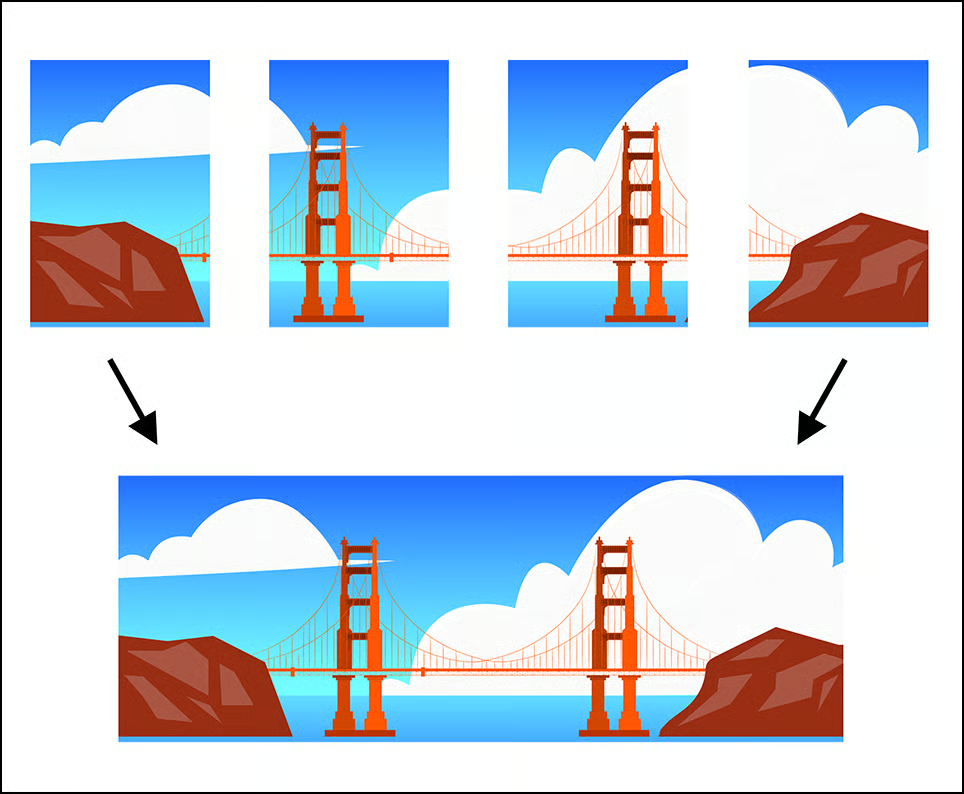
Import your RAWs into Lightroom/Camera Raw first for basic color, chromatic aberration correction, and lens profiles (you can defer lens correction if your stitcher handles it better). Then stitch in PTGui, Hugin, or your preferred tool. Rectilinear ultrawide images need more frames than fisheye but produce straighter lines and more natural interiors. Target ~25–35% overlap. PTGui’s control point editor and optimizer are superb for complex scenes and multi-row sets. After stitching, export as equirectangular TIFF/JPEG for VR platforms or as a high-res flat panorama for print. For a deep-dive into PTGui’s strengths, see this review by Fstoppers at the end of this paragraph. PTGui: best-in-class panorama tool (review)
Cleanup & Enhancement
- Nadir patch: Use PTGui’s Viewpoint correction or export to Photoshop and clone/patch the tripod. AI-based content-aware fill tools work well on patterned floors.
- Color and noise: Match tones between rows; correct any WB drifts; apply luminance noise reduction for ISO 800+ night shots.
- Horizon: Use pitch/yaw/roll controls or the optimizer’s verticals to ensure a level, natural result.
- Output: For VR, export equirectangular 2:1 at 8000–16000 px width depending on target. Keep JPEG quality high (90–100) or TIFF for max fidelity.
For a step-by-step primer on panoramic heads and workflow, this tutorial is a solid reference. Panoramic head setup and use
Useful Tools & Resources
Software
- PTGui panorama stitching
- Hugin (open source)
- Lightroom / Photoshop / Affinity Photo
- AI tools for tripod removal and patching
Hardware
- Panoramic heads: Nodal Ninja, Leofoto, Sunwayfoto
- Carbon fiber tripods and leveling bases
- Wireless remote shutters (Sony RMT-P1BT or app)
- Pole extensions / car mounts with safety tethers
Disclaimer: software/hardware names provided for research; verify details and compatibility on official sites.
For end-to-end DSLR/mirrorless 360 workflows (shoot to stitch), Meta’s guide is pragmatic and current. Using a mirrorless camera to shoot and stitch a 360 photo
Common Mistakes & How to Avoid Them
- Parallax error: Calibrate and lock the entrance pupil; don’t bump the rail mid-shoot.
- Exposure flicker: Manual mode, fixed WB, and consistent aperture. Bracket only with shutter speed.
- Tripod shadows or photographer reflections: Shift your position for the nadir; use masking and patching.
- Ghosting from movement: Shoot a second pass, then mask the clean frames in post.
- Night noise and blur: Use a stable tripod, timer/remote, IBIS off, and keep ISO ≤800 when possible.
- Flare at ultrawide: Avoid direct sun angles; shield the front element when possible and clean frequently.
Field-Proven Scenarios
Indoor Real Estate (Bright Windows)
Set up at 12mm, f/8, ISO 100–200. Shoot 3×6 around + zenith + nadir. Bracket ±2 EV (3–5 frames) to hold window highlights. Lock WB to 4000–5000K depending on interior lights. Watch for mirrors; shoot extra frames to mask yourself out. The A7R IV’s 61MP files carry plenty of detail—avoid ISO rises unless necessary; longer shutters are fine on tripod.
Outdoor Sunset
Use f/8, ISO 100, 1/60–1/200 depending on light. Consider a 5‑frame bracket ±2 EV for sun disk and shadowed foreground. Keep the sun either at a frame edge or shoot extra around it to ensure robust control points. Correct flare later; gentle dehaze and local contrast can enhance the sky without haloing.
Crowded Event
Work at 16mm for slightly narrower FOV to reduce edge stretching on people. Use 1/250 s, f/5.6–f/8, ISO 400–800. Do two passes, timing for gaps. Mask moving subjects between passes in PTGui or Photoshop.
Rooftop / Pole Shot
At 12mm, do 2 rows × 8 around (quick) plus zenith. Shutter at 1/250–1/500 for micro-movements. Use a tether line and avoid high winds. Do not lean over parapets with a pole; safety first.
Frequently Asked Questions
- Can I shoot handheld panoramas with the Sony A7R IV?
Yes for simple flat panoramas, using IBIS and overlapping 40–50%. For 360×180, a tripod with a panoramic head is strongly recommended to avoid parallax errors, especially indoors with close objects.
- Is the Sony FE 12–24mm f/4 G wide enough for a single-row 360?
Not for a full 360×180. At 12mm rectilinear, you’ll typically need at least two rows plus zenith and nadir. A single-row 360 is feasible only with fisheye lenses; the 12–24 is rectilinear.
- Do I need HDR for interiors with bright windows?
Usually yes. Bracket ±2 EV (3–5 frames). The A7R IV has excellent DR, but interiors with strong window light exceed single-shot range. HDR ensures clean window detail and shadow noise control.
- How do I avoid parallax issues with this combo?
Use a calibrated panoramic head. Align the rotation axis to the lens entrance pupil and lock it. Start with the rail roughly 95–110 mm forward of the sensor plane at 12mm, then refine using the two-stick test and mark your rail positions.
- What ISO range is safe on the A7R IV in low light?
For tripod-based panoramas, ISO 100–400 is ideal; use slower shutters instead of higher ISO. If needed, ISO 800–1600 is usable with good noise reduction. Avoid ISO 50 (reduced DR) for HDR-critical scenes.
- Can I set Custom Shooting Modes for pano?
Yes. Save C1 as “Daylight Pano” (M, ISO 100, f/8, 2‑s timer, IBIS off), and C2 as “Interior HDR” (M, f/8, AEB ±2 EV, fixed WB). This speeds up on-site work and consistency.
- How do I reduce flare with this ultra‑wide?
Avoid direct sun at mid‑frame; shade the lens with your hand just outside the frame; keep the front element spotless. If flare appears, shoot an extra clean frame with your hand shading and mask it in post.
- What tripod head is best for this setup?
A two-rail panoramic head (e.g., Nodal Ninja, Leofoto) with fore-aft and lateral adjustments. Add a leveling base to speed setup. For gigapixel at 24mm, a sturdy, indexed rotator helps maintain consistent yaw steps.
Further Learning & Standards
Industry best practices on multi-row panoramas and resolution planning are documented by the PanoTools community. DSLR spherical resolution (PanoTools)
For a clear, practical DSLR/mirrorless 360 overview, this guide is excellent. Set up a panoramic head for high-end 360 photos
Safety, Reliability & Backup Workflow
Always secure your tripod in wind; use a weight or your bag. With the 12–24’s protruding front glass, install the hood cap when moving between locations. On rooftops, use a short lanyard tethered to the tripod and keep a safe distance from edges. For poles and car mounts, add a safety line and never work above crowds or active traffic.
Redundancy: shoot a second full round if the scene permits, especially at sunset or with people. Back up to two cards or copy to a portable SSD immediately after the session. Keep a notes file with nodal positions and row/step info for repeatability.