Why This Camera & Lens Are Great for Panoramas
The Sony A7R IV paired with the Samyang 12mm f/2.8 ED AS NCS Fish-Eye is a powerhouse combo for high-quality 360° panoramas. The A7R IV’s 61MP full-frame sensor (35.7 × 23.8 mm, ~3.76 µm pixel pitch) delivers exceptional detail and flexibility for large equirectangular outputs, while its excellent base-ISO dynamic range (~14+ stops at ISO 100) helps preserve sky highlights and deep shadow detail. The 5-axis IBIS (up to ~5.5 stops) is great handheld, though you should turn it off on a tripod for consistent stitching.
The Samyang 12mm f/2.8 is a full-frame diagonal fisheye lens with approximately 180° diagonal field of view (about 120–125° horizontal, ~95–100° vertical). It’s manual focus—ideal for panoramas where you lock focus at hyperfocal—and it’s sharpest around f/5.6–f/8 with manageable lateral CA. The fisheye projection means you’ll need fewer shots around compared to a rectilinear ultrawide, speeding up capture in changing light or busy environments. On an A7R IV, this translates to fast field work and very high-resolution 360 photos once stitched.
Quick Setup Overview
- Camera: Sony A7R IV — Full-frame, 61MP (9504 × 6336), excellent base-ISO DR, 5-axis IBIS.
- Lens: Samyang 12mm f/2.8 ED AS NCS Fish-Eye — Full-frame diagonal fisheye, manual focus, sharpest at f/5.6–f/8, moderate CA, bulbous front (no standard front filters).
- Estimated shots & overlap:
- Fast 360: 6 around at 60° yaw + 1 zenith + 1 nadir (30–35% overlap).
- Higher-res/safety: 8 around + zenith + nadir (25–30% overlap).
- Difficulty: Moderate (easier than rectilinear ultrawide thanks to fewer shots, but nodal calibration is essential).
Planning & On-Site Preparation
Evaluate Shooting Environment
Assess light direction and range (DR), moving objects (people, trees, vehicles), and reflective surfaces (glass, polished floors, cars). If shooting behind glass, clean it and shoot with the lens as close as possible (without touching) to reduce reflections. Avoid direct sun into the fisheye when possible; even a small flare can spread across the frame. For sunrise/sunset, capture quickly—light changes can cause inconsistent color across frames.
Match Gear to Scene Goals
The A7R IV excels in detail-heavy scenes like cityscapes and interiors. At ISO 100–200 outdoors you’ll get top-tier dynamic range. Indoors, you can comfortably use ISO 200–800 on a tripod; if you must push, ISO 1600–3200 is usable with careful noise reduction, but bracketed HDR is often better. The Samyang fisheye reduces shot count, which minimizes ghosting in scenes with movement (crowds, traffic) but does introduce fisheye distortion—no problem for 360 stitches, but keep straight-line-heavy compositions in mind if planning partial panoramas.
Pre-shoot Checklist
- Charge batteries, clear space on fast cards; bring a second card for redundancy.
- Clean lens and sensor; a smudge on a fisheye shows everywhere.
- Level your tripod; verify your panoramic head is calibrated for this lens.
- Safety: secure straps, use weight/bag on tripod in wind; use a tether on rooftops or when using a pole or car mount.
- Backup: shoot an extra safety round (especially for critical scenes or when people are moving).
Essential Gear & Setup
Core Gear
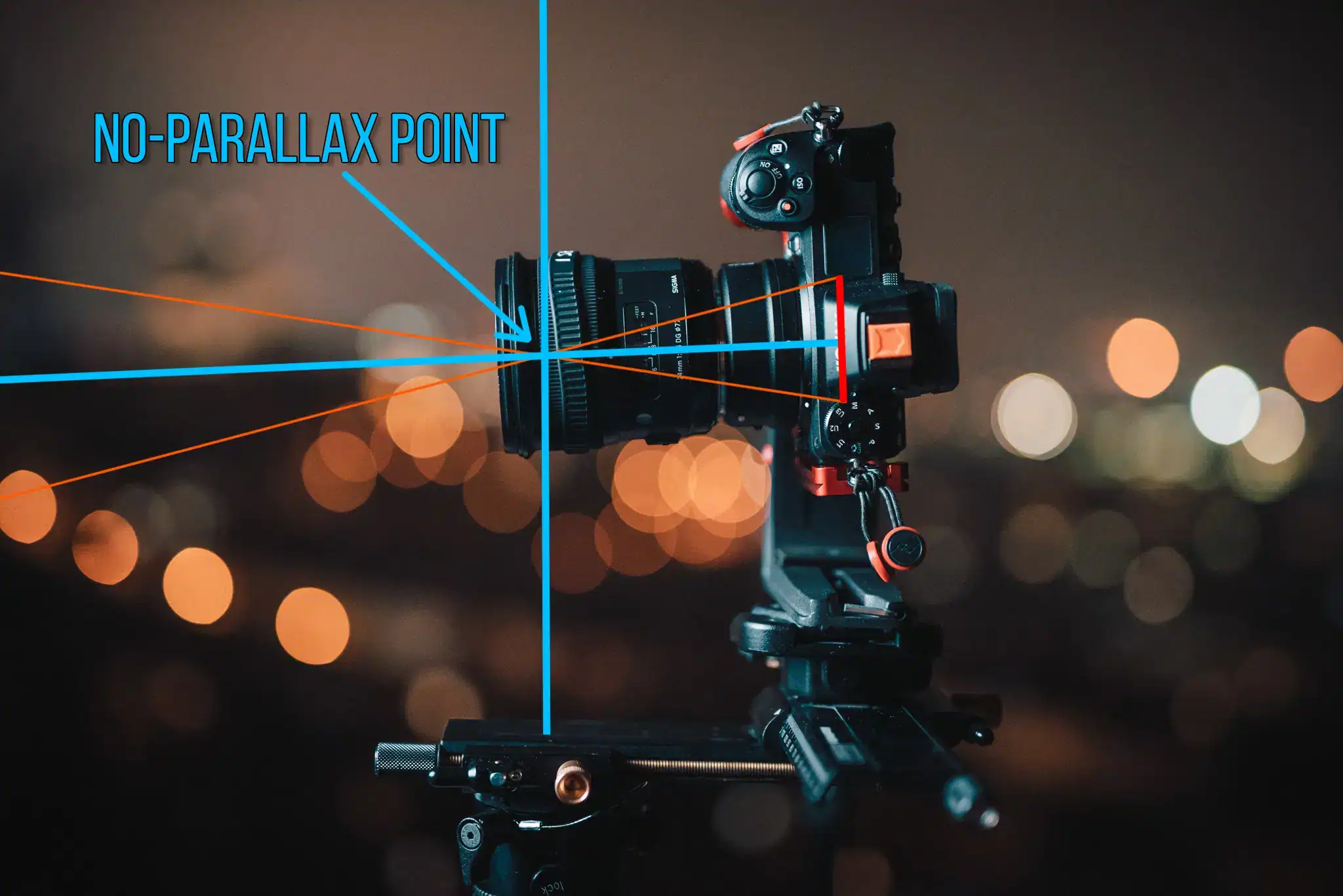
- Panoramic head: Lets you rotate the camera around the lens’s entrance pupil (nodal point) to eliminate parallax between near/far objects—critical for clean stitches.
- Stable tripod with a leveling base: Level once, then pan freely without a drifting horizon.
- Remote trigger or Sony Imaging Edge Mobile app: Prevents shake and keeps pacing consistent between frames.
Optional Add-ons
- Pole or car mount: Great for unique perspectives, but always tether gear. Beware of wind; reduce rotation speed and increase shutter speed to mitigate vibration.
- Lighting aids: Small LED panels can fill dark corners in interiors (keep them consistent across frames).
- Weather protection: A rain cover, microfiber cloths, and silica packs keep the A7R IV and fisheye safe in changing conditions.
Want a deeper primer on panoramic heads and alignment? This panoramic head setup tutorial offers a clear walkthrough of the concepts and hardware choices. Panoramic head tutorial
Step-by-Step Shooting Guide
Standard Static Scenes
- Level the tripod and align the nodal point. Use your panoramic head’s rails to position the lens so the rotation axis passes through the entrance pupil. Practical method: place two vertical objects (one near, one far), rotate the camera; adjust fore-aft on the rail until the near object stays aligned against the far object as you pan. Mark the rail index for this lens (and keep a note on your phone).
- Set manual exposure and lock white balance. Choose an exposure that preserves highlights (especially sky). Use RAW and a fixed WB (Daylight or custom Kelvin) to avoid color shifts across frames.
- Compose your capture plan.
- With the Samyang 12mm: 6 shots around at 60° increments is reliable. Aim for 30–35% overlap.
- Take 1 zenith shot by tilting up ~60–75°. For clean sky, you often need just one.
- Take 1 nadir shot. Option A: shoot in place and patch later. Option B: offset the camera (viewpoint correction in PTGui) for a cleaner tripod removal.
- Focus: Use manual focus near the hyperfocal distance. At f/8 with a 12mm on full frame, hyperfocal is roughly 0.6–0.7 m; at f/5.6 it’s around ~0.9 m. Set focus once and don’t touch it for the entire sequence.
HDR / High Dynamic Range Interiors
- Bracket ±2 EV (3 or 5 frames). For very bright windows, 5 frames (±4 EV) can be safer. Keep shutter speed the only variable—lock aperture and ISO.
- Lock WB and disable auto lighting optimizers. Use a remote to keep timing consistent between brackets, reducing ghosting from moving curtains or people.
Low-Light / Night Scenes
- Use a sturdy tripod and remote. Start around f/4–f/5.6, ISO 400–800, and slow shutters. The A7R IV can handle ISO 1600–3200 if needed, but prioritizing lower ISO yields cleaner skies—expose longer instead, unless wind gusts move the setup.
- Turn off IBIS and any in-camera long exposure NR (shoot RAW; denoise in post for more control).
Crowded Events
- Shoot two passes: a quick baseline and a second slower pass waiting for gaps. If you can, ask people near the tripod to pause briefly.
- Later, mask moving subjects in your stitcher (PTGui’s masking tools make this straightforward).
Special Setups (Pole / Car / Drone)
- Pole: Use a lightweight carbon pole; keep the camera centred and tethered. Use faster shutter speeds (1/200–1/500) to freeze sway; increase ISO if necessary.
- Car mount: Tighten all connections, safety-tether the rig, and shoot in empty areas. Expect vibrations—use higher shutter speeds and consider electronic first-curtain shutter.
- Drone: This lens/body is too heavy for consumer drones; use dedicated aerial pano methods instead.
Recommended Settings & Pro Tips
Exposure & Focus
| Scenario | Aperture | Shutter | ISO | Notes |
|---|---|---|---|---|
| Daylight outdoor | f/8–f/11 | 1/100–1/250 | 100–200 | Lock WB (Daylight); expose to protect highlights |
| Low light/night | f/4–f/5.6 | 1/30–1/60 (longer if wind is calm) | 400–800 | Tripod & remote; consider ISO 1600–3200 only if needed |
| Interior HDR | f/8 | Bracket ±2 EV (3–5 shots) | 100–400 | Balance windows and lamps; tripod essential |
| Action / moving subjects | f/5.6–f/8 | 1/200+ | 400–800 | Freeze motion; do a second pass for clean plates |
Critical Tips
- Manual focus at hyperfocal and tape the focus ring to avoid accidental bumps.
- Nodal calibration: with the Samyang 12mm, expect the fore-aft rail position to be relatively close to the front group compared to longer lenses. Calibrate once, then mark the rail index for repeatability.
- White balance lock: set a fixed Kelvin or Daylight/Tungsten to avoid visible shifts across frames.
- Shoot RAW for maximum DR and color grading flexibility. JPEG-only handicaps shadow recovery.
- IBIS OFF on tripod to prevent micro-shake artifacts during long exposures. Also disable pixel shift multi-shooting for panoramas.
Stitching & Post-Processing
Software Workflow
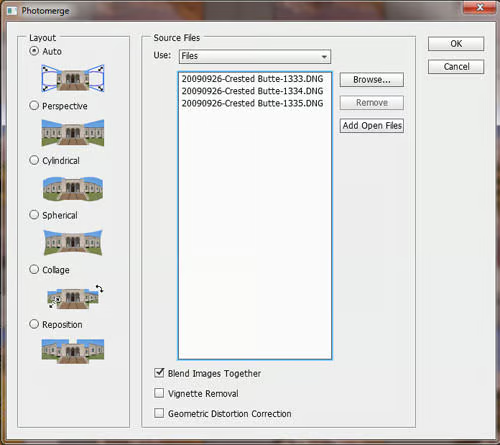
PTGui is a gold standard for 360 pano stitching, and Hugin is a powerful open-source alternative. With a full-frame fisheye, you’ll input fewer shots; let the software recognize the fisheye projection and optimize control points. For PTGui, set Lens Type to “Full-frame fisheye,” 12 mm focal length, and allow Optimize to refine the exact projection. Aim for overlap around 25–35% for reliable control point matching. For output, export an equirectangular image (2:1 aspect ratio) at your target resolution—expect 14k–20k pixel width from 6-around sequences with the A7R IV, depending on overlap and processing choices. For more background on pano stitching tools, this review covers why PTGui remains a pro favorite. PTGui review and features
Cleanup & Enhancement
- Tripod/nadir patch: Use viewpoint correction (PTGui Pro) with an offset nadir shot, or patch with content-aware fill/clone tools. AI-based patchers can speed this up.
- Color consistency: Synchronize white balance and base color grade before stitching, or apply a uniform grade to the final equirectangular.
- Noise reduction: Apply global denoise first, then selective masking on sky/shadows if needed.
- Leveling: Use horizon leveling tools and refine yaw/pitch/roll to avoid a tilted horizon in the viewer.
- Export: Save a high-quality JPEG (quality 10–12) or 16-bit TIFF master. For VR platforms, export standard equirectangular JPEG.
For an authoritative overview of DSLR/mirrorless capture and stitching for VR, see this guide. DSLR/Mirrorless 360 capture & stitching
If you’re new to panoramic head setup for perfect 360s, this step-by-step explainer complements the workflow above. Set up a panoramic head for high-end 360 photos
Useful Tools & Resources
Software
- PTGui panorama stitching (fast and robust for fisheye workflows)
- Hugin open source (free and capable with a learning curve)
- Lightroom / Photoshop (RAW processing, masking, nadir patch)
- AI tripod removal tools (content-aware fill, inpainting)
Hardware
- Panoramic heads (e.g., Nodal Ninja, Leofoto geared rails)
- Carbon fiber tripods with a leveling base
- Wireless remote shutters or smartphone trigger
- Pole extensions / car mounts with safety tethers
Disclaimer: brand names provided for research; check official specs and compatibility for your use case.
Field Scenarios & Case Studies
Indoor Real Estate (Bright Windows)
Set WB to ~4000–5000K, aperture f/8, ISO 100–200, and bracket ±2 EV (5 shots) to cover the bright exterior and interior shadows. Use 6 around + Z + N. Ask occupants to pause momentarily. In PTGui, mask people who moved between brackets. Export a 14–18k equirectangular for crisp details in VR tours.
Outdoor Sunset (High DR, Changing Light)
Work fast: 6 around at 60° and a single zenith. Expose for the highlights (sky), ISO 100–200, f/8, let shutter vary if bracketing (3 shots). Shoot a second safety round because color temperature shifts quickly near sunset. Consider graduated color correction in post to balance sky and ground warmth.
Event Crowds
Use single exposures (no bracketing) at ISO 400–800 and 1/200–1/500 shutter to freeze motion. Do two passes and use PTGui’s masks to keep the cleanest subjects per sector. The fisheye’s reduced shot count minimizes ghosting while preserving coverage.
Rooftop / Pole Shooting
Wind is your enemy. Lower the pole height or use a guy-line to stabilize. Increase shutter speed and consider ISO 800–1600 to stay sharp. Take an extra nadir from a safe offset after lowering the rig to ensure an easy tripod removal.
Common Mistakes & How to Avoid Them
- Parallax error → Always align the entrance pupil; re-check if you change focus or aperture significantly.
- Exposure flicker → Shoot full manual and fixed WB; avoid auto ISO, auto WB, or variable aperture.
- Tripod shadows and footprints → Capture a dedicated nadir and patch it later with viewpoint correction.
- Ghosting from moving subjects → Take multiple passes and mask in post; minimize brackets at busy events.
- High noise at night → Favor longer exposures over high ISO; keep IBIS off on tripod.
- Flare and glare → Shield the lens with your hand (outside the frame) and avoid direct bright light sources in the same sector.
Frequently Asked Questions
- Can I shoot handheld panoramas with the Sony A7R IV?
Yes for partial panos; for full 360° with clean stitches you’ll get better results on a tripod with a panoramic head. Handheld 360s can work in open spaces, but parallax from nearby objects often causes stitching artifacts.
- Is the Samyang 12mm f/2.8 fisheye wide enough for single-row 360?
Yes. On full-frame, 6 shots around plus a zenith and a nadir is reliable. For higher resolution or complex ceilings, use 8 around + Z + N.
- Do I need HDR for interiors with bright windows?
Usually. Bracketing ±2 EV (3–5 frames) captures both interior shadows and bright exteriors, letting you produce a natural result with minimal noise and clipping.
- How do I avoid parallax issues with this combo?
Calibrate the nodal point using two alignment objects and adjust the fore-aft rail until the near object does not shift relative to the far object as you pan. Mark the rail index for the Samyang 12mm and re-use it.
- What ISO range is safe on the A7R IV in low light?
For tripod-based panoramas, ISO 100–400 is ideal; 800 is often fine. If wind or movement forces faster shutter speeds, ISO 1600–3200 can still produce good results with careful denoising.
Further Reading
For deeper dives into DSLR/mirrorless 360 workflows and gear selection, see these expert resources:
Choosing DSLR/mirrorless gear for virtual tours and
Community techniques for 360 panoramas.