Why This Camera & Lens Are Great for Panoramas
If you want to know how to shoot panorama with Sony A7R IV & Olympus 8mm f/1.8 PRO Fisheye, you’re aiming for a powerful combo: a 61MP full-frame body with class-leading dynamic range paired with one of the sharpest fisheyes ever made. There’s one critical note first: the Olympus 8mm f/1.8 PRO is a Micro Four Thirds (MFT) lens and does not natively mount to Sony E-mount. Due to flange distance and electronic aperture control, there is no practical adapter that preserves infinity focus and full functionality on the A7R IV. In practice, you have two paths:
- Use the Olympus 8mm on a Micro Four Thirds body (it delivers a 180° diagonal field of view on MFT), then stitch as usual.
- Replicate the Olympus 8mm PRO’s diagonal fisheye field of view on the Sony A7R IV with a compatible full-frame diagonal fisheye (e.g., Canon EF 8–15mm at 15mm via an EF–E adapter, Samyang/Rokinon 12mm f/2.8 FE, or Sony FE 28mm + fisheye converter). The technique, settings, and shot plans below apply directly.
Why this general fisheye + A7R IV approach works: the A7R IV’s 35.7 × 23.8 mm full-frame sensor and 61MP resolution (pixel pitch ~3.76 µm) resolve fine detail for high-end 360 photos and virtual tours. Its measured dynamic range at base ISO hovers around 14.5 EV, giving you headroom for HDR panoramas with bright windows or sunsets. Fisheye coverage reduces the number of shots needed for a full 360×180 sphere, speeding up capture and minimizing stitching seams. The trade-off is distortion, which is expected and easily handled by modern stitchers like PTGui and Hugin.
Quick Setup Overview
- Camera: Sony A7R IV — Full-frame 35mm sensor (61MP, ~3.76 µm pixel pitch), strong base ISO dynamic range, 5-axis IBIS (turn off on tripod).
- Lens: Olympus 8mm f/1.8 PRO Fisheye — diagonal fisheye designed for Micro Four Thirds; on MFT it’s 180° diagonal FOV, exceptionally sharp, low flare, fast aperture. On Sony A7R IV, use a full-frame diagonal fisheye of equivalent coverage (15–16mm diagonal fisheye) to replicate shot counts and overlap.
- Estimated shots & overlap (field-tested equivalents):
- Diagonal fisheye on full-frame (15–16mm equivalent to Olympus 8mm on MFT): 6 around (60° increments) + 1 zenith + 1 nadir, 25–35% overlap.
- Circular fisheye on full-frame (8mm circular): 3–4 around + zenith + nadir, 30–40% overlap.
- Difficulty: Moderate — fast capture, but requires accurate nodal alignment and exposure control for perfect stitches.
Planning & On-Site Preparation
Evaluate Shooting Environment
Before you set up, scan for moving people, wind, reflective glass, chromed surfaces, and direct light sources that can cause flares. If you must shoot through glass, press the lens hood gently against it and keep the angle close to perpendicular to minimize reflections and ghosting. In bright outdoor scenes, be mindful of the sun relative to the fisheye’s huge FOV; try to position the sun at frame overlaps rather than the center of the frame when possible.
Match Gear to Scene Goals
The A7R IV excels when you need clean detail for prints, VR tours, or gigapixel-level crops. Its base ISO 100 offers maximum DR; ISO 100–400 is ideal for daylight and tripod work. For interiors, ISO 200–800 is a safe range when you can stabilize and bracket; above ISO 1600, noise reduction will become more necessary, though the large sensor still holds up. A diagonal fisheye keeps your shot count low (typically 6 around + Z + N), which is great for time-sensitive captures (events, crowds), while still providing ample resolution once stitched.
Pre-shoot Checklist
- Charge batteries to 100%, carry a spare; ensure fast, high-capacity cards (UHS-II or CFexpress via adapter if used).
- Clean the front element meticulously—fisheyes show everything. Also clean the sensor to avoid cloning dust across a huge field of view.
- Tripod: bring a leveling base; verify panoramic head calibration and lock any play.
- Safety: tether on rooftops and poles; check wind conditions; avoid overhanging public walkways; always secure the camera with a secondary strap/carabiner.
- Backup workflow: shoot a second full round at the end (same settings). If a frame is soft or someone stepped into view, you’ll have a fallback.
Essential Gear & Setup
Core Gear
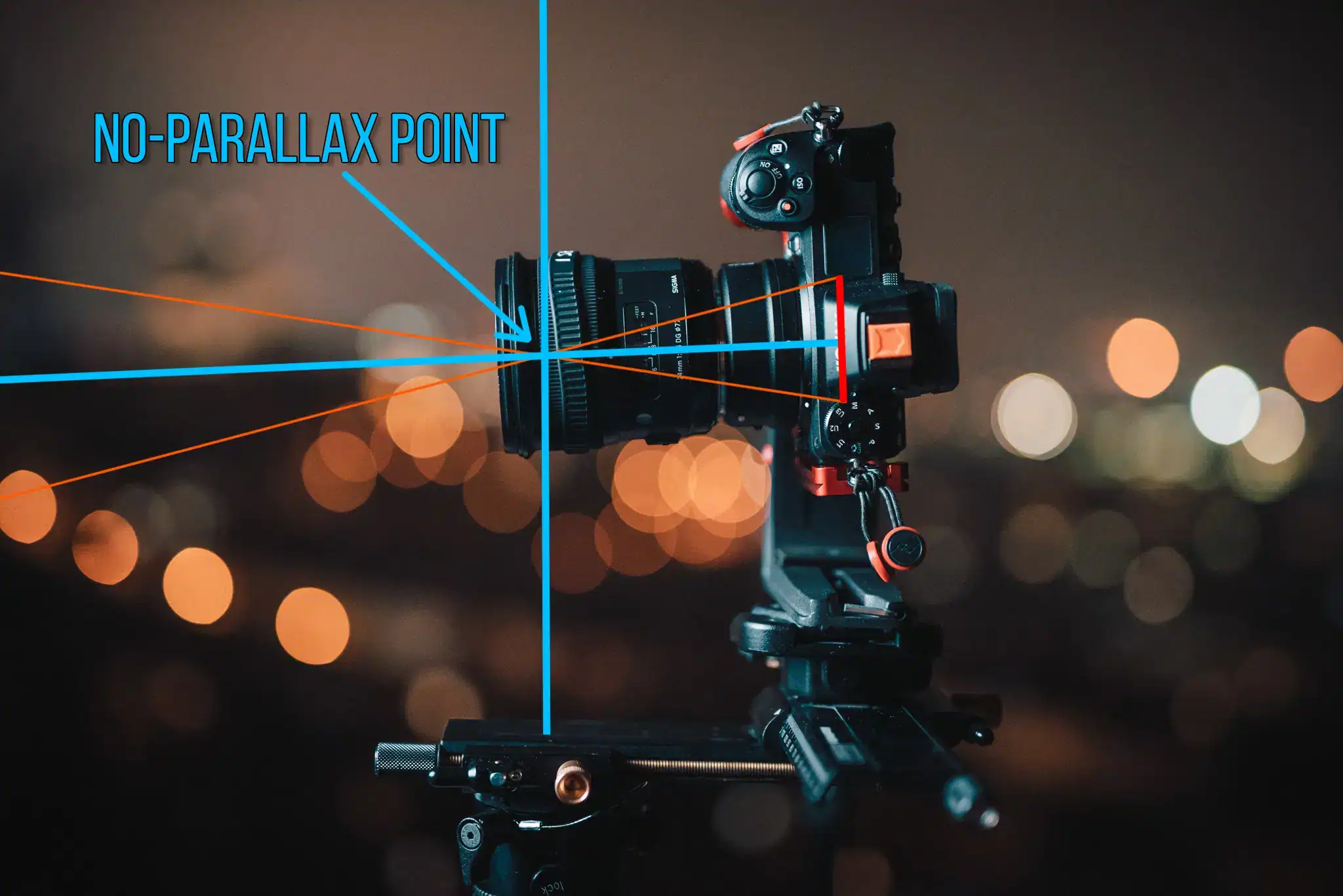
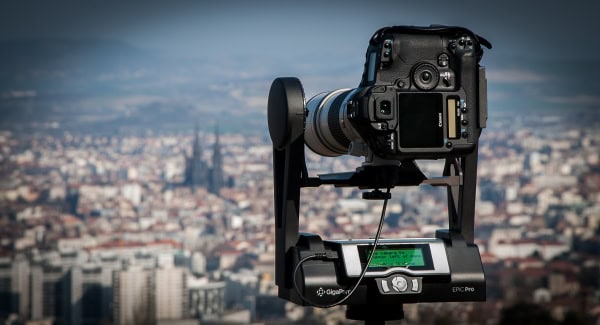
- Panoramic head: Enables rotation around the no-parallax (entrance) pupil, minimizing parallax and simplifying stitching.
- Stable tripod with leveling base: Speed-level the platform so the rotator’s degrees are true, keeping horizon management easy in post.
- Remote trigger or Sony Imaging Edge Mobile app: Fire the shutter without touching the camera to avoid micro-vibration.
Optional Add-ons
- Carbon fiber pole or car mount for elevated or moving-platform panoramas. Always tether and consider wind loads and vibration.
- Compact LED panels or flash bounced off ceilings for low-light interiors (avoid mixed color temps when possible).
- Rain cover/wrap and microfiber cloths for unpredictable weather or seaspray.
Video: Head Setup Walkthrough
Seeing a panoramic head setup visually makes nodal alignment much easier. Watch this concise video to reinforce the steps before you head out:
For a deeper written guide on panoramic heads and alignment techniques, see this panoramic head tutorial. Panoramic head tutorial
Step-by-Step Shooting Guide
Standard Static Scenes
- Level tripod and align the nodal point. On the panoramic head, slide the camera forward/back until near and far objects don’t shift relative to each other when you pan left-right. Mark this position with a paint pen or tape for repeatability with your fisheye.
- Set manual exposure, focus, and white balance. Locking exposure and WB prevents flicker and color casts across frames. Use MF assist magnification to focus once, then switch AF off to prevent refocusing between shots.
- Capture the sequence with consistent overlap. For a diagonal fisheye equivalent (15–16mm on full frame), shoot 6 frames around at 60° increments, then a zenith and a nadir. For a circular fisheye, you can often do 3 or 4 around plus zenith/nadir. Rotate smoothly, keep the horizon centered, and keep your feet out of the frame.
- Take a dedicated nadir (ground) shot. Tilt the camera downward and move the tripod out of the shot (or shoot a handheld nadir from the same entrance-pupil position). This makes tripod removal easy later.
HDR / High Dynamic Range Interiors
- Bracket ±2 EV or use 3–5 frames covering at least a 4–6 EV range. The A7R IV’s dynamic range is excellent, but windows and lamps demand bracketing for clean results.
- Lock white balance (e.g., 3200–4000K for tungsten interiors) to avoid WB shifts across brackets. Verify that AEB plus self-timer or remote triggering is enabled to reduce vibrations.
- Use a consistent sequence (e.g., darkest to brightest) for all nodes to simplify batch processing later.
Low-Light / Night Scenes
- Use base ISO (100–200) with longer exposures if on a solid tripod. If wind or vibration is present, ISO 400–800 is a safe range on the A7R IV; use longer exposures only as stability allows.
- Disable IBIS on the tripod to avoid sensor micro-shifts that can soften long exposures. Use electronic first curtain shutter to minimize shutter shock.
- Consider two full passes: one exposed for highlights (neon signs) and one for shadows, then blend during HDR merging or masking in post.
Crowded Events
- Do a fast first pass prioritizing framing and overlap. Then wait for gaps in foot traffic and re-shoot any frames with subject overlap issues.
- Use the fewest frames possible (fisheye advantage) to reduce moving subject inconsistencies. Later, mask in the best people positions to minimize ghosting.
Special Setups (Pole / Car / Elevated)
- Secure everything with safety tethers. Keep the center of gravity below your hands and keep the camera aligned to the pole axis.
- Rotate slower, use higher shutter speeds (1/250+ if the platform is moving), and consider slight over-lap (35–40%) to help the stitcher handle vibration-induced skew.
Recommended Settings & Pro Tips
Exposure & Focus
| Scenario | Aperture | Shutter | ISO | Notes |
|---|---|---|---|---|
| Daylight outdoor | f/8–f/11 | 1/100–1/250 | 100–200 | Lock WB to Daylight; avoid including the sun dead-center if possible |
| Low light/night | f/4–f/5.6 | 1/30–1/60 (or longer on sturdy tripod) | 400–800 | Remote trigger; IBIS off on tripod; consider multi-pass blend |
| Interior HDR | f/8 | Bracket ±2 EV (3–5 shots) | 100–400 | Lock WB; expose for highlights and fill shadows via HDR |
| Action / moving subjects | f/5.6–f/8 | 1/200+ | 400–800 | Shorten sequence time; mask movement in post |
Critical Tips
- Manual focus near hyperfocal. For a 15–16mm diagonal fisheye on full frame at f/8, hyperfocal is roughly 0.9–1.0 m; set focus just under 1 m for front-to-back sharpness.
- Mark your nodal alignment on the rail once found. A paint dot saves minutes each shoot and keeps parallax under control.
- Lock white balance. Mixed lighting can be graded, but WB shifts between frames add needless pain to stitching.
- Shoot RAW. You’ll want the A7R IV’s full dynamic range, color depth, and lens correction latitude when stitching and grading.
- Turn off stabilization (IBIS) on a tripod. Sensor movement can reduce micro-contrast at longer exposures.
Stitching & Post-Processing
Software Workflow
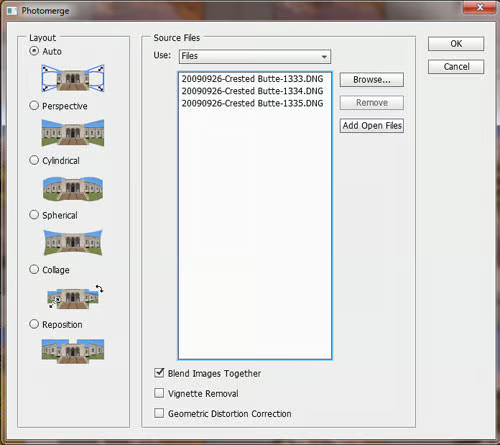
PTGui remains the industry standard for fast, reliable 360 stitching with fisheyes. Hugin is an excellent open-source alternative. Fisheye panoramas typically need fewer images and can be more forgiving if your nodal alignment is close. Use about 25–35% overlap for fisheyes and 20–25% for rectilinear lenses. After importing, set lens type correctly (fisheye vs. rectilinear), check control points, optimize yaw/pitch/roll, and verify horizon leveling in the panorama editor. For a detailed review of PTGui’s strengths and workflow, this article is helpful. PTGui review and workflow insights
Cleanup & Enhancement
- Nadir patch: Use a dedicated nadir shot, then patch via Photoshop or an AI-based tripod removal tool.
- Color correction: Balance mixed light sources, match WB throughout the set, and apply gentle contrast curves.
- Noise reduction: Apply luminance NR sparingly, especially on night/HDR frames, to preserve detail.
- Leveling: Correct roll/yaw/pitch so the horizon is straight; set the panorama’s center where it tells the best story.
- Export: For VR players and web, output an equirectangular 2:1 image (e.g., 12000 × 6000 px JPEG or 16-bit TIFF for mastering).
Meta and delivery: embed XMP for north/alignment if your platform supports it; keep master TIFFs archived. For a compact 360 capture and stitching overview from a VR platform perspective, see this DSLR/mirrorless 360 guide. DSLR/mirrorless 360 capture overview
Useful Tools & Resources
Software
- PTGui panorama stitching
- Hugin (open-source)
- Adobe Lightroom Classic / Photoshop
- AI tripod removal tools (various)
Hardware
- Panoramic heads (Nodal Ninja, Leofoto)
- Carbon fiber tripods with leveling base
- Wireless remotes or Sony Imaging Edge Mobile
- Pole extensions and automotive suction mounts with safety lines
Disclaimer: names provided for search reference; check official sites for specs and compatibility before purchase.
Common Mistakes & How to Avoid Them
- Parallax error: Always align the entrance pupil. Even small misalignments cause stitching struggles with near objects.
- Exposure flicker: Manual exposure and fixed WB across the entire set are mandatory.
- Tripod in frame: Plan a nadir shot or patch later. Keep feet and straps out of the FOV.
- Ghosting from movement: Time your shots between people or vehicles; shoot a backup pass and mask later.
- Noise at night: Favor lower ISO and longer exposures on a stable tripod; bracket instead of pushing ISO too high.
Real-World Scenarios & Tips
Indoor Real Estate
Use ISO 100–200, f/8, and 3–5 bracketed exposures at ±2 EV to retain window detail and reduce halos. Keep lights consistent; turn off mixed color temperature sources if possible. A diagonal fisheye minimizes the number of shots per room, limiting chances of people walking through frames.
Outdoor Sunset
Meter for the sky highlights at ISO 100–200, bracket for shadows, and shoot quickly as light changes fast. Consider two complete rounds 2–3 minutes apart to choose the best sky later. Keep the sun near the edge of the frame during capture to reduce flare; the Olympus 8mm PRO’s coatings are excellent if you’re using MFT, and quality full-frame fisheyes with modern coatings behave similarly.
Crowded Events
A fisheye’s fewer frames dramatically reduce inconsistencies. Shoot 6-around (or 4-around circular) rapidly, then wait for a lull and re-shoot any trouble frames. PTGui’s masking tools make blending easy, but clean source frames save time.
Rooftop or Pole
Inspect wind, tether the camera, and use higher shutter speeds (1/200–1/500) with slightly elevated ISO if needed. Rotate slower, and consider shooting an extra overlap (e.g., 7-around instead of 6-around) to give the stitcher redundancy. Always prioritize safety over getting the shot.
Compatibility Note: Olympus 8mm PRO on A7R IV
There is no practical adapter that maintains full functionality or infinity focus for the Olympus 8mm f/1.8 PRO (Micro Four Thirds) on the Sony A7R IV (E-mount full-frame). To achieve identical coverage on the A7R IV, use a full-frame diagonal fisheye at 15–16mm or a circular fisheye around 8mm depending on your capture strategy. The techniques in this guide remain directly applicable—the stitcher only needs the correct lens model set (fisheye projection) and good overlap.
For an overview of DSLR/mirrorless 360 capture best practices, including lens choices and workflow, this resource is a good starting point. Camera and lens choices for virtual tours
Safety & Gear Protection
- Always secure gear with a secondary tether when working at height or over crowds.
- Check every clamp and knob on the panoramic head; a fisheye sees everything—dangling straps can enter the frame or cause vibration.
- Wind management: lower the center column, hang a weight from the tripod, and shield the setup with your body if necessary.
- Carry a microfiber cloth; fisheye front elements are magnets for fingerprints and raindrops.
Frequently Asked Questions
- Can I shoot handheld panoramas with the Sony A7R IV?
Yes, for quick single-row panos outdoors. For full 360×180, you’ll get better results on a tripod with a panoramic head. Handheld introduces parallax errors and inconsistent overlap that complicate stitching, especially with nearby objects.
- Is the Olympus 8mm f/1.8 PRO wide enough for single-row 360?
On its native MFT bodies, it’s a diagonal fisheye with 180° diagonal FOV. For a full sphere, plan 6-around + zenith + nadir. To replicate that on the A7R IV, use a 15–16mm diagonal fisheye and follow the same shot plan.
- Do I need HDR for interiors with bright windows?
Usually, yes. Bracket ±2 EV (3–5 frames) to retain clean window detail and natural interiors. The A7R IV’s DR helps, but HDR keeps noise low and highlights intact.
- How do I avoid parallax issues?
Align rotation around the entrance pupil using a panoramic head. Slide the camera along the rail until near/far objects don’t shift when panning. Mark the rail once found.
- What ISO range is safe on the A7R IV for low light?
ISO 100–400 is ideal on a tripod; ISO 800 is still clean with good exposure. If you must go higher (1600–3200), expose to the right and plan on careful noise reduction.
Final Thoughts
Learning how to shoot panorama with Sony A7R IV & Olympus 8mm f/1.8 PRO Fisheye is mostly about embracing the fisheye workflow—few frames, precise nodal alignment, and consistent exposure. While the Olympus 8mm doesn’t mount natively to the A7R IV, using a full-frame diagonal fisheye of equivalent coverage will give you the same practical advantages and shot counts. Combine careful capture with a reliable stitcher and sensible HDR, and the A7R IV’s 61MP sensor will deliver crisp, immersive 360 imagery suitable for high-end VR tours and large prints.