Why This Camera & Lens Are Great for Panoramas
If you’re wondering how to shoot panorama with Sony A7R IV & Nikon Z 20mm f/1.8 S, you’re aiming for a high-resolution, low-distortion workflow with excellent dynamic range. There is an important compatibility note: Nikon’s Z-mount lenses cannot be mounted on Sony E-mount cameras with a simple mechanical adapter due to flange distance constraints. In practice, you should either (A) use the Sony A7R IV with a comparable 20mm rectilinear prime such as the Sony FE 20mm f/1.8 G, or (B) use the Nikon Z 20mm f/1.8 S on a Nikon Z body. The guidance below focuses on the A7R IV body with a 20mm rectilinear lens—technique and shot counts remain valid whether that 20mm is Sony’s FE 20/1.8 G or the Nikon Z 20/1.8 S on a Z body.
Why this combo is strong: the Sony A7R IV’s 61MP full-frame BSI sensor (approx. 9504 × 6336; pixel pitch ~3.76 µm) captures tremendous detail and offers roughly 14.5 EV of dynamic range at base ISO—excellent for stitching clean 360 photos with generous overlap. A high-resolution body means fewer pano tiles can still yield print-ready or VR-ready results. A 20mm f/1.8 rectilinear prime provides a natural perspective with minimal mustache distortion, high corner sharpness by f/5.6–f/8, and low coma—great for architecture and night skies. Rectilinear lenses do require more shots than fisheyes, but stitching quality and straight lines are often better with careful overlap.
Autofocus and manual controls on the A7R IV are precise, and shooting in manual exposure with locked white balance is straightforward. The body’s IBIS helps handheld capture but should be turned off on a tripod. In short: a 20mm rectilinear + a 61MP full-frame sensor is a proven, flexible pairing for multi-row 360 panoramas, real estate VR, and ultra-detailed gigapixel-style sweeps.
Quick Setup Overview
- Camera: Sony A7R IV — Full-frame 35.7 × 23.8 mm, 61MP, ~14.5 EV DR at ISO 100, excellent base ISO color depth.
- Lens: Nikon Z 20mm f/1.8 S (rectilinear prime) — sharp by f/4–f/5.6, low CA, minimal coma; use an equivalent Sony FE 20mm f/1.8 G on A7R IV due to mount incompatibility.
- Estimated shots & overlap (full 360×180):
- Three-row method (recommended for 20mm): 8 around at +60°, 8 around at 0°, 8 around at −60° = 24 tiles, plus 1–2 nadir safety frames. ~30–40% overlap.
- Compact method: 6 around at +60°, 6 around at 0°, 6 around at −60° = 18 tiles + 1–2 nadir. ~25–30% overlap (use only with precise nodal alignment).
- Difficulty: Intermediate — requires nodal calibration and careful overlap control.
Planning & On-Site Preparation
Evaluate Shooting Environment
Check light direction and intensity (harsh sun can boost flare), reflective surfaces (glass, polished stone), and moving elements (people, cars, trees). If shooting through glass, get as close as possible—ideally within a few centimeters—to minimize reflections and ghosting. Use a rubber lens hood or cloth to flag stray light. For night scenes, scout tripod placement to avoid vibrations from foot traffic or wind gusts.
Match Gear to Scene Goals
The A7R IV’s 61MP sensor handles daylight and interior HDR well, with base ISO files offering rich shadow recovery. Safe ISO ranges for critical work are ISO 100–400; ISO 800–1600 is fine when you need shutter speed at night. A 20mm rectilinear lens keeps straight lines straight—ideal for architecture and real estate. Compared to a fisheye (fewer frames but more distortion), 20mm will require more tiles but gives cleaner edges and easier vertical corrections.
Pre-shoot Checklist
- Charge batteries, format cards, clean front and rear elements, inspect sensor.
- Level tripod; verify panoramic head is tight and calibrated to the no-parallax point.
- Safety: weigh down tripod or use spikes in wind; tether gear on rooftops or over railings; check vehicle mounts for torque and redundancy.
- Backup workflow: shoot an extra full pass after your main set. If people move, capture a second pass for easier masking.
Essential Gear & Setup
Core Gear
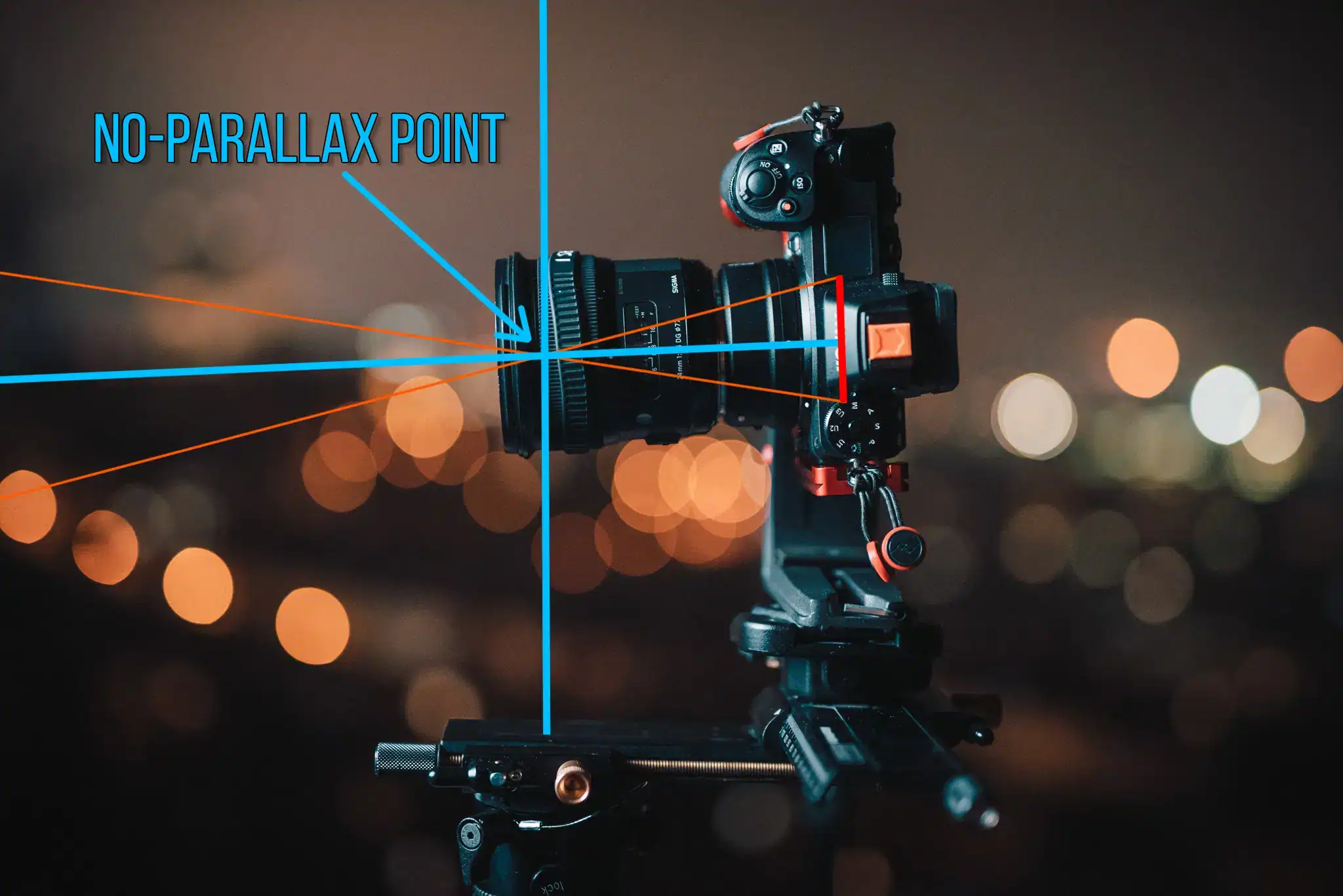
- Panoramic head with rail adjustments: Aligning the lens to the entrance pupil (often called the nodal point) prevents parallax when rotating. This is critical for stitching clean 360 photos with nearby objects.
- Stable tripod with leveling base: A bowl-leveler speeds up setup and keeps yaw rotation truly level to the horizon.
- Remote trigger or app control: Use a cable release or the Sony Imaging Edge Mobile app for vibration-free shots.
Optional Add-ons
- Pole or car mount: Use guy-lines or tethers; beware wind loads. Avoid high speeds or gusts that can induce rolling vibration.
- Lighting aids: Small LED panels to lift shadow corners in interiors; keep color temperature matched and lock white balance.
- Weather protection: Rain covers, silica packs, and a microfiber towel for drizzle or sea spray.
Step-by-Step Shooting Guide
Standard Static Scenes
- Level and align: Level the tripod using a leveling base. On the pano head, slide the camera so rotation happens around the lens’s entrance pupil. Test by aligning a near vertical object against a distant background—rotate 20–30° left/right. If relative positions shift, adjust fore-aft until parallax disappears.
- Manual exposure and white balance: Set manual exposure for the brightest area you must retain detail in, typically protecting windows or sky highlights. Lock white balance (e.g., Daylight/Cloudy/Kelvin) to avoid shifts between frames.
- Capture sequence with consistent overlap: With a 20mm rectilinear on full frame, shoot 8 frames around at +60°, 8 at 0°, and 8 at −60° (24 frames total). Aim for ~30–40% overlap. Rotate in equal increments—most pano heads have click-stops.
- Take the nadir: Tilt down to −90° for a dedicated ground frame. You may shoot 2–3 slight offsets for easier tripod removal later.
HDR / High Dynamic Range Interiors
- Bracket ±2 EV: Use 3 or 5 frames per angle depending on contrast. The A7R IV supports extensive AEB—3–5 frames at 2 EV usually covers window-to-shadow differences.
- Lock WB and focus: Keep white balance fixed and use manual focus to avoid shifts across brackets. Shoot all brackets at each angle before rotating.
Low-Light / Night Scenes
- Use a tripod and remote: Turn off IBIS on the tripod to prevent micro-jitter. Start at f/4–f/5.6, ISO 400–800, and shutter 1/10–2 s as needed. For starry skies, consider 15–20 s at ISO 1600–3200 if your pano head is rock solid (watch for star trailing across rows).
- Check flare and ghosting: Shield the lens from point light sources with your hand or a flag. Avoid placing bright streetlights on the edge of the frame.
Crowded Events
- Two-pass strategy: First pass for composition; second pass while waiting for moving people to shift. This gives you clean tiles to mask in post.
- Faster shutter: Use 1/200–1/500 with ISO 800–1600 to freeze motion. Expect some ghosting but plan to mask it out.
Special Setups (Pole / Car / Drone)
- Pole work: Keep rotations slow to minimize flex. Use a safety tether. If using a long pole, reduce to 6 around × 3 rows to shorten time in the air.
- Car mounts: Use high-strength suction cups plus a secondary tether. Avoid highways; shoot in controlled environments at very low speed to minimize vibration.
Recommended Settings & Pro Tips
Exposure & Focus
| Scenario | Aperture | Shutter | ISO | Notes |
|---|---|---|---|---|
| Daylight outdoor | f/8–f/11 | 1/100–1/250 | 100–200 | Lock WB (Daylight). Avoid f/16+ to limit diffraction on 3.76 µm pixels. |
| Low light/night | f/4–f/5.6 | 1/10–1/60 | 400–800 | Turn off IBIS on tripod. Use remote trigger; consider ETTR for cleaner shadows. |
| Interior HDR | f/8 | Bracket ±2 EV | 100–400 | Keep all brackets consistent; don’t change aperture between rows. |
| Action / moving subjects | f/5.6–f/8 | 1/200+ | 400–800 | Short shutter reduces subject displacement between tiles. |
Critical Tips
- Manual focus at hyperfocal: At 20mm and f/8 on full frame, focus around 2 m to keep near-to-infinity sharp. Use magnified live view to confirm.
- Nodal alignment: Mark your rail position once calibrated for this body + 20mm. The entrance pupil for a 20mm rectilinear typically sits a little behind the front element—fine-tune with the near/far alignment test.
- White balance lock: Mixed lighting? Set Kelvin (e.g., 4000–4500K for cool interiors) to avoid frame-to-frame shifts.
- RAW over JPEG: RAW maximizes dynamic range, highlight rolloff, and color flexibility—important when blending HDR brackets and matching seams.
- IBIS off on tripod: The A7R IV’s stabilization can introduce blur on a locked mount. Disable it for static pano sequences.
Field Case Studies
Indoor Real Estate (Mixed Light)
Use 3-row coverage for ceilings and floors: 8 around per row at +60°/0°/−60°, HDR 3–5 shots at ±2 EV. Aperture f/8, ISO 100–200, shutter floats based on bracket. Lock WB at 4000–5000K or use a custom value. Keep the camera exactly centered in doorways to minimize stitching stress on door frames.
Outdoor Sunset Landscape
Dynamic range is high—meter to protect the sky, then shoot a 3-frame bracket if needed. Use f/8, ISO 100, 8 around per row × 3 rows. If the sun is in frame, shoot a second set with your hand blocking flare in adjacent frames for better masking later.
Event with Crowds
Go faster: 6 around per row × 3 rows. Use 1/250, f/5.6–f/8, ISO 800–1600. Capture two full passes—one for scene, one for clean areas. In post, mask moving people using the cleaner pass tiles.
Rooftop/Pole Shooting
Shorten the sequence to 6×3 rows to reduce wind exposure. Use a safety tether. Keep shutter 1/125+ to counter micro-movements. Avoid leaning over ledges—extend the pole inboard and keep your center of gravity safe.
Stitching & Post-Processing
Software Workflow
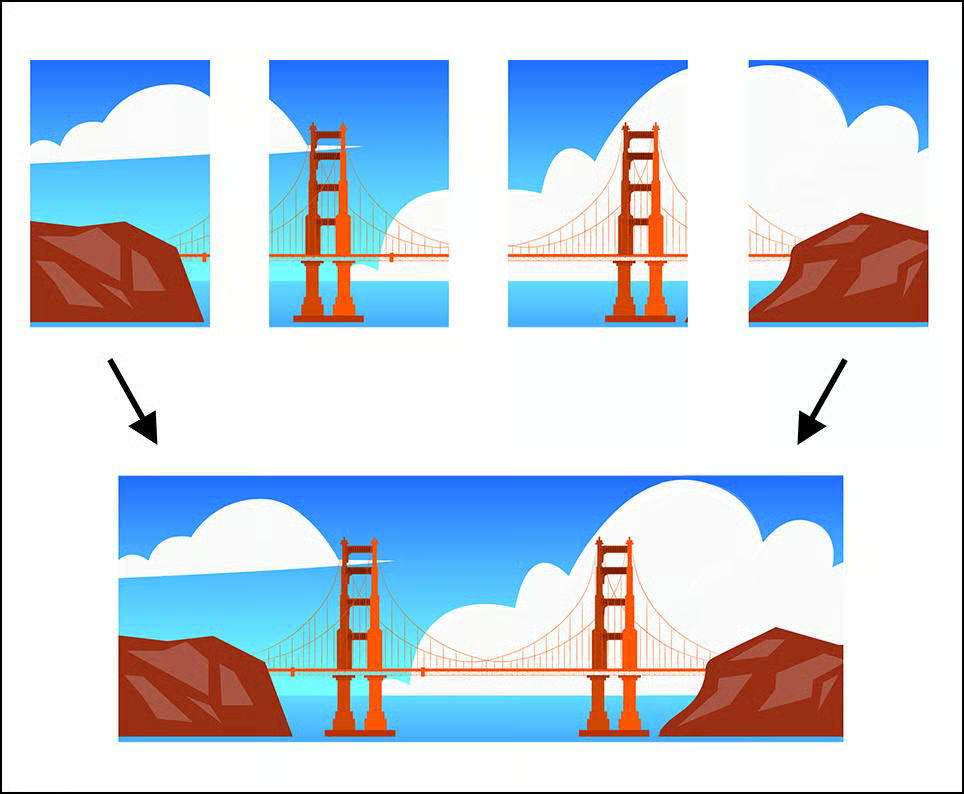
Import RAWs into Lightroom or Capture One for basic corrections (lens profile off is often best for pano software). Export 16-bit TIFFs if you want maximum fidelity. Stitch in PTGui or Hugin. For rectilinear 20mm sets, use ~25–30% overlap and enable “optimize lens parameters” only after you’ve set control points—avoid overfitting. Fisheyes typically need fewer shots but require defishing; rectilinear sets take more frames but reduce edge distortion, especially on architecture. PTGui is a gold standard for speed, HDR merging, and masking control. See an in-depth review of PTGui’s strengths at the end of this section. PTGui review: why it’s favored for complex panoramas.
Cleanup & Enhancement
- Nadir patch: Export a layered file and use PTGui’s Viewpoint correction or patch with AI tools in Photoshop. A dedicated nadir shot makes removal clean.
- Match color and noise: Balance exposure across rows, apply modest noise reduction for ISO 800+ frames, and match WB if anything drifted.
- Level horizon: Use the optimizer to set the verticals and horizon perfectly flat; correct roll/yaw/pitch before exporting.
- Export formats: For VR, export 2:1 equirectangular JPEG (8k–12k wide) or 16-bit TIFF for archival/gigapixel work. Check your host platform’s max resolution.
For a structured tutorial on setting up panoramic heads and technique fundamentals, these resources are worth bookmarking: Panoramic head setup best practices. If you plan to publish to a VR platform, consider the official guidelines here: Using a DSLR/mirrorless to shoot and stitch a 360 photo.
Video: Multi-row 360 Panorama Workflow
Prefer a visual walkthrough? This video provides a solid end-to-end overview from capture to stitch.
Useful Tools & Resources
Software
- PTGui panorama stitching (fast, robust control points, HDR support)
- Hugin (open-source alternative with powerful optimizers)
- Lightroom / Photoshop (RAW development, masking, nadir patch)
- AI tripod removal tools (Content-Aware Fill, generative AI for clean floors)
Hardware
- Panoramic heads: Nodal Ninja, Leofoto, Sunwayfoto (with fore-aft rails)
- Carbon fiber tripods with a 75mm bowl + leveling base
- Wireless remote shutters or mobile app control
- Pole extensions / car mounts with safety tethers
Disclaimer: brand names are for research reference; check official sites for specs and compatibility.
Common Mistakes & How to Avoid Them
- Parallax error: Always align to the entrance pupil. Even a few millimeters off can cause stitching errors with near objects.
- Exposure flicker: Manual exposure and locked white balance prevent visible seams.
- Tripod shadows and footprints: Plan a clean nadir shot or patch later with Viewpoint correction.
- Ghosting from movement: Shoot a second pass and mask clean areas in post.
- Night noise: Use base ISO when possible and longer shutter with a stable mount. Avoid pushing ISO too high unless necessary.
Frequently Asked Questions
- Can I actually mount the Nikon Z 20mm f/1.8 S on a Sony A7R IV?
Not natively. Z-mount to E-mount isn’t feasible with a simple adapter. Use a Sony FE 20mm f/1.8 G on the A7R IV, or use the Nikon Z 20mm on a Nikon Z body. The techniques and shot counts in this guide remain valid for any 20mm rectilinear on full frame.
- Is 20mm wide enough for a single-row 360?
No. A single row at 20mm will leave large gaps at the zenith and nadir. Use at least three rows (e.g., +60°, 0°, −60°), 6–8 shots per row, plus nadir coverage.
- Do I need HDR for interiors with bright windows?
Usually yes. Bracket ±2 EV (3–5 frames) to preserve view-through highlights and interior shadows. Merge HDR per angle before stitching, or let PTGui handle exposure fusion.
- What ISO range is safe on the A7R IV in low light?
For critical work, ISO 100–400. Night panoramas are still very usable at ISO 800–1600 with careful noise reduction. Favor longer shutter on a solid tripod rather than pushing ISO.
- How do I avoid parallax problems with a 20mm lens?
Use a panoramic head and align the entrance pupil. Perform the near/far alignment test and mark the correct rail position. Recheck if you change plates or filters.
Safety, Limitations, and Trustworthy Handling
High places, poles, and car mounts add risk. Always use a tether, weigh down the tripod, and avoid overhanging edges. In wind, shorten your sequence or lower your pole. Don’t rely solely on IBIS; turn it off on a tripod. Back up your files to dual cards (if available) or a portable SSD in the field. Finally, remember the mount limitation: the Nikon Z 20mm f/1.8 S will not natively fit the Sony A7R IV—use the FE 20mm f/1.8 G instead for the same field of view and performance class.
If you’d like to go deeper into pano technique fundamentals and lens/body selection for virtual tours, this independent guide is a solid reference: DSLR/mirrorless virtual tour FAQ and lens guide.