Why This Camera & Lens Are Great for Panoramas
The Sony A7R IV is a high-resolution, full-frame mirrorless body with a 61MP BSI CMOS sensor (35.7 × 23.8 mm) and ~3.76 µm pixel pitch. It delivers outstanding detail, class-leading dynamic range at base ISO (about 14–15 EV), and 5-axis in-body image stabilization (IBIS). These traits are perfect for panoramic and 360° work because you benefit from clean shadows, flexible exposure latitude for HDR, and the resolving power to produce huge equirectangular outputs for VR or large prints.
The Fujifilm XF 10–24mm f/4 OIS WR is a rectilinear ultra-wide zoom designed for APS-C Fujifilm X-mount. It offers a constant f/4 aperture, weather resistance, optical stabilization, controlled chromatic aberration, and strong edge-to-edge sharpness when stopped down (sweet spots around f/5.6–f/8). At 10mm on APS-C, it roughly matches a 15mm full-frame field of view—ideal for multi-row spherical panoramas with manageable distortion.
Important compatibility note: The XF 10–24mm f/4 OIS WR is not natively compatible with Sony E-mount. There is no practical adapter that maintains infinity focus from Fuji X to Sony E due to flange distance differences. If your goal is to shoot panoramas on an A7R IV, use an equivalent rectilinear zoom (e.g., Sony FE 12–24mm f/4 G or FE 16–35mm) and apply the exact techniques below. If you own the XF 10–24mm, pair it with a Fujifilm X body (e.g., X-T5/X-H2); the shooting workflow is the same—only the field of view and shot counts vary slightly.
Quick Setup Overview
- Camera: Sony A7R IV — Full-frame 61MP, ~3.76 µm pixels, excellent DR and IBIS; best results ISO 100–800 for panoramas.
- Lens: Fujifilm XF 10–24mm f/4 OIS WR — Rectilinear ultra-wide zoom for APS-C; strong corners at f/8, mild barrel distortion at 10mm, OIS useful off-tripod.
- Estimated shots & overlap (assuming 15mm FF equivalent FoV):
– Spherical 360°: two-row method: 10–12 shots around at 0° pitch + 10–12 at +45°, plus zenith & nadir (total ~22–26 frames).
– Three-row high-detail: 12 around at -30°, 12 at +30°, 8 at +75°, plus nadir (total ~33–35 frames).
– Cylindrical (no full sphere): 12–16 around at 0°. - Difficulty: Intermediate (precise nodal alignment and consistent exposure are required).
Planning & On-Site Preparation
Evaluate Shooting Environment
Start by reading the light and the scene dynamics. Check for strong backlight (sun, windows), reflective surfaces (glass, glossy floors), and moving elements (people, cars, trees in wind). If shooting through glass, keep the front element close (1–3 cm) to minimize reflections and flare, and use a rubber lens hood to seal against the glass. Observe wind conditions, especially if you plan to use a pole or shoot from rooftops where vibration is amplified.
Match Gear to Scene Goals
The A7R IV excels in dynamic range and fine detail. Keep ISO at 100–400 outdoors and 100–800 indoors for the cleanest files; ISO 1600–3200 is usable with careful noise reduction on static tripod shots. The XF 10–24mm (or an equivalent FE ultra-wide) is a rectilinear lens, so you’ll need more frames than a fisheye but will get straighter lines and more natural architecture. This is ideal for real estate, interiors, and any scene with critical geometry.
Pre-shoot Checklist
- Charge batteries and bring spares; use fast, redundant storage (dual cards if possible).
- Clean lens and sensor. Dust can multiply across frames.
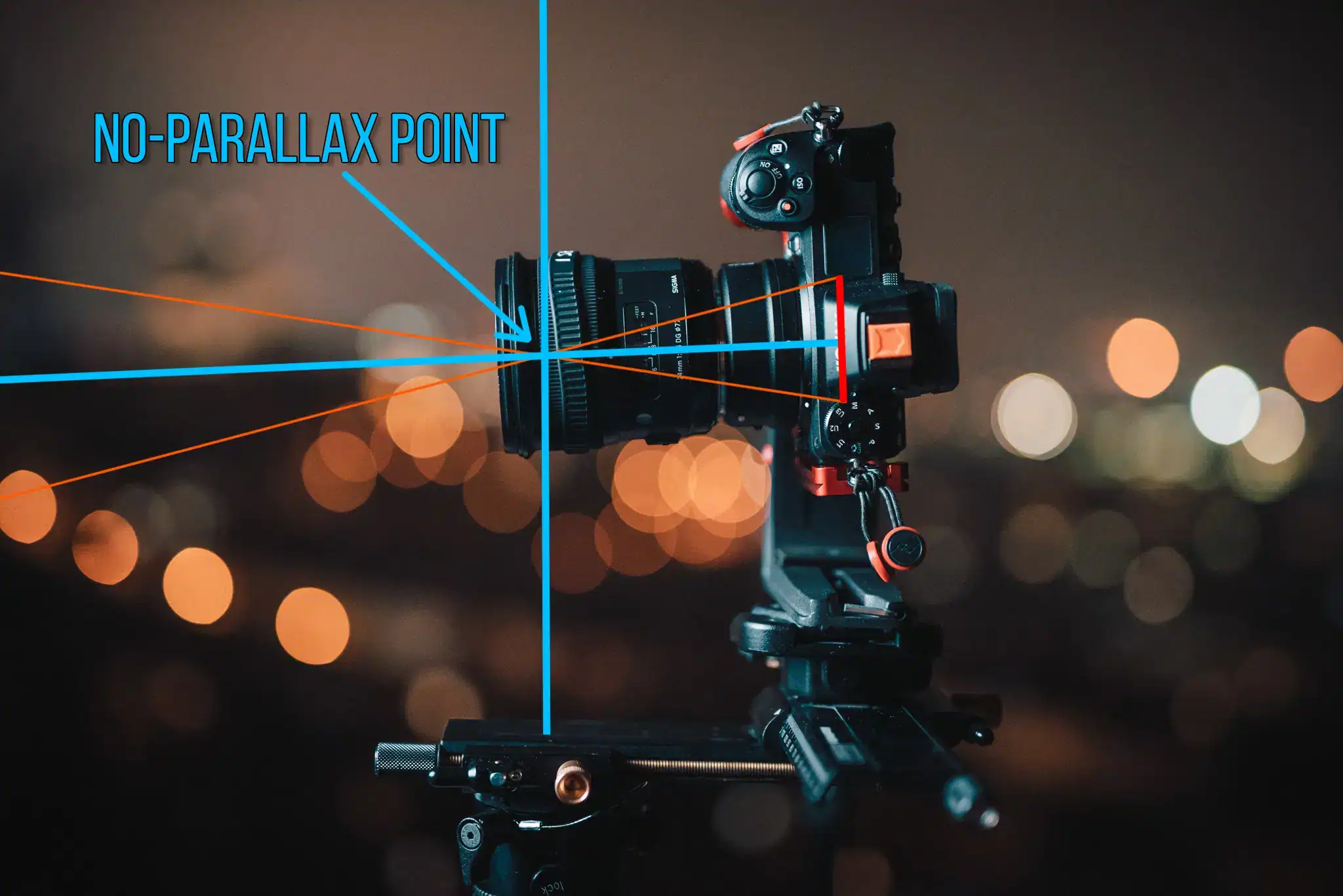
- Level the tripod; calibrate your panoramic head to the lens’s no-parallax point.
- Safety checks: secure straps and tethers; watch wind loads on rooftops or poles; inspect car mounts for vibration points.
- Backup workflow: after the main sequence, shoot a second safety round—same settings—to cover any stitching gaps or motion artifacts.
Essential Gear & Setup
Core Gear
- Panoramic head: Lets you rotate precisely around the lens’s no-parallax (entrance pupil) point. This eliminates parallax errors that cause stitching seams—critical for interiors with nearby objects.
- Stable tripod with a leveling base: Level the base once, then your yaw increments remain consistent across rows.
- Remote trigger or app: Fire the shutter without touching the camera to avoid micro-blur. Sony Imaging Edge Mobile works well for remote release and quick review.
Optional Add-ons
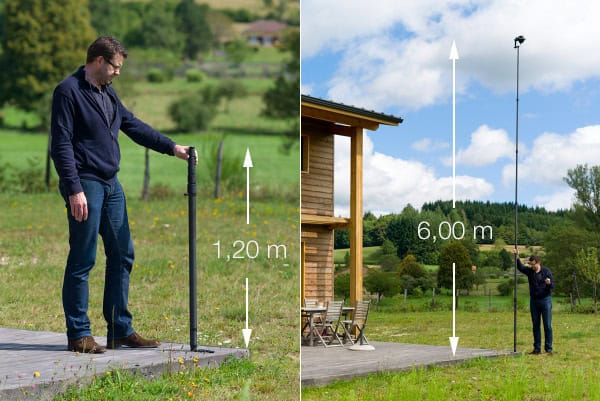
- Pole or car mount: Great for vantage points above crowds or vehicle-mounted captures. Use a safety tether and monitor wind; reduce shutter speed risks by shooting bursts and slightly faster shutter times.
- Lighting aids for low-light interiors: Small LED panels to fill dark corners between HDR brackets.
- Weather protection: Rain covers, silica gel, and gaffer tape for sealing moving parts in dusty or salty environments.
New to pano heads? A clear panoramic head setup primer will speed you up and prevent common alignment mistakes. See this panoramic head tutorial for fundamentals at the end of this section. Panoramic head tutorial
Step-by-Step Shooting Guide
Standard Static Scenes
- Level tripod and align nodal point: With your pano head, slide the camera forward/back until near/far objects do not shift relative to each other when you yaw the head. Mark this position on your rail for 10mm, 12mm, etc.
- Manual exposure and locked white balance: Set M mode. Meter midtones and protect highlights. Lock WB (Daylight for sun, Tungsten for incandescent, custom for mixed light). This prevents exposure and color shifts that cause stitching bands.
- Capture with overlap: For 15mm FF equivalent (10mm APS-C), shoot two rows:
– Row 1 (0° pitch): 10–12 shots around with 25–30% overlap.
– Row 2 (+45° pitch): 10–12 shots around, offset yaw by half a click from the first row to stagger seams.
– Add a zenith shot (~+90°) and a nadir shot (~-90°) if the head allows.
If using a wider lens (e.g., FE 12mm), 8–10 around per row is often enough. - Take a dedicated nadir: If your head cannot shoot zenith/nadir cleanly, take a handheld nadir after lifting the tripod slightly out of frame. Capture multiple nadirs to give yourself options for patching.
HDR / High Dynamic Range Interiors
- Bracket ±2 EV (3–5 frames): Windows and bright fixtures will likely clip without HDR. Keep the entire panorama on the same bracketing pattern and interval.
- Lock WB across brackets and frames: Consistency is more important than “perfect” color on capture—correct globally later.
- Shoot from darkest shadow: If people are moving, capture the shadows-first bracket set quickly, then work toward highlights so you preserve motion where it matters most.
Low-Light / Night Scenes
- Use longer exposures with a solid tripod: f/4–f/5.6 at 10–30 s and ISO 100–400 will be cleaner than pushing ISO. The A7R IV handles ISO 800–1600 if needed, but watch shadow noise.
- Disable IBIS/OIS on tripod: Both the A7R IV IBIS and the lens OIS can introduce micro-jitter on a locked-down rig. Re-enable stabilization for pole or vehicle mounting.
- Use a remote/app and a 2 s self-timer as a failsafe to kill vibrations.
Crowded Events
- Two-pass method: Pass A for complete coverage, Pass B for clean plates when people move out of key areas. In post, mask in low-traffic moments.
- Shorter shutter speeds (1/200–1/400) and slightly higher ISO (400–800) help freeze motion. Expect some ghosting; plan to blend.
Special Setups (Pole / Car / Drone)
- Secure everything: Use a safety tether, tighten all clamps, and check balance before elevation. On vehicles, isolate vibration with damping mounts and avoid high speeds during capture.
- Mind wind: Shoot in bursts, rotate slower, and consider slightly higher shutter speeds (1/125–1/250) to reduce motion blur.
Recommended Settings & Pro Tips
Exposure & Focus
| Scenario | Aperture | Shutter | ISO | Notes |
|---|---|---|---|---|
| Daylight outdoor | f/8–f/11 | 1/100–1/250 | 100–200 | Lock WB to Daylight; prioritize DR and corner sharpness |
| Low light/night | f/4–f/5.6 | 1/30–30 s | 100–800 | Disable IBIS/OIS on tripod; remote trigger; expose to the right |
| Interior HDR | f/8 | Bracket ±2 EV | 100–400 | Windows and lamps balanced; keep bracketing consistent |
| Action / moving subjects | f/5.6–f/8 | 1/200+ | 400–800 | Short exposures reduce ghosting; consider two-pass method |
Critical Tips
- Manual focus at hyperfocal: At ~15mm FF equivalent, f/8 hyperfocal is roughly 0.9–1.1 m on full frame (about 0.6–0.7 m at 10mm APS-C). Focus there, then switch to MF.
- Mark your nodal point: Calibrate once per focal length and mark the rail. For rectilinear ultra-wides, expect different entrance pupil positions at 10mm vs 24mm.
- White balance lock: Keep WB fixed across the entire sequence to avoid color banding when stitched.
- RAW over JPEG: You’ll recover highlights and unify color casts much easier in RAW, especially for HDR.
- Stabilization strategy: Turn off IBIS/OIS on a tripod; turn on when handholding, on a pole, or in a moving platform to reduce micro-shake.
- Pixel Shift (A7R IV): Great for static interiors, but not recommended for multi-frame panos unless you keep scenes perfectly static and manage a complex post workflow.
Stitching & Post-Processing
Software Workflow
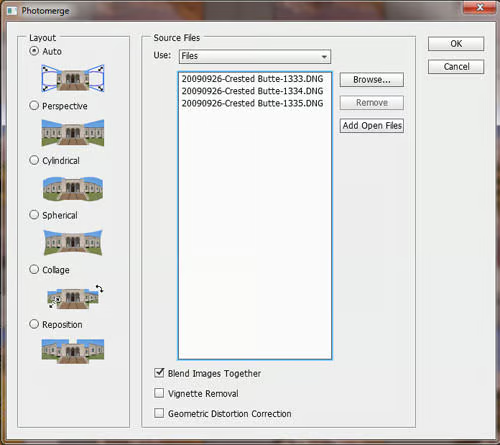
Ingest and cull in Lightroom or your preferred DAM. If you bracketed, merge HDR per view first (consistent exposure/white balance!) before stitching. PTGui is an industry standard for robust control point generation, advanced optimizer settings, and template workflows. Hugin is a powerful open-source alternative. Rectilinear lenses need more frames and careful control points near edges, but they preserve straight lines—ideal for architecture and real estate. Typical overlap recommendations: ~25–30% for very wide rectilinears, ~20–25% for moderate wide angles.
Once stitched, output an equirectangular 2:1 image. With a 61MP sensor and two-row coverage at ~15mm FF equivalent, expect 150–300 MP final panoramas depending on your shot count and overlap. That’s excellent for VR viewers and large-format prints. For more depth on PTGui’s capabilities, see this review. PTGui review and workflow insights
Cleanup & Enhancement
- Tripod/nadir patch: Use an AI remove tool or clone stamp. Capture a clean ground plate during the shoot to make this easy.
- Color unification: Apply a consistent profile, correct mixed lighting, and fine-tune WB and tint to avoid seams.
- Noise reduction: Apply conservative NR to shadows, especially if you used ISO 1600–3200; preserve texture with masking.
- Level the horizon: Ensure roll/yaw/pitch are corrected so viewers don’t feel tilted in VR.
- Export formats: Equirectangular JPEG/TIFF for VR (2:1 aspect), multi-resolution tiles for web viewers, or cropped perspective renders for print.
Want a step-by-step on setting up a panoramic head and capture routine? This guide from Meta’s Creator resources is concise and practical. Set up a panoramic head for high-end 360 photos
Video guide
Watch a quick walkthrough to reinforce the workflow before your next shoot:
Useful Tools & Resources
Software
- PTGui panorama stitching
- Hugin open source
- Lightroom / Photoshop
- AI tripod removal tools
Hardware
- Panoramic heads (Nodal Ninja, Leofoto)
- Carbon fiber tripods
- Leveling bases
- Wireless remote shutters
- Pole extensions / car mounts
For deeper reading on DSLR/mirrorless 360 capture and lens choices, this overview is helpful for planning your kit. DSLR/mirrorless 360 capture and lens guide
Disclaimer: software/hardware names provided for search reference; check official sites for details.
Common Mistakes & How to Avoid Them
- Parallax error: Always align the no-parallax point for the focal length you’re using; don’t assume “one position fits all.”
- Exposure flicker: Manual exposure and locked WB across the whole sequence prevent stitching bands and color shifts.
- Tripod shadows and legs: Shoot a clean nadir and plan your patching; sometimes stepping the tripod out and shooting a ground plate is fastest.
- Ghosting from movement: Use two-pass capture and mask in the clean frames; faster shutter speeds help for crowds.
- Night noise and micro-blur: Keep ISO modest (100–800), use a remote, disable stabilization on tripod, and shield the setup from wind.
Real-World Scenarios & Field Advice
Indoor Real Estate
Shoot at f/8, ISO 100–200, bracket ±2 EV. Keep verticals straight by ensuring the camera is level—avoid tilting up/down in single-row interiors; instead, add extra rows. Use the two-pass method to remove moving people or pets. The A7R IV’s DR keeps window highlights controllable, and at 10–12mm (APS-C) or 15–18mm (FF), you’ll preserve architecture with minimal distortion.
Outdoor Sunset
Meter for highlights to protect the sunlit horizon, then use a modest bracket set to lift the foreground later. Wind is the biggest threat—hang a small weight from the tripod and use a 2 s timer. Expect to do color unification and gradient balancing in post.
Event Crowds
Plan on 1/200–1/400 shutter speeds at f/5.6–f/8, ISO 400–800. Capture an extra, near-empty frame for each view if possible. Masking moving subjects is easier when you have a clean plate per yaw angle.
Rooftop or Pole Shooting
Safety first: tether the camera, use a spotter, and never extend a pole into traffic or power lines. With poles, enable stabilization, increase shutter speed, and shoot multiple bursts per angle so you can pick the sharpest frame later.
Frequently Asked Questions
- Can I shoot handheld panoramas with the Sony A7R IV?
Yes for simple single-row or cylindrical panos, but for full 360×180°, a tripod and pano head dramatically improve alignment and reduce stitching errors. Handheld is possible with generous overlap and fast shutter speeds; expect more time cleaning seams.
- Is the Fujifilm XF 10–24mm f/4 OIS WR wide enough for single-row 360?
For rectilinear lenses, 10mm on APS-C (≈15mm FF equivalent) typically cannot cover zenith and nadir in one row. Use two or three rows plus dedicated zenith/nadir frames for a complete sphere.
- Do I need HDR for interiors with bright windows?
Often yes. Bracketing ±2 EV (3–5 frames) preserves window detail and shadow texture. Merge HDR per angle first, then stitch the resulting series for the cleanest results.
- How do I avoid parallax issues?
Use a panoramic head and align rotation around the lens’s entrance pupil. Calibrate per focal length and mark the rail—tiny changes at 10mm can cause big stitching errors with nearby objects.
- What ISO range is safe on the A7R IV in low light?
On tripod, try to stay ISO 100–400 and extend shutter time. ISO 800–1600 is workable with careful noise reduction. For moving scenes, prioritize shutter speed and accept ISO 800–1600 as needed.
- Can I set Custom Modes for pano work?
Yes. Save a manual-exposure pano preset (manual focus, IBIS off, WB locked) to a custom mode. It speeds setup and keeps your files consistent across the sequence.
- Which tripod head is best for this setup?
A two-axis panoramic head with leveling base is ideal for rectilinear lenses. Look for indexed click-stops, fore-aft rail length to position the entrance pupil, and solid clamps to handle wind and heavy bodies.
Standards & Further Reading
For a concise DSLR/mirrorless 360 capture overview (gear and stitching), see Meta’s guide to using a DSLR or mirrorless for 360 photos. DSLR/mirrorless to shoot and stitch a 360 photo
Curious how focal length and frame counts affect final resolution? Panotools’ spherical resolution wiki is a great technical reference. Understanding spherical resolution
Compatibility & Practical Alternatives
Because the Fujifilm XF 10–24mm f/4 OIS WR uses X-mount and the Sony A7R IV uses E-mount, there is no practical adapter that maintains infinity focus between this specific lens and body. To follow this guide on the A7R IV, use a comparable rectilinear FE-mount lens like the Sony FE 12–24mm f/4 G or FE 16–35mm. If you wish to use the XF 10–24mm, pair it with a Fujifilm X body such as the X-T5 or X-H2—focal length, overlap, and nodal techniques in this article still apply with minor adjustments for field of view.