Why This Camera & Lens Are Great for Panoramas
If you want fewer shots with rock-solid stitching, a full-frame body paired with a fisheye zoom is a proven recipe. The Sony A7R IV brings a 61MP full-frame BSI-CMOS sensor (approx. 35.7×23.8mm, ~3.76µm pixel pitch) with excellent base ISO dynamic range (about 14.5–15 EV at ISO 100), giving you clean shadows and resilient highlights—perfect for HDR panoramas and low-light scenes. Its 5-axis in-body stabilization and precise electronic level make setup easier, while the massive resolution ensures crisp equirectangular exports even after heavy cropping.
The Canon EF 8–15mm f/4L Fisheye USM is a versatile fisheye zoom that delivers both circular fisheye at 8mm (180° across the image circle) and diagonal/full-frame fisheye at 15mm (approximately 180° diagonal). For panoramas this means you can choose speed (very few shots at 8mm circular) or quality/detail (more coverage and overlap at 12–15mm). Adapt it to the A7R IV with a reliable EF-to-E adapter (e.g., Sigma MC-11 or Metabones V). Aperture control works; AF is adequate but for panoramas you’ll typically switch to manual focus and lock at hyperfocal. Distortion is expected with fisheye—stitchers like PTGui handle it well—but you must align the nodal/entrance pupil correctly to avoid parallax errors.
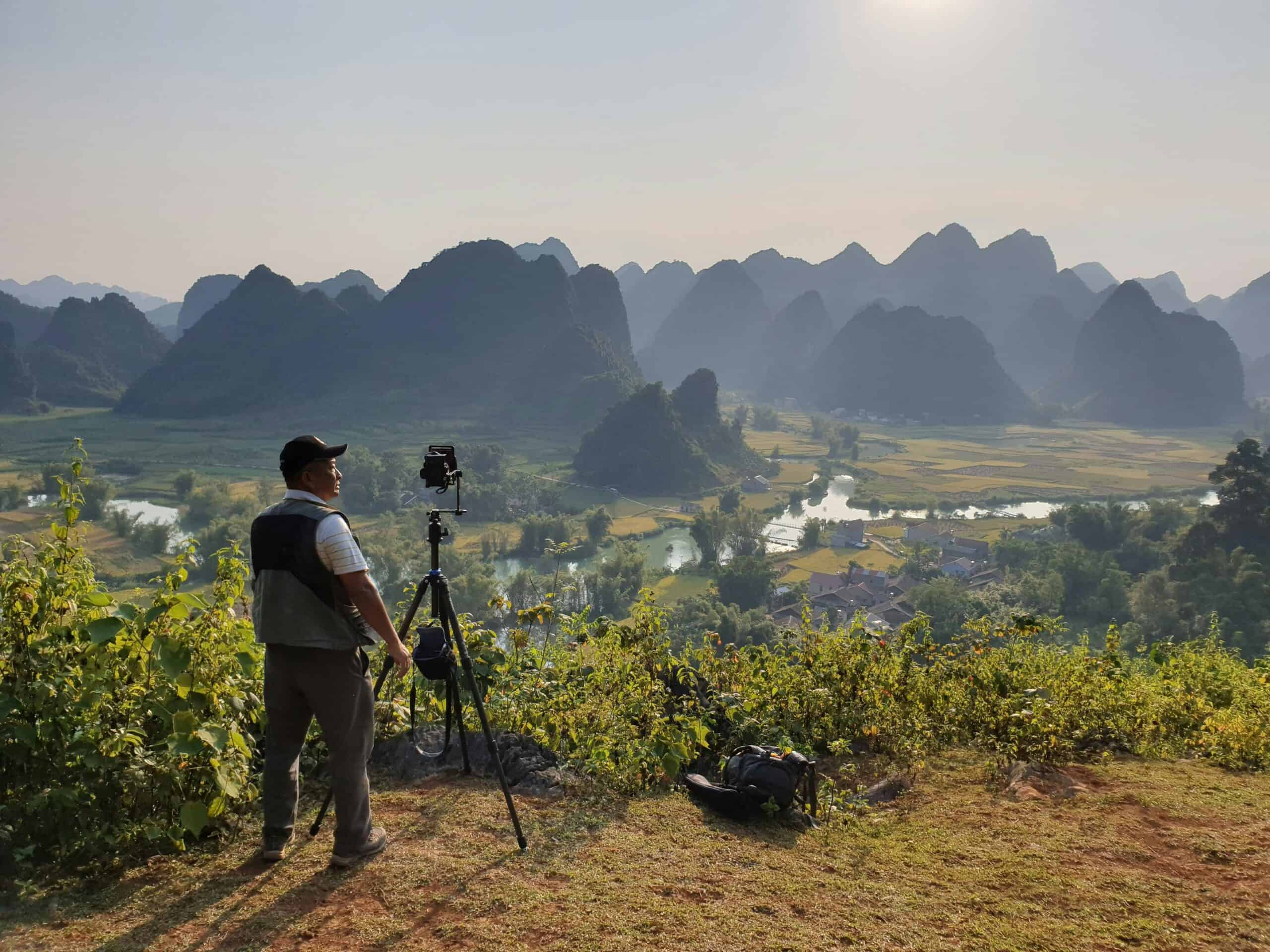
Quick Setup Overview
- Camera: Sony A7R IV — Full-frame 61MP BSI-CMOS; ~14.8 EV base dynamic range; native ISO 100–32,000 (expandable 50–102,400).
- Lens: Canon EF 8–15mm f/4L Fisheye USM — fisheye zoom; circular at 8mm, diagonal/full-frame fisheye toward 15mm; sharp by f/5.6–f/8; well-controlled CA for a fisheye and easy to profile in PTGui/Hugin.
- Estimated shots & overlap (tested, full-frame):
- 8mm (circular fisheye): 3 shots around at 120° + 1 zenith + 1 nadir (5 total). For extra safety: 4 around + zenith + nadir (6 total).
- 12mm (diagonal fisheye): 5–6 around at 60–72° + zenith + nadir.
- 15mm (diagonal fisheye): 6 around at 60° + zenith + nadir (8 total); 8 around for complex interiors.
- Difficulty: Moderate. The fisheye keeps shot counts low, but nodal alignment is critical.
Planning & On-Site Preparation
Evaluate Shooting Environment
Scan for moving elements, reflective surfaces, and bright light sources. Glass and polished floors can create flare and ghosting—try to shoot perpendicular to glass and keep the front element clean. If you must shoot through a window, get close (2–5 cm) and shade the lens to reduce reflections. At night, beware of LED flicker (use mechanical shutter or EFCS) and light pollution gradients across frames.
Match Gear to Scene Goals
Use the fisheye’s flexibility to match your scene. Outdoors at sunset, the A7R IV’s dynamic range and RAW depth help preserve sky color while lifting shadows. Indoors, the sensor is clean up to ISO 800–1600; bracket HDR when you have bright windows. At 8mm, you can finish quickly (great for busy areas), but you’ll have a circular frame and more stretching near the poles; at 12–15mm you’ll capture more pixels per degree, ideal for high-quality virtual tours.
Pre-shoot Checklist
- Power & storage: charged batteries, high-speed cards; 61MP files add up quickly.
- Optics clean: front/rear elements and sensor; avoid dust bunnies in large sky areas.
- Support: tripod leveled; panoramic head calibrated for the lens’s entrance pupil at your chosen focal length.
- Adapter: EF–E adapter seated firmly; test aperture control before you go.
- Safety: secure on rooftops (strap/tether), mind wind with poles, check traffic for car mounts.
- Backup plan: shoot a second pass in case a frame has motion blur or a person walks through.
Essential Gear & Setup
Core Gear
- Panoramic head: lets you rotate precisely around the lens’s entrance pupil (aka “nodal point”) to eliminate parallax. Use fore/aft and vertical adjustments to align the lens center over the rotation axis.
- Stable tripod with a leveling base: fast horizon leveling when floors aren’t flat. A bubble level or the A7R IV’s electronic level helps keep pitch/roll perfect.
- Remote trigger or app: trigger via Sony Imaging Edge Mobile or a cabled/wireless release to avoid vibration.
Optional Add-ons
- Pole or car mount: keep rotations slow and use a safety tether. Watch for wind-induced sway; increase shutter speed accordingly.
- Lighting aids: small LED panels for dark corners in interiors (avoid mixed color temperatures if possible).
- Weather protection: rain cover for body/lens, microfiber cloths, and a lens hood removed for 8mm to avoid vignetting.
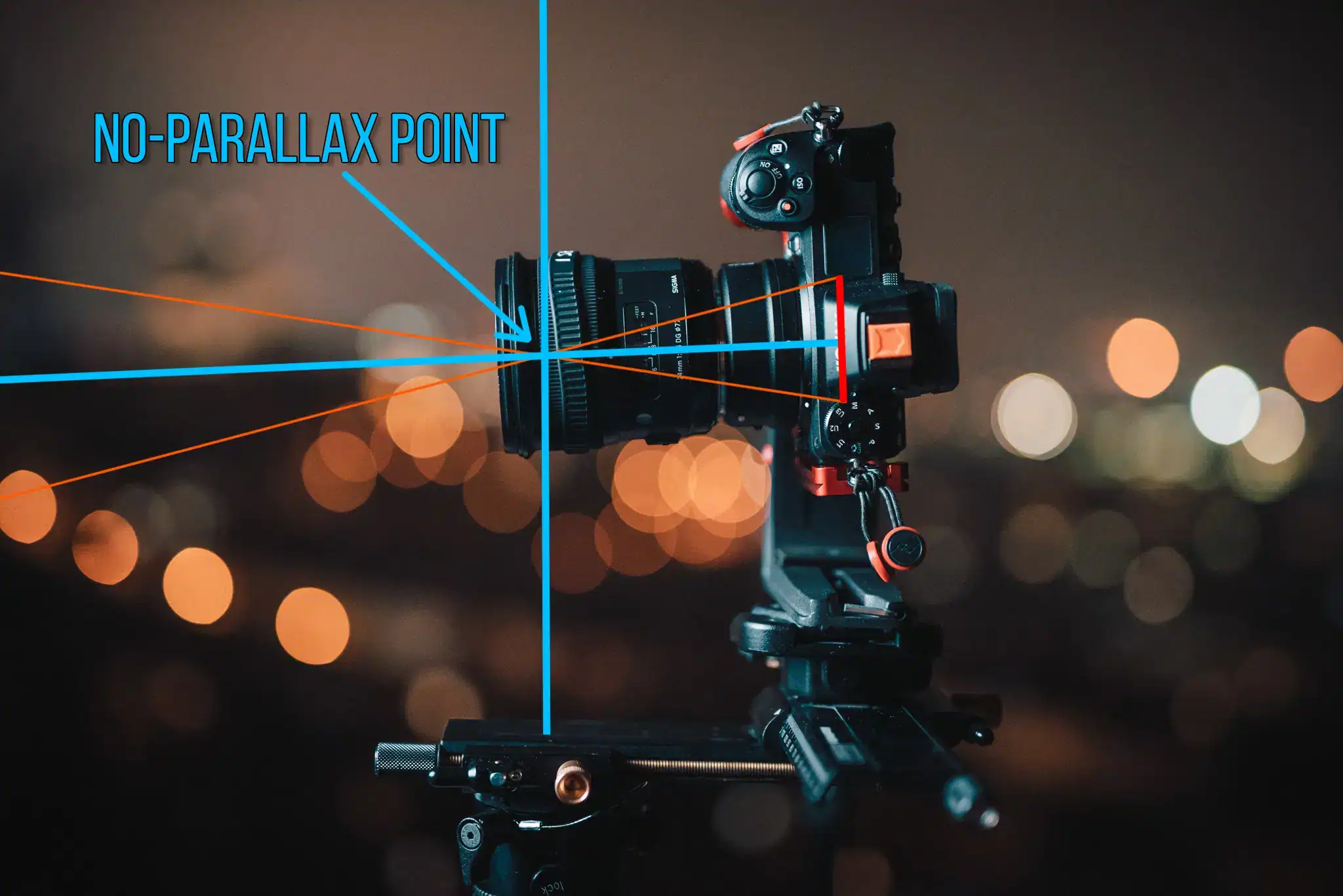
For a deeper primer on panoramic heads and why entrance pupil alignment matters, see this panoramic head tutorial. Panoramic head fundamentals
Step-by-Step Shooting Guide
Standard Static Scenes
- Level and align: Level the tripod, then the head. Position the camera so the lens’s entrance pupil sits exactly over the rotation axis. Mark your rail settings for 8mm and for 15mm (the entrance pupil shifts with focal length).
- Manual exposure and WB: Set M mode, pick a base exposure from the midtones (avoid clipping highlights), and lock a fixed white balance (Daylight/Tungsten/Kelvin). Disable Auto ISO. With LEDs, avoid silent shutter to prevent banding.
- Focus: Use AF to focus once on a mid-distance object, then switch to MF. For fisheye at f/8, focus near the hyperfocal (around 0.5–1 m) to keep near-to-far sharp.
- Capture sequence:
- 8mm: 3 around at 120° yaw, plus 1 up, 1 down. Rotate smoothly; overlap at least 30–40% to help control point matching.
- 12–15mm: 6 around at 60° yaw, plus zenith/nadir. Add a second around pass if people or cars are moving for masking options.
- Nadir shot: If the tripod appears, capture a dedicated nadir frame by tilting down or shifting the rig slightly and shooting the ground for later patching.
HDR / High Dynamic Range Interiors
- Bracket ±2 EV (3 or 5 frames): The A7R IV’s DR is excellent, but windows often need HDR. Use exposure bracketing with fixed aperture and ISO; vary shutter speed only.
- Lock WB and keep the same focus for all brackets and all frames. Use a consistent bracket order (e.g., 0, −2, +2) to simplify batch processing.
- Check the histogram: Ensure your +EV bracket recovers shadows without blowing highlights in the −EV frame.
Low-Light / Night Scenes
- Shutter speed: With a tripod, use longer shutters (1–10 s) at ISO 100–400 for the cleanest files. If wind or vibrations are present, raise ISO to 800–1600 and keep shutter 1/4–1 s.
- Stabilization: Turn IBIS off on a locked tripod to prevent micro-jitters. Use a remote release and 2 s self-timer to damp vibration.
- Noise control: Expose to protect highlights, then lift shadows in RAW. The A7R IV remains very usable up to ISO 1600 with proper noise reduction.
Crowded Events
- Two passes: First pass for full coverage, second pass to catch gaps when people move. You’ll blend later.
- Higher shutter speed: Use 1/200 s or faster and ISO 400–800 at f/5.6–f/8 to freeze motion.
- Masking plan: Note which frames have clean areas so you can mask people out during stitching.
Special Setups (Pole / Car / Drone)
- Pole: Use a carbon-fiber pole and keep it vertical. Secure the camera with a safety tether. In wind, keep exposures short (1/250–1/500 s) and shoot more overlap.
- Car mount: Stick to slow speeds, avoid potholes, and plan safe routes. Vibrations demand faster shutter speeds and possibly higher ISO.
- Drone: The A7R IV is not a drone payload; for mast/pole work, mind balance and center of gravity.
Recommended Settings & Pro Tips
Exposure & Focus
| Scenario | Aperture | Shutter | ISO | Notes |
|---|---|---|---|---|
| Daylight outdoor | f/8–f/11 | 1/100–1/250 | 100–200 | Lock WB (Daylight). EFCS on, silent shutter off if LED signs present. |
| Low light/night | f/4–f/5.6 | 1/4–1 s (tripod) or 1/30–1/60 (wind) | 100–1600 | Remote trigger, IBIS off on tripod. Raise ISO if wind shakes. |
| Interior HDR | f/8 | Bracket ±2 EV | 100–400 | Balance windows & lamps; consistent bracket order. |
| Action / moving subjects | f/5.6–f/8 | 1/200+ | 400–800 | Two passes for clean masking in post. |
Critical Tips
- Manual focus at hyperfocal: At 8–12mm and f/8, focusing around 0.5–1 m yields near-to-infinity sharpness.
- Nodal (entrance pupil) calibration: Place two vertical objects (one near, one far) and rotate. Adjust the fore/aft rail until there’s no relative shift between them.
- WB lock: Fix WB to avoid color jumps between frames and brackets; Kelvin 5600 for daylight, 3200–4000 for warm interiors.
- RAW workflow: Always capture RAW for maximum DR and easier color matching; 14-bit from the A7R IV grades beautifully.
- IBIS and EFCS: Turn IBIS off on a solid tripod; enable EFCS to reduce shutter shock. Avoid silent shutter under artificial lights (banding risk).
- Lens hood: Remove the hood at 8mm circular; it will vignette or appear in-frame. Shield the lens with your hand to block flare if needed.
- Adapter reflections: Some EF–E adapters can cause internal reflections with strong light sources; check test shots and adjust angle to avoid hotspots.
Stitching & Post-Processing
Software Workflow
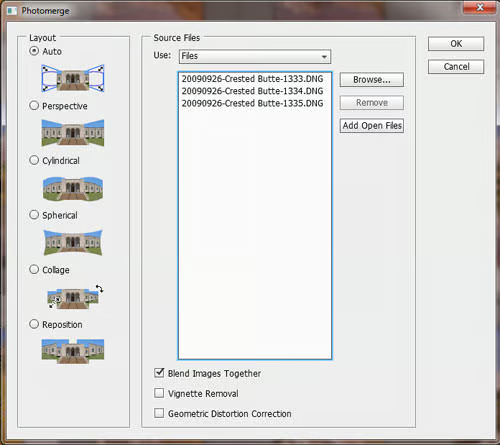
PTGui and Hugin are top choices for fisheye panoramas. In PTGui, set lens type accurately: “circular fisheye” at 8mm, “full-frame fisheye” at 12–15mm. Use control point generators, then optimize yaw/pitch/roll, lens parameters, and viewpoint (for nadir patching). Fisheye panoramas need about 25–35% overlap; rectilinear lenses need 20–25% but more tiles. Export an equirectangular 2:1 image (e.g., 12k×6k for virtual tours) and refine in Lightroom or Photoshop. For background reading on camera-based 360 workflows, see this guide for shooting and stitching DSLR/mirrorless 360 photos. Using a DSLR or mirrorless camera to shoot and stitch a 360 photo
Cleanup & Enhancement
- Nadir patch: Export a nadir view or clone/patch in Photoshop. Many virtual tour platforms accept a nadir logo.
- Color and noise: Match color casts frame-to-frame, reduce noise in the shadows (especially ISO 1600+), and apply lens corrections if needed.
- Leveling: Use horizon tools in PTGui/Hugin or set the verticals in Photoshop to correct roll, yaw, and pitch.
- Export: Save 16-bit TIFF for archiving; export JPEG for web (quality 90–95) or a cube map/equirectangular for 360 viewers.
PTGui’s speed and control point tools make it a favorite among professionals; see this review for insights. PTGui review: creating incredible panoramas
Useful Tools & Resources
Software
- PTGui panorama stitching
- Hugin (open-source)
- Lightroom / Photoshop for finishing
- AI tripod/nadir removal tools
Hardware
- Panoramic heads (Nodal Ninja, Leofoto)
- Carbon fiber tripods with leveling base
- Wireless remote shutters
- Pole extensions and car mounts with safety tethers
Disclaimer: names provided for research; always verify specifications and compatibility on official sites.
For a broader discussion of 360 capture with interchangeable-lens cameras, this overview is helpful. DSLR/mirrorless 360 virtual tour FAQ
Common Mistakes & How to Avoid Them
- Parallax error: Align the entrance pupil using a panoramic head and don’t shift the camera between frames.
- Exposure flicker: Use full manual exposure and locked WB; avoid Auto ISO for consistent tonality.
- Tripod shadows/legs: Capture a clean nadir plate and patch in post.
- Ghosting: Shoot a second pass to mask moving people/vehicles in post.
- High ISO noise: Prefer longer shutter speeds on a tripod; keep ISO at 100–800 when possible on the A7R IV.
- LED banding: Avoid silent shutter under artificial lighting; use mechanical or EFCS.
- Vignetting at 8mm: Remove the hood; ensure the adapter and filters don’t intrude into the image circle.
Frequently Asked Questions
- Can I shoot handheld panoramas with the Sony A7R IV?
Yes for quick 180° or multi-row panos, but for 360° work—especially with the 8–15mm fisheye—you’ll get better results on a tripod with a panoramic head. Handheld shots make nodal alignment inconsistent, causing stitching artifacts in near objects.
- Is the Canon EF 8–15mm f/4L wide enough for single-row 360 on full frame?
Absolutely. At 8mm (circular) you can cover the sphere with as few as 3 around + zenith + nadir. At 12–15mm (diagonal fisheye), 6 around + zenith + nadir is reliable, with excellent detail for virtual tours.
- Do I need HDR for interiors with bright windows?
Usually yes. Bracket ±2 EV (3–5 frames) to preserve window highlights and interior shadows. The A7R IV’s DR is strong, but HDR keeps noise low and color consistent across the pano.
- How do I avoid parallax issues with this lens and adapter?
Calibrate the entrance pupil on your panoramic rail at the chosen focal length (8mm differs from 15mm). Lock everything down, rotate only about the vertical axis, and don’t bump the tripod between frames. Mark your rail positions for repeatability.
- What ISO range is safe on the A7R IV in low light?
ISO 100–800 is effectively clean; 1600 is still very usable with good noise reduction. Try to avoid pushing beyond ISO 3200 unless shutter speed demands it.
- Can I set custom modes for pano on the A7R IV?
Yes. Save manual settings (M, ISO, WB), EFCS on, IBIS off (tripod), bracketing mode, and a fixed focus method to a custom recall slot (e.g., MR/C1/C2). This speeds up consistent pano capture.
- How do I reduce flare with the fisheye?
Remove the hood at 8mm but use your hand/body to shade the lens from direct sun. Slightly angle frames to keep the sun near overlap regions where it’s easier to mask or blend.
- What’s the best tripod head for this setup?
A compact multi-row panoramic head (e.g., Nodal Ninja or a Leofoto with fore/aft and vertical rails) that supports the A7R IV’s weight and allows precise entrance pupil alignment.
Real-World Scenarios & Settings
Indoor Real Estate (Bright Windows)
Use 12–15mm for higher pixel density and cleaner edges. Tripod, panoramic head. Settings: f/8, ISO 100–200, bracket ±2 EV. Lock WB at 3800–4200K for warm interiors. Capture 6 around + zenith + nadir. In PTGui, enable HDR Merge or pre-merge brackets, then stitch.
Outdoor Sunset (Windy Rooftop)
At 8mm for speed: 3 around + zenith + nadir. f/8, ISO 200–400, 1/60–1/125 s. IBIS off, EFCS on. If wind shakes the rig, increase ISO to keep shutter speed up. Wear a harness and tether the tripod; wait between gusts for the cleanest frames.
Event Crowds (Street Festival)
12mm for balance. f/5.6–f/8, ISO 400–800, 1/200–1/320 s. Two passes: first for structure, second for clean areas when people move. Mask in PTGui using the Mask tab to minimize ghosting.
High Mast/Pole Shot
8mm to keep frame count low and rotation quick. Use a carbon pole, keep exposures short (1/250–1/500 s), and bracket only if absolutely necessary. Balance the rig carefully; avoid strong winds.
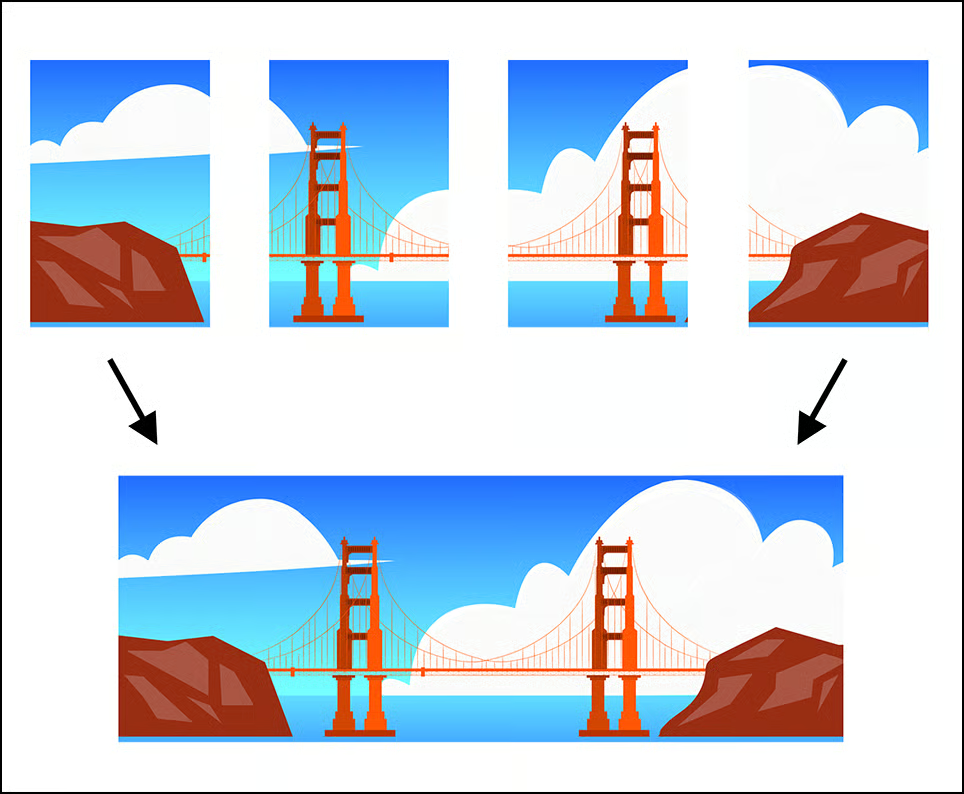
If you want an industry perspective on pano fundamentals and focal length implications, this B&H overview is a helpful complement. Panoramas, focal lengths, and stitching concepts
Advanced Notes Specific to the A7R IV + EF 8–15mm
- Pixel shift: The A7R IV’s Pixel Shift Multi Shooting isn’t ideal for scenes with motion and complicates multi-frame panos—use only for very controlled interiors, and test carefully.
- Adapter behavior: Some EF–E adapters can introduce slight play; always lock down the collar and re-check nodal alignment after mounting.
- Focal length and entrance pupil shift: Mark rail positions for 8mm and 15mm; the entrance pupil moves as you zoom, so don’t assume one setting fits all.
- File management: 61MP RAWs are heavy. Consider down-sampling the final equirectangular to your delivery target (e.g., 10–14k wide) to balance detail and performance.
For a structured, end-to-end panoramic head setup walkthrough from another perspective, this guide is useful. Set up a panoramic head for high‑end 360 photos