Why This Camera & Lens Are Great for Panoramas
If you want to master how to shoot panorama with Sony A7R III & Samyang 8mm f/3.5 UMC Fish-Eye CS II, you’re pairing a high-resolution full-frame mirrorless body with a compact, ultra-wide fisheye. The Sony A7R III uses a 42.4MP back-illuminated full-frame sensor (35.9 × 24.0 mm) with excellent base ISO dynamic range (≈14.5–15 stops at ISO 100) and 14‑bit RAW, plus 5-axis IBIS for stabilization when you need to go handheld. The pixel pitch is about 4.51 µm, yielding clean detail and great highlight headroom when shooting RAW.
The Samyang 8mm f/3.5 UMC Fish-Eye CS II is a diagonal fisheye designed for APS-C coverage. On the A7R III, you’ll want to engage APS-C/Super 35 mode to avoid black corners and use the lens as intended. This gives you an ≈18MP capture per frame—more than enough for 8K+ equirectangular outputs when stitched efficiently. The lens is fully manual (focus + aperture), has UMC coatings to control flare, and is at its sharpest around f/5.6–f/8. Being a fisheye, it dramatically reduces the number of shots needed for a full spherical 360°, speeding up capture in tight or busy environments.
In practice: the A7R III’s excellent low-ISO dynamic range and reliable manual controls, combined with the 8mm fisheye’s wide field of view, make this combo ideal for indoor real estate, quick outdoor 360s, and HDR panoramas with fewer frames and fewer stitch seams to manage.
Quick Setup Overview
- Camera: Sony A7R III — Full-frame, 42.4MP BSI CMOS; APS-C crop output ≈ 18MP per frame; 14-bit RAW; strong DR at ISO 100; 5-axis IBIS.
- Lens: Samyang 8mm f/3.5 UMC Fish-Eye CS II — diagonal fisheye designed for APS-C, fully manual, sharpest at f/5.6–f/8, moderate CA that’s easy to correct in RAW.
- Estimated shots & overlap (APS-C mode): 4 shots around at 90° yaw intervals + 1 zenith + 1–2 nadirs (with 25–30% overlap). For safer coverage in complex scenes: 6 around + zenith + nadir.
- Difficulty: Easy to Moderate (easy capture; requires nodal alignment and careful nadir handling for perfect stitches).
Planning & On-Site Preparation
Evaluate Shooting Environment
Assess light contrast, reflective surfaces (glass, mirrors), and moving elements (people, trees, vehicles). For glass shots, keep the lens as close as possible to reduce reflections; wear dark clothing, and angle the camera slightly to avoid direct reflections when feasible. Note wind exposure (for rooftops or poles) and vibration sources (bridges, traffic) that can cause micro-blur during long exposures.
Match Gear to Scene Goals
The A7R III’s wide dynamic range helps retain window highlights and interior shadow detail during daytime real estate. Indoors, ISO 200–800 stays very clean; if you must go higher, ISO 1600–3200 remains usable with careful noise reduction. The 8mm fisheye minimizes the number of shots needed—great for crowded events or quick outdoor 360 photo capture. The trade-off is fisheye distortion, which your stitcher corrects during equirectangular projection; just keep consistent overlap and precise nodal alignment to avoid parallax errors.
Pre-shoot Checklist
- Battery & storage: Bring a spare battery and fast UHS-II cards. Shooting brackets multiplies file count.
- Optics: Clean front element; check for smudges that can flare under strong lights.
- Tripod & head: Leveling base and a calibrated panoramic head are critical for clean stitches.
- Camera prep: Enable APS-C/Super 35 mode; set Release w/o Lens = Enable (the Samyang is manual). Disable IBIS on tripod.
- Safety checks: Secure on rooftops, use a tether when working over edges or with poles, watch wind gusts.
- Backup workflow: If time allows, shoot an extra full round of the panorama to hedge against stitching or ghosting issues.
Essential Gear & Setup
Core Gear
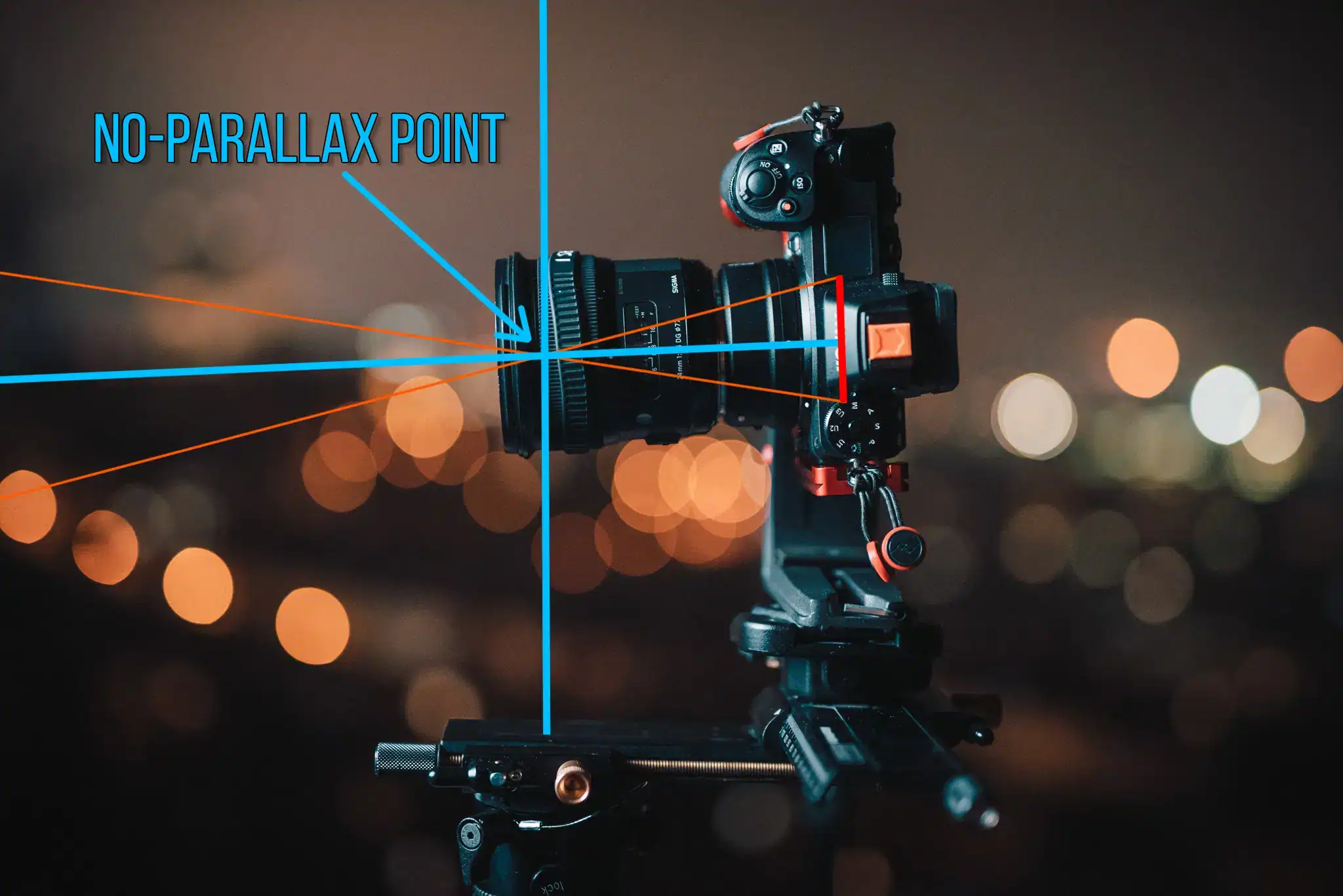
- Panoramic head: Align the lens’s entrance pupil (nodal point) over the rotation axis to eliminate parallax. This is mandatory when foreground objects are close. Use fore-aft and lateral sliders to dial in alignment once, then mark your rails for fast repeatability.
- Stable tripod with leveling base: A leveling base speeds setup and keeps your horizon consistent across frames.
- Remote trigger or Imaging Edge Mobile app: Prevent vibration during long exposures; use a delay or remote shutter.
Optional Add-ons
- Pole or car mount: Fantastic for elevated or moving 360s but require tethers and cautious speeds. Consider wind load; the fisheye sees everything, so keep the rig minimal.
- Lighting aids: Small LED panels for dim interiors. Keep light blends consistent across frames.
- Weather protection: Rain cover and microfiber cloth. Fisheyes are prone to flare from droplets—keep the front element spotless.
Step-by-Step Shooting Guide
Standard Static Scenes
- Level the tripod and align the nodal point. Place a near and far vertical object in your view; rotate the camera. Adjust the rail until the relative position of objects doesn’t shift when you pan—this marks your nodal setting for the Samyang 8mm.
- Manual everything: Set manual exposure, manual focus, and lock white balance. Avoid auto settings that change between frames and cause stitching or color inconsistencies.
- Capture sequence (APS-C mode): 4 shots around at 0° tilt, 90° apart, with 25–30% overlap; then 1 zenith (+90°) and 1–2 nadirs (−90°) for tripod coverage. Use a simple repeatable order to make post-processing faster.
- Take a dedicated nadir shot: Either shoot the tripod footprint directly or move the tripod and shoot a clean patch for later patching. Use a plumb line or a nodal tilt adapter for a cleaner nadir.
HDR / High Dynamic Range Interiors
- Bracket ±2 EV (3 or 5 frames) to balance bright windows and shadowy corners. The A7R III’s 14-bit RAW is robust, but HDR bracketing simplifies post and reduces noise in deep shadows.
- Lock WB to a neutral value (e.g., 4000–5000K for mixed light) and keep it constant across the entire capture. This avoids color shifts across merges.
- Use consistent timing: shoot all brackets per angle before rotating to the next position. Label or keep a mental map to avoid mixing frame sets.
Low-Light / Night Scenes
- Exposure: f/4–f/5.6, ISO 400–800 for quality; go to ISO 1600–3200 if necessary. Use multi-second shutter speeds as needed—tripod and remote release are essential.
- Stability: Turn IBIS off on tripod to prevent micro-movement; use a 2–5 s shutter delay or remote trigger.
- Shutter mode: Use EFCS (electronic first curtain shutter) to reduce vibration; avoid Silent Shutter under LED lighting to prevent banding.
Crowded Events
- Two-pass approach: First pass for coverage; second pass for clean plates when people move away. This gives you options for masking during stitching.
- Shorten time per shot: The 8mm fisheye means fewer frames, which reduces ghosting from motion between shots.
- Mask in post: Use your stitcher’s masking to prioritize stationary parts from the clean pass.
Special Setups (Pole / Car / Drone)
- Pole: Secure the camera with a safety tether. Keep rotations slow and deliberate; wind can cause rigs to sway. Take multiple around shots in quick succession.
- Car mount: Limit speed, avoid rough surfaces, and consider higher shutter speeds (1/250+) with a slightly higher ISO to freeze vibration.
- Drone: This combo isn’t drone-friendly due to weight; use dedicated drone workflows instead.
Recommended Settings & Pro Tips
Exposure & Focus
| Scenario | Aperture | Shutter | ISO | Notes |
|---|---|---|---|---|
| Daylight outdoor | f/8–f/11 | 1/100–1/250 | 100–200 | Lock WB to Daylight; avoid auto. |
| Low light/night | f/4–f/5.6 | 1/30–multi‑sec | 400–800 (1600–3200 if needed) | Tripod, remote, IBIS off. |
| Interior HDR | f/8 | Bracket ±2 EV | 100–400 | Balance windows and lamps; shoot all brackets per angle. |
| Action / moving subjects | f/5.6–f/8 | 1/200+ | 400–800 | Freeze motion; consider two-pass capture for masking. |
Critical Tips
- Manual focus at hyperfocal: For an 8mm on APS-C at f/8, hyperfocal distance is around 0.4–0.5 m. Pre-focus slightly beyond 0.5 m; everything from ~0.25 m to infinity stays sharp.
- Nodal calibration: Once you find the rail position that eliminates parallax, mark your fore-aft setting with tape or a scribe line for quick, repeatable setup.
- White balance lock: Pick a WB that best matches the dominant light. Mixed lighting? Neutral 4000–5000K is a workable compromise; fine-tune in RAW.
- RAW over JPEG: The A7R III’s 14-bit RAW gives you extra DR and better highlight recovery—especially helpful when you want to minimize bracketing.
- IBIS off on tripod: Stabilization can cause micro-blur when the camera is already stable; turn it off for long exposures on a tripod.
- Camera specifics: On the A7R III, enable APS-C/Super 35 mode for this lens; set Release w/o Lens to Enable; use EFCS; avoid Silent Shutter under artificial lighting.
Stitching & Post-Processing
Software Workflow
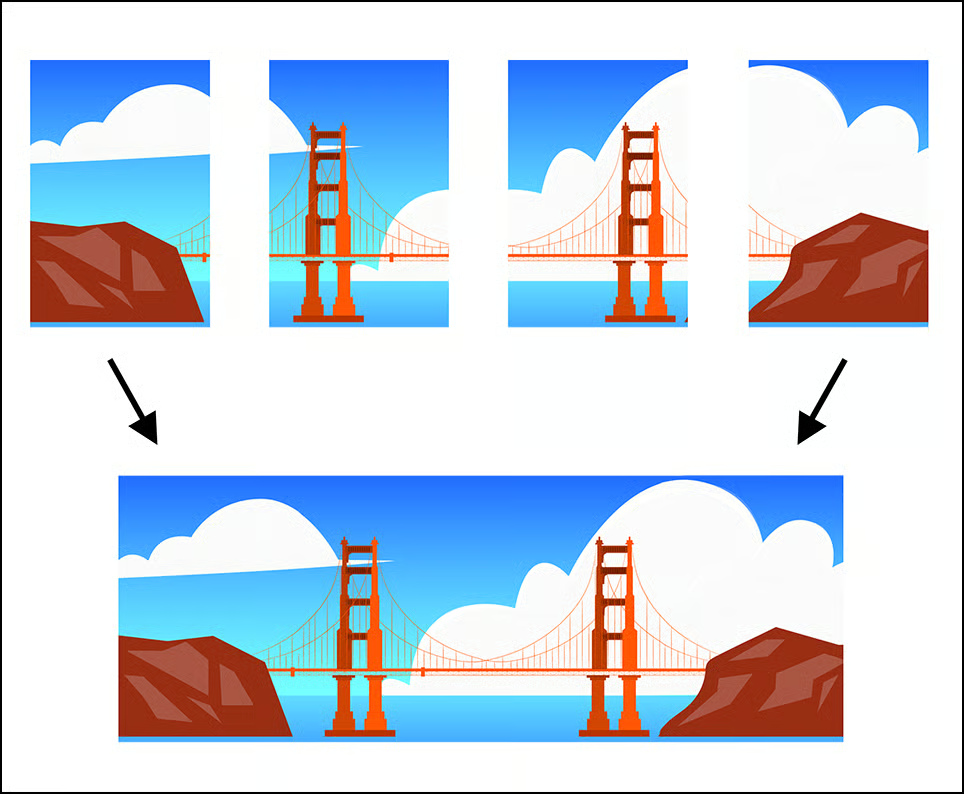
With a fisheye, stitching is typically easier because you need fewer frames. PTGui and Hugin both recognize fisheye projections; set lens type to Diagonal Fisheye, focal length 8 mm, and sensor crop 1.5× (APS-C). Use 25–30% overlap for robust control point generation. For bracketed sets, either pre-merge HDR in Lightroom/Camera Raw or let PTGui’s Exposure Fusion/HDR handle it per viewpoint; just stay consistent across the whole series. Export an equirectangular 2:1 panorama sized to your use case. With 4-around + Z + N from ≈18MP frames, expect clean 8K–10K wide outputs depending on overlap and sharpening. For more on why PTGui is preferred for challenging panos, see this review of PTGui’s panorama capabilities. PTGui overview and review
Cleanup & Enhancement
- Tripod/nadir patch: Shoot a clean ground plate and patch in Photoshop or use AI-based tools. Clone/heal remaining seams.
- Color & noise: Apply global color correction, fix CA and vignetting, and use gentle noise reduction for ISO 1600+ captures.
- Level horizon: Most stitchers can auto-level; verify roll/yaw/pitch for perfect horizon and verticals.
- Export: Save 16-bit TIFF masters and final JPEG equirectangulars for web/VR. For platform guidelines, see this DSLR-to-360 stitching guide. Using a DSLR/mirrorless to shoot and stitch a 360 photo
Recommended Deep Dives
To understand nodal alignment and gear considerations more deeply, this panoramic head tutorial is a solid reference. Panoramic head setup and best practices
Useful Tools & Resources
Software
- PTGui panorama stitching
- Hugin (open-source alternative)
- Lightroom / Photoshop for RAW and retouching
- AI tripod/nadir removal tools
Hardware
- Panoramic heads (Nodal Ninja, Leofoto)
- Carbon fiber tripods with leveling base
- Wireless remote shutters
- Pole extensions / car mounts (with safety tethers)
Disclaimer: software and hardware names are provided for research. Check official sources for the latest specifications and compatibility.
Common Mistakes & How to Avoid Them
- Parallax error: Always align the lens’s nodal point over the rotation axis; re-check if you change the zoom or adapter spacing.
- Exposure flicker: Manual exposure and locked WB throughout the sequence. Avoid Auto ISO and Auto WB.
- Tripod shadows and footprints: Plan your sun angle; capture a clean nadir and patch later.
- Ghosting from moving subjects: Use two-pass capture and mask in the stitcher.
- High-ISO noise: Prefer longer shutter on tripod with lower ISO; consider HDR bracketing in high-contrast interiors.
Frequently Asked Questions
- Can I shoot handheld panoramas with the Sony A7R III?
Yes for simple partial panos, but for a clean 360×180 HDR panorama, a leveled tripod and panoramic head are strongly recommended. Handheld increases parallax and stitching errors, especially with close foreground objects.
- Is the Samyang 8mm f/3.5 UMC Fish-Eye CS II wide enough for a single-row 360?
In APS-C crop mode, yes. Four shots around (≈90° apart) plus zenith and nadir typically cover a full sphere with 25–30% overlap. In very complex spaces or when you want more safety, use 6 around.
- Do I need HDR for interiors with bright windows?
Often yes. Bracket ±2 EV (3–5 shots) to protect highlight detail in windows and maintain clean interior shadows. The A7R III has great DR, but HDR reduces noise and makes editing faster.
- How do I avoid parallax issues?
Use a panoramic head and align the lens’s entrance pupil over the rotation axis. With the Samyang 8mm, set your fore-aft rail once, then mark it for repeat work. Keep the camera level, and avoid changing focus distance mid-shoot.
- What ISO range is safe on this camera in low light?
ISO 100–400 is optimal; 800 remains very clean; 1600–3200 is usable with noise reduction. On a tripod, lower ISO with longer shutter yields the best quality.
Field Notes: Real Scenarios
Indoor Real Estate
Use f/8, ISO 100–200, and bracket ±2 EV to tame window highlights. Lock WB around 4500–5000K. Aim for 4 around + zenith + nadir. If mirrors are present, angle slightly and plan a clean extra frame for masking. The 8mm fisheye minimizes frame count, speeding multi-room tours.
Outdoor Sunset
Shoot right before sun dips to keep sky color and foreground detail. Bracket if the sun is in-frame. Shade the lens with your hand (just out of frame) to reduce flare or plan a second clean frame after the sun moves to mask later.
Crowded Event
Work quickly: 4 fast frames around + zenith + nadir. Then wait for gaps and shoot a second pass of any busy angles for clean plates. In post, mask people from the clean pass to reduce ghosting.
Rooftop / Pole Shooting
Check wind: fisheyes expose any sway. Use a safety tether. Keep shutter speeds up (1/200+) if handheld on a pole; in low light, switch to tripod or accept higher ISO.