Why This Camera & Lens Are Great for Panoramas
Wondering how to shoot panorama with Sony A7R III & Pentax DA 10-17mm f/3.5-4.5 ED Fisheye? This combo is a surprisingly capable 360° rig when configured correctly. The Sony A7R III is a 42.4MP full-frame mirrorless camera with a back-illuminated sensor, 14-bit RAW output, about 15 stops of base ISO dynamic range, and 5-axis in-body stabilization (IBIS). Its pixel pitch is roughly 4.5 µm, which gives you excellent detail retention and low noise when you keep ISO in check. The Pentax DA 10–17mm is a diagonal fisheye zoom for APS-C with a 180° diagonal field of view at 10mm, which dramatically reduces the shot count needed for spherical panoramas.
There are a few important notes for this pairing. The Pentax DA 10–17 is a K-mount APS-C lens. On the A7R III, you’ll need a Pentax K to Sony E adapter (ideally with aperture control, since the DA lens lacks an aperture ring). You should shoot in APS-C crop mode to avoid heavy vignetting and maximize image quality. In APS-C mode, the A7R III outputs ~18MP files, which are more than adequate for 360 photo and virtual tours. You’ll likely use manual focus and manual aperture via the adapter; that’s fine, since panoramic shooting is primarily manual anyway.
The fisheye’s intentional distortion is an advantage here: fewer frames are needed to cover the full sphere, and modern stitching tools handle fisheye projections extremely well. Combined with the A7R III’s robust dynamic range and clean low-ISO performance, the result is sharp, low-noise panoramas with smooth tonal transitions—indoors and outdoors alike.
Quick Setup Overview
- Camera: Sony A7R III — Full Frame 35mm sensor (42.4MP), ~15 EV DR at base ISO, 5-axis IBIS. In APS-C crop mode: ~18MP output.
- Lens: Pentax DA 10-17mm f/3.5-4.5 ED Fisheye — diagonal fisheye (APS-C). Best around f/5.6–f/8. Expect moderate CA and purple fringing against bright light; correctable in post.
- Adapter: Pentax K → Sony E (prefer with mechanical aperture control ring). Focus will be manual; aperture display may be uncalibrated—test and note your positions.
- Estimated shots & overlap (tested, APS-C mode):
- At 10mm (diag fisheye): 6 around (60° yaw steps) + 1 zenith + 1 nadir = 8 frames total (25–30% overlap).
- At 12–14mm: 8 around + zenith + nadir (or 6 around plus higher tilt and careful coverage).
- At 17mm: 10–12 around + zenith + nadir; not recommended unless you absolutely must zoom in.
- Difficulty: Intermediate (simple once nodal point is calibrated).
- Expected output: With 8 frames at ~18MP each, stitched equirectangulars in the 10,000–14,000 px width range are common, depending on overlap and software settings. For spherical resolution guidance, see industry math references. Read more about spherical resolution estimates.
Planning & On-Site Preparation
Evaluate Shooting Environment
Before you even set up the tripod, scan the scene. Note moving elements (people, cars, trees in wind), reflective surfaces (glass, polished floors), and high-contrast light (bright windows vs. dark interiors). If you must shoot through glass, stand as close as possible (1–3 cm) and shoot at a slight angle to reduce reflections; use a lens hood or cloth to block stray light. In complex lighting, plan to bracket exposures for an HDR panorama to keep windows and shadows under control.
Match Gear to Scene Goals
The A7R III’s high dynamic range at ISO 100–200 excels for sunsets and interiors with bright highlights. Indoors, you can safely work in the ISO 100–400 range, and if necessary push to 800–1600 with careful exposure to avoid noisy shadows—this body stays clean up to 1600, and remains usable at 3200 with noise reduction. The fisheye lens drastically reduces shot count, speeding up captures in changing light or in crowds. The trade-off is a fisheye projection that emphasizes curvature; your stitching software will remap it to equirectangular without issue, but straight lines at the edge of the frame can still require careful masking.
Pre-shoot Checklist
- Power & storage: Fully charged batteries, ample card space; bring a spare. Shoot RAW (14-bit if possible).
- Clean optics: The DA 10–17 has a bulbous front element—keep it spotless and capped until shooting.
- Tripod & pano head: Leveling base, panoramic head calibrated to the lens’s entrance pupil (nodal point).
- Camera prep: APS-C crop mode enabled; IBIS OFF for tripod work; lens corrections OFF to avoid conflict with stitching.
- Safety: Assess wind, rooftop edges, and car mounts. Always tether the rig when elevated or over crowds.
- Backup: When time allows, shoot an extra round at a different tilt or with more overlap. It can save a job.
Essential Gear & Setup
Core Gear
- Panoramic head: Lets you rotate around the lens’s entrance pupil to eliminate parallax. This is critical when close objects overlap distant backgrounds. A compact head with fore–aft and left–right sliders (e.g., Nodal Ninja or Leofoto) is ideal.
- Stable tripod + leveling base: A leveling base speeds setup and keeps the horizon flat; it’s faster than trying to level legs.
- Remote trigger or app: Use a cable release or Sony Imaging Edge Mobile to trigger vibration-free exposures, especially for brackets.
Optional Add-ons
- Pole or car mount: Great for rooftops or above crowds, but always tether the rig. Mind wind loads on a fisheye—use 1/200s or faster and increase overlap.
- Lighting aids: Small LEDs or bounced flash for dark corners in interiors. Avoid mixed color temperatures when possible.
- Weather covers: Protect the A7R III from moisture and dust; the fisheye’s front element is exposed—use a rain hood if needed.
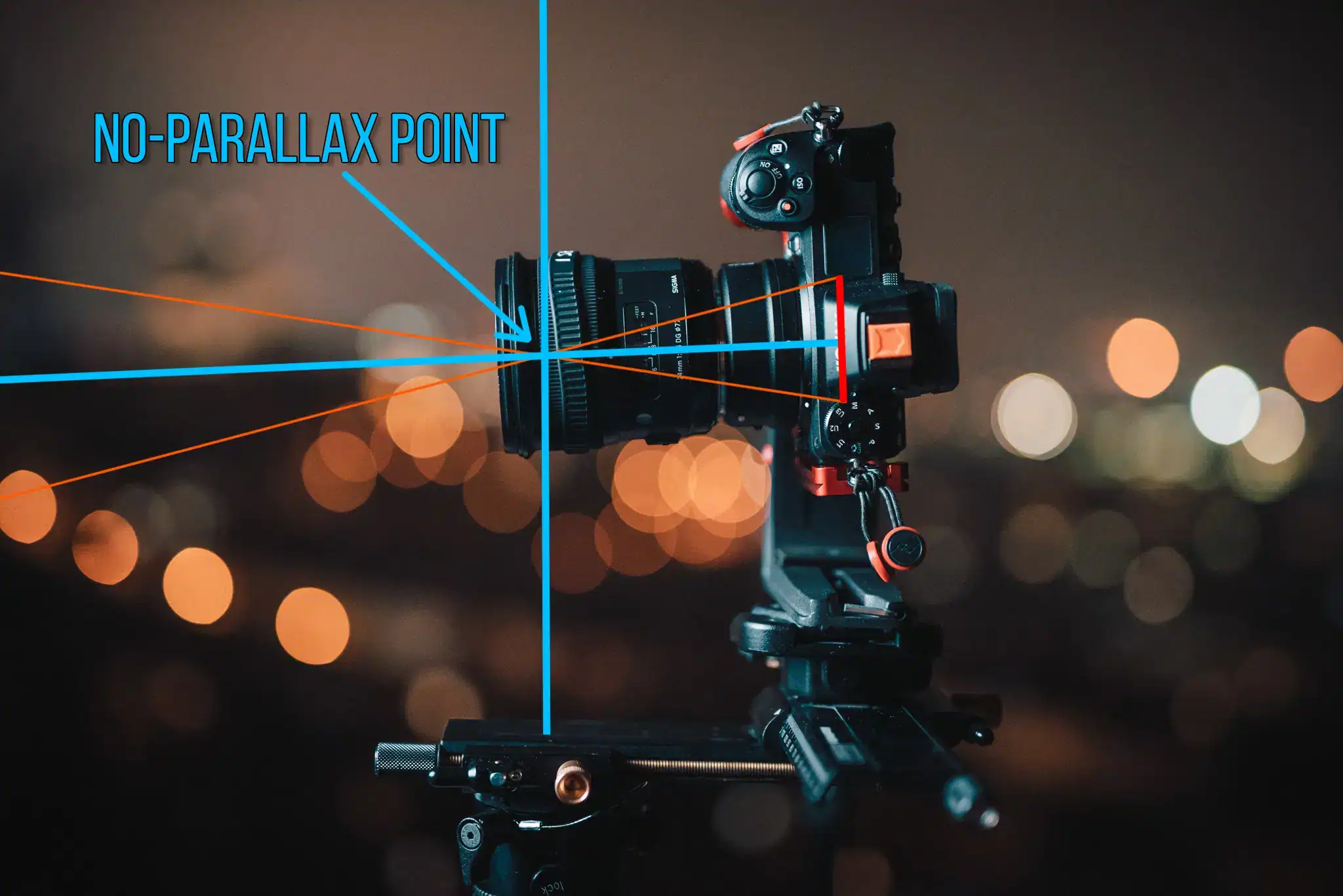
New to nodal alignment? This illustrated primer walks you through entrance pupil setup and why it matters for 360 photos. Panoramic head tutorial and no-parallax basics.
Step-by-Step Shooting Guide
Standard Static Scenes
- Level the tripod and align the nodal point. Mount the camera in APS-C crop mode. Slide the camera on the pano head’s rails so that foreground objects don’t shift against the background when panning. Mark this position on the rail for 10mm on the DA 10–17.
- Set manual exposure and lock white balance. Start at ISO 100–200, f/8, and a shutter that suits the light. Lock WB (e.g., Daylight or custom Kelvin) to avoid color shifts across frames.
- Manual focus at the hyperfocal distance. At 10mm and f/8 on APS-C, hyperfocal is roughly 0.6–0.7 m; set focus there and tape the ring if needed. Enable focus magnification to confirm.
- Capture the round: At 10mm, shoot 6 frames around at 60° yaw increments. Slightly tilt down (−5° to −10°) to ensure the lower hemisphere is covered. Then shoot 1 zenith (tilt up ~60–90°) and 1 nadir (tilt down ~60–90°) for clean tripod removal.
- Take a clean nadir. If possible, lift the rig slightly or take a hand-held nadir from the same nodal position for easier tripod patching.
HDR / High Dynamic Range Interiors
- Bracket ±2 EV (3–5 shots). The A7R III supports exposure bracketing; 5-shot ±2 EV is a solid start for interiors with bright windows.
- Lock WB and keep aperture constant. Change shutter speed only during bracketing to keep depth of field and vignetting consistent.
- Use a remote. Fire brackets with a cable or app to avoid vibrations, and wait for any oscillation to settle between frames.
Low-Light / Night Scenes
- Stay on a tripod with IBIS OFF. Use longer shutter speeds (1–8 s). Keep ISO as low as practical: 100–400 is ideal; 800–1600 is still clean on the A7R III with proper exposure.
- Use the 2-second timer or remote. Minimize shake and wind movement. Add more overlap (30–40%) if stars or moving elements are present.
- Consider multiple rounds. One pass for sky, one for foreground, then blend during stitching or in Photoshop.
Crowded Events
- Shoot two passes. First, capture the complete set quickly. Second, wait for gaps in the crowd to fill problem areas. You’ll mask between passes in PTGui/Hugin.
- Use faster shutter speeds (1/200–1/500). Raise ISO to 800–1600 if needed to freeze motion and reduce ghosting.
Special Setups (Pole / Car / Drone)
- Secure everything. Tether the camera and head; check clamps, plates, and pole locks. Balance the load and stay under safe wind limits.
- Shorten exposure times. On a pole or vehicle, favor 1/200s or faster and increase overlap to 30–40% to give the stitcher more to work with.
- Rotate slowly and smoothly. Avoid sudden yaw changes that flex the pole or induce motion blur.
Recommended Settings & Pro Tips
Exposure & Focus
| Scenario | Aperture | Shutter | ISO | Notes |
|---|---|---|---|---|
| Daylight outdoor | f/8–f/11 | 1/100–1/250 | 100–200 | Lock WB (Daylight); IBIS OFF on tripod |
| Low light/night | f/4–f/5.6 | 1/30–8 s (tripod) | 100–800 (1600 if needed) | Remote trigger; avoid pushing ISO above 1600 unless necessary |
| Interior HDR | f/8 | Bracket ±2 EV | 100–400 | Balance windows vs. lamps; keep aperture fixed |
| Action / moving subjects | f/5.6–f/8 | 1/200+ | 400–1600 | Freeze motion, double pass for masking |
Critical Tips
- Manual focus at hyperfocal. At 10mm f/8 on APS-C, set ~0.6–0.7 m; nearly everything from ~0.35 m to infinity will be sharp.
- Nodal point calibration. Place a near object (0.5–1 m) against a far background. Pan the camera; adjust the rail until the near object doesn’t shift relative to the background. Mark that position for 10mm and 12mm if you use both.
- White balance lock. Pick Kelvin or a preset that matches the scene to prevent color flicker across frames and brackets.
- RAW over JPEG. Use 14-bit RAW for maximum DR and color flexibility, especially for HDR merges and shadow recovery.
- IBIS OFF on tripod. Stabilization can introduce micro-blur when the camera is perfectly still. Turn IBIS back ON if you must shoot hand-held.
- Lens corrections OFF. Disable in-camera distortion/vignette corrections; let PTGui/Hugin handle fisheye mapping precisely.
- Adapter aperture marks. If your K-to-E adapter has a stepless aperture ring, create your own reference chart (e.g., “mark 3 ≈ f/8”) using exposure tests.
Stitching & Post-Processing
Software Workflow
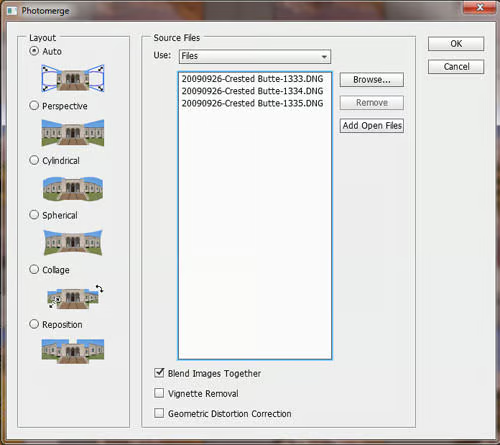
Import your RAW files into Lightroom (or Capture One), apply lens-agnostic basic edits (WB, exposure, chromatic aberration removal), and export 16-bit TIFFs. In PTGui or Hugin, set the lens type to “full-frame fisheye” with 10mm focal length (APS-C). For this lens, start with 6 around + zenith + nadir and 25–30% overlap. PTGui’s control point generator usually nails fisheye matches; refine with optimizer and check for verticals. If you captured brackets, use the built-in HDR fusion or pre-merge brackets in Lightroom (keep exposures consistent). Industry best practice for fisheye overlap is ~25–30% (rectilinear lenses typically need 20–25%). For an in-depth overview of PTGui’s strengths, see this review. Why PTGui is a top tool for complex panoramas.
When you’re new to DSLR/mirrorless 360 pipelines, it helps to understand the full flow—capture to equirectangular export to VR viewers. This short guide covers end-to-end considerations for 360 photos. Using a mirrorless camera to shoot and stitch a 360 photo.
Cleanup & Enhancement
- Tripod/nadir patch: In PTGui, shoot and use a separate nadir; otherwise patch later with a logo or clone in Photoshop.
- Color & noise: Match WB across shots; apply gentle noise reduction to shadow areas from HDR merges or night scenes.
- Leveling: Use the horizon/vertical controls in PTGui to correct roll, yaw, and pitch. Straighten key vertical lines for interiors.
- Export: Equirectangular 2:1 ratio. For web VR, 8000–12000 px width is common; for high-end tours, go 14000–16000 px (watch file size).
- Delivery: Save master 16-bit TIFF and a compressed JPEG. Keep lens and project templates for repeatable results.
If you want an additional perspective on choosing camera/lens combos and pano workflow trade-offs, this field guide is a solid starting point. DSLR/mirrorless 360 virtual tour camera/lens guide.
Useful Tools & Resources
Software
- PTGui panorama stitching
- Hugin (open source)
- Lightroom / Photoshop / Affinity Photo
- AI tripod removal and object clean-up tools
Hardware
- Panoramic heads (Nodal Ninja, Leofoto)
- Carbon fiber tripods
- Leveling bases or half-balls
- Wireless remote shutters
- Pole extensions / car suction rigs (with safety tethers)
Disclaimer: Names are for search reference; check official documentation and current versions for accurate operation.
Common Mistakes & How to Avoid Them
- Parallax error → Use a pano head and align the entrance pupil; don’t rotate around the tripod socket.
- Exposure flicker → Manual exposure and locked WB. Keep aperture fixed across stacks and brackets.
- Tripod shadows or missing floor → Shoot a dedicated nadir; patch later if access is limited.
- Ghosting from movement → Shoot two passes and mask the best parts in PTGui; increase shutter speed in crowds.
- Night noise and banding → Keep ISO low, expose to the right without clipping, and use 16-bit processing.
- Severe flare on fisheye → Shade the lens, avoid direct sun near the edge of frame, and bracket to protect highlights.
Frequently Asked Questions
- Can I shoot handheld panoramas with the Sony A7R III?
Yes, for quick captures. Turn IBIS ON, use 1/200s or faster, and increase overlap (30–40%). Handheld introduces parallax because you can’t rotate perfectly around the entrance pupil, so avoid close foregrounds. For critical work—interiors, architecture—use a pano head and tripod.
- Is the Pentax DA 10–17mm wide enough for single-row 360 on APS-C?
At 10mm (diagonal fisheye) in APS-C crop mode, 6 shots around plus zenith and nadir reliably cover a full sphere. Some scenes allow 6 around with careful tilt and no zenith, but adding a dedicated zenith and nadir yields cleaner results and easier stitching.
- How do I avoid parallax issues with this lens?
Use a panoramic head and align the entrance pupil by sliding the camera over the rotation axis until a near object doesn’t shift against the background when panning. Mark that rail position for 10mm. Recheck if you change focal length or adapters.
- What ISO range is safe on the A7R III in low light?
For tripod-based panoramas, aim for ISO 100–400. ISO 800–1600 remains very clean if you expose properly. ISO 3200 is usable with noise reduction, but try to avoid it for critical interior tours to preserve micro-contrast.
- How can I reduce flare with a fisheye?
Avoid placing the sun or strong lamps at the frame edge; shade the lens with your hand or a flag (keep it out of frame), and bracket to protect highlights. In post, use dehaze and selective contrast sparingly to avoid revealing CA or halos.
Real-World Scenarios & Field Notes
Indoor Real Estate
Use a tripod and pano head with the DA 10–17 at 10mm. Start at f/8, ISO 100–200, and bracket 5 shots ±2 EV for bright windows. Keep white balance fixed (around 3800–4200K for warm LED interiors). Shoot 6 around + zenith + nadir. In PTGui, use HDR fusion and mask window frames to avoid ghosting from swaying curtains or moving people in hallways.
Outdoor Sunset
Lock in ISO 100, f/8, and use a shutter that exposes midtones well; consider one HDR pass at sunset (±2 EV) and one non-HDR pass just after for a cleaner sky. Watch for flare—keep the sun centered in one frame instead of at the edge, then mask in post if needed.
Events and Crowds
Shoot faster (1/200–1/500) at ISO 800–1600. Do two rounds: one fast pass to freeze people, a second where you wait for gaps in traffic for problem sectors. In PTGui, use masks to prefer frames with fewer people and crisp backgrounds.
Rooftop or Pole Shooting
Use a sturdy pole, tether everything, and keep exposures short (1/200s+). Add overlap to 30–40%. Expect some stitching challenges if the pole flexes; rotate slowly and lock your elbows against your body to dampen movement. Don’t overshoot in high winds—safety first.
Safety, Limitations & Trustworthy Workflows
The A7R III’s build is robust, but elevated/pole/car work demands tethers, checked clamps, and wind limits. The DA 10–17’s protruding front element is vulnerable—use the cap until the moment you shoot. Adapted lenses may not report exact apertures; test and record your “f/8” mark on the adapter ring. Always shoot a backup round if time allows and keep both the project file and exported equirectangular. For detailed mechanical setup of panoramic heads (standards you can rely on), this step-by-step resource is helpful. How to set up a panoramic head for high-end 360 photos.