
Why This Camera & Lens Are Great for Panoramas
Here’s how to shoot panorama with Sony A7R III & Fujifilm XF 10-24mm f/4 OIS WR the right way, with the least frustration and the best results. The Sony A7R III gives you a 42.4MP full-frame BSI sensor (35.9×24mm) with excellent dynamic range (about 14.7 EV at base ISO), low read noise, and reliable 5-axis IBIS. Those traits are perfect for multi-image 360 photo work where tonal latitude, clean shadows, and precise alignment matter. The Fujifilm XF 10–24mm f/4 OIS WR is a rectilinear ultra-wide zoom for APS-C: on a Fujifilm X body it covers an angle of view equivalent to ~15–36mm on full-frame, with good edge sharpness stopped down and controlled distortion—ideal for architecture and interiors.
Critical compatibility note: the Fujifilm XF 10–24mm f/4 OIS WR is an X-mount lens designed for Fujifilm APS-C bodies. There is no practical, fully functional adapter to mount this XF lens on a Sony A7R III (E-mount). The lens requires electronic control for aperture and focus (fly-by-wire), which passive adapters cannot provide. For this guide, you have two realistic paths that both yield professional pano results:
- Use the Sony A7R III with a native ultra-wide rectilinear (e.g., Sony FE 12–24mm f/4 G, FE 16–35mm f/4, or similar). The shooting workflow, nodal alignment, and settings below apply directly.
- Use the Fujifilm XF 10–24mm on a Fujifilm X body (X-T/X-H series). All field techniques and shot counts below for “10–24mm APS-C” carry over perfectly. The only difference is sensor size and ISO behavior.
If you proceed with the A7R III (recommended), its 42.4MP files stitch into massive, clean panoramas and HDR panorama sets. If you proceed with the Fujifilm XF 10–24mm on a Fuji body, you’ll benefit from fewer shots needed at 10–14mm equivalent angles-of-view and very straight lines—great for real estate and cityscape work.
Quick Setup Overview
- Camera: Sony A7R III — Full-frame 42.4MP BSI-CMOS, ~4.5 µm pixel pitch, strong dynamic range at ISO 100–200, excellent color depth. IBIS included.
- Lens: Fujifilm XF 10–24mm f/4 OIS WR — Rectilinear APS-C ultra-wide zoom, good at f/5.6–f/8, controlled distortion and CA. Note: not natively compatible with Sony E. Use a native FE ultra-wide with similar FOV on A7R III.
- Estimated shots & overlap (rectilinear, full spherical, 20–30% overlap safe):
- FF ~12–16mm (e.g., FE 12–24 @12–14mm): 3 rows × 6 shots (±45°, 0°) + zenith + nadir ≈ 20–22 frames.
- APS-C 10mm (≈15mm FF eq on Fuji): 3 rows × 6 shots + zenith + nadir ≈ 20–22 frames.
- APS-C 24mm (≈36mm FF eq): 4–5 rows × 8–10 shots + zenith + nadir ≈ 40–55 frames.
- Difficulty: Moderate (easier with a panoramic head and careful nodal alignment).
Planning & On-Site Preparation
Evaluate Shooting Environment
Look for moving elements (people, cars, leaves), strong backlight, reflections, and wind. For interiors with glass or glossy surfaces, position the camera at least 0.5–1.0 m away from glass, and avoid shooting directly into bright light sources when possible. For sunrise/sunset, plan your rotation so the sun-side exposures are bracketed carefully to preserve highlights.
Match Gear to Scene Goals
The A7R III’s wide dynamic range and clean ISO 100–800 performance shine for HDR panorama sets and low-light scenes. Stick to ISO 100–200 for daylight, ISO 200–800 on a tripod at night. With a rectilinear ultra-wide (whether FE 12–24 on the A7R III or XF 10–24 on Fuji), you’ll need more shots than a fisheye but get straight lines—critical for interiors and architecture. If you must shoot handheld in a pinch, the A7R III’s IBIS helps stabilize, but a tripod + panoramic head remains the gold standard for accurate stitching.
Pre-shoot Checklist
- Charge batteries and bring spares; high-res bracketing drains faster.
- Empty and format fast cards; shoot RAW; consider backup cards.
- Clean lens and sensor; dust spots are very noticeable in skies.
- Tripod leveled; panoramic head calibrated at the lens’s no-parallax (nodal) point.
- Safety: use a weight bag in wind, tether gear on rooftops/poles, and avoid public hazards. For car mounts, verify suction mounts, safety lines, and speed limits.
- Backup workflow: do one complete safety round after your main set—small time cost, big peace of mind.
Essential Gear & Setup
Core Gear
- Panoramic head: Lets you rotate around the lens’s entrance pupil (no-parallax point), minimizing alignment errors. Mark the rail position for your chosen focal length.
- Stable tripod with a leveling base: Leveling keeps your rows consistent, simplifying stitching and reducing horizon warp.
- Remote trigger or app: Fire the shutter without touching the camera to avoid micro-blur, especially for HDR brackets and long exposures.
Optional Add-ons
- Pole or car mount: Great for elevated or moving perspectives. Always add a safety tether, watch wind gusts, and keep speeds conservative to reduce vibration.
- Lighting aids: Small LED panels or bounced flash for dark interiors (use carefully to avoid hotspots).
- Weather gear: Rain covers, microfiber cloths, and silica packs. Moisture or mist can ruin a set mid-rotation.
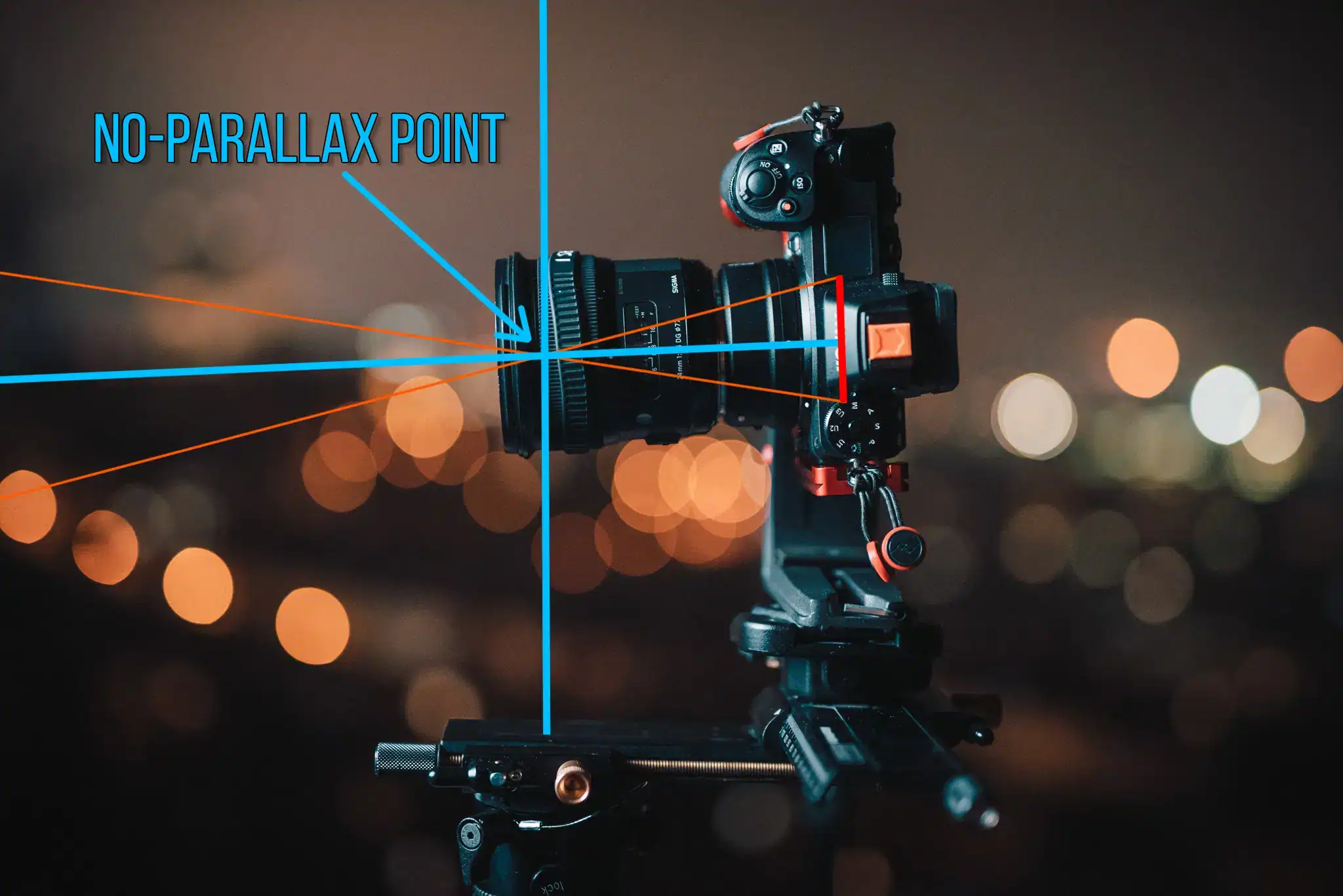
For a deeper primer on panoramic heads and no-parallax alignment, see this panoramic head walkthrough. Panoramic head tutorial
Step-by-Step Shooting Guide
Standard Static Scenes
- Level the tripod: Use a leveling base or the camera’s virtual horizon. A level base prevents creeping pitch misalignment during the sweep.
- Find and set the nodal point: Place two vertical objects (one near, one far) in the frame. Rotate the camera. Slide the lens along the nodal rail until the near/far alignment no longer shifts when rotating. Mark this setting for common focal lengths (e.g., 10, 14, 18, 24mm APS-C or 12, 14, 16mm FF).
- Manual exposure and WB: Meter the brightest part, then lock exposure (M mode) and white balance (e.g., Daylight/Custom). This avoids exposure flicker and color shifts across images.
- Focus: Switch to manual focus and set near the hyperfocal distance at your chosen aperture. For ultra-wide rectilinear, f/8–f/11 gives excellent edge-to-edge sharpness.
- Capture plan (rectilinear ~15mm FF eq):
- Row +45° pitch: 6 shots around, yaw 60° apart.
- Row 0° pitch: 6 shots around, yaw 60° apart, offset by 30° from the previous row.
- Row −45° pitch: 6 shots around, yaw 60° apart.
- Zenith: 1–2 frames at +80° pitch (rotate 180° if taking two).
- Nadir: 1–3 frames at −80° pitch for tripod removal.
This yields ~20–22 frames with robust overlap. If you shoot at narrower focal lengths (e.g., 24mm APS-C), add rows and shots per row for coverage and overlap.
- Take a nadir patch: After the main set, move the tripod slightly and shoot a clean ground patch to replace the tripod in post, or shoot a handheld nadir at the same nodal point height if possible.
HDR / High Dynamic Range Interiors
- Bracket ±2 EV (3 or 5 frames): The A7R III supports 3/5/9-frame bracketing. For windows and lamps, 3 or 5 frames at ±2 EV is usually enough.
- Lock WB and focus: Keep settings consistent across brackets to avoid color flicker and focus drift.
- Use a 2s timer or remote: Prevent vibration between bracketed exposures.
Low-Light / Night Scenes
- Tripod + remote: Use 1/30–several seconds exposures at f/4–f/5.6. Keep ISO as low as possible (ISO 100–400, up to 800 if needed on A7R III).
- Turn off IBIS on a tripod: Stabilization can introduce micro-blur on long exposures when mounted. For handheld panos, IBIS helps.
- Use mechanical shutter under flickering lights: Electronic shutter can band; stick to mechanical in mixed artificial lighting.
Crowded Events
- Two-pass approach: First pass for coverage, second pass for clean plates when gaps appear in the crowd.
- Shorter shutter speeds: Aim for 1/200s+ to freeze motion if you want people sharp. Otherwise embrace motion blur for creative effect.
- Masking later: Plan overlaps so you can easily mask moving subjects during stitching or in the retouch phase.
Special Setups (Pole / Car / Drone)
- Pole: Balance the rig, use a safety line, avoid strong winds, and rotate slowly. Consider fewer shots at a slightly wider focal length to shorten exposure time at height.
- Car mount: Use redundant suction mounts plus safety cords. Avoid high speeds. Pre-plan a simple rotation plan (fewer shots, slightly higher ISO) to reduce time.
- Drone: If you must, lock exposure and WB, and ensure consistent overlap. Watch for horizon leveling errors due to IMU drift.
Recommended Settings & Pro Tips
Exposure & Focus
| Scenario | Aperture | Shutter | ISO | Notes |
|---|---|---|---|---|
| Daylight outdoor | f/8–f/11 | 1/100–1/250 | 100–200 | Lock WB to daylight; keep exposure manual across all frames. |
| Low light/night | f/4–f/5.6 | 1/30–multi-sec | 100–800 | Tripod + remote; IBIS off on tripod; avoid e-shutter banding under LEDs. |
| Interior HDR | f/8 | Bracket ±2 EV | 100–400 | Balance windows and practical lights; manual WB. |
| Action / moving subjects | f/5.6–f/8 | 1/200+ | 400–800 | Freeze motion; consider two-pass capture for clean plates. |
Critical Tips
- Manual focus near hyperfocal: With ultra-wide rectilinear at f/8–f/11, you’ll get front-to-back sharpness. Verify at 100% on a test frame.
- Nodal calibration: On rectilinear wides (10–16mm), the no-parallax point is typically near the front optical group. Expect rail offsets roughly 60–90mm from the sensor plane as a starting point; always confirm by the near/far alignment test.
- White balance lock: Mixed lighting can shift WB frame to frame; manual WB avoids patchy color across the stitch.
- RAW over JPEG: Give yourself DR and color latitude for blending and perspective corrections.
- IBIS vs OIS: Turn IBIS off on a tripod. Lens OIS on the XF 10–24 won’t apply on Sony due to incompatibility; on Fuji bodies, also disable OIS on a tripod.
- Pixel Shift (A7R III): Great for static, single-frame shots; not recommended for multi-image panos due to motion between frames and stitching complexity.
Stitching & Post-Processing
Software Workflow
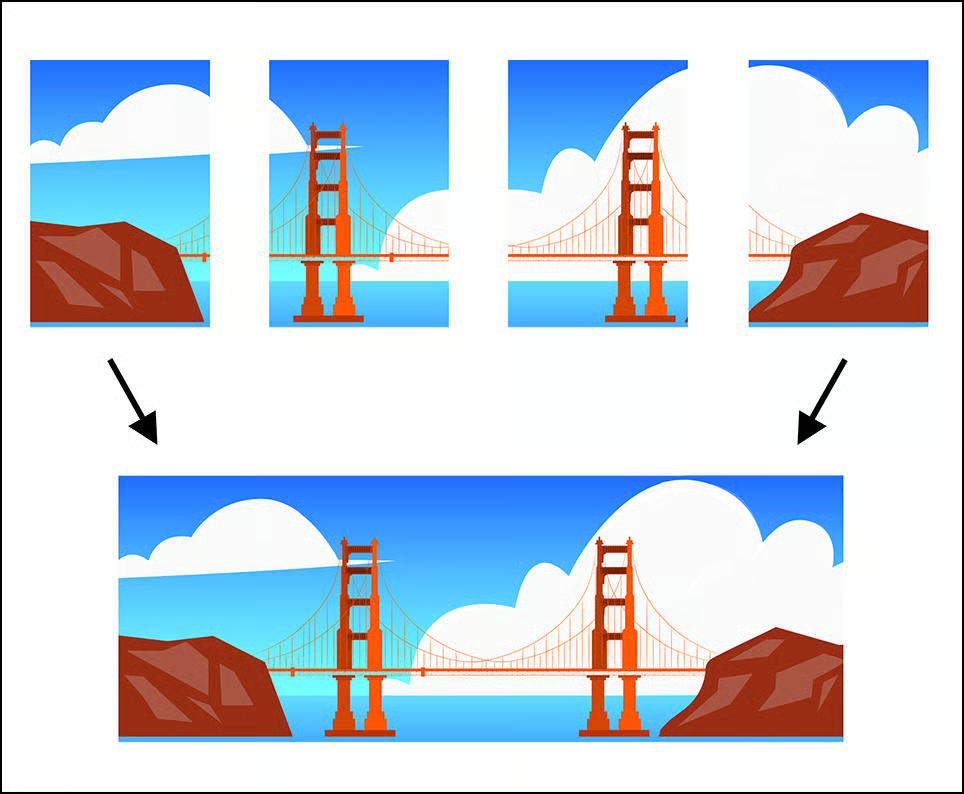
Import RAWs into Lightroom or Capture One, apply uniform white balance and lens corrections (if not handled by the stitcher), and export 16-bit TIFFs. Stitch with PTGui or Hugin. For rectilinear lenses, use about 20–25% overlap minimum; more overlap improves control point robustness, especially at wider zoom settings like 10–12mm APS-C or 12–14mm FF. PTGui’s optimizer will handle yaw/pitch/roll and lens distortion simultaneously; use its masking to resolve moving objects. PTGui is a favorite for speed and control point reliability. PTGui review and workflow insights
Cleanup & Enhancement
- Nadir patch/tripod removal: Render a nadir view and patch using a clean ground frame or an AI object removal tool. Clone/heal remaining seams.
- Color and noise: Apply gentle noise reduction for night sets, and use HSL to normalize mixed lighting.
- Level and straighten: Set the horizon and verticals in the stitcher; adjust yaw/pitch/roll until lines are true.
- Export formats: For virtual tours, export equirectangular 2:1 (e.g., 12000×6000 JPG/TIFF). Keep layered masters in 16-bit TIFF for future edits.
For deeper technical background on pano sampling and resolution trade-offs, see this reference on spherical resolution. Understanding spherical resolution
Useful Tools & Resources
Software
- PTGui panorama stitching
- Hugin (open-source)
- Adobe Lightroom / Photoshop
- AI object removal for nadir patching
Hardware
- Panoramic heads: Nodal Ninja, Leofoto, Sunwayfoto
- Carbon fiber tripods with a leveling base
- Wireless remote shutters
- Pole extensions / car mounts with safety tethers
Disclaimer: Product names are for reference—check official sites for specs and compatibility.
Common Mistakes & How to Avoid Them
- Parallax error: Not rotating around the entrance pupil. Calibrate and mark the nodal rail for your focal length.
- Exposure flicker: Auto modes changing exposure mid-sweep. Use full manual and fixed WB.
- Tripod shadows and footprints: Shoot a nadir patch or plan your shadow to fall outside the main subject area.
- Ghosting from movement: Use masks in your stitcher; shoot extra clean plates for busy regions.
- Night noise: Keep ISO low and use longer shutter speeds with a stable tripod and remote trigger.
- Wind shake on poles: Shorter shutter, wider focal length, and slow rotation. Add a safety line.
Field-Proven Scenarios
Indoor Real Estate (Bright Windows)
Set f/8, ISO 100–200, bracket ±2 EV (3 or 5 frames), manual WB (4000–5000K). Use 10–14mm APS-C or 12–16mm FF. Shoot 3 rows × 6, plus zenith/nadir. In PTGui, blend using HDR fusion with “medium” or “high” deghosting, then refine verticals in Photoshop.
Outdoor Sunset
Expose for highlights at ISO 100–200 and bracket ±2 EV. Rotate starting just before the sun to minimize the time between brightest frames. Consider a second pass a few minutes later to capture changing sky colors for a blended sky if needed.
Event Crowds
Use 1/200–1/400s at f/5.6–f/8, ISO 400–800. Take two passes to capture clean plates of background areas. In the stitcher, mask moving people from the “clean” pass into the final stitch.
Rooftop / Pole
Keep the rig compact, avoid bracketing if wind is strong (or use faster ISO to shorten shutter), and always clip a safety tether to a fixed point. Rotate slower and monitor for vibration before each shot.
For a broader DSLR/mirrorless-to-360 pipeline overview, the Oculus Creator documentation offers a solid, platform-agnostic primer. Using a mirrorless camera to shoot and stitch a 360 photo
Frequently Asked Questions
- Can I shoot handheld panoramas with the Sony A7R III?
Yes, in a pinch. The A7R III’s IBIS helps, but parallax and framing errors increase. Keep focal length wide (e.g., 12–16mm), use 30–40% overlap, and shoot fast shutter speeds. For critical work, use a tripod and panoramic head.
- Is the Fujifilm XF 10–24mm f/4 OIS WR wide enough for single-row 360?
Not for full spherical 360×180. At 10mm APS-C (~15mm FF eq), you’ll need at least two to three rows plus zenith/nadir for complete coverage. Single-row works for cylindrical panoramas only (no top/bottom coverage).
- Do I need HDR for interiors with bright windows?
Usually, yes. Bracket ±2 EV (3 or 5 frames). The A7R III’s base ISO DR is excellent, but window-to-interior contrast often exceeds a single exposure. HDR preserves highlights and clean midtones, easing post-processing.
- How do I avoid parallax issues?
Rotate the camera around the lens’s entrance pupil. Calibrate with a near/far alignment test and mark your panoramic head rails for each focal length. Keep the camera height consistent for zenith/nadir shots.
- What ISO range is safe on the A7R III in low light?
On a tripod, aim for ISO 100–400 whenever possible; ISO 800 is still very usable. If you must increase ISO for faster shutters (wind/poles/events), try to stay ≤1600 and apply light noise reduction later.
- Can I set up Custom Shooting Modes for pano?
Yes. Program a custom mode with manual exposure, manual focus, fixed WB, IBIS off (for tripod), and bracketing settings. This makes your pano setup one dial turn away.
- How should I handle flare with ultra-wides?
Use your body or a flag to shade the lens, avoid pointing directly at strong lights, and consider slight framing offsets to keep the sun just outside the frame. Clean the front element to reduce veiling flare.
- What’s the best panoramic head for this setup?
A two-rail adjustable head (e.g., Nodal Ninja, Leofoto) with clear scale markings. Ensure it supports your camera’s weight and allows repeatable fore-aft and lateral adjustments for different focal lengths.
Compatibility Clarity: Working Around the Sony–XF Pairing
Because the Fujifilm XF 10–24mm f/4 OIS WR is not practically adaptable to the Sony A7R III, choose one of these proven workflows:
- Stay Sony: Pair A7R III with a native ultra-wide rectilinear like FE 12–24mm. You’ll get maximum resolution, great DR, and seamless control.
- Stay Fuji for that lens: Use the XF 10–24mm on a Fujifilm X body. The techniques, shot counts, and post flow in this guide apply exactly; only ISO/DR behavior differs slightly.
The rest of this guide stays 100% applicable to either path because pano fundamentals—nodal alignment, overlap, exposure discipline, and stitching—are identical.
Safety, Reliability, and Backup Practices
- Always tether elevated rigs; never work near edges without fall protection.
- Wind check: if the tripod vibrates, increase shutter speed, add weight, or postpone.
- Write-once, read-many: Don’t reformat cards until you’ve verified stitched results and offloaded to two locations.
- Carry a small toolkit: hex keys, spare plates, lens cloths, gaffer tape.
Want a second, independent perspective on end-to-end pano capture? Here’s a concise Q&A style overview from a pano-focused site. DSLR/mirrorless virtual tour FAQ
Wrap-Up
Even with the mount mismatch between the Sony A7R III and the Fujifilm XF 10–24mm f/4 OIS WR, you can still follow the same professional workflow: wide rectilinear zoom, careful nodal alignment, disciplined exposure and white balance, and robust overlap. On the A7R III with a native FE ultra-wide, expect clean, detailed 360s with outstanding highlight latitude. With the XF 10–24mm on a Fuji X body, enjoy straight lines, fewer shots at the wide end, and a simplified architectural workflow. Stitch with a modern tool, patch the nadir, and export an equirectangular master ready for the web or VR.