Why This Camera & Lens Are Great for Panoramas
The Sony A7 IV paired with the Tokina ATX-i 11–20mm f/2.8 is a powerful, budget-conscious combo for high-resolution 360 photos and wide panoramic scenes. The A7 IV’s 33MP full-frame Exmor R sensor delivers roughly 14 stops of dynamic range at base ISO, excellent color depth, and robust 14-bit RAW files. In-body image stabilization (IBIS) helps handheld frames, while on a tripod you can switch stabilization off for maximum sharpness. The Tokina ATX-i 11–20mm f/2.8 is a rectilinear ultra-wide zoom designed for APS-C. On the A7 IV, that means you should enable APS-C/Super 35 crop mode, yielding about 14–14.5 MP per frame—perfectly fine because spherical panoramas stack many frames to create very high total resolution.
Unlike fisheye lenses, the Tokina’s rectilinear projection keeps straight lines straight, which is ideal for interiors and architecture. The trade-off: you’ll shoot more frames to cover the full 360×180° sphere than a fisheye would require. Optically, the Tokina is sharp in the center with best results around f/5.6–f/8, shows mild barrel distortion at 11mm, and modest lateral chromatic aberration that profiles can correct easily. Autofocus is nice to have, but for panoramas you’ll usually set manual focus to a hyperfocal distance and lock it. Overall, this kit is dependable, color-rich, and flexible—great for real estate, travel, and landscape panoramas.
Quick Setup Overview
- Camera: Sony A7 IV — Full-frame, 33MP Exmor R BSI sensor (~5.1 µm pixel pitch), ~14EV DR at ISO 100.
- Lens: Tokina ATX-i 11–20mm f/2.8 — Rectilinear APS-C ultra-wide zoom; best sharpness f/5.6–f/8; mild lateral CA and barrel distortion at 11mm, 82mm filter thread.
- APS-C/Super 35 mode: On the A7 IV this yields ~14MP per frame; 11mm becomes a 16.5mm FF-equivalent field of view.
- Estimated shots & overlap (360×180):
- At 11mm (APS-C; ~16.5mm FF eq): 2 rows of 8 shots around at ±30–35° tilt (+ 2–3 zenith, 2–3 nadir) ≈ 20–24 frames total, 25–30% overlap.
- At 16–20mm (APS-C; ~24–30mm FF eq): 2 rows of 10–12 around (+ 3–4 zenith, 3–4 nadir) ≈ 26–32+ frames, 25–30% overlap.
- Cylindrical single-row (not full sphere) at 11mm: 10–12 shots around with 25–30% overlap.
- Difficulty: Intermediate — rectilinear pano demands accurate nodal alignment and multi-row shooting.
Planning & On-Site Preparation
Evaluate Shooting Environment
Assess light direction and range (e.g., windows vs interior shadows), reflective surfaces (glass, polished floors), and moving elements (people, vehicles, foliage). For glass, work at an angle and keep the lens as close as safely possible to reduce reflections; a rubber lens hood helps. Watch for flare when shooting into the sun—rectilinear ultra-wides can catch stray light at the frame edges. For long exposures at dusk/night, plan wind shielding and a sturdy tripod.
Match Gear to Scene Goals
The A7 IV’s strong dynamic range lets you push shadows in RAW, but for interiors with bright windows, bracketing still produces cleaner results. Its ISO handling is reliable—on a tripod, stay at ISO 100–400 for pristine files; ISO 800–1600 is workable if you must keep shutter speed up. The Tokina 11–20mm is ideal for rectilinear accuracy—fewer curved lines than a fisheye—but you’ll need more shots. Expect two rows for a full sphere at 11mm (APS-C) plus zenith/nadir frames.
Pre-shoot Checklist
- Batteries charged, extra card space; clean the lens and sensor.
- Tripod leveled; pano head calibrated to the lens’s no-parallax (nodal) point.
- Safety: check wind and pedestrian traffic; tether gear on rooftops/poles; avoid overreaching.
- Backup workflow: shoot a second full round (or two), especially if crowds or wind might cause stitching errors.
Essential Gear & Setup
Core Gear
- Panoramic head: Align the lens’s entrance pupil (no-parallax point) directly over the rotation axis to eliminate foreground/background shifts. This is crucial for tight spaces and interiors.
- Stable tripod with a leveling base: A bubble or half-ball base speeds setup and keeps rows true.
- Remote trigger or app (Sony Imaging Edge): Prevent vibrations and maintain cadence for bracketed sequences.
Optional Add-ons
- Pole or car mount: Use safety tethers and consider wind loading and vibration. Avoid crowded areas and overhead hazards.
- Small LED panels or bounced flash: Lift shadows in dark interiors without changing white balance between frames.
- Weather protection: Rain cover, microfiber cloths, and silica gel for condensation-prone environments.
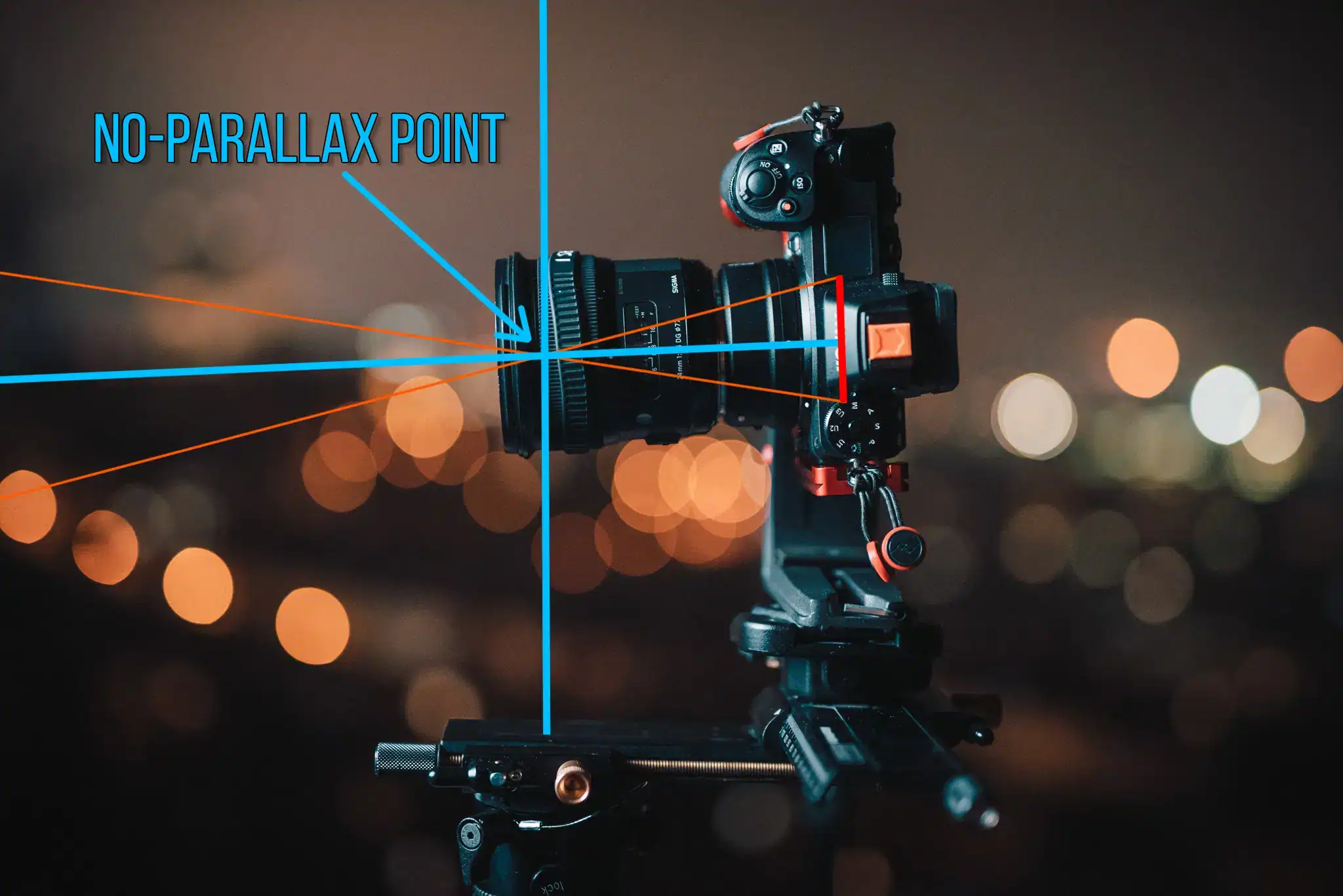
For nodal alignment basics with diagrams and best practices, see this panoramic head setup guide from Oculus Creator: set up a panoramic head to shoot high‑end 360 photos.
Step-by-Step Shooting Guide
Standard Static Scenes
- Level and nodal align. Place the tripod on stable ground. Level the base. On the pano head, adjust fore-aft until near/far objects remain aligned as you pan. Mark the rail for repeatability. With this Tokina at 11mm, a typical forward offset is in the ~6–8 cm range from the rotation axis to align the entrance pupil—start at ~65 mm and fine-tune.
- Manual exposure and locked white balance. Set Manual mode, choose a consistent shutter/aperture/ISO that avoids clipping highlights where possible, and lock white balance (e.g., Daylight/Tungsten) to prevent color shifts between frames. Shoot RAW for maximum flexibility.
- Capture with proper overlap. At 11mm (APS-C), 25–30% overlap works well. For a full sphere, shoot two rows at ±30–35° tilt with 8 shots around each row, then add 2–3 zenith shots and 2–3 nadir shots.
- Take a clean nadir. After the main sweep, tilt the camera down to capture a clean ground plate for removing the tripod in post. You can also shoot a handheld nadir by shifting the tripod out of frame, as long as you keep the lens over the original nodal point.
HDR / High Dynamic Range Interiors
- Bracket ±2 EV (3–5 frames). The A7 IV’s dynamic range is excellent, but bracketing preserves highlights in windows while maintaining shadow detail.
- Lock WB and focus. Keep color consistent across brackets and avoid refocusing between brackets to prevent micro-misalignment.
- Use the 2s timer or remote. This stabilizes every frame in the bracket set. Consider electronic first-curtain shutter for minimal vibration.
Low-Light / Night Scenes
- Longer exposures on a tripod. Use f/4–f/5.6, ISO 100–400 for clean files, and lengthen shutter speed to 1/8–4s as needed. Turn off IBIS on a tripod to prevent micro-blur.
- Keep star trails in check. If capturing sky as part of your 360, aim for 10–20s at wider focal lengths to limit trails, but remember the multi-row time overhead—clouds and stars shift between rows.
- Noise reduction workflow. Prefer noise reduction in post, not in-camera long exposure NR, to keep cadence and avoid hot-pixel mismatch across frames.
Crowded Events
- Two-pass strategy. First pass for coverage, second pass to catch clean patches when people move. This gives you frames to mask in post and reduce ghosting.
- Faster shutter and overlap. Use 1/200s+ and 30–40% overlap for more control-point options during stitching with moving subjects.
- Respect privacy and safety. Avoid obstructing traffic and keep the tripod footprint compact.
Special Setups (Pole / Car / Drone)
- Pole shots. Use a carbon pole with guy-lines or a belt support. Keep rotation slower and use higher overlap (30–40%). Leave IBIS on to damp small motions.
- Car-mounted. Ensure vibration isolation, increase shutter to 1/500s or faster, and shoot when the vehicle is stationary if possible. Confirm local laws.
- Rooftops and wind. Always use tethers, avoid gusty edges, and never lean over parapets. If the head wobbles, reduce row count and increase overlap for safety.
Field-Tested Shot Patterns
Full 360 Sphere at 11mm (APS-C crop)
Row 1: +35° tilt, 8 shots around (45° yaw steps). Row 2: −35° tilt, 8 shots around (staggered between Row 1 positions). Add 3× zenith (90° tilt, 120° yaw) and 3× nadir. This delivers generous overlap and solid control points for PTGui/Hugin, even in low-texture areas.
Single-Row Cylindrical (Wide Banner)
Level camera at horizon, 10–12 shots around at 30% overlap. Great for web banners or print panoramas where full zenith/nadir data isn’t required.
Recommended Settings & Pro Tips
Exposure & Focus
| Scenario | Aperture | Shutter | ISO | Notes |
|---|---|---|---|---|
| Daylight outdoor | f/8–f/11 | 1/100–1/250 | 100–200 | Lock WB (Daylight); turn IBIS off on tripod |
| Low light/night | f/4–f/5.6 | 1/8–1/30 (tripod) | 100–400 (800 if needed) | Remote trigger; avoid in-camera NR |
| Interior HDR | f/8 | Bracket ±2 EV | 100–400 | Protect highlight detail in windows |
| Action / moving subjects | f/5.6–f/8 | 1/200+ | 400–800 | Two-pass capture for clean masks |
Critical Tips
- Manual focus and hyperfocal: At 11mm and f/8 (APS-C), hyperfocal is roughly 0.8 m; set focus there to keep everything from ~0.5 m to infinity acceptably sharp.
- Nodal calibration: Use near/far objects, pan left/right, and adjust until parallax disappears. Mark the rail for 11mm and 16–20mm positions to speed future setups.
- White balance lock: Avoid mixed color casts across frames by setting a specific WB preset or custom Kelvin value.
- RAW over JPEG: Panoramas magnify small differences; RAW gives headroom for color matching and noise control.
- IBIS/shutter: Turn IBIS off on a tripod; use electronic first-curtain shutter to reduce vibration. For pole work, IBIS can help counter tiny shakes.
- A7 IV crop setup: Enable APS-C/Super 35 mode for the Tokina. Expect ~14MP per frame—total pano resolution will still be very high due to frame count.
Stitching & Post-Processing
Software Workflow
Import RAWs into Lightroom/Capture One for baseline adjustments (lens profile, white balance match, exposure tweaks) and export 16-bit TIFFs. Stitch in PTGui, Hugin, or similar. Rectilinear ultra-wides like the Tokina usually benefit from 25–30% overlap and plentiful control points. If you bracketed, use exposure fusion/HDR merge in PTGui or pre-merge bracket sets before stitching. PTGui’s optimizer and masking tools are industry standards for tricky scenes with moving subjects. For a thorough review of PTGui in real workflows, see this overview: Why PTGui is a top tool for complex panoramas.
For understanding how focal length and frame count affect finished resolution, the Panotools wiki is an excellent resource: DSLR spherical resolution explained.
Cleanup & Enhancement
- Nadir/tripod removal: Patch with a dedicated nadir shot or use masking and clone/heal tools. Some AI tools can speed up floor plate cleanup.
- Color and noise: Match color across rows first; apply mild noise reduction to shadow brackets from interiors and night scenes.
- Geometry: Level the horizon and correct roll/pitch/yaw in the stitching software. Rectilinear lenses help keep lines true.
- Export: Equirectangular 2:1 at 8K/10K/16K depending on use (web, VR, large prints). For VR platforms, export JPEG at ~80–90% quality or 16-bit TIFF for archival masters.
Note: Always consult the latest documentation for your stitching software, as features and best practices evolve.
For additional panoramic head fundamentals and practical tips, see this tutorial: Panoramic head tutorial and buyer’s guide.
Useful Tools & Resources
Software
- PTGui panorama stitching
- Hugin open source
- Lightroom / Photoshop / Affinity Photo
- AI tripod removal and masking tools
Hardware
- Panoramic heads (e.g., Nodal Ninja, Leofoto)
- Carbon fiber tripods with leveling bases
- Wireless remote shutters (Sony or third-party)
- Pole extensions and car mounts with safety tethers
Disclaimer: product names are for reference; always check official specifications and documentation before purchase.
Common Mistakes & How to Avoid Them
- Parallax error → Calibrate the entrance pupil and keep it over the rotation axis, especially for near objects.
- Exposure flicker → Use Manual exposure and locked WB across all frames and brackets.
- Tripod shadows and footprints → Shoot a dedicated nadir frame and patch during post.
- Ghosting from moving subjects → Two-pass shooting and masking in PTGui/Hugin.
- Soft edges at f/2.8 → Stop down to f/5.6–f/8 for better corner sharpness on the Tokina.
- Motion blur on pole/car rigs → Increase shutter speed, raise ISO carefully, and add overlap for stability in stitching.
Frequently Asked Questions
-
Can I shoot handheld panoramas with the Sony A7 IV?
Yes, for quick cylindrical pans outdoors. Use 1/200s+ and 30–40% overlap. For full 360 spheres—especially interiors—use a tripod and panoramic head to avoid parallax and alignment problems.
-
Is the Tokina ATX-i 11–20mm wide enough for a single-row 360?
Not for a full 360×180 sphere. At 11mm in APS-C mode (~16.5mm FF eq), you’ll need at least two rows plus zenith/nadir shots. A single row is fine for cylindrical panoramas.
-
Do I need HDR for interiors with bright windows?
Often yes. Bracket ±2 EV (3–5 exposures) to preserve highlight detail outside windows and clean shadows indoors. The A7 IV has strong DR, but HDR yields smoother, less noisy results.
-
How do I avoid parallax issues with this lens?
Use a panoramic head and align the entrance pupil. Start with ~65 mm forward rail offset at 11mm, then fine-tune using a near/far alignment test. Mark the rail for repeatable positions.
-
What ISO range is safe on the A7 IV in low light?
On a tripod, prioritize ISO 100–400 for cleanest files. ISO 800–1600 is still usable if you need faster shutters; apply noise reduction in post. Avoid pushing beyond that unless necessary.
Practical Scenarios & Field Advice
Indoor Real Estate
Set APS-C mode, 11–14mm, f/8, ISO 100–200, and bracket ±2 EV. Lock WB (e.g., 3500–4500K for mixed indoor light), turn off IBIS, and use two 8-shot rows plus zenith/nadir. Keep the lens parallel to walls to reduce perspective stretch. Use PTGui’s exposure fusion or HDR merge to balance window light and interior shadows. Place the tripod away from reflective surfaces or shoot additional frames to patch reflections later.
Outdoor Sunset
At blue hour, use f/8, ISO 100–200, and longer shutters (1–2s). Add 30% overlap and two rows to capture sky gradients without banding. Consider bracketing when the sun is in-frame. Use a lens hood and shield the lens from flare with your hand just outside the frame. Shoot a second full round to hedge against moving clouds between rows.
Crowded Events or Markets
Go 11mm, f/5.6–f/8, 1/250–1/500s, ISO 400–800. Capture two full passes: one to map the scene, another to grab clean spots as people move. In PTGui, use masks to select the least crowded areas from each overlapping frame. Increase overlap to 30–40% to give the stitcher more options for clean control points.
Rooftop / Pole Shooting
Use a compact carbon pole with a tether. At 11mm, increase overlap to 35–40% and use 1/250s+ if wind is present. Keep the A7 IV’s IBIS on for pole work. Safety first: avoid overhangs and high winds; never rely on a single clamp or strap.