Why This Camera & Lens Are Great for Panoramas
The Sony A7 IV paired with the Sony FE 12–24mm f/4 G is a powerful combo for creating high-quality 360° and ultra-wide panoramas. The A7 IV’s 33MP full-frame BSI sensor (approx. 7008 × 4672 pixels; ~5.1 μm pixel pitch) offers excellent dynamic range (~14+ stops at base ISO), clean color, and reliable low-light performance. Its 5-axis IBIS helps when shooting handheld scouting frames, while 14-bit RAW capture preserves subtle tonal gradations critical for smooth sky and interior gradients.
The FE 12–24mm f/4 G is an ultra-wide rectilinear zoom, delivering an expansive field of view without the characteristic curvature of fisheye lenses. At 12mm, you get an approximate 122° horizontal and ~84° vertical FOV on full frame, which is wide enough to reduce the number of frames needed for a full spherical panorama compared to longer rectilinear lenses. Optical performance is strong at f/5.6–f/8, with good corner sharpness for an ultra-wide, well-controlled lateral CA, and Sony’s Nano AR coatings to tame flare. Note: it has a bulbous front element with no standard front filter thread; use rear gel filters if needed and employ a lens hood and careful light angles to minimize flare.
This guide shows exactly how to shoot panorama with Sony A7 IV & Sony FE 12–24mm f/4 G, from planning through stitching, with field-tested overlaps, exposure tactics, and nodal-point alignment techniques for reliable results indoors and out.
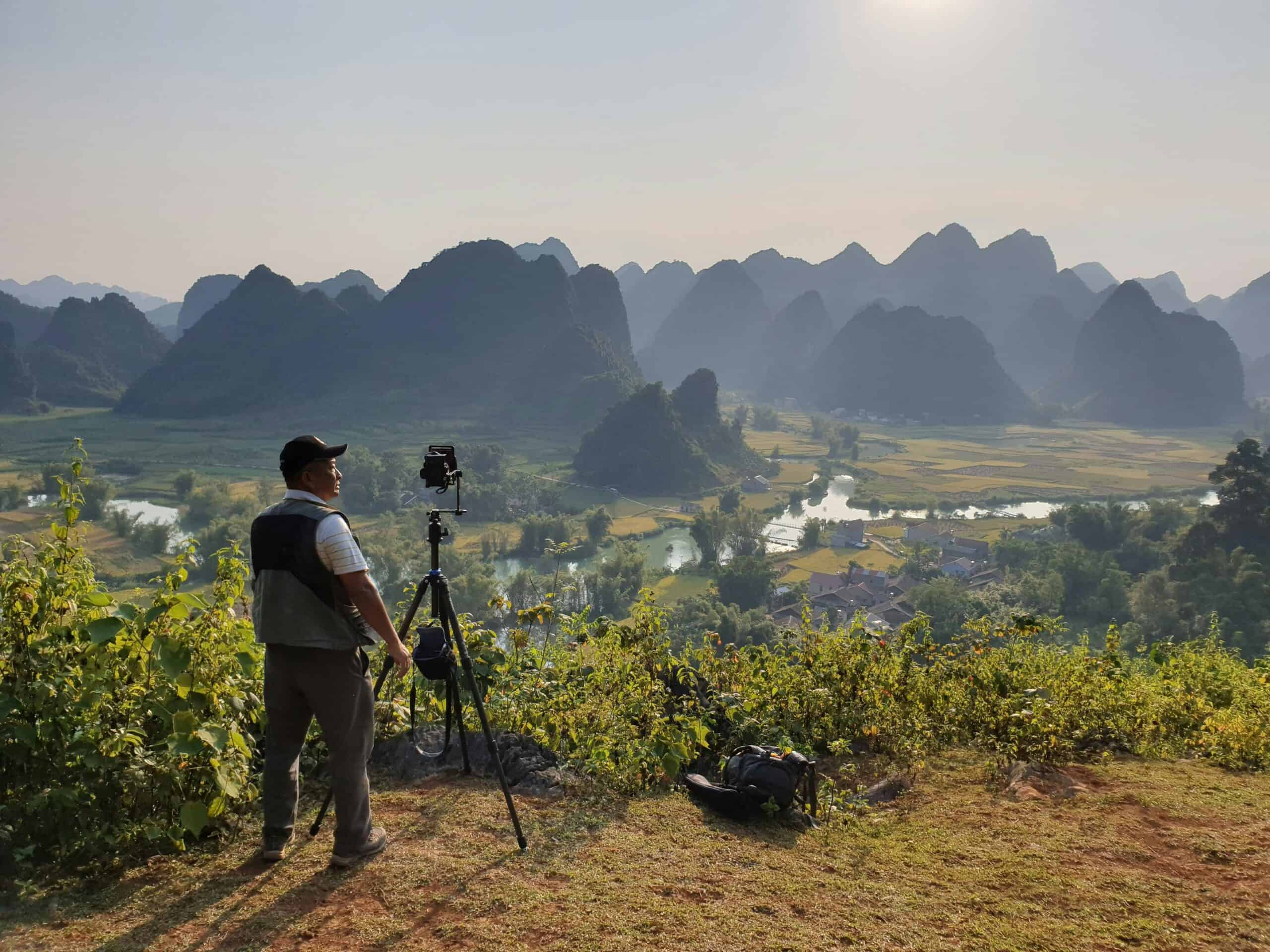
Quick Setup Overview
- Camera: Sony A7 IV — Full-frame 33MP BSI CMOS, ~14+ stops DR at ISO 100, 14-bit RAW, 5.5-stop IBIS.
- Lens: Sony FE 12–24mm f/4 G — rectilinear ultra-wide zoom, best sharpness around f/5.6–f/8, good flare resistance (Nano AR), mild lateral CA manageable in post.
- Estimated shots & overlap (field-tested):
- 12mm rectilinear (fast capture): 8 around (0° pitch) + 1 zenith + 1–3 nadir cleanup. Overlap: 25–30%.
- 12mm rectilinear (safer coverage): 8 around at +30° pitch + 8 around at −30° pitch + zenith + 1–3 nadir. Total: 18–20 shots.
- 16–24mm rectilinear (higher detail/gigapixel look): 10–12 around × 2–3 rows + poles; 28–40+ shots depending on overlap.
- Difficulty: Intermediate (requires nodal-point alignment and consistent manual exposure/WB).
Planning & On-Site Preparation
Evaluate Shooting Environment
Walk the location first. Note moving elements (people, cars, foliage), reflective surfaces (glass, glossy floors), and light direction. Avoid direct flare from low sun by angling the camera slightly off-axis or shading the lens with your hand or hood. If shooting through glass, get the front element as close as safely possible (1–2 cm) to reduce reflections and ghosting, and watch for suction-mount safety if shooting from vehicles or rooftops.
Match Gear to Scene Goals
The Sony A7 IV’s dynamic range helps retain highlight detail in sunsets and interior windows, while the FE 12–24mm’s expansive rectilinear FOV reduces frame count compared to longer lenses. For real estate and interior VR tours, expect to use HDR bracketing and keep ISO low (100–400; 800 if necessary). For outdoor sunset/sunrise HDR panoramas, bracket ±2 to ±3 EV. The rectilinear lens avoids fisheye stretching artifacts but requires more frames than a fisheye. That’s a fair trade if you want straighter lines and higher final resolution.
Pre-shoot Checklist
- Charge batteries; bring spares. Use high-speed SD/CFexpress for burst bracketing.
- Clean front element and sensor; dust shows up when cloning the nadir.
- Level tripod and verify panoramic head calibration (entrance pupil/nodal point).
- Safety: add a tether/leash on rooftops, watch wind with poles, confirm car mounts and straps.
- Backup capture: do a second full pass in case of a big moving subject or accidental bump.
Essential Gear & Setup
Core Gear
- Panoramic head: Align the camera’s entrance pupil (commonly referred to as nodal point) over the rotation axis to eliminate parallax. This ensures foreground and background align cleanly during stitching.
- Stable tripod with leveling base: A leveling base speeds setup and keeps your horizon clean, reducing post corrections.
- Remote trigger or app: Use a remote release, 2-sec self-timer, or Sony’s Imaging Edge Mobile/Creator’s App for vibration-free exposures.
Optional Add-ons
- Pole or car mount: Use a safety tether and avoid strong winds. Keep shutter speeds higher to counter vibration and shoot extra overlap.
- Lighting aids: Small LEDs for dark interiors; balance lamp color with gels to reduce mixed-light WB issues.
- Weather protection: Rain covers for the A7 IV and a microfiber towel for the FE 12–24mm’s bulbous element.
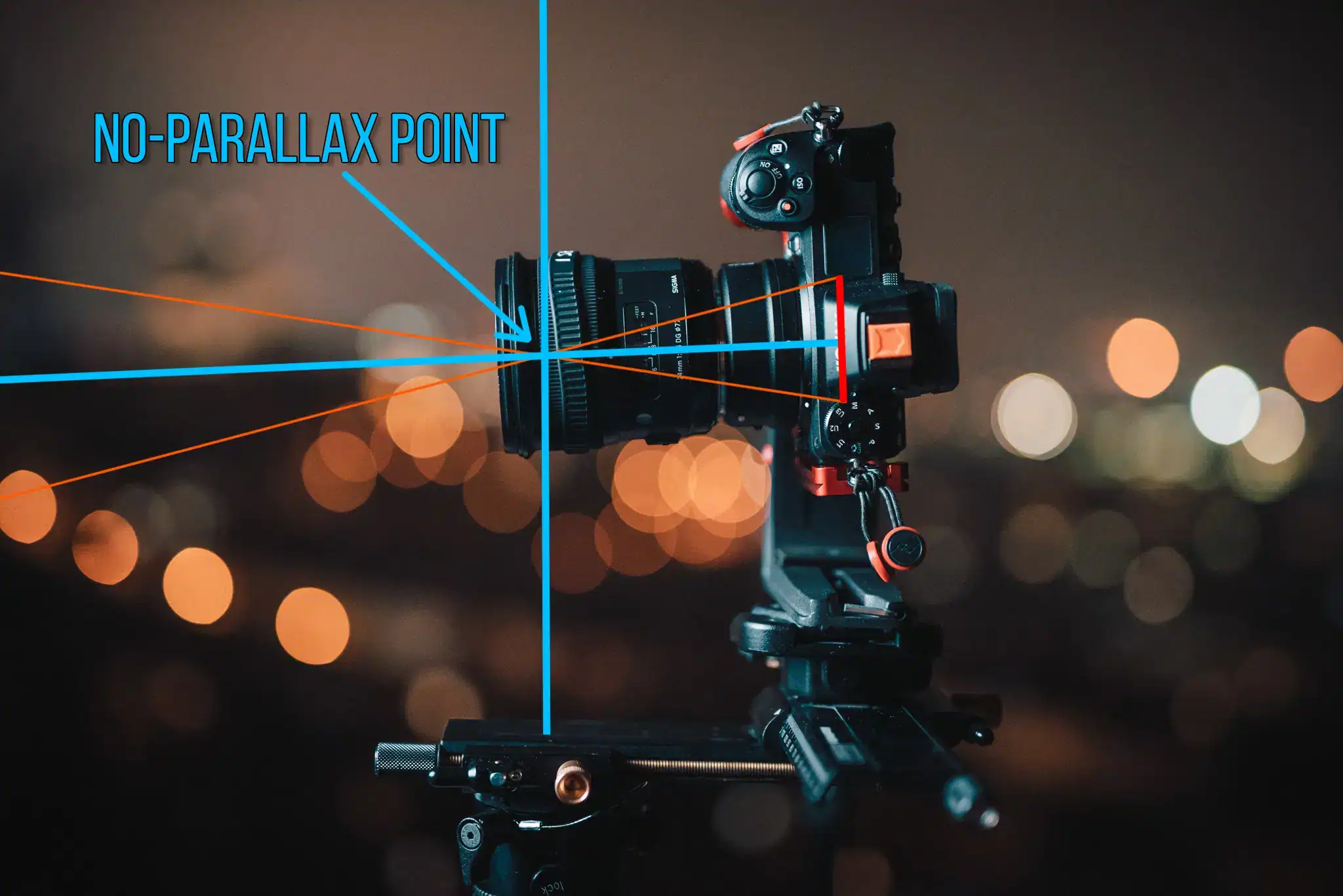
New to panoramic heads? This step-by-step tutorial on panoramic head setup gives a clear visual walkthrough that complements the process described below. See a panoramic head alignment tutorial.
Video: Panorama Head and Shooting Basics
Watching a short demo can accelerate learning the muscle memory for rotating, bracketing, and maintaining overlap.
Step-by-Step Shooting Guide
Standard Static Scenes
- Level and balance: Level the tripod using the leveling base. Mount the A7 IV on the panoramic head, ensuring the rotation axes intersect the lens’s entrance pupil.
- Nodal calibration (practical): Place a light stand or pole close to the camera and a building edge far behind it. Rotate left/right while adjusting the fore-aft rail until the near/far alignment doesn’t shift. On the FE 12–24mm, start with the rail such that the sensor plane mark (Φ symbol on the camera top) sits roughly 75–85 mm behind the rotation axis at 12mm, then fine-tune. Mark your rail with tape once perfect.
- Manual exposure, focus, and WB: Set M mode. Meter a midtone frame; lock exposure. Set WB to a fixed value (e.g., daylight 5600K outside; custom Kelvin indoors). Focus using magnified view on a mid-distance object and switch to MF. For 12mm at f/8, a hyperfocal of ~0.6–0.7 m keeps everything from ~0.35 m to infinity acceptably sharp.
- Capture sequence and overlap: For “fast capture,” shoot 8 frames around (every 45°) at 0° pitch with 25–30% overlap, then shoot a zenith and at least one nadir frame. For “safer coverage,” shoot two rows: 8 frames around at +30° and 8 around at −30°, then a zenith and nadir.
- Nadir technique: After the main sequence, tilt the camera straight down. Take 1–3 frames and, if possible, move the tripod slightly and shoot a handheld downward plate for easier tripod patching later.
HDR / High Dynamic Range Interiors
- Bracket ±2 EV (or ±3 EV for very bright windows). Use AEB with 3–5 frames; drive mode set to continuous bracket for speed.
- Lock WB and focus before starting; avoid flicker by keeping ISO fixed and turning off Auto ISO.
- Shutter type: Use electronic first-curtain shutter (EFCS) on tripod to reduce vibration. Disable Long Exposure NR to keep the cadence consistent.
- Confirm overlap across brackets. Shoot a full set at each position before rotating to the next.
Low-Light / Night Scenes
- Use the tripod and remote. Start around f/4–f/5.6, ISO 100–400 when possible. The A7 IV remains clean up to ISO 1600; ISO 3200 is workable with NR; 6400 is an emergency ceiling for 360s where fine detail matters.
- Increase exposure time instead of ISO where practical (e.g., 1–4 seconds). Turn IBIS off on tripod to prevent micro-blur.
- Watch movement: shoot the sky first if clouds are moving fast, then complete the rest.
Crowded Events
- Two-pass method: First capture a full set quickly. Then wait for gaps and recapture problematic frames for later masking.
- Use faster shutter speeds (1/200+ at f/5.6–f/8, ISO 400–800) to freeze motion at the horizon row.
- In post, blend clean plates where people crossed seams.
Special Setups (Pole / Car / Drone)
- Pole: Balance weight, tether the camera, and avoid winds over ~15–20 mph. Increase overlap to 35–40% and use higher shutter speeds (1/250+).
- Car mount: Use vibration-damped suction rigs and a safety strap. Pre-focus and shoot bursts at each heading; consider 12mm to reduce frame count.
- Drone: This lens/camera combo isn’t drone-friendly; instead shoot from a high vantage or use a pole extension.
Recommended Settings & Pro Tips
Exposure & Focus
| Scenario | Aperture | Shutter | ISO | Notes |
|---|---|---|---|---|
| Daylight outdoor | f/8–f/11 | 1/100–1/250 | 100–200 | Lock WB (Daylight 5200–5600K); IBIS off on tripod |
| Low light/night | f/4–f/5.6 | 1/30–4s | 100–800 | Remote release; EFCS; long exposure instead of high ISO |
| Interior HDR | f/8 | Bracket ±2 to ±3 EV | 100–400 | Continuous bracketing; fixed WB; avoid Auto ISO |
| Action / moving subjects | f/5.6–f/8 | 1/200+ | 400–800 | Two-pass capture for clean plates |
Critical Tips
- Manual focus at hyperfocal: At 12mm and f/8, ~0.6–0.7 m is a reliable set-and-forget distance.
- Nodal calibration: Use a near/far alignment test; mark your rail for 12mm and for 24mm. Recheck if you change zoom or add a filter gel.
- White balance lock: Never let WB drift across frames; it causes visible seams, especially indoors with mixed lighting.
- RAW vs JPEG: Shoot RAW (Lossless Compressed). Apply lens corrections and chromatic aberration fixes in post for cleaner stitches.
- IBIS: Turn IBIS off on tripod; leave it on for handheld scouting or emergency handheld capture.
- Sony quick recall: Save a “Pano” memory (1/2/3) with M mode, EFCS, RAW, fixed WB, MF, bracketing off/on as needed for speed.
Stitching & Post-Processing
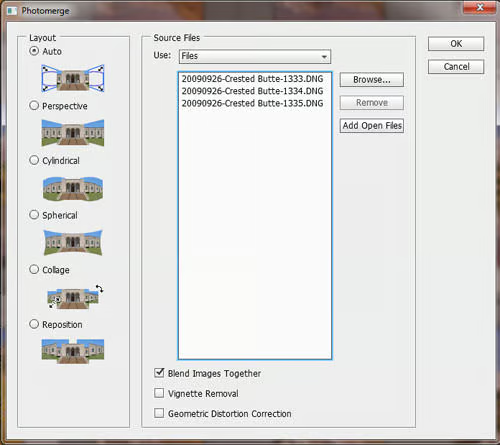
Software Workflow
For best control, stitch in PTGui or Hugin. PTGui handles rectilinear ultra-wide sets robustly, especially with mixed HDR brackets. Rectilinear lenses require more frames than fisheyes, but the payoff is straighter lines and more natural perspective. Aim for 25–30% overlap at 12mm, and 20–25% at longer focal lengths if your head is perfectly calibrated. Export as an equirectangular 2:1 image for VR players or web viewers, and consider 8K (7680×3840) to 16K (15360×7680) depending on your capture density. For a deeper review of PTGui’s advantages for complex panoramas, see this practical overview. Why PTGui is a top choice for panoramic stitching.
If you’re building full VR tours or need a DSLR/mirrorless pipeline refresher, this guide walks through capture-to-stitch considerations. Using a mirrorless camera to shoot and stitch a 360 photo.
Cleanup & Enhancement
- Nadir patch: Use PTGui Viewpoint Correction, AI-based patchers, or clone stamping to remove tripod legs and shadows.
- Color & WB: Balance global WB first, then local HSL to harmonize mixed light in interiors.
- Noise reduction: Apply conservative NR on the sky and shadows; preserve edge detail on architecture.
- Horizon: Level using the pitch/roll/yaw tool; A7 IV’s level aids reduce correction needed if you start level.
- Export: Save a high-quality 16-bit TIFF master and a web-optimized 8-bit JPEG for VR platforms.
Tip: If you need more background on pano fundamentals and head setup, this explainer is concise. DSLR/mirrorless virtual tour FAQ and lens guide.
Disclaimer: Software and features evolve; consult each tool’s latest documentation for updated steps.
Useful Tools & Resources
Software
- PTGui (Windows/macOS) — fast, robust control point generation and HDR fusion.
- Hugin — open-source alternative with fine control.
- Lightroom / Photoshop — RAW development, masking, and nadir cleanup.
- AI tripod/nadir removal — speeds patching repetitive floors or grass.
Hardware
- Panoramic heads (Nodal Ninja, Leofoto, Sunwayfoto) calibrated for entrance pupil.
- Carbon fiber tripods — stiffness without weight.
- Leveling bases — quick horizon setup.
- Wireless remotes — vibration-free exposures.
- Pole extensions / car mounts — with safety tethers for elevated or mobile shots.
Disclaimer: Brand names for research only; verify compatibility and specs on official product pages.
Common Mistakes & How to Avoid Them
- Parallax error → Always align the entrance pupil; recheck after changing focal length or adding gels.
- Exposure/WB flicker → Lock manual exposure and fixed WB; avoid Auto ISO and Auto WB.
- Tripod shadows at nadir → Shoot an extra handheld nadir plate and patch cleanly.
- Ghosting from moving subjects → Use two-pass capture and mask in post.
- Night noise and blur → Keep ISO modest (100–800), use longer exposures, EFCS, and remote triggering.
- Flare from the sun or bright fixtures → Re-angle slightly, shield the lens, and take a second frame to blend out flare.
Real-World Case Studies
Indoor Real Estate, Midday
Sony A7 IV at ISO 100, f/8, HDR ±2 EV, FE 12–24mm at 12mm. Use two rows (8 around each at ±30°) plus zenith and nadir. Lock WB around 4000–4500K if daylight mixes with warm lamps. Stitch in PTGui with exposure fusion, correct verticals, and patch the tripod with a cloned tile or logo plate.
Outdoor Sunset, Rooftop
Wind safety: tether your rig. Expose for midtones, bracket ±2 EV to protect highlights. Shoot the sky row first while colors change quickly, then the lower row and nadir. ISO 100–200, f/8, shutter varies 1/250 to 1s across brackets. Apply highlight recovery and graduated adjustments in post.
Crowded Event, Street Level
Use fast single-row capture at 12mm (8 around + zenith + nadir) and a second pass for clean plates. Shutter 1/200–1/400, f/5.6–f/8, ISO 400–800. In post, mask people at seams using the clean plates to avoid half-subject artifacts.
Frequently Asked Questions
- Can I shoot handheld panoramas with the Sony A7 IV?
Yes, for quick partial panos or creative 360 experiments. Use 12mm, IBIS on, 30–40% overlap, and faster shutters (1/200+). Expect more stitching errors and parallax artifacts, especially indoors with foreground objects. A tripod and pano head are strongly recommended for professional 360 work.
- Is the FE 12–24mm f/4 G wide enough for single-row 360s?
It’s possible but tight. At 12mm, one row of 8 around plus dedicated zenith and nadir frames can cover the sphere, but you’ll often have thin coverage near the poles. For safer stitching, use two rows at ±30° plus poles.
- Do I need HDR for interiors with bright windows?
Usually yes. The A7 IV has strong DR, but windows can exceed it. Bracket ±2 EV (or ±3 EV for very bright exteriors) and merge in PTGui or Lightroom to preserve both window detail and interior shadows.
- How do I avoid parallax issues with this lens?
Mount the camera on a calibrated panoramic head and align the entrance pupil. With the FE 12–24mm at 12mm, start your rail around 75–85 mm behind the rotation axis (approximation), then fine-tune using a near/far alignment test. Mark your final positions on the rail for repeatability.
- What ISO range is safe on the A7 IV for low light panoramas?
On tripod, favor ISO 100–400 and lengthen the shutter. ISO 800 is still clean; ISO 1600 is workable with mild noise reduction. ISO 3200 can be used in a pinch; avoid 6400+ if you need fine architectural detail.
- Can I set up custom modes to speed pano shooting?
Yes. Use the A7 IV’s Memory Recall (1/2/3 on the mode dial) to store “Pano Daylight” (M, RAW, EFCS, WB fixed, MF) and “Pano HDR” (M, AEB ±2 EV, continuous bracket). Also add “Release w/o lens” ON if your pano head uses an adapter that requires it.
Want broader context on head setup and capture principles? This concise guide expands on the fundamentals. Set up a panoramic head for high-end 360 photos.
Safety, Reliability, and Quality Control
Rooftops and poles demand cautious rigging: tether the A7 IV body, use redundant clamps, and never leave the tripod unattended in wind. Use a lens hood or your hand to flag the sun and prevent flare blobs on the FE 12–24mm’s bulbous front element. In wet conditions, keep a microfiber ready and a rain cover over the camera between rotations. For mission-critical work, perform a quick test stitch onsite on a laptop or tablet, and shoot a full backup round before changing locations.
Finally, maintain a versioned backup workflow: copy RAWs to two devices in the field, keep a checksum log, and store stitched masters plus layered nadir patch files separately from your exported equirectangulars. This ensures you can re-edit for future clients or higher-resolution outputs later.
Further Reading
For a fundamentals refresher, explore a community Q&A on panoramic best practices at the end of your learning session. Best techniques to take 360 panoramas.