Why This Camera & Lens Are Great for Panoramas
The Sony A7 IV is a versatile 33MP full-frame mirrorless camera with excellent color depth, roughly 14 stops of usable dynamic range at base ISO, and a pixel pitch of about 5.1 μm. That combination delivers clean files, robust highlight retention, and flexible shadows—ideal for stitching seamless 360 photos and HDR panoramas. The Olympus M.Zuiko 8mm f/1.8 PRO Fisheye is a fast, weather-sealed, diagonal fisheye with 180° diagonal coverage on Micro Four Thirds bodies. Stopped down to f/5.6–f/8, it’s impressively sharp corner to corner, with restrained chromatic aberration and low coma, making it a reliable fisheye optic for panoramic work.
Important Mount Compatibility Note
The Olympus 8mm f/1.8 PRO is a Micro Four Thirds (MFT) lens and is not natively compatible with Sony E-mount. There is no common electronic adapter that preserves autofocus/aperture control or provides full image circle coverage on the A7 IV. Practically, you have two best options:
- Use a native E-mount fisheye with similar coverage on the A7 IV (e.g., a 12–16mm diagonal fisheye or 8mm circular fisheye via EF adapter). Shooting steps below apply 1:1.
- Use the Olympus 8mm on an OM System/Olympus MFT body for capture, then stitch and publish normally; the shooting and stitching workflow described here still applies.
If you do find a niche mechanical adapter, expect heavy vignetting and no electronic aperture control (stuck wide open), which is suboptimal for panoramas. For a smooth experience on the A7 IV, use a native or adapt-friendly fisheye. The technique, nodal alignment, overlap rules, and post-processing are identical.
Quick Setup Overview
- Camera: Sony A7 IV — Full-frame (35.9 × 23.9 mm), 33MP RAW, ~14-stop DR at base ISO, dual card slots (CFexpress Type A/SD for Slot 1; SD UHS-II for Slot 2).
- Lens: Olympus M.Zuiko 8mm f/1.8 PRO Fisheye — Diagonal fisheye, very sharp by f/2.8–f/5.6, well-controlled CA, weather-sealed. Note: MFT mount; use an E-mount fisheye with equivalent coverage on A7 IV.
- Estimated shots & overlap:
- Diagonal fisheye on full-frame (12–16mm equivalent): 6 shots around at 60° spacing + zenith + nadir (25–30% overlap). Distant scenes can work with 4 around + Z + N.
- Diagonal fisheye on smaller sensor (MFT/APS-C): 6–8 around + Z + N (30–35% overlap) for safer seams indoors.
- Difficulty: Moderate (fisheye is forgiving), but higher if using non-native mount. With a native E-mount fisheye: Easy–Moderate.
Planning & On-Site Preparation
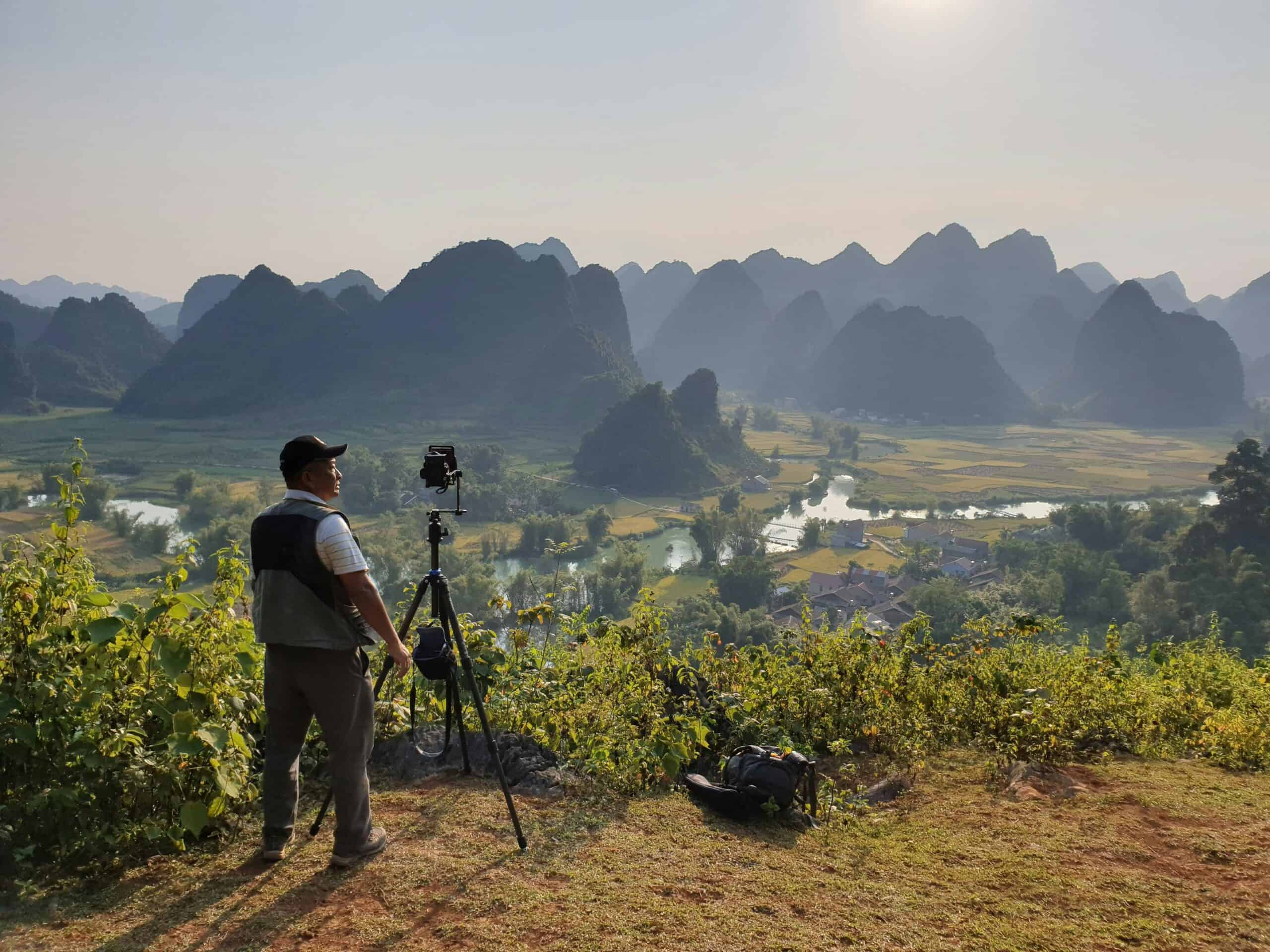
Evaluate Shooting Environment
Start by reading the light and movement. For interiors, note dynamic range hotspots (bright windows, downlights, dark corners). For exteriors, watch for moving people, trees, cars, and the sun’s position—fisheyes are prone to flare when the sun sits near the frame edge. Around glass, keep the front element a few centimeters off the glass and shoot at a slight angle to avoid reflections; bring a flexible rubber lens hood or a black cloth if you must shoot flat against glass.
Match Gear to Scene Goals
The A7 IV’s clean base ISO and strong dynamic range excel in high-contrast scenes, while its 14-bit RAW files and precise manual controls make exposure and white balance locking easy. With a fisheye, you’ll need fewer shots to cover 360°, speeding up shooting in windy or crowded environments. If low light is expected, the fast aperture of an 8mm fisheye on MFT (or a fast E-mount fisheye alternative on the A7 IV) keeps shutter speeds reasonable without pushing ISO too high.
Pre-shoot Checklist
- Charge batteries; enable dual recording (RAW to Slot 1, JPEG to Slot 2) on the A7 IV for redundancy.
- Clean lens/sensor meticulously—small dust becomes huge in equirectangular projection.
- Level the tripod; calibrate the panoramic head’s nodal point for the body/lens combo.
- Assess safety: wind load on rooftops, tethers for pole/car rigs, no overhangs above pedestrian traffic.
- Backup workflow: shoot a second safety round or a second bracket set when time allows.
Essential Gear & Setup
Core Gear
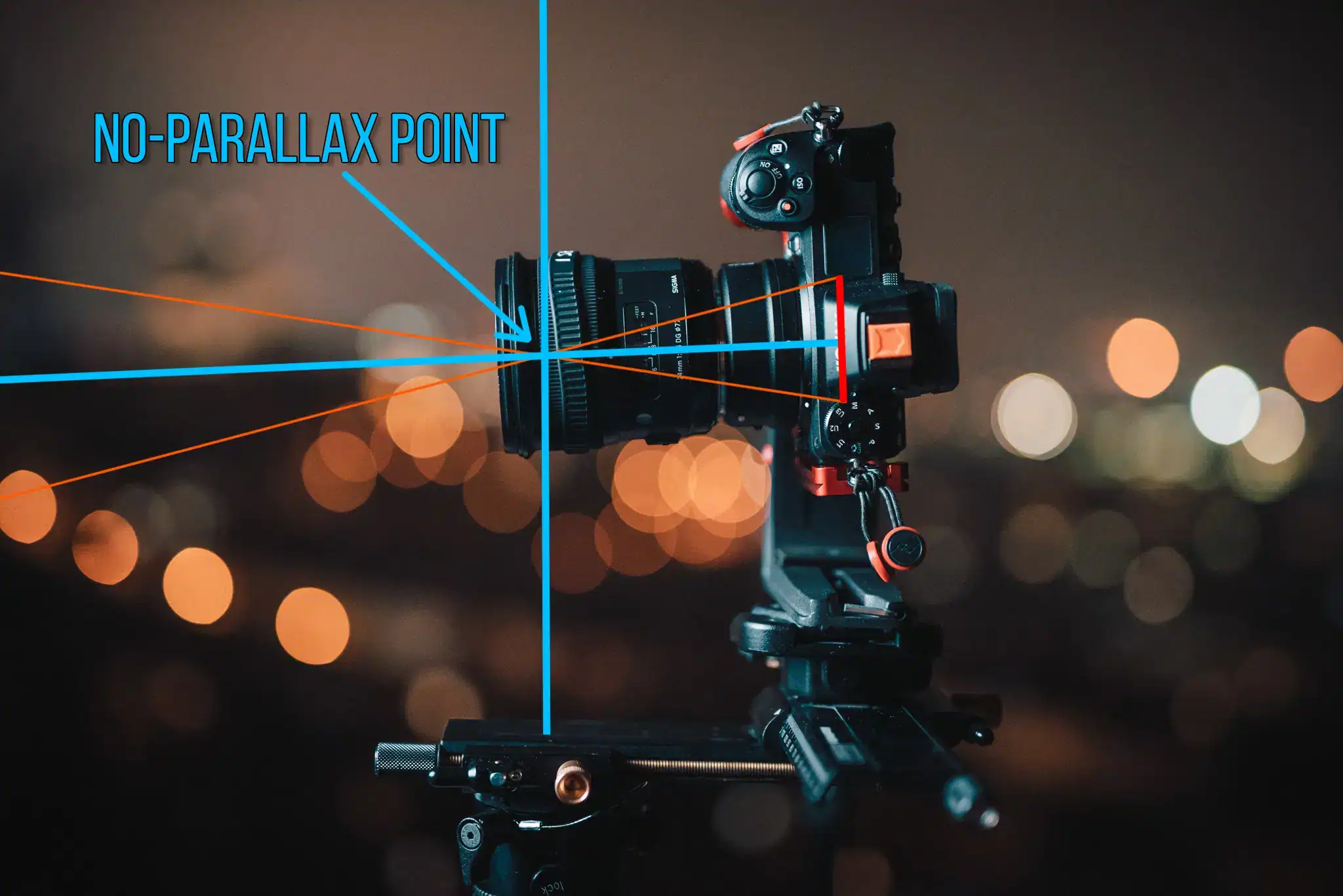
- Panoramic head: A multi-row head (Nodal Ninja/Leofoto) lets you place the lens’s entrance pupil (nodal point) over the rotation axis to eliminate parallax errors—critical for indoor scenes and near objects.
- Stable tripod with a leveling base: Level the base first, then your head stays level as you rotate.
- Remote trigger or Sony Imaging Edge Mobile app: Fire the shutter without touching the camera to avoid micro-shake.
Optional Add-ons
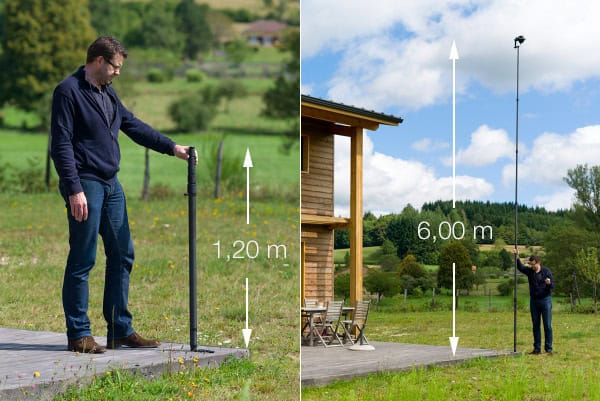
- Pole or car mount: Use a safety tether and check wind gusts; reduce rotation speed and keep shutter speeds higher to fight vibration.
- Lighting aids: Small LED panels or bounced flash for interiors; avoid mixed color temps if possible.
- Weather covers: Fisheyes are exposed. A simple rain cover preserves coatings and prevents water droplets that are nearly impossible to clone out.
Step-by-Step Shooting Guide
Standard Static Scenes
- Level and nodal alignment: Level the tripod via the leveling base. On the panoramic head, align the entrance pupil by adjusting the fore–aft rail until near and far objects stay aligned as you pan. Mark the rail once found so you can set it quickly next time.
- Manual exposure and white balance: Set Manual mode, meter the brightest panel you must keep (e.g., sky or window) and protect highlights. Lock WB to Daylight or a specific Kelvin to prevent color shifts across frames.
- Capture around: With a diagonal fisheye on full frame (12–16mm), shoot 6 frames around at 60° spacing with 25–30% overlap. Add a zenith (tilt up 90°) and a nadir (tilt down 90°, offset the tripod slightly or shoot an extra handheld nadir for clean floor).
- Metadata and cadence: Use a repeatable rotation cadence (e.g., click-stops). Keep horizon mid-frame for consistency.
HDR / High Dynamic Range Interiors
- Bracket ±2 EV (3 or 5 frames) to balance bright windows and interior shadows. The A7 IV’s bracketing menu makes this quick; use self-timer or remote for each pano position.
- Lock WB and focus across all brackets and positions. Consistency is essential for clean stitches.
- For windows with extreme contrast, consider 5–7 brackets in 1–2 EV steps; merge HDRs before or during stitching in PTGui.
Low-Light / Night Scenes
- Prioritize stability: Use tripod, turn off IBIS (SteadyShot) to avoid long-exposure micro-jitter on a tripod. Use a 2s timer or remote.
- Exposure: Start around f/4–f/5.6, 1/30–1/60 s, ISO 400–800. The A7 IV handles ISO 1600 gracefully if needed; above that, expect more aggressive noise reduction in post.
- Avoid mixed lighting: If unavoidable, plan for localized color correction during post.
Crowded Events
- Two passes: First for coverage, second for clean plates as gaps appear. Keep the tripod planted to preserve alignment.
- Use a faster shutter (1/200 s+) to reduce motion blur. You can mask moving subjects across frames later.
Special Setups (Pole / Car)
- Secure everything: Safety tether the camera. Check local rules and keep people clear below the pole.
- Wind management: Keep exposures short (1/250 s+), increase ISO if necessary, and rotate more slowly to avoid flexing the pole.
- Parallax compromise: Without a full panoramic head atop a pole, expect small parallax errors. A fisheye and healthy overlap minimize issues.
Real-World Case Studies
Indoor Real Estate
Set f/8, ISO 100–200. Bracket 5 shots at ±2 EV to retain window views. Use 6 around + Z + N. Avoid tripod in mirrors by stepping slightly aside for the nadir and patch later.
Outdoor Sunset Vista
Meter for the sky to preserve color; shoot 6 around quickly while the sun drops. Consider a second exposure set for foreground details to blend in post. Flare control: block the sun with your hand just outside the frame, or plan a seam away from the sun.
Event Crowd
Go with 6–8 around for more choices to mask motion. Shoot a second pass specifically to capture clean background gaps. Keep shutter 1/200 s or faster; raise ISO to 400–800 if needed.
Recommended Settings & Pro Tips
Exposure & Focus
| Scenario | Aperture | Shutter | ISO | Notes |
|---|---|---|---|---|
| Daylight outdoor | f/8–f/11 | 1/100–1/250 | 100–200 | Lock WB (Daylight/Kelvin 5600); protect highlights |
| Low light/night | f/4–f/5.6 | 1/30–1/60 | 400–800 | Tripod & remote; A7 IV tolerates ISO 1600 if necessary |
| Interior HDR | f/8 | Bracket ±2 EV | 100–400 | Merge HDR before or during stitching |
| Action / moving subjects | f/5.6–f/8 | 1/200+ | 400–800 | Freeze motion, plan two-pass capture |
Critical Tips
- Focus: Use manual focus around the hyperfocal distance. With an 8–12mm fisheye at f/8, focusing around 0.5–0.8 m typically keeps everything from ~0.3 m to infinity sharp.
- Nodal calibration: Center the camera over the rotation axis. Use two light stands (one near, one far) and adjust rails until there’s no relative shift as you pan.
- White balance lock: Don’t let AWB wander; it causes seam color shifts that are tedious to fix.
- RAW over JPEG: 14-bit RAW maximizes dynamic range and color latitude—essential for HDR panorama workflows.
- IBIS management: On tripod, disable SteadyShot to avoid micro-blur during long exposures. Handheld panos: enable SteadyShot and set focal length if using fully manual lenses.
Stitching & Post-Processing
Software Workflow
Import images into your stitcher of choice (PTGui recommended for speed/accuracy with fisheyes; Hugin for open-source). Do not defish files before stitching—feed the original fisheye frames. For diagonal fisheyes, aim for ~25–30% overlap. Let the software detect lens type and FOV, then refine control points manually where necessary. PTGui’s mask and vertical/horizon tools make it easy to fix small misalignments and hide moving objects. After stitching, export an equirectangular 2:1 image for VR platforms or virtual tour software. For HDR, either pre-merge brackets (e.g., to 32-bit EXR) or let PTGui merge them during stitching.
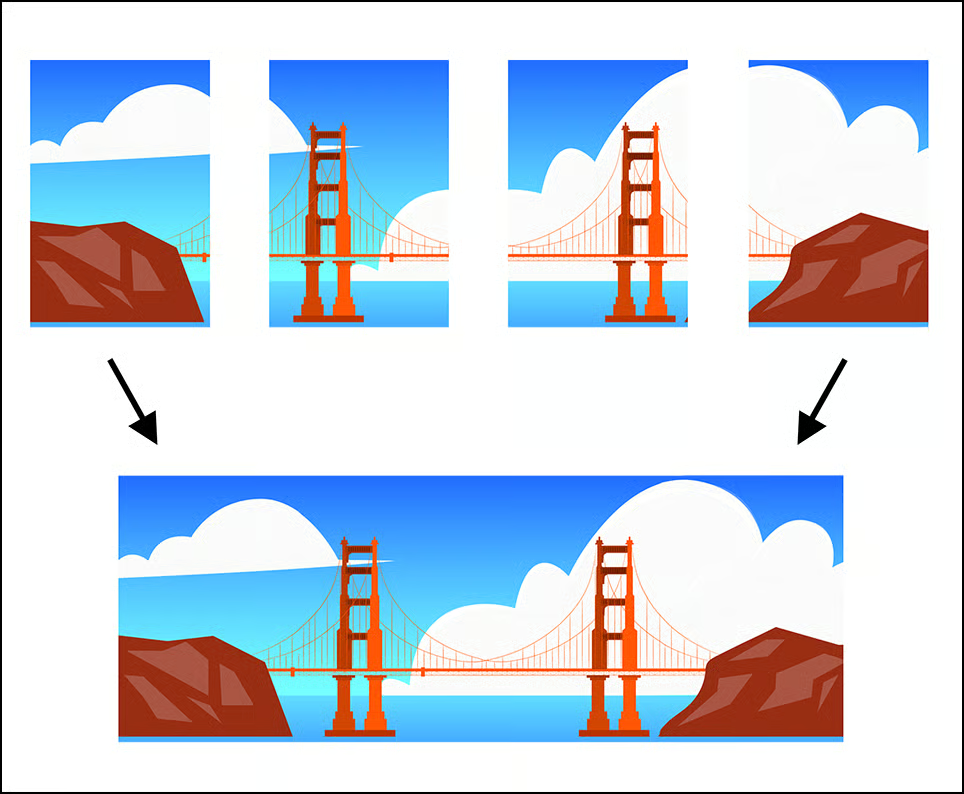
PTGui is widely used in the industry and offers excellent mask-based cleanup and horizon leveling tools, while Hugin remains a great free alternative. For an overview of PTGui in professional pano work, see this review. PTGui review and why pros rely on it
Cleanup & Enhancement
- Nadir patch: Shoot a handheld nadir or use AI-based nadir patching tools, then clone/heal as needed.
- Color and noise: Perform global color correction first, then reduce noise selectively in the shadows.
- Leveling: Use the horizon tool in PTGui/Hugin to set a true horizon; adjust yaw/pitch/roll to ensure a natural viewing experience.
- Export: For virtual tours, deliver equirectangular JPEG (8-bit, quality 90–95). For archival/retouching, keep a 16-bit TIFF master or 32-bit EXR for HDR.
For an end-to-end DSLR/mirrorless pano capture-to-stitch primer, the Oculus Creator documentation is concise and practical. How to shoot and stitch a 360 photo with a DSLR/mirrorless
Video Walkthrough
Prefer a visual demonstration? This video covers practical panorama techniques and stitching fundamentals:
Useful Tools & Resources
Software
- PTGui panorama stitching (fast, accurate for fisheyes)
- Hugin open source (robust, free)
- Lightroom / Photoshop (global edits, masking, cloning)
- AI tripod/nadir removal tools
Hardware
- Panoramic heads: Nodal Ninja, Leofoto (reliable, calibrated repeatability)
- Carbon fiber tripods (stiffness with low weight)
- Leveling bases for quick setup
- Wireless remote shutters / phone app triggers
- Pole extensions / car mounts (with tethers)
For deeper reading on panoramic head setup and parallax fundamentals: Panoramic head setup tutorial
Disclaimer: Brand names are provided for reference; always check official documentation and compatibility before purchasing.
Common Mistakes & How to Avoid Them
- Parallax error: Always align the entrance pupil before shooting, especially indoors or with near objects.
- Exposure flicker: Use full manual exposure and lock white balance and focus across the set.
- Tripod shadows and reflections: Plan your zenith/nadir; shoot an offset nadir or capture a patch shot.
- Ghosting from movement: Capture two passes and mask moving subjects during stitching.
- High-ISO noise: Keep ISO low with a tripod and a fast lens; apply selective noise reduction on shadows only.
- Mount mismatch: Using an incompatible lens/camera combo can cost you aperture control and image circle coverage—prefer native or fully supported adapters.
Frequently Asked Questions
- Can I shoot handheld panoramas with the Sony A7 IV?
Yes, for quick single-row panos outdoors. Enable SteadyShot, keep shutter around 1/200 s+, and maintain 30% overlap. For critical quality (interiors), use a tripod and panoramic head.
- Is the Olympus 8mm f/1.8 PRO wide enough for single-row 360?
On its native MFT bodies, yes—6 around + zenith + nadir is standard. On the A7 IV, the lens is not natively compatible; use a 12–16mm diagonal fisheye in E-mount to achieve the same coverage.
- Do I need HDR for interiors with bright windows?
Usually yes. Bracket ±2 EV (3–5 frames) to preserve window detail and interior shadows. Merge in PTGui or pre-merge to a 32-bit file, then stitch.
- How do I avoid parallax issues with a fisheye?
Use a panoramic head and align the entrance pupil over the rotation axis. Calibrate once with near/far targets, then mark your rail positions for fast setup.
- What ISO range is safe on the A7 IV for low light pano work?
ISO 100–800 is the sweet spot on a tripod. ISO 1600 remains very usable; 3200 is workable with careful noise reduction and stacking.
Safety, Limitations, and Trust Tips
Be transparent with clients about constraints: certain reflections, crowds, or wind can limit perfection. On rooftops or poles, always tether gear and avoid shooting directly over foot traffic. Keep a duplicate set of shots and use the A7 IV’s dual card recording for in-field redundancy. If your project requires the Olympus 8mm f/1.8 specifically, capture with an OM System body for full compatibility; if you must use the A7 IV, switch to a native E-mount fisheye with equivalent coverage. Those pragmatic choices prevent technical failures and help you deliver on time.
If you want a compact primer on virtual tour camera/lens selection and workflow, this resource helps map gear choices to results: DSLR/mirrorless virtual tour camera & lens guide