
Why This Camera & Lens Are Great for Panoramas
The Sony A7 IV brings a 33MP full‑frame sensor with excellent dynamic range and dependable color, while the Nikon Z 20mm f/1.8 S is one of the sharpest modern rectilinear 20mm primes with low coma and minimal chromatic aberration. Together, the field of view is perfect for immersive single- and multi-row panoramas, architectural interiors, and night cityscapes.
Important compatibility note: the Nikon Z 20mm f/1.8 S is a Nikon Z-mount lens. Due to flange distance and electronic protocol differences, there is currently no practical adapter to mount a Nikon Z lens onto a Sony E-mount body like the A7 IV while retaining infinity focus or electronic control. If you own this specific lens, you should use it on a Nikon Z body, or use a closely equivalent E-mount lens (for example, the Sony FE 20mm f/1.8 G). All shooting guidance below applies directly to 20mm full-frame rectilinear lenses; only the mount/communication differs.
Why 20mm for panoramas: as a rectilinear ultrawide it renders straight lines accurately, which is valuable for interiors and architecture. The tradeoff versus a fisheye is more frames to cover a full sphere, but you gain straight horizons and higher stitched resolution. The A7 IV’s 14-bit RAW depth and approximately 14 stops of base-ISO dynamic range give you clean shadows to blend and excellent headroom when bracketing for HDR panoramas.
Quick Setup Overview
- Camera: Sony A7 IV — Full Frame (35.6 × 23.8 mm), 33MP (~7008 × 4672), approx. 5.1 μm pixel pitch, ~14 stops DR at ISO 100.
- Lens: Nikon Z 20mm f/1.8 S — rectilinear prime, very sharp center-to-corner by f/4–f/8, low coma/CA, minimal distortion (profile correction available on Nikon bodies; on Sony you would profile/stitch in post). Note: not natively mountable to Sony E-mount.
- Estimated shots & overlap (FF, rectilinear 20mm):
- Single-row cylindrical: 10–12 shots around at ~25–30% overlap (covers ~120–140° vertical if well leveled).
- Full 360×180 multi-row: 3 rows × 10–12 shots (e.g., +60°, 0°, −60°) + zenith + nadir = ~32–38 frames total. Use 20–25% overlap for efficiency.
- Difficulty: Intermediate (requires nodal alignment and careful exposure control).
Planning & On-Site Preparation
Evaluate Shooting Environment
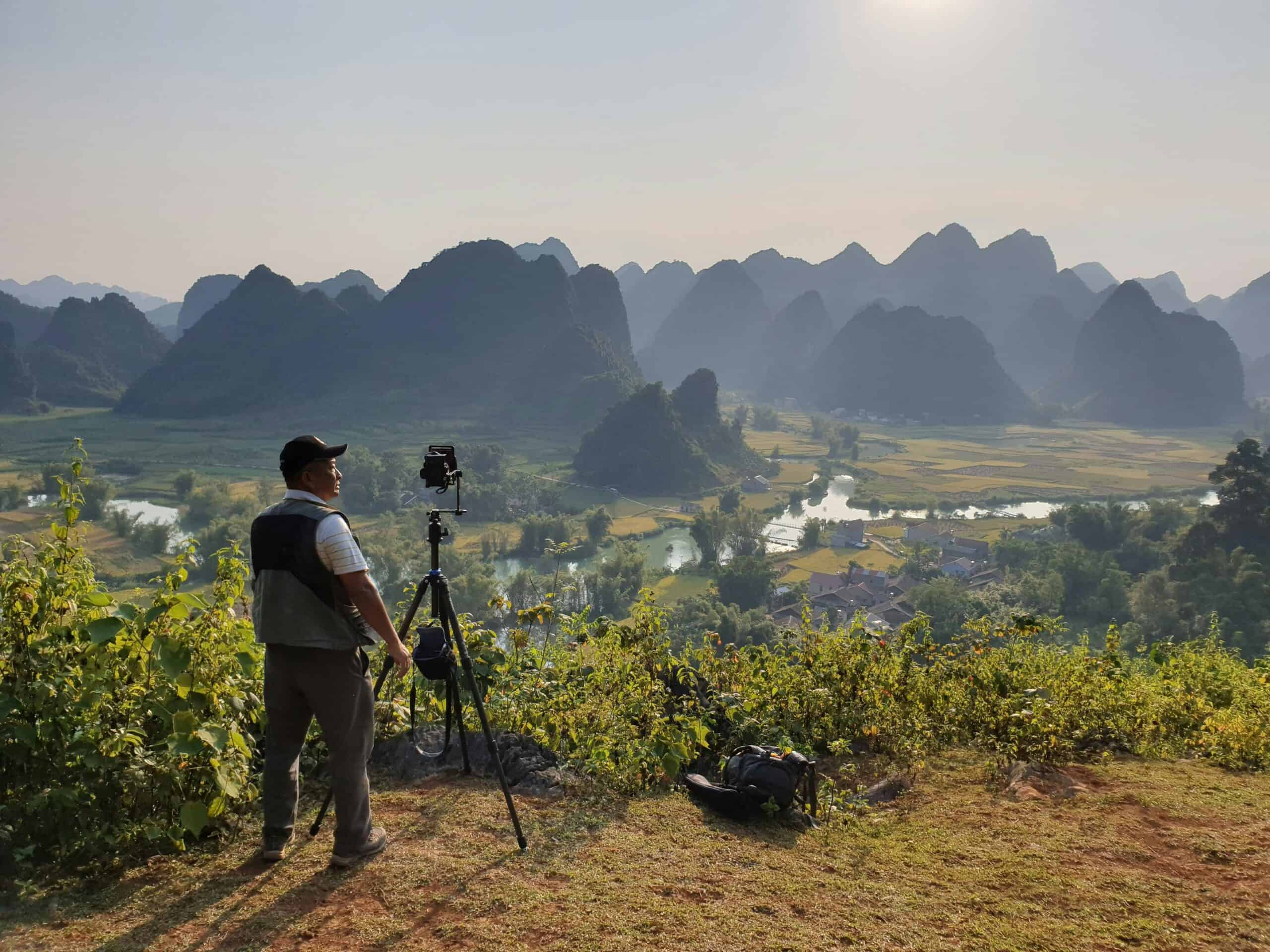
Scout the light: for sunset cityscapes, plan to start a little before golden hour to find your vantage and level your head. For interiors with windows, expect a high contrast scene and plan HDR bracketing. Watch out for reflective surfaces (glass, glossy floors) that reveal your tripod. If you must shoot through glass, get the front element as close as safely possible (1–3 cm) and use a flexible lens hood to reduce flare/ghosting from internal reflections.
Match Gear to Scene Goals
The Sony A7 IV’s clean ISO up to 800–1600 and strong DR make it flexible across indoor and outdoor panoramas. At 20mm rectilinear, you’ll capture straight lines—excellent for real estate and architecture—with the tradeoff of more frames vs a fisheye. For fast-moving scenes, 20mm demands quicker capture; consider shorter exposures and a streamlined shot plan (fewer rows) to minimize ghosting. If you need fewer frames, consider a fisheye; if you need straight geometry and high resolution, stay with 20mm.
Pre-shoot Checklist
- Battery and storage: A7 IV batteries are solid; bring at least 2 batteries and ample fast UHS-II SD or CFexpress Type A if shooting HDR bursts.
- Clean optics: Wipe lens and sensor; dust becomes very visible across stitched frames.
- Leveling and calibration: Level the tripod, check panoramic head index marks, and verify nodal point alignment for 20mm.
- Safety checks: Confirm tripod stability in wind; on rooftops use a safety tether. For car mounts or poles, double-tether and avoid crowds.
- Backup workflow: Shoot an extra pass at the main row; if anything misfires (blur, blocking pedestrians), you’ll have replaceable frames.
Essential Gear & Setup
Core Gear
- Panoramic head: A nodal-rail panoramic head allows you to place the lens’s entrance pupil (no-parallax point) on the rotation axis, eliminating parallax for clean stitches. This is critical with a 20mm rectilinear around near objects.
- Stable tripod with leveling base: A leveling base speeds setup and helps maintain a consistent horizon across rows.
- Remote trigger/app: Use the Imaging Edge app or a wired remote to avoid vibrations. Turn on a 2s self-timer if you lack a remote.
Optional Add-ons
- Pole or car mount: Great for elevated viewpoints; add safety tethers and dampers, and avoid high winds. Check local regulations for elevated rigs.
- Lighting aids: For real estate, small LED panels in adjacent rooms can balance exposure; keep them consistent per row.
- Weather protection: A simple rain cover and microfiber towels save shoots in light rain. For sea spray, a clear filter is sacrificial protection.

Step-by-Step Shooting Guide
Standard Static Scenes
- Level and align: Level the tripod. Mount the panoramic head and set the camera so that the lens’s entrance pupil sits directly above the rotation axis. As a starting point for a 20mm prime, place the entrance pupil approximately 75–85 mm forward of the sensor plane, then fine-tune using the near/far object test.
- Manual exposure and white balance: Set Manual mode. Lock a fixed WB (Daylight or 5200K outdoors; custom Kelvin indoors) to avoid color shifts across frames.
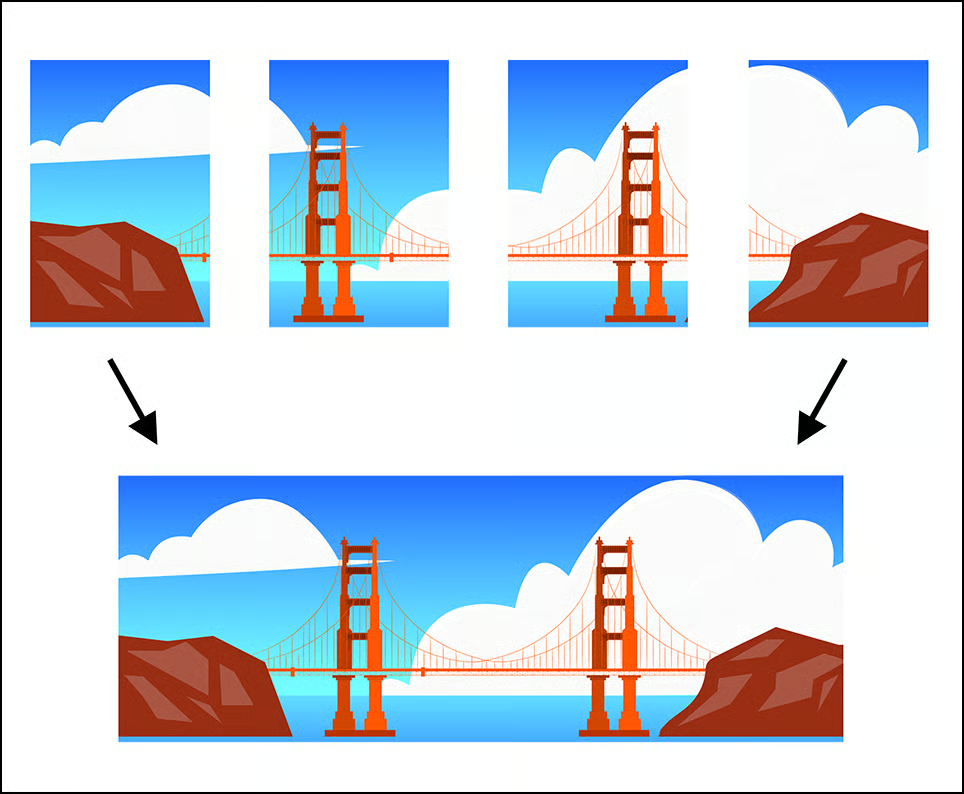
- Capture sequence: For single-row cylindrical panoramas, shoot 10–12 frames around with 25–30% overlap. For full spherical 360s, capture 3 rows (+60°, 0°, −60°) with 10–12 frames each at ~20–25% overlap. Add a zenith shot (tilt up 90°) and a nadir shot (tilt down 90°).
- Nadir cleanup: After the main set, shift the tripod slightly and take a clean ground (nadir) frame for patching out the tripod. Remember to keep the same exposure and WB.
HDR / High Dynamic Range Interiors
- Bracket ±2 EV (3 or 5 exposures): Use AEB to capture shadow/ midtone/ window highlights. On the A7 IV, 5-shot brackets at 1 EV or 3-shot at 2 EV work well depending on contrast.
- Consistency: Keep aperture constant (typically f/8 for corner sharpness) and lock WB. Avoid auto-ISO in brackets; use fixed ISO 100–400 when on a tripod.
Low-Light / Night Scenes
- Long exposure: With a stable tripod, set f/4–f/5.6 and use exposures from 1/10 to several seconds as needed at ISO 100–400. The A7 IV remains clean up to ISO 800–1600 if you need to shorten shutter times.
- Vibration control: Turn off IBIS when locked on a tripod to prevent micro-jitter. Use a remote or 2s timer, and wait a second after each rotation for vibrations to settle.
Crowded Events
- Two passes: First pass quickly for coverage; second pass selectively to capture “clean” gaps where people moved away from key seams.
- Post masking: In PTGui or similar, mask in the clean frames for each seam line to remove ghosting and duplicates.
Special Setups (Pole / Car / Drone)
- Safety first: Use a rigid pole with guy lines and a safety tether. For car rigs, mount low and central with vibration isolators, and shoot parked if possible.
- Rotation strategy: Fewer, faster frames reduce motion artifacts. Consider boosting ISO to 800–1600 and using 1/250s or faster, then denoise in post.
Recommended Settings & Pro Tips
Exposure & Focus
| Scenario | Aperture | Shutter | ISO | Notes |
|---|---|---|---|---|
| Daylight outdoor | f/8–f/11 | 1/100–1/250 | 100–200 | Lock WB (Daylight/5200K) |
| Low light/night | f/4–f/5.6 | 1/10–1/60 (tripod) | 100–800 | IBIS off on tripod; remote trigger; denoise in post |
| Interior HDR | f/8 | Bracket ±2 EV | 100–400 | Balance windows & lamps with 3–5 shot brackets |
| Action / moving subjects | f/5.6–f/8 | 1/200+ | 400–1600 | Double pass and mask moving people later |
Critical Tips
- Manual focus: Focus once at the hyperfocal distance (around 1.6–2 m at 20mm f/8 on full frame) and switch to MF to keep every frame identical.
- Nodal calibration: Use two vertical objects (one near, one far). Rotate the camera on the pano head; adjust the rail until the near object doesn’t shift against the far object. Mark this distance on your rail for 20mm.
- White balance lock: Mixed lighting can vary frame to frame. Fix WB in Kelvin or use a custom preset shot from a gray card on-site.
- RAW over JPEG: 14-bit RAW preserves highlight and shadow detail, critical for HDR blending and seamless color matching.
- Stabilization: On a tripod, disable IBIS in the A7 IV to prevent sensor micro-movements between frames. Handheld, leave IBIS on.
Stitching & Post-Processing
Software Workflow
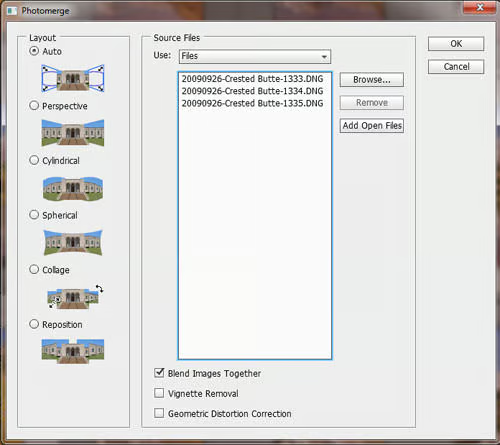
Import RAWs into Lightroom or Capture One, apply uniform white balance and lens-neutral preprocessing (avoid heavy distortion correction before stitching for rectilinear ultrawide unless your stitcher requests it), then export to your stitcher. PTGui remains an industry standard for speed and control; Hugin is a capable open-source alternative. With a rectilinear 20mm, aim for ~20–25% overlap to minimize frames and keep geometry consistent. After stitching, you can level the horizon, refine masks, and export an equirectangular image for VR or a high-res pano for print.
For an in-depth look at panoramic heads and setup, see the panoramic head tutorial by 360 Rumors. Read panoramic head setup guidance
Cleanup & Enhancement
- Nadir patching: Use PTGui’s Viewpoint correction or export to Photoshop to clone/patch the tripod area with your dedicated nadir frame.
- Color and noise: Apply consistent color grading and subtle noise reduction; the A7 IV files tolerate denoising well at ISO 800–1600.
- Level and geometry: Use the panorama editor to correct roll/yaw/pitch, then fine-tune verticals in Photoshop if it’s an architectural deliverable.
- Export for platform: For VR, export 16-bit TIFF or high-quality JPEG equirectangular at 8K–16K on the long edge, depending on your frame count and target platform.
For a broader reference on capturing and stitching with mirrorless bodies, Meta’s Creator documentation provides a concise overview. See DSLR/Mirrorless 360 photo guide
PTGui is frequently recommended for complex pano work; Fstoppers reviews why it’s a top choice. Why PTGui excels for panoramas
Video Walkthrough
Prefer a visual guide? This video demonstrates practical field techniques for panoramic capture and stitching:
Useful Tools & Resources
Software
- PTGui panorama stitching
- Hugin (open source) for stitching
- Lightroom / Photoshop for RAW processing and cleanup
- AI-based tripod/nadir removal tools
Hardware
- Panoramic heads: Nodal Ninja, Leofoto, or similar nodal-rail systems
- Carbon fiber tripods with leveling bases
- Wireless remotes or intervalometers
- Pole extensions and stabilized car mounts (with tethers)
Disclaimer: Names are for search reference; confirm compatibility and current specs on official sites.
Common Mistakes & How to Avoid Them
- Parallax error: Always align to the lens’s entrance pupil. Even small misalignments will cause stitching mismatches near close objects.
- Exposure flicker: Manual mode, fixed WB, fixed ISO. Don’t let auto-exposure shift frame to frame.
- Tripod shadows and reflections: Watch your feet and tripod in reflective floors; shoot a dedicated nadir frame for clean patching.
- Ghosting from moving subjects: Capture a second pass and mask clean frames at seam lines during stitching.
- Night noise and blur: Keep ISO moderate (100–800 on tripod), use longer shutters, and ensure vibrations settle before each shot.
Field-Proven Scenarios
Indoor Real Estate (Window View + Interior Lamps)
Use f/8, ISO 100–200, and 3–5 shot brackets at ±2 EV. A three-row capture ensures ceiling and floor detail. For glossy floors, fire a dedicated nadir shot with the tripod offset. In PTGui, apply Viewpoint correction for a perfect floor patch and mask window highlights from the −2 EV exposure.
Outdoor Sunset Cityscape
Arrive early and pre-level. Shoot a base set at f/8, ISO 100, then a second pass 10 minutes later for deeper sky color. Mask in the richer sky where needed. If winds are moderate, hang a weight from the tripod and use a 2s timer.
Crowded Event Walkway
Plan a fast single-row cylindrical pano (12 shots) at 1/250s, f/5.6, ISO 800–1600 to freeze people. Then shoot a slow multi-row set when foot traffic momentarily eases. In post, use masks from the cleaner set to replace busy seams.
Rooftop or Pole Capture
Mount your panoramic head on a rigid pole. Keep the camera close to the mast to reduce leverage in wind. Use fewer frames with slightly higher ISO to shorten capture time. Always tether the pole and spot for safety.
About Mount Compatibility: Sony A7 IV & Nikon Z 20mm f/1.8 S
Because Nikon Z lenses are designed for a shorter flange distance than Sony E-mount, adapting a Nikon Z 20mm f/1.8 S to a Sony A7 IV while keeping infinity focus and electronic control is not presently feasible. In practice, use one of these approaches:
- Use a native or equivalent E-mount lens: The Sony FE 20mm f/1.8 G is an excellent match with similar optical strengths.
- Use a Nikon Z body with the 20mm S: All techniques in this guide apply identically at 20mm; only camera-specific menu names differ.
This honest limitation doesn’t change the pano technique. If your goal is “how to shoot panorama with Sony A7 IV & Nikon Z 20mm f/1.8 S,” the most practical route is to use the Sony FE 20mm f/1.8 G on the A7 IV, or pair the Nikon Z 20mm S with a Nikon Z body. The capture flow, overlap, and post-processing remain the same.
Visual Aids
Frequently Asked Questions
- Can I shoot handheld panoramas with the Sony A7 IV?
Yes, for simple cylindrical panos outdoors. Use fast shutter (1/250s+), IBIS on, and 30–40% overlap. Expect some stitch errors near foreground objects. For precise 360×180 panos, use a panoramic head and tripod.
- Is the Nikon Z 20mm f/1.8 S wide enough for single-row 360?
As a rectilinear 20mm on full frame, a single row won’t cover the full sphere. You’ll need multi-row capture (typically 3 rows of 10–12 shots plus zenith and nadir). For full 360s with fewer frames, a fisheye lens is more efficient.
- Do I need HDR for interiors with bright windows?
Usually, yes. Bracket ±2 EV (3–5 frames) to retain both window views and interior shadows. Blend the brackets before or during stitching to avoid haloing and noisy shadows.
- How do I avoid parallax issues with a 20mm lens?
Mount the camera on a nodal rail and align the lens’s entrance pupil over the rotation axis. Use the near/far alignment test and mark the rail setting for repeatability at 20mm.
- What ISO range is safe on the A7 IV in low light?
Base ISO 100 delivers maximum DR. On a tripod, prefer ISO 100–400 with longer shutter speeds. If you must shorten exposure (wind or crowds), ISO 800–1600 still produces excellent results with light denoising.
- Can I use Custom Shooting Modes to speed pano setup?
Yes. Save Manual exposure, fixed WB, MF, IBIS off (for tripod), and bracketing settings to a custom mode. This shortens on-site setup and ensures consistency across frames.
- What’s the best tripod head for this setup?
A two-axis panoramic head with fore-aft and lateral nodal adjustment (e.g., Nodal Ninja, Leofoto) is ideal. It allows precise entrance pupil alignment and indexed rotations for repeatable overlap.
Safety, Data, and Backup
Use a wrist strap or tether in high places. In wind, lower the center column and hang a counterweight. After each row, quickly review for blurs or missed frames. Back at base, duplicate your card to two locations immediately and create a verified backup before deleting original cards. Consistency, redundancy, and caution keep both your gear and your project safe.
