Why This Camera & Lens Are Great for Panoramas
If you want a reliable, pro-leaning workflow for 360 photos and high-resolution panoramas, the Sony A7 IV brings a 33MP full-frame BSI sensor with excellent dynamic range, robust color, and dependable AF/manual aids. Its 5-axis IBIS is great for handheld scouting and low-light framing (though you should turn stabilization off on a tripod). The Fujifilm XF 10–24mm f/4 OIS WR is a constant-aperture ultra‑wide rectilinear zoom that keeps lines straight, resists flare well, and is sharp enough across the frame at f/8–f/11—the sweet spot for panoramas.
Important Compatibility Note
Fujifilm XF lenses are X‑mount and are not natively compatible with the Sony A7 IV’s E‑mount. There is no practical adapter that preserves infinity focus or electronics for this pairing. In real shoots, you should use an E‑mount ultra‑wide rectilinear zoom that matches the XF 10–24mm’s field of view (for example: Sony FE 12–24mm f/4 G, Sony FE 16–35mm f/4, Tamron 17–28mm f/2.8, or Sony E 10–20mm f/4 PZ G in APS‑C crop mode). All techniques in this guide apply directly to that equivalent focal range. Where we reference the “XF 10–24mm,” treat it as guidance for a 10–24mm rectilinear zoom used on APS‑C (15–36mm full‑frame equivalent).
Bottom line: you can fully follow this tutorial on how to shoot panorama with Sony A7 IV & Fujifilm XF 10–24mm f/4 OIS WR by substituting an E‑mount ultra‑wide zoom of similar coverage; the capture math (overlap, rows, nodal workflow) remains the same.
Quick Setup Overview
- Camera: Sony A7 IV — Full Frame 35.9×23.9mm, 33MP; pixel pitch ≈ 5.1 µm; base ISO 100; real‑world DR ≈ 14 stops at base.
- Lens: Fujifilm XF 10–24mm f/4 OIS WR — Rectilinear APS‑C ultra‑wide zoom (FF equiv 15–36mm). Character: well‑controlled distortion, modest lateral CA, best sharpness around f/8–f/11. Note: use E‑mount lens of similar FOV on A7 IV.
- Estimated shots & overlap (rectilinear):
- At 10mm on APS‑C (≈15mm FF eq): 8 shots around (45° steps) + 1 zenith + 1–2 nadirs (safe).
- At ~14–16mm FF eq: 10–12 shots around + zenith + nadir.
- At 24mm APS‑C (≈36mm FF eq): 16–18 shots around; recommend 2‑row (e.g., 12 top + 12 middle) for full 360 coverage.
- Overlap target: 25–30% between frames; slightly more for complex interiors with close foregrounds.
- Difficulty: Moderate (easier with a calibrated panoramic head).
Planning & On-Site Preparation
Evaluate Shooting Environment
Before you unpack, scan the location. Look for reflective glass, chrome rails, moving foliage or crowds, and direct light sources that may cause flare or ghosting. If shooting through glass, get as close as possible (1–5 cm) and shade the lens with your body or a rubber hood. For interiors, note bright windows versus dark corners—expect to bracket ±2 EV for a clean HDR panorama.
Match Gear to Scene Goals
The A7 IV’s 33MP sensor is a sweet spot: very good base ISO dynamic range with clean shadow recovery up to ~2.5–3 EV, and low pattern noise. Use ISO 100–400 for tripod work; ISO 800–1600 remains very usable for night cityscapes with noise reduction. A rectilinear 10–24mm‑equivalent lens keeps architecture straight and is ideal for real estate, museums, and virtual tours; you’ll take more shots than with a fisheye, but stitching is cleaner along edges and verticals.
Pre-shoot Checklist
- Charge batteries, clear/format fast SD/CFexpress cards; carry a spare card for redundancy.
- Clean both lens elements and sensor; dust is painfully visible across multiple frames.
- Level the tripod and verify your panoramic head’s nodal point marks for the chosen focal length.
- Stability & safety: sandbag in wind; use a tether on rooftops or when working over edges; avoid traffic lines for car mounts.
- Backup insurance: if time allows, shoot a second full rotation (or a safety nadir) in case of people movement or stitching gaps.
Essential Gear & Setup
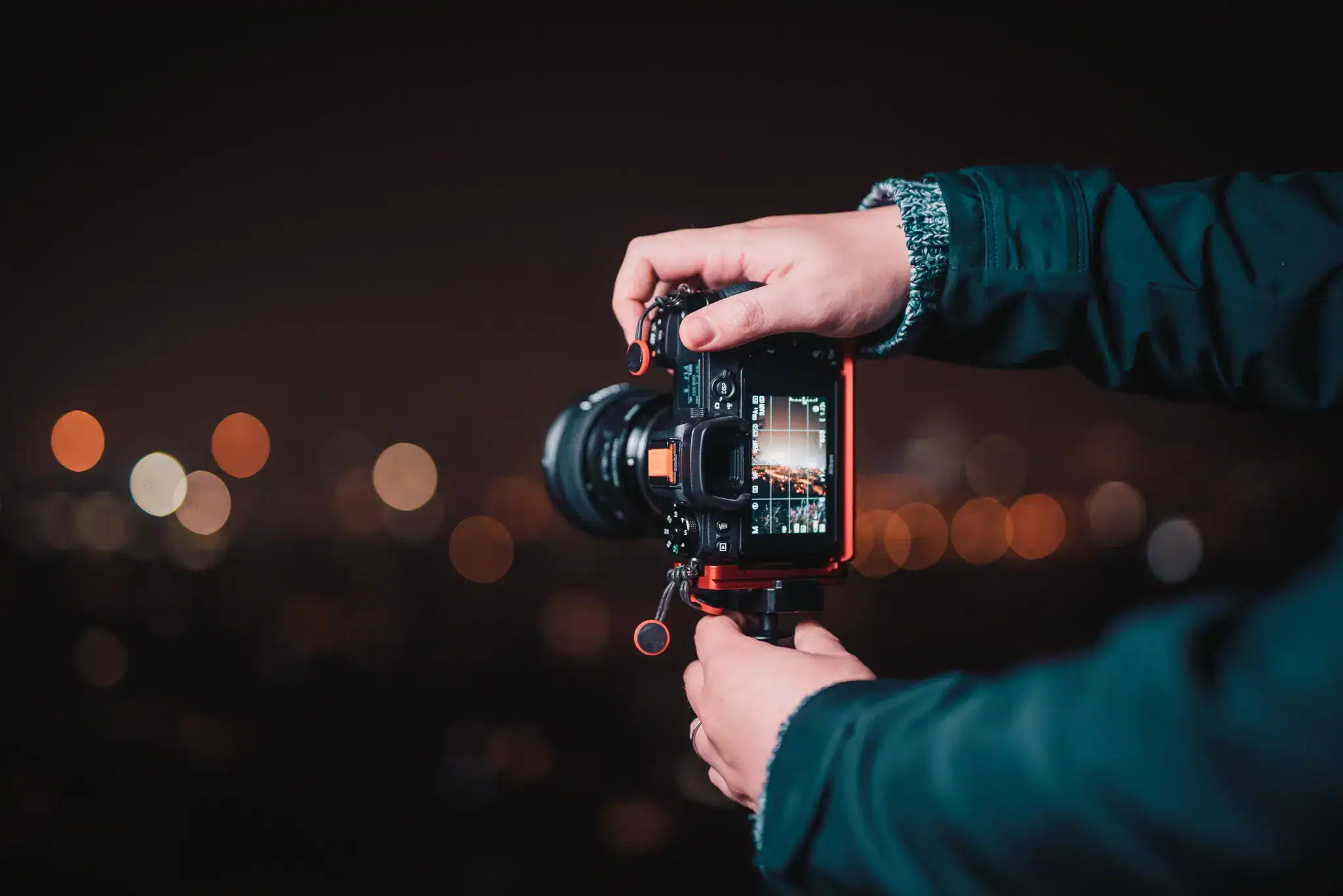
Core Gear
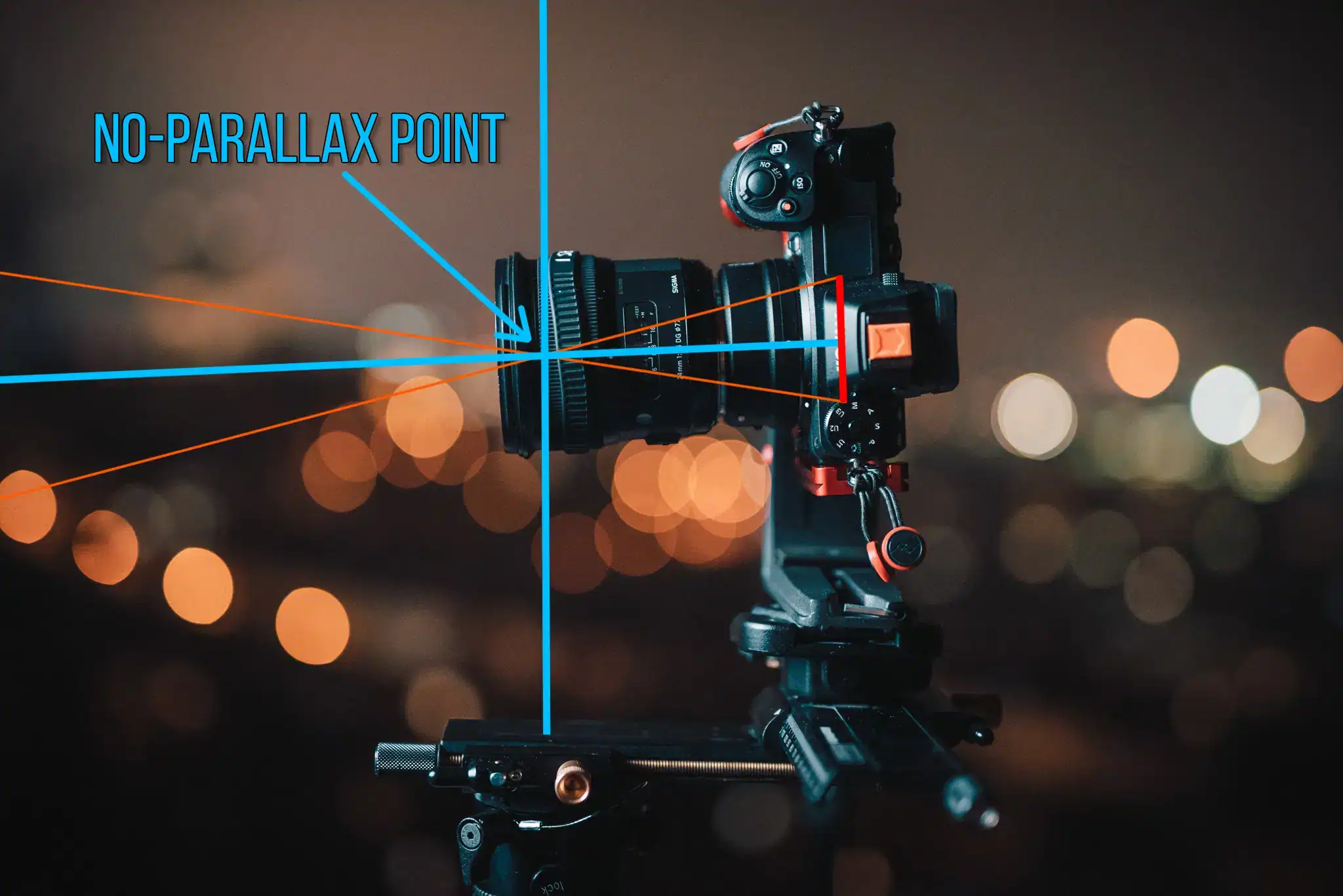
- Panoramic head: This allows you to rotate around the lens’s no‑parallax (entrance pupil) point to prevent foreground/background shifts. Mark the rail position for each focal length you use often.
- Stable tripod with a leveling base: A bubble level or half‑ball/leveling base speeds setup and ensures consistent horizon across the set.
- Remote trigger or app: Use the Sony Imaging Edge app or a simple remote to avoid vibrations and keep a steady rhythm.
Optional Add-ons
- Pole or car mount: Keep rotation slow, watch wind gusts, and always use a safety tether. For poles, stay under local height/permit limits and beware of overhead lines.
- Lighting aids: A small LED panel can lift dark corners in interior tours; keep it indirect to avoid harsh hotspots.
- Weather protection: Rain cover, microfiber cloths, and silica packs. Water on the front element ruins stitching consistency.
Step-by-Step Shooting Guide
Standard Static Scenes
- Level and align: Level the tripod, then set your panoramic head to the pre‑marked nodal position for your chosen focal length (e.g., 10mm APS‑C eq). A quick field method: place two light stands—one 0.5 m away, another 3–5 m behind—then rotate the camera. Adjust the fore‑aft rail until the near and far objects do not shift relative to each other.
- Manual exposure and WB: Switch to M mode, set a base like f/8, 1/125s at ISO 100 for daylight, and lock white balance (e.g., 5600K). Consistency prevents visible seams and color shifts.
- Focus: Manual focus at or just beyond hyperfocal. At 10mm APS‑C, f/8 hyperfocal is roughly 0.6–0.7 m; set MF and confirm with magnification/peaking.
- Capture rotation: For 10mm APS‑C (≈15mm FF eq), take 8 shots around with 25–30% overlap. Add a zenith (tilt up ~60–90°) and one or two nadirs (tilt down, then a handheld offset nadir for tripod removal).
- Stability: Turn off IBIS and lens OIS on a tripod to avoid micro jitter. Use a 2 s self‑timer or remote. Shield the camera from wind with your body.
HDR / High Dynamic Range Interiors
- Bracket strategy: Use 3 or 5 frames at ±2 EV to balance bright windows and shadows. The A7 IV supports up to 9‑frame bracketing, but 3–5 frames keep workflow reasonable.
- Lock WB and aperture: Keep WB fixed and aperture constant (f/8) so every bracket aligns perfectly. Use shutter speed to vary exposure.
- Sequence: Shoot the entire rotation at each exposure level or use auto‑bracket per position. Maintain the same overlap per frame set.
Low-Light / Night Scenes
- Use tripod times: Start around f/5.6–f/8 at ISO 100–400, extend shutter as needed (1–8 s). For moving city lights, ISO 800–1600 is acceptable on A7 IV with noise reduction in post.
- Stability is everything: IBIS and OIS off on tripod; use remote or 2 s timer. Consider Long Exposure NR off and handle noise in post for speed.
- Check flare: Avoid pointing at strong point sources between frames; a small change in angle can reduce ghosting dramatically.
Crowded Events
- Two passes: First pass for composition and coverage; second pass patiently waiting for gaps in traffic/people.
- Blend in post: Mask moving people and cars using the cleaner frames from the second pass.
- Shutter choice: If you must freeze motion, aim for 1/200s+ and ISO 800–1600. Expect some noise, which you can reduce later.
Special Setups (Pole / Car / Drone)
- Pole: Keep the rig under its rated weight. Avoid gusty conditions. A 10–12mm APS‑C view with 6–8 around can work from a high pole; spin more slowly to reduce sway.
- Car: Use triple suction mounts, redundancy straps, and avoid highways. Shot spacing can be wider (20–25°) at 10–12mm APS‑C, but beware parallax at close foregrounds.
- Drone: If you must, use the drone’s built‑in pano modes; for mirrorless from a drone platform, comply with regulations and payload limits.
Walkthrough Video
For a clear, practical demonstration of field technique and stitching logic, this video overview is helpful:
Recommended Settings & Pro Tips
Exposure & Focus
| Scenario | Aperture | Shutter | ISO | Notes |
|---|---|---|---|---|
| Daylight outdoor | f/8–f/11 | 1/100–1/250 | 100–200 | Lock WB (daylight); RAW for max DR |
| Low light/night | f/4–f/5.6 | 1/30–8 s | 100–800 | Tripod & remote; stabilization OFF |
| Interior HDR | f/8 | Bracket ±2 EV | 100–400 | Balance windows & lamps; consistent WB |
| Action / moving subjects | f/5.6–f/8 | 1/200+ | 400–800 (1600 if needed) | Freeze motion; consider double pass |
Critical Tips
- Manual focus at hyperfocal: At 10mm APS‑C, f/8 hyperfocal ~0.6–0.7 m; at 16mm FF, f/8 hyperfocal ~1.2–1.5 m. Set MF and don’t touch it through the set.
- Entrance pupil (nodal) calibration: Mark your panoramic head’s rail for 10mm, 14mm, and 24mm once and reuse. Recheck when swapping plates or lenses.
- WB lock: Mixed light (tungsten + daylight) can cause panel‑to‑panel color shifts. Set a fixed Kelvin or custom WB from a gray card.
- RAW all the way: You’ll need the latitude for HDR merging, deghosting, and color matching. JPEGs clip highlights sooner and limit stitching corrections.
- IBIS/OIS policy: On tripod, turn both OFF. For handheld scouting or single‑row panos, stabilization can help—but expect more parallax errors without a proper pano head.
Stitching & Post-Processing
Software Workflow
PTGui remains the industry workhorse for complex 360s and HDR panos thanks to its robust control point editor and masking. Hugin is an excellent open‑source alternative. Lightroom and Photoshop can stitch simple single‑row panoramas but offer less control over parallax and nadir/zenith issues. With rectilinear ultra‑wides, plan 20–30% overlap; fisheye methods accept fewer shots but require defishing and more careful projection control. If your scene includes close foregrounds (railings, furniture), add more overlap to increase the chance of clean control points.
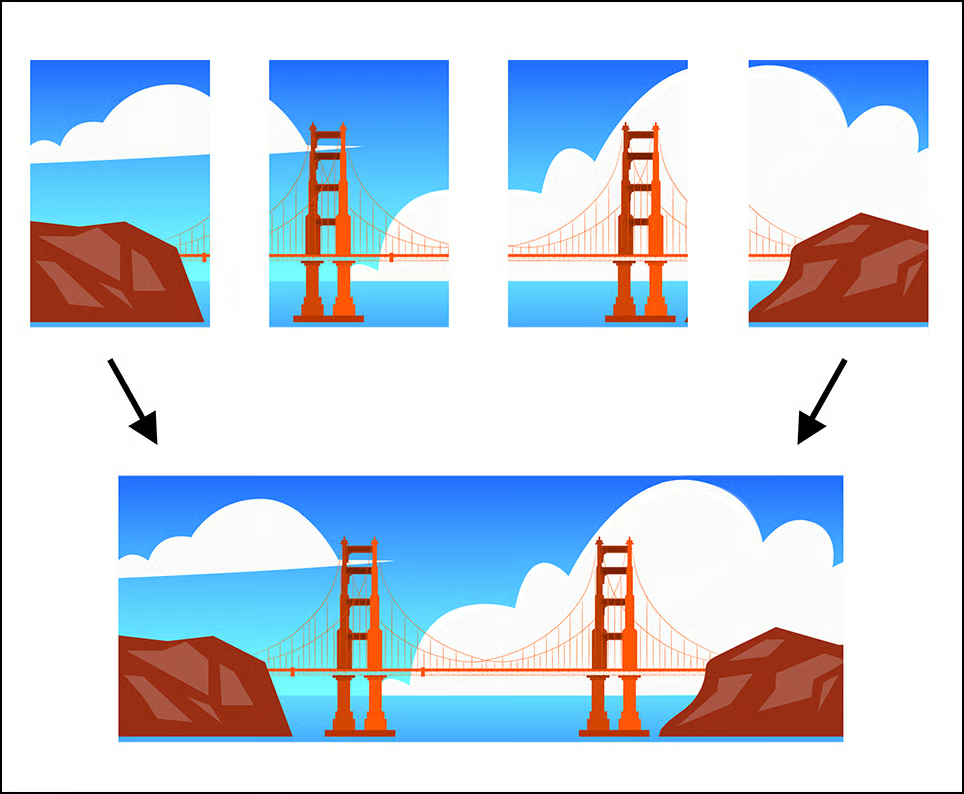
Export as equirectangular 2:1 for VR delivery (e.g., 16384×8192 for “8K”). For web virtual tours, JPEG at 80–90% quality is common. Keep a 16‑bit TIFF master for archival and re‑edits.
Cleanup & Enhancement
- Nadir patch: Either shoot an offset nadir to clone over the tripod or patch with a logo/AI tool after stitching.
- Color balance: Match panels with global WB adjustments; use selective HSL to tame mixed lighting casts.
- Noise reduction: Apply moderate NR to shadows for night scenes; avoid over‑smoothing textures.
- Level horizon: Use pitch/roll/yaw controls to level verticals, especially critical for architecture.
- Output: Generate multi‑resolution tiles if your viewer supports it to speed web delivery.
For deeper dives into pano heads and setup, see this panoramic head tutorial by 360 Rumors, and for software choice, this PTGui review outlines why it’s a top tool. Panoramic head basics · PTGui review and workflow highlights
If your goal is VR publishing (equirectangular 2:1), consult platform guidance on capture and export parameters. Using a DSLR/mirrorless to shoot and stitch a 360 photo (Meta)
Useful Tools & Resources
Software
- PTGui panorama stitching
- Hugin (open source)
- Lightroom / Photoshop for basic stitches and tonal edits
- AI tripod removal / inpainting tools for nadir patching
Hardware
- Panoramic heads: Nodal Ninja, Leofoto, Sunwayfoto
- Carbon fiber tripods with a leveling base
- Wireless remote shutters and L‑brackets
- Pole extensions and car mounts with safety tethers
Disclaimer: product names for search reference; verify specs and compatibility on official sites.
Common Mistakes & How to Avoid Them
- Parallax errors: Always rotate around the entrance pupil; calibrate the fore‑aft rail for your focal length.
- Exposure flicker: Shoot in full Manual, lock WB and focus, and avoid auto ISO in multi‑row work.
- Tripod shadows and footprints: Shoot a clean, offset nadir or plan to patch later.
- Ghosting from movement: Double‑pass strategy, then mask moving subjects in PTGui or Photoshop.
- High ISO noise: Keep ISO low, use longer shutter on tripod, and apply targeted NR in post.
- Insufficient overlap: Aim for 25–30%—more if you have near objects or complex patterns.
Real-World Scenarios: What Works
Indoor Real Estate
At 10–12mm APS‑C (≈15–18mm FF eq), shoot 8–10 around + zenith + nadir. Bracket 3–5 frames at ±2 EV for windows. Keep verticals straight by leveling meticulously and using a rectilinear lens. This combo yields clean, professional virtual tours.
Outdoor Sunset Overlooks
Use f/8, ISO 100–200, and 1/60–1/250s; underexpose by −0.3 to hold highlights, or bracket if the sun is in frame. A7 IV can recover shadows cleanly at base ISO.
Events with Crowds
Prefer 14–16mm FF eq to reduce perspective stretch on people at the edges. Shoot two passes and blend. If you must freeze motion, 1/200s+ and ISO 800–1600 works with careful NR.
Rooftop or Pole Capture
Use a lightweight head, lock everything down, rotate slowly, and add 2–4 extra frames for safety. Wind is the enemy—sandbag and keep your profile low.
Car-Mounted Drive-By
Tripod is out; use multi‑suction mounts, strap redundancies, and a short prime or wider zoom (10–14mm APS‑C). Expect parallax with close objects; keep your subject distant or accept that some scenes won’t stitch perfectly.
Frequently Asked Questions
- Can I actually mount the Fujifilm XF 10–24mm f/4 OIS WR on the Sony A7 IV?
No. The XF lens is X‑mount and not physically compatible with Sony E‑mount; there is no practical adapter that preserves infinity focus or electronics. Use an E‑mount ultra‑wide rectilinear zoom of similar coverage and follow the same capture steps.
- Is a 10–24mm rectilinear wide enough for single‑row 360s?
Yes at the wider end on APS‑C (~10–12mm), you can do a single row with 8–10 shots around plus zenith and nadir. For tighter focal lengths (20–24mm APS‑C), plan multi‑row to ensure full coverage and easier stitching.
- Do I need HDR for interiors with bright windows?
Almost always. Use ±2 EV bracketing (3–5 shots) at each position to retain window detail and clean shadows. Merge in PTGui or first HDR‑merge, then stitch—both approaches work, but merging pre‑stitch keeps exposure sets organized.
- What ISO range is safe on the A7 IV in low light?
Tripod scenes: ISO 100–400 with longer shutter is best. Handheld or to freeze motion: ISO 800–1600 is very usable; ISO 3200 can work with careful noise reduction. The A7 IV’s RAW files tolerate ~2.5–3 EV shadow lifting at base ISO.
- How do I avoid parallax issues in tight interiors?
Calibrate and rotate around the entrance pupil with a panoramic head. Increase overlap to 30–40% if objects are very close, and avoid changing focus/zoom mid‑set. A rectilinear ultra‑wide and careful nodal alignment are key.
Author Notes, Safety & References
In the field, the most common failure points are minor: a tilted tripod, one frame accidentally in Auto WB, or a bumped focus ring. Build a consistent pre‑shot routine and always shoot an extra rotation if the scene allows. When working on rooftops or with pole/car rigs, prioritize safety—tethers, sandbags, and a second person to spot and manage public interactions.
For a broader perspective on DSLR/mirrorless 360 photography and pano math, these resources are reliable: DSLR/virtual tour FAQ and lens guidance.