Why This Camera & Lens Are Great for Panoramas
The Sony A7 IV paired with the 7Artisans 10mm f/2.8 II Fish-Eye is a powerful, budget-friendly combo for fast, clean 360° panoramas. The A7 IV’s 33MP full-frame BSI sensor (approx. 7008×4672 pixels, ~5.1µm pixel pitch) delivers excellent dynamic range at base ISO (about 14 stops), robust color, and dependable autofocus for setup—even if you’ll shoot manual focus. The body adds 5-axis IBIS, dual card slots, and excellent battery life—useful for long panorama sessions. The 7Artisans 10mm f/2.8 II is a full-frame diagonal fisheye (up to ~178° diagonal FOV), fully manual, compact, and sharp in the center by f/5.6–f/8. As a fisheye, it cuts the number of shots needed for a full sphere, speeding up capture and reducing the chance of stitching errors from moving subjects.
Distortion is intentional with a fisheye lens and is easily handled by modern stitching software. The E-mount version is a snug fit on the A7 IV, and manual aperture/focus give you predictable, repeatable results. If your goal is fast single-row 360 photos with reliable stitching, this combo shines—especially for real estate interiors, event snapshots, and outdoor travel scenes.
Quick Setup Overview
- Camera: Sony A7 IV — Full-frame 35.6×23.8mm, 33MP BSI CMOS; native ISO 100–51,200 (expandable to 50–204,800); ~14 stops DR at base.
- Lens: 7Artisans 10mm f/2.8 II Fish-Eye — Full-frame diagonal fisheye (~178° diagonal FOV), manual focus/aperture, best sharpness at f/5.6–f/8, typical fisheye CA well-controlled at mid apertures.
- Estimated shots & overlap: Field-proven with this combo: 6 shots around at 0° pitch (60° yaw steps) + 1 zenith + 1 nadir; 30–40% overlap between frames. Bracketed HDR triples the frame count.
- Difficulty: Easy–Moderate (manual focus and nodal alignment required).
Planning & On-Site Preparation
Evaluate Shooting Environment
Assess light direction and contrast first. For interiors with bright windows, expect to bracket exposure. Watch for reflective surfaces: glass, polished floors, cars, and mirrors can double reflections and amplify flare. If shooting through glass, place the front element as close as safely possible (1–2 cm) and shoot perpendicular to minimize glare. Outdoors, note the sun position; with a fisheye, even slight backlight can introduce flare—shade the lens with your hand or body between exposures.
Match Gear to Scene Goals
The A7 IV’s dynamic range helps preserve highlights and shadows in a single exposure when scenes are balanced, while HDR bracketing handles high-contrast interiors. ISO performance is strong; on a tripod, aim for ISO 100–400 for cleanest files. Handheld or event work may need ISO 800–1600. The 10mm fisheye drastically reduces the number of frames required for a full 360°, which is perfect for scenes with people or wind-blown foliage where time matters. The tradeoff is typical fisheye distortion, which stitching software compensates for in the final equirectangular output.
Pre-shoot Checklist
- Power & storage: fully charged battery (carry a spare), formatted dual cards, RAW enabled.
- Optics: clean the front element and check the sensor for dust—fisheyes see everything.
- Support: level your tripod, ensure your panoramic head is calibrated for the lens’s entrance pupil.
- Safety: check wind and rooftop railings; use a tether on poles; verify car mounts with redundant straps.
- Backup workflow: shoot a second full rotation as a safety pass in case of motion or misfire.
Essential Gear & Setup
Core Gear
- Panoramic head: Allows rotation around the lens’s entrance pupil (nodal point) to eliminate parallax. Calibrate once, then mark your rail settings for fast field setup.
- Stable tripod with leveling base: A flat, level platform keeps the horizon true and speeds stitching.
- Remote trigger or app: Use Sony Imaging Edge Mobile or a simple remote to avoid shaking the rig.
Optional Add-ons
- Pole or car mount: Great for elevated or vehicle-based shots. Always tether gear and consider wind loads; IBIS on can help micro-jitter, but keep shutter speeds higher.
- Lighting aids: Small LED panels or bounced flashes for dim corners in interiors.
- Weather protection: Rain covers and microfiber cloths for drizzle, sea spray, or dust.
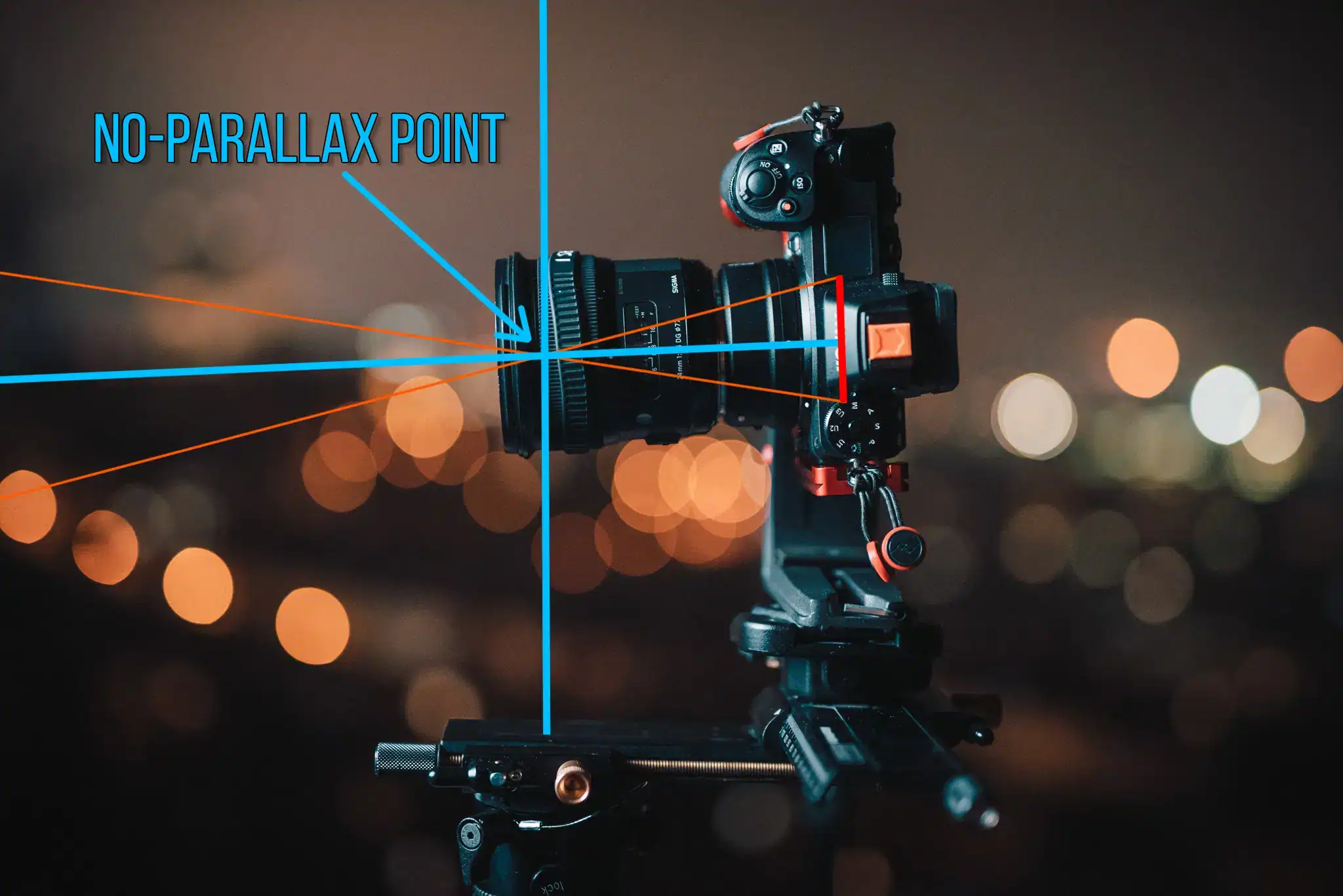
Calibrating the entrance pupil (often misnamed “nodal point”): place two vertical objects (one near, one far) in your frame. Rotate the camera on your pano head. If their relative position shifts, adjust the fore-aft rail until the shift disappears. For this 10mm fisheye on the A7 IV, your entrance pupil will be relatively close to the front of the lens compared to longer lenses; start with a fore-aft offset of a few centimeters ahead of the camera’s sensor plane and fine-tune. Once you find the sweet spot, mark the rail with tape for quick repeats. For a deeper primer on panoramic head setup, see this panoramic head tutorial. Learn panoramic head calibration fundamentals.
Step-by-Step Shooting Guide
Standard Static Scenes
- Level and align: Level the tripod using a leveling base or built-in bubble. Set the panoramic head so the rotation axis is vertical. Confirm your entrance pupil fore-aft setting from calibration.
- Manual exposure and WB: Switch to Manual (M). For daylight, start around f/8, 1/125s, ISO 100–200. Set white balance to Daylight or a custom Kelvin (e.g., 5600K) to avoid color shifts across frames.
- Manual focus: With the 7Artisans 10mm, set focus to near hyperfocal. At f/8 the hyperfocal distance is roughly 0.43–0.45 m; focusing just under 0.5 m provides front-to-back sharpness from about 0.25 m to infinity.
- Capture sequence: Shoot 6 frames around at 0° pitch with 60° yaw increments and 30–40% overlap. Add 1 zenith (tilt up) and 1 nadir (tilt down). A7 IV: use a 2-sec timer or remote to minimize vibration. Prefer mechanical or EFCS shutter under artificial lighting to avoid banding.
- Nadir patch: If the tripod is visible, take a handheld nadir shot after moving the tripod slightly out of the way while keeping the camera position as close as possible to the original nodal point.
HDR / High Dynamic Range Interiors
- Bracket exposure: Use AEB at ±2 EV (3 frames) for each pano position. Lock WB and focus. For very contrasty scenes, consider 5-frame bracketing (±1, ±2 EV).
- Sequence quickly: Minimize time between frames to reduce movement of people, clouds, or curtains. The A7 IV’s drive mode and bracketing interface make this fast; use a remote or self-timer to fire bursts.
Low-Light / Night Scenes
- Tripod and longer exposure: Start at f/4–f/5.6, expose between 1/15–1/60s, and keep ISO as low as practical (100–800). The A7 IV remains very clean to ISO 800–1600 if needed.
- Stabilization: Turn IBIS off on a tripod to avoid micro-blur from stabilization drift; turn it on if shooting handheld or on a lightly flexing pole.
- Avoid flicker/banding: Under LED/fluorescent lights, prefer mechanical shutter or EFCS; test a short series before committing.
Crowded Events
- Two-pass technique: First pass captures the whole sphere. Second pass repeats any frames with distracting motion when the crowd momentarily clears.
- Masking later: In PTGui or similar, use masks to choose the cleanest people placement and remove ghosting.
Special Setups (Pole / Car / Drone)
- Pole: Secure a safety tether, keep the rig balanced, and rotate slowly. Use faster shutter speeds (1/200–1/500s) and slightly higher ISO (400–1600) to counter sway.
- Car mount: Double up on suction cups and straps. Park and shoot to avoid motion blur, or take multiple passes with the engine off.
- Drone: The A7 IV is too heavy for most drones; use a pole or rooftop instead. Plan wind exposure carefully.
Recommended Settings & Pro Tips
Exposure & Focus
| Scenario | Aperture | Shutter | ISO | Notes |
|---|---|---|---|---|
| Daylight outdoor | f/8–f/11 | 1/100–1/250 | 100–200 | Lock WB to Daylight or 5600K |
| Low light/night | f/4–f/5.6 | 1/15–1/60 | 100–800 | Tripod + remote; IBIS off on tripod |
| Interior HDR | f/8 | Bracket ±2 EV | 100–400 | Bracket each position; lock WB and focus |
| Action / moving subjects | f/5.6–f/8 | 1/200+ | 400–1600 | Faster shutter to freeze motion; double pass |
Critical Tips
- Manual focus: Set just short of hyperfocal at f/8 (~0.43–0.45 m) for full-scene sharpness.
- Nodal calibration: Use near/far object alignment to find the entrance pupil; mark your pano head rails for the A7 IV + 10mm combo.
- White balance lock: Prevents color mismatch across frames and brackets.
- RAW capture: Maximizes dynamic range and white balance flexibility—strongly recommended.
- Stabilization: Turn IBIS off on a tripod; turn off lens corrections/in-camera distortion for fisheye to let the stitcher work with true geometry.
- Shutter mode: Prefer mechanical or EFCS under artificial lights to avoid banding; silent/electronic can cause flicker with some LEDs.
Stitching & Post-Processing
Software Workflow
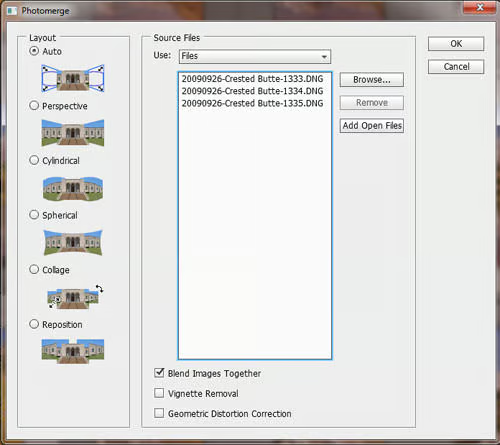
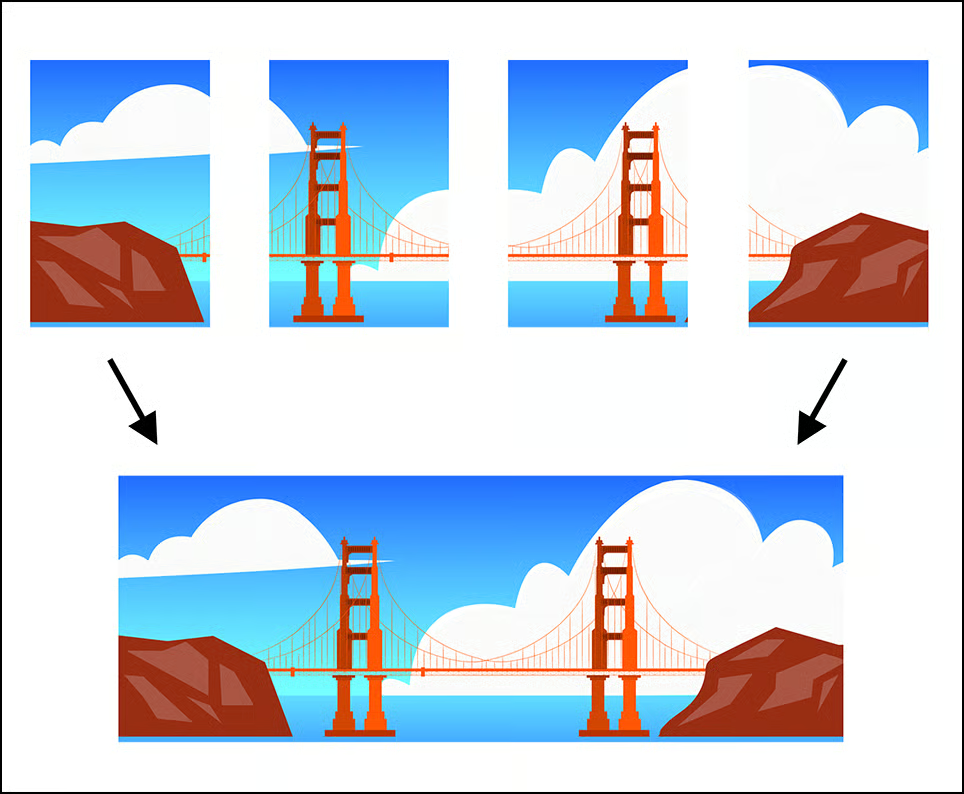
Import RAWs into Lightroom or your preferred RAW editor. Apply a consistent white balance and basic exposure tweaks across the set. Export to 16-bit TIFF or keep RAW workflow if your stitcher supports it. For fisheye panoramas, PTGui is a top-tier option, with excellent control point generation and masking tools; Hugin is a capable open-source alternative. With a 10mm fisheye, you’ll usually stitch faster and need fewer frames than with a rectilinear lens. Aim for 30–40% overlap for reliable control points. After stitching, output an equirectangular image (2:1 aspect) for VR platforms or virtual tour engines. For a practical review of PTGui’s advantages, see this overview. Why many pros choose PTGui for complex panoramas.
Cleanup & Enhancement
- Nadir repair: Use PTGui Viewpoint correction or patch the tripod with a clean nadir shot and clone tools.
- Color and noise: Apply consistent color grading; use moderate noise reduction for ISO 800–1600 night scenes.
- Level and alignment: Use the horizon tool to correct pitch/roll; keep vertical lines vertical for interiors.
- Export: For web/VR, export jpeg equirectangular at 8000–12000 px width depending on your needs; keep a 16-bit TIFF master for archives.
For end-to-end DSLR/mirrorless 360 photo considerations (workflow, export formats, and platform nuances), Oculus’s creator guide is a helpful reference. Using a mirrorless camera to shoot and stitch a 360 photo
Useful Tools & Resources
Software
- PTGui panorama stitching
- Hugin (open source)
- Lightroom / Photoshop for RAW and finishing
- AI-based tripod removal tools and content-aware fill
Hardware
- Panoramic heads: Nodal Ninja, Leofoto, and similar adjustable systems
- Carbon fiber tripods for a strong weight-to-stability ratio
- Leveling bases for fast setup
- Wireless remote shutters or intervalometers
- Pole extensions and car mounts with redundant safety tethers
Disclaimer: Brand names are for search reference only—check official sites for the latest specifications and compatibility.
If you’re new to panoramic heads and want a second tutorial perspective, this practical explainer covers common pitfalls and alignment strategy. DSLR/virtual tour FAQ and lens guide
Common Mistakes & How to Avoid Them
- Parallax error: Always align to the entrance pupil. Test with near/far objects before the real shoot.
- Exposure flicker: Use full manual exposure and locked white balance; avoid auto ISO.
- Tripod shadows and feet: Shoot a nadir patch or plan to clone in post.
- Ghosting from movement: Use masks in PTGui/Hugin and consider a two-pass capture.
- Soft edges: Stop down to f/5.6–f/8; use manual focus near hyperfocal distance; avoid IBIS on a tripod.
- Flare: Shade the lens between frames and avoid direct sun in the same relative position across shots.
Field-Proven Scenarios
Indoor Real Estate
Use tripod, 6 around + zenith + nadir, f/8 at ISO 100–200, HDR ±2 EV. Lock WB to a custom Kelvin that balances window daylight and interior lighting (e.g., 5000–5200K if mixing warm lights with daylight). Mask windows if curtains flutter between brackets. The A7 IV’s clean base ISO and 33MP resolution help render crisp details in décor and textures.
Outdoor Sunset
As the sun dips, meter for highlights and consider a 3-frame bracket to preserve sky color. Set f/8, 1/60s, ISO 100–200, then adjust for the darkest side of the scene. A quick second pass right after the first can save the shot if clouds move dramatically.
Event Crowds
Go handheld only if necessary, but a monopod or lightweight tripod improves results. Use 1/200–1/500s at f/5.6–f/8, ISO 800–1600. Keep the rotation smooth and level. Later, pick the best frames for each sector and mask in the stitcher.
Safety, Care, and Data Integrity
Fisheye fronts are bulbous and scratch-prone—use a cap when moving between locations and avoid contact with glass or rough surfaces. On rooftops or near traffic, tether your camera and keep a low profile. For poles, never stand under the rig and avoid high winds. After each pano, confirm a quick playback sweep to ensure you didn’t miss a frame. Back up to the second card slot (simultaneous RAW recording) and copy to a portable SSD after the session.
Frequently Asked Questions
- Can I shoot handheld panoramas with the Sony A7 IV?
Yes, but stability and parallax control suffer. Handheld works in a pinch for outdoor scenes; use faster shutter speeds (1/200–1/500s), IBIS on, and maintain consistent rotation around the lens. For professional results, use a tripod and panoramic head.
- Is the 7Artisans 10mm f/2.8 II wide enough for a single-row 360?
Yes. Six shots around at 0° pitch plus a zenith and nadir reliably cover 360×180°. Overlap at ~30–40% for robust stitching. You can sometimes get away with fewer shots, but 6+Z+N is a dependable baseline.
- Do I need HDR for interiors with bright windows?
Often yes. Bracket ±2 EV at each position to capture both bright windows and interior shadows. Merge brackets in the stitcher or pre-merge to HDR DNGs before stitching.
- How do I avoid parallax issues with this combo?
Use a panoramic head and calibrate the entrance pupil by aligning near/far objects with no relative movement during rotation. Mark your rail settings for the A7 IV + 10mm and reuse them in the field.
- What ISO range is safe on the A7 IV for low light panoramas?
On a tripod, keep ISO 100–800 for best quality; ISO 1600 is still very usable. For events or pole work, ISO 800–1600 with faster shutter speeds is a good balance.