Why This Camera & Lens Are Great for Panoramas
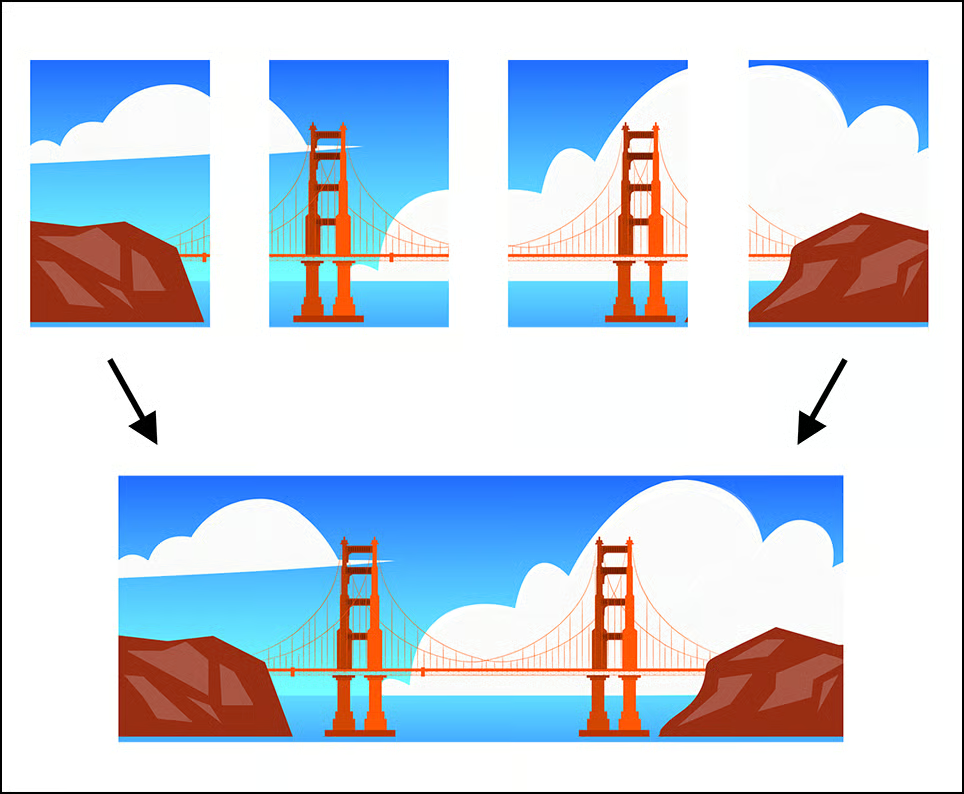
If you’re wondering how to shoot panorama with Sony A1 & Tokina ATX-i 11-20mm f/2.8, you’ve picked a combo that can deliver clean, high-resolution 360° results—provided you set it up correctly. The Sony A1 is a 50.1MP full-frame, stacked CMOS mirrorless with excellent dynamic range (~14 EV at ISO 100), fast readout, and reliable autofocus. Its pixel pitch is about 4.16 µm, which balances detail capture and low-light performance well for panoramas. The Tokina ATX-i 11-20mm f/2.8 is a rectilinear APS-C ultra-wide zoom with constant f/2.8, strong center sharpness from f/4–f/8, and manageable barrel distortion at 11mm.
Important note: the Tokina ATX-i 11-20mm f/2.8 is designed for APS-C. On the Sony A1 (full-frame), you should shoot in APS-C/Super 35 mode to avoid heavy vignetting, resulting in ~21MP files. If you mount the Canon EF or Nikon F version via an adapter, ensure compatibility and manually enable APS-C crop on the A1. With the Sony A1’s clean 21MP APS-C output and Tokina’s rectilinear rendering, you’ll get architectural lines that stitch predictably and a field of view wide enough to keep shot counts reasonable for a full 360×180° sphere.
Compared to a fisheye, this rectilinear lens requires more frames but gives straighter edges and more natural perspective—ideal for real estate, interiors, and scenes where straight lines matter.
Quick Setup Overview
- Camera: Sony A1 — Full-frame (35.9×24mm), 50.1MP; APS-C/S35 crop yields ~21MP. Dynamic range ~14 EV at ISO 100; excellent AF; 5-axis IBIS.
- Lens: Tokina ATX-i 11-20mm f/2.8 — Rectilinear APS-C ultra-wide zoom; constant f/2.8; good center sharpness at f/4–f/8; mild barrel distortion at 11mm; moderate lateral CA (correctable).
- Estimated shots & overlap (360×180°, rectilinear):
- At 11mm (APS-C crop): 3 rows + zenith + nadir. Typical: 8 shots around at 0°, 6 shots at +45°, 6 shots at −45°, plus 1 zenith, 1 nadir = ~22 frames (30–35% overlap).
- At 15–20mm: expect 8–10 shots per row, three rows + Z/N = 28–34 frames.
- Difficulty: Moderate — fast once your nodal point is calibrated.
Planning & On-Site Preparation
Evaluate Shooting Environment
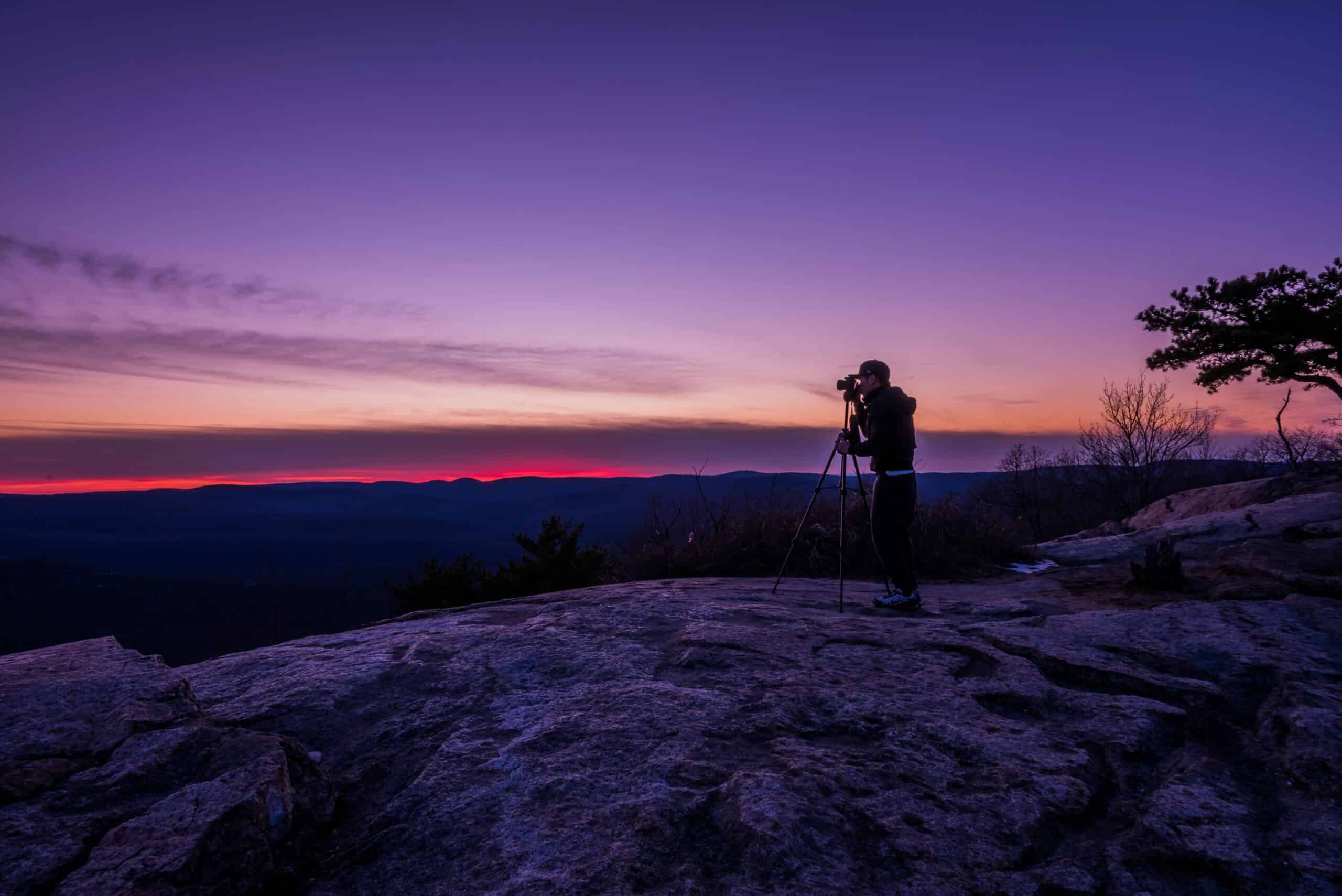
Walk the scene before you set up. Identify bright light sources (windows, sun), reflective surfaces (glass, polished floors), and moving elements (people, trees, traffic). For interiors with glass, shoot 0.5–1 m away and angle slightly to reduce reflections or ghosting, and keep the lens clean to avoid flare. Wind and vibration are the enemy—choose a stable surface and consider a heavier tripod or a bag weight hook in exposed locations.
Match Gear to Scene Goals
The Sony A1’s ~14 EV of DR and low-noise 21MP APS-C crops make it great for real estate and landscapes. Safe ISO for clean results is ISO 100–800; ISO 1600 remains usable with careful noise reduction. The Tokina ATX-i 11–20mm f/2.8 gives you rectilinear rendering—fewer curvature issues than fisheyes but you’ll shoot more frames. For interiors, rectilinear lines look natural; for fast outdoor captures, consider fewer shots at 11mm with larger overlap to speed stitching and increase reliability in featureless skies.
Pre-shoot Checklist
- Batteries charged; spacious, fast card (UHS-II), and a backup card.
- Clean lens and sensor; bring a blower and microfiber cloth.
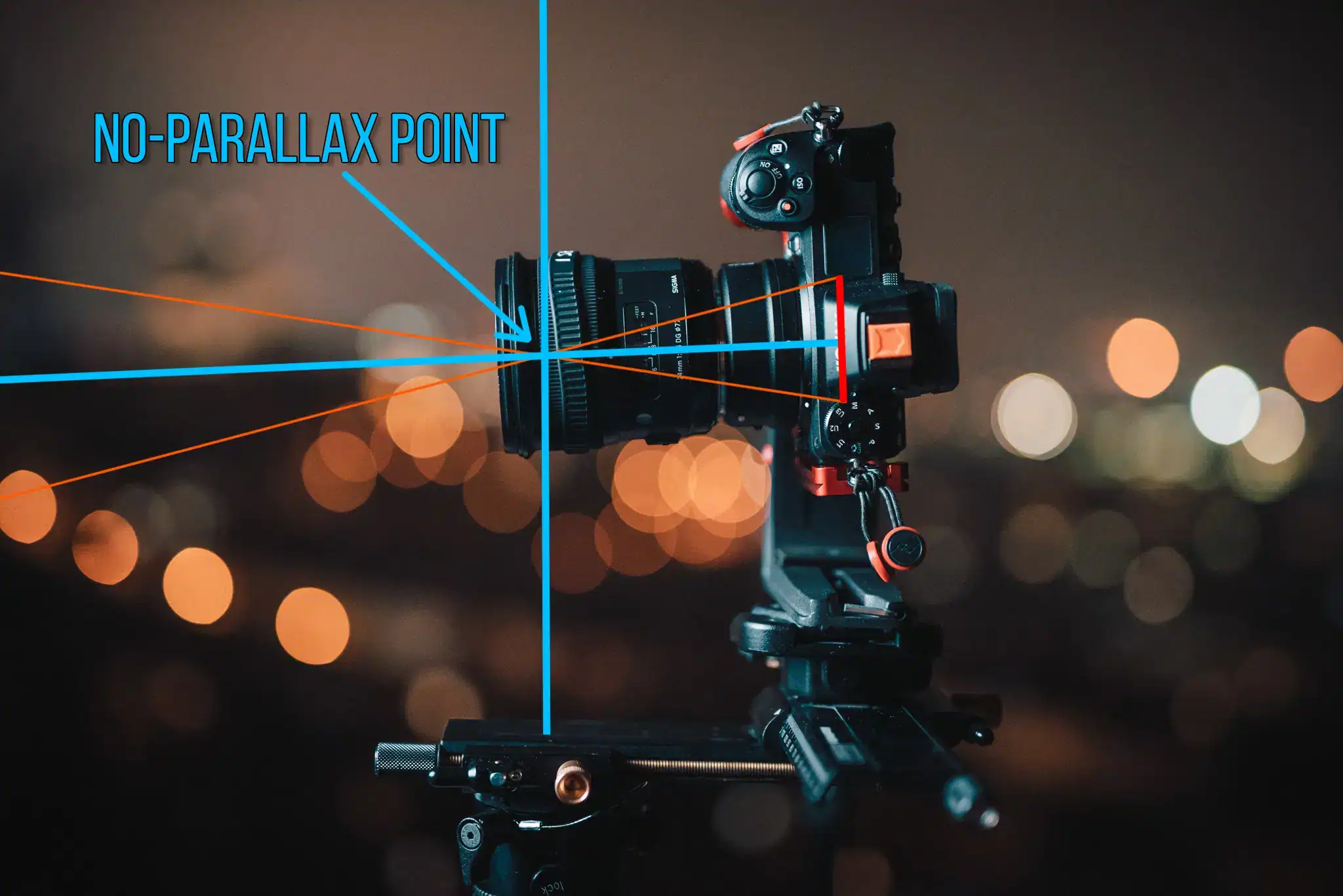
- Tripod leveled; panoramic head calibrated for the lens’s no-parallax (nodal) point.
- Safety: assess wind loads, rooftop edges, crowds; use a tether for pole/car rigs.
- Backup workflow: shoot a second full round if time allows (especially with crowds or changing light).
Essential Gear & Setup
Core Gear
- Panoramic head: Enables rotation around the lens’s no-parallax point to eliminate parallax error. This is essential for clean stitches, especially in tight interiors or near objects.
- Stable tripod with leveling base: A leveling base speeds setup; keeping the rotational axis vertical reduces horizon warps.
- Remote trigger or app: Use Sony Imaging Edge or a wired remote to avoid vibrations, especially for longer exposures.
Optional Add-ons
- Pole or car mount: Great for elevated or moving perspectives. Safety first—use tethers, limit speed, avoid high winds, and ensure you’re compliant with local laws.
- Lighting aids (LED panels) for low-light interiors: Fill shadows while keeping WB consistent.
- Weather protection: Rain covers, silica gel, and gaffer tape for unexpected weather.
Step-by-Step Shooting Guide
Standard Static Scenes
- Level tripod & align nodal point:
- Mount the Tokina at your chosen focal length (11mm recommended for fewer frames).
- Place two vertical objects at different distances; pan the camera and adjust fore/aft on the rail until the near and far objects don’t shift relative to each other.
- Mark that rail position for quick future setups (expect the NPP to be several cm in front of the mount; exact value varies by copy and focal length).
- Manual exposure & locked white balance:
- Switch A1 to M mode. Set exposure for mid-tones without clipping highlights (check zebras/histogram).
- Lock WB (Daylight/Tungsten/Custom). Avoid Auto WB; it causes color shifts across frames.
- Turn off IBIS on a tripod to prevent micro-blur (A1: SteadyShot Off). Use EFCS or mechanical shutter.
- Set APS-C/Super 35 mode to On for this lens.
- Capture with tested overlap:
- At 11mm: 8 shots around at 0° pitch (every 45°), 6 shots at +45°, 6 shots at −45°, plus 1 zenith and 1 nadir. Aim 30–35% overlap.
- Pause 1–2 seconds after touching the camera; use a remote to minimize vibration.
- Take a nadir (ground) shot:
- Shoot a clean nadir by shifting the tripod slightly or using a nadir adapter. Capture a hand-held offset nadir if needed for tripod removal in post.
HDR / High Dynamic Range Interiors
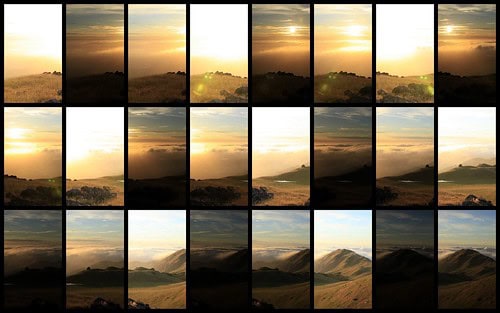
- Bracket ±2 EV (3 or 5 frames) to balance bright windows and interior shadows. Keep the A1 in manual exposure; use AEB with a remote for consistency.
- Lock WB and focus. Merge HDR per view before stitching for consistent control points.
- Keep ISO at 100–400 to maximize dynamic range; let shutter speed vary across brackets.
Low-Light / Night Scenes
- Open to f/4–f/5.6 for sharpness; use tripod times of 1–10s as needed. Aim ISO 100–800 for best quality; ISO 1600 is usable with noise reduction.
- Disable IBIS on tripod; use a remote or 2s timer. Wind or traffic vibrations? Hang a weight from the tripod center column.
- Take an extra pass if light sources flicker or if there’s traffic/trails you want to manage in post.
Crowded Events
- Shoot two passes. First pass quickly for coverage; a second pass aiming for moments when areas clear. This gives options to mask out moving people.
- Use shorter shutter speeds (1/100–1/250s) and ISO 400–800 to freeze motion and minimize ghosting.
- Keep overlap generous (35–40%) to help stitching deal with motion.
Special Setups (Pole / Car / Drone)
- Pole: Use a lightweight panoramic head and a safety tether. Keep the pole vertical. Limit shutter speeds to minimize sway; shoot bursts and select the sharpest.
- Car-mounted: Use vibration dampers, low speeds, and high shutter (1/500s+). Avoid busy areas. Secure everything with safety lines.
- Drone (if applicable with other gear): Ensure legal compliance. For this A1 + Tokina combo, drones are typically not applicable due to weight.
Recommended Settings & Pro Tips
Exposure & Focus
| Scenario | Aperture | Shutter | ISO | Notes |
|---|---|---|---|---|
| Daylight outdoor | f/8–f/11 | 1/100–1/250 | 100–200 | Lock WB (Daylight); generous overlap in sky |
| Low light/night | f/4–f/5.6 | 1/2–1/60 | 100–800 | Tripod & remote; IBIS off; watch wind |
| Interior HDR | f/8 | Bracket ±2 EV | 100–400 | Merge HDR before stitching for consistency |
| Action / moving subjects | f/5.6–f/8 | 1/200+ | 400–800 | Freeze motion; consider two passes |
Critical Tips
- Manual focus at hyperfocal distance. At 11mm and f/8 on APS-C, focusing ~1 m keeps almost everything sharp to infinity.
- Nodal point calibration: Do it once per focal length (11, 14, 20mm) and mark your rail. Keep a cheat card with rail positions in your bag.
- White balance lock: Use a custom WB for mixed lighting (shoot a gray card) to prevent color shifts across frames.
- RAW vs JPEG: Shoot RAW for DR and color latitude; JPEG only if speed matters and lighting is uniform.
- IBIS and shutter: Turn IBIS off on tripod. Use EFCS or mechanical shutter to avoid shutter-induced blur at certain speeds.
- A1 menu must-do: Enable APS-C/Super 35 mode for this lens; turn off long exposure NR (do noise reduction in post).
Stitching & Post-Processing
Software Workflow
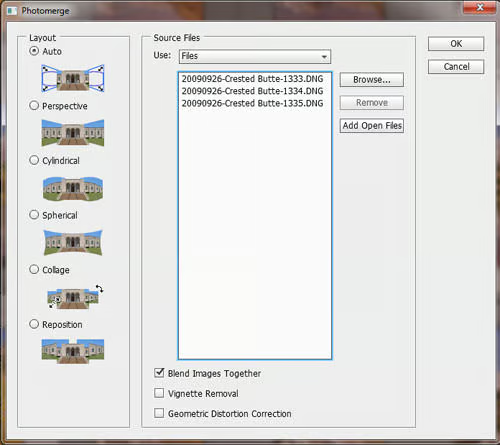
For professional results, PTGui is a gold standard: fast, robust control points, HDR merges, and excellent masking. Hugin is a strong open-source alternative. Rectilinear lenses like the Tokina ATX-i usually stitch cleanly with 20–30% overlap; I prefer 30–35% on the middle row to be safe. If you bracketed, first merge HDR per viewpoint, then stitch the tone-mapped images or stitch HDR stacks directly in PTGui’s HDR workflow. PTGui’s optimizer and vertical line controls are terrific for architecture. For finishing, use Lightroom/Photoshop for color, noise, and sharpening. See a deep-dive PTGui review on Fstoppers for context on its strengths at large projects. PTGui review: strengths for complex panoramas
Cleanup & Enhancement
- Nadir patch: Export a layered file from PTGui and use content-aware fill or AI tools to remove the tripod.
- Color correction: Balance WB across the pano; use HSL to tame mixed lighting. Apply moderate noise reduction for ISO 800–1600 captures.
- Level horizon: Use pitch/yaw/roll adjustments or straight lines in PTGui to enforce verticals.
- Export: For VR, export 2:1 equirectangular JPEG (8–12k wide) or TIFF for further editing.
Want a primer on panoramic head technique and control points? This succinct tutorial is a great reference. Panoramic head setup tutorial
Video: Panoramic Head Setup Basics
Watch this clear walkthrough if you’re new to nodal alignment and rotation technique:
For platform-ready 360 photo workflows (export specs, metadata), Meta’s DSLR 360 guide is also helpful. DSLR/mirrorless 360 photo workflow
Disclaimer: Always check the latest software documentation; interfaces and features evolve.
Useful Tools & Resources
Software
- PTGui panorama stitching
- Hugin open source
- Lightroom / Photoshop for color and cleanup
- AI tripod removal tools (content-aware, generative fill)
Hardware
- Panoramic heads (Nodal Ninja, Leofoto, Sunwayfoto)
- Carbon fiber tripods with leveling bases
- Wireless remote shutters
- Pole extensions / car mounts with safety tethers
Disclaimer: Brand names provided for search reference; confirm details and compatibility on official sites.
Common Mistakes & How to Avoid Them
- Parallax error → Align the no-parallax point precisely; re-check after zoom changes.
- Exposure flicker → Manual mode, fixed ISO and WB. Don’t use Auto WB or Auto ISO for 360 work.
- Tripod shadows or reflections → Shoot a nadir and plan to patch; move slightly for a clean offset shot.
- Ghosting from moving subjects → Shoot two passes, then mask in PTGui or Photoshop.
- Noise at night → Keep ISO low; extend shutter on tripod; stack frames if necessary.
- Insufficient overlap → Target 30–35% with rectilinear lenses, especially near the zenith/nadir rows.
- IBIS micro-blur → Turn stabilization off on a locked-down tripod.
Frequently Asked Questions
-
Can I shoot handheld panoramas with the Sony A1?
Yes for partial panos; for full 360×180° with a rectilinear ultra-wide, it’s risky. Handheld introduces parallax and horizon tilt. If you must, use a faster shutter (1/250s+), high overlap (40–50%), and avoid near objects. For professional results, use a tripod and panoramic head.
-
Is the Tokina ATX-i 11-20mm f/2.8 wide enough for single-row 360?
Not for full spheres. At 11mm APS-C, a single row won’t cover zenith/nadir. You’ll need multi-row: typically +45°, 0°, −45°, plus separate zenith and nadir shots.
-
Do I need HDR for interiors with bright windows?
Usually yes. The A1’s DR is strong, but windows and interior shadows often exceed it. Bracket ±2 EV (3–5 frames), merge to HDR per viewpoint, then stitch. This preserves detail both outside and inside.
-
How do I avoid parallax issues with this lens?
Calibrate the no-parallax point at each focal length (11, 14, 20mm) on your pano head and mark the rail. Keep the nodal point exactly over the rotation axis, and don’t change focus distance after calibration.
-
What ISO range is safe on the A1 in low light?
ISO 100–800 is very clean; ISO 1600 remains usable with moderate noise reduction. For tripod work, prefer lower ISO and longer shutter times.
-
Can I create custom modes on the A1 for panos?
Yes. Save a “Pano” setup to a custom mode with APS-C/S35 On, M mode, fixed WB, RAW, EFCS, IBIS Off, and your typical f/8 + ISO 100 starting point. This speeds up field work.
-
How can I reduce flare with this rectilinear ultra-wide?
Avoid direct strong backlight, shade the lens with your hand/flag just outside frame, clean the front element, and bracket in case you need to blend a clean frame for the sun area.
-
What panoramic head should I choose for this setup?
Look for an arca-compatible, two-axis head with fore/aft and vertical rails (e.g., Nodal Ninja, Leofoto). Add a leveling base to speed setup and improve horizon accuracy.
Field-Tested Scenarios & Settings
Indoor Real Estate (Mixed Light)
Setup A1 in APS-C mode, f/8, ISO 100–200, bracket ±2 EV, focus manual at ~1 m, IBIS off. Shoot +45°/0°/−45° rows plus zenith/nadir. Use a gray card to fix WB and reduce time grading later. Mask moving people or pets in PTGui.
Outdoor Sunset Landscape
Meter for highlights (don’t clip the sun area), then bracket if needed. f/8, ISO 100, shutter varies. Windy? Add weight to tripod. Overlap generously near the top row to help PTGui handle low-contrast sky.
Event Crowds
Go faster: f/5.6, 1/200–1/250s, ISO 400–800. Two passes to catch cleaner gaps. Expect to mask. Avoid near objects if you’re not perfectly nodal.
Rooftop / Pole
Use a compact head and tether the rig. Keep exposures short to prevent sway blur. Consider a single focal length (11mm) for speed. Don’t operate in strong wind; safety overrides the shot.
Car-Mounted Capture
Only on private property or where permitted. Hard-mount with vibration dampers, safety lines, and drive slowly. High shutter (1/500s+), ISO 800–1600, f/5.6–f/8. Expect to fix micro misalignments in post.
What to Expect from the Stitch
A well-executed multi-row stitch at 11mm APS-C on the A1 yields a detailed equirectangular ready for virtual tours. Straight lines remain straight, and window views retain highlight detail if you bracketed. Keep rows consistent and overlap ample—the software will do the rest.