Why This Camera & Lens Are Great for Panoramas
If you’re learning how to shoot panorama with Sony A1 & Sony FE 16-35mm f/2.8 GM, you’re starting with a world-class combination. The Sony A1 is a 50.1MP full-frame mirrorless body (approx. 35.9 × 24mm sensor, pixel pitch ~4.16 µm) with excellent dynamic range at base ISO, robust color depth, and reliable autofocus. Its native ISO 100–32,000 (expanded 50–102,400) provides clean files up through ISO 1600–3200 when needed, while the 5-axis IBIS helps handheld shooting (turn it off on a tripod). The FE 16–35mm f/2.8 GM is a pro-grade rectilinear ultra-wide zoom: sharp in the center to edges when stopped down, low CA, and well-controlled coma. At 16mm, the diagonal FOV is about 107° (horizontal ~96°, vertical ~74°), which is great for fast coverage in multi-row 360° panoramas.
Compared to a fisheye, this rectilinear zoom requires more shots for a full spherical 360×180°, but rewards you with straighter lines, less distortion at the edges, and higher final resolution. The A1’s dual card slots (CFexpress Type A/SD UHS-II), fast buffer, and precise exposure tools (zebra, histogram, advanced WB) make it ideal for HDR panorama and low-light shooting. With a calibrated panoramic head and careful nodal alignment, this combo delivers clean stitches in PTGui or Hugin with minimal parallax and superb detail.
Quick Setup Overview
- Camera: Sony A1 — Full-frame 50.1MP; excellent DR (~14.5–15 stops at base ISO), clean ISO up to 1600–3200 with careful exposure.
- Lens: Sony FE 16–35mm f/2.8 GM — Rectilinear ultra-wide zoom; best sharpness around f/5.6–f/8; low CA; mild barrel distortion at 16mm.
- Estimated shots & overlap (tested):
- 16mm (portrait orientation): Two rows at ±30–35° tilt with 8 shots each (30% overlap), plus 1 zenith and 1–2 nadir frames → 18–19 shots total.
- 16mm (extra-safe coverage): Two rows of 10 shots each at ±35°, plus zenith + nadir → 22–24 shots total.
- 24mm (higher resolution): 12 shots around at 0°, +6 at +45°, +6 at −45°, plus Z/N → ~26 shots.
- Difficulty: Intermediate (requires nodal alignment and multi-row rotation).
Planning & On-Site Preparation
Evaluate Shooting Environment
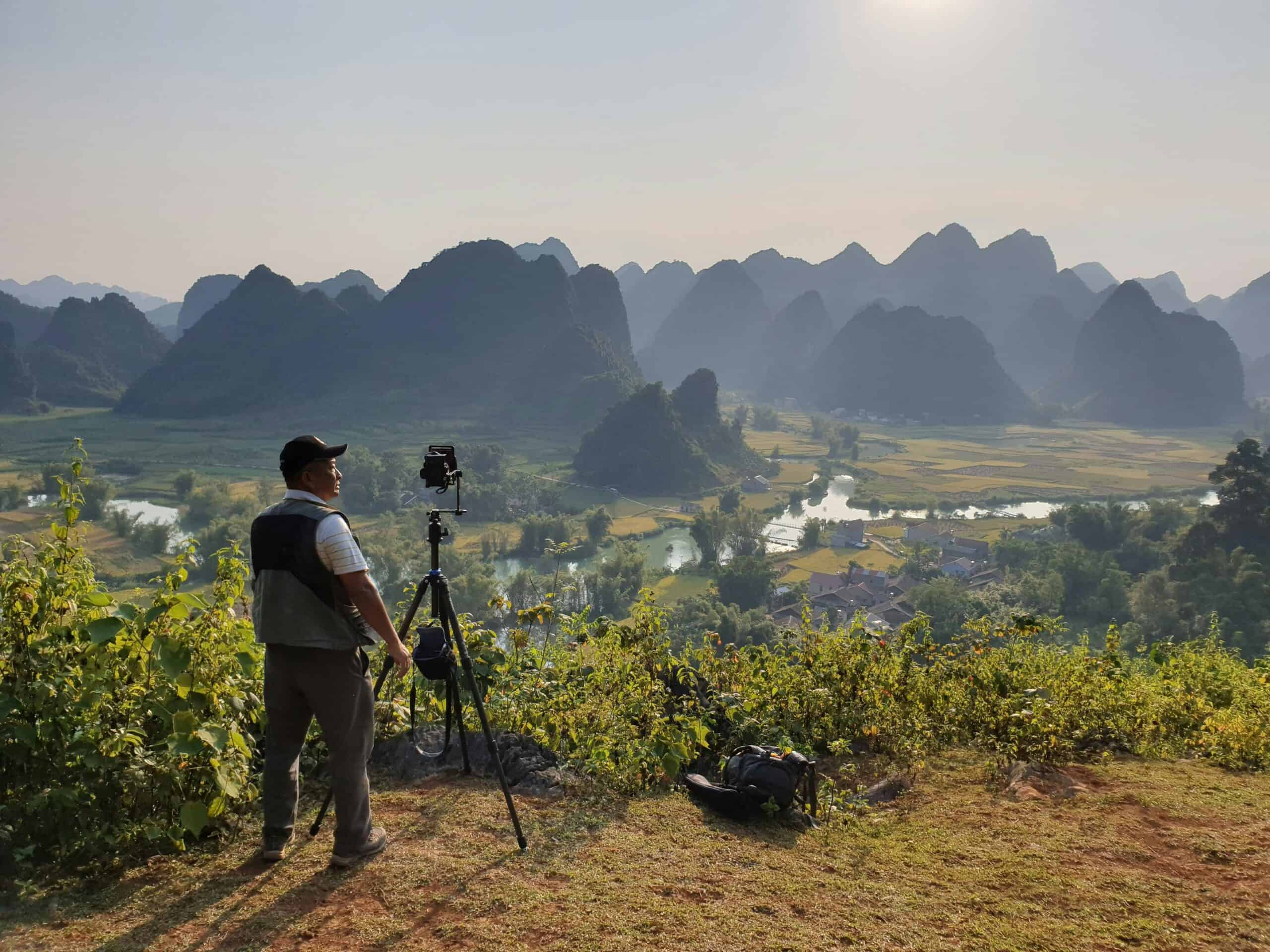
Walk the scene before setting up. Note light direction, reflective surfaces (glass, polished floors), and moving elements (people, vehicles, foliage). If shooting through glass, keep the front element close (within a few centimeters) to reduce reflections and ghosting, and angle slightly to avoid your own reflection. For sunsets or city night scenes, expect wide dynamic range and mixed color temperatures—plan to bracket exposures and lock white balance.
Match Gear to Scene Goals
The Sony A1 & FE 16–35mm f/2.8 GM excel in both interiors and landscapes. The A1’s dynamic range and color depth handle complex lighting, while the lens’ rectilinear rendering keeps lines straight—critical for architecture and real estate. Safe ISO ranges for clean panoramas are generally ISO 100–400 outdoors, ISO 200–800 for interiors, and ISO 800–1600 at night if you must. Use HDR bracketing rather than pushing ISO too high when windows or bright signs blow out highlights. The 16mm end minimizes the number of frames required; zoom to 24–35mm when you want higher-resolution gigapixel-style output and have time for more shots.
Pre-shoot Checklist
- Power and storage: Fully charge batteries; use fast SD/CFexpress cards; enable dual-card backup (Simultaneous Recording).
- Clean optics: Wipe the lens and check for dust on the sensor; dust becomes obvious when cloning the nadir.
- Leveling & calibration: Bring a leveling base; confirm your panoramic head’s nodal settings for 16mm and 24mm.
- Safety: Assess wind and crowd flow; tether the camera on rooftops or poles; use a sandbag or ground spikes if allowed.
- Backup workflow: Shoot an extra full rotation in case of missed frames or people blocking the lens; label HDR brackets clearly.
Essential Gear & Setup
Core Gear
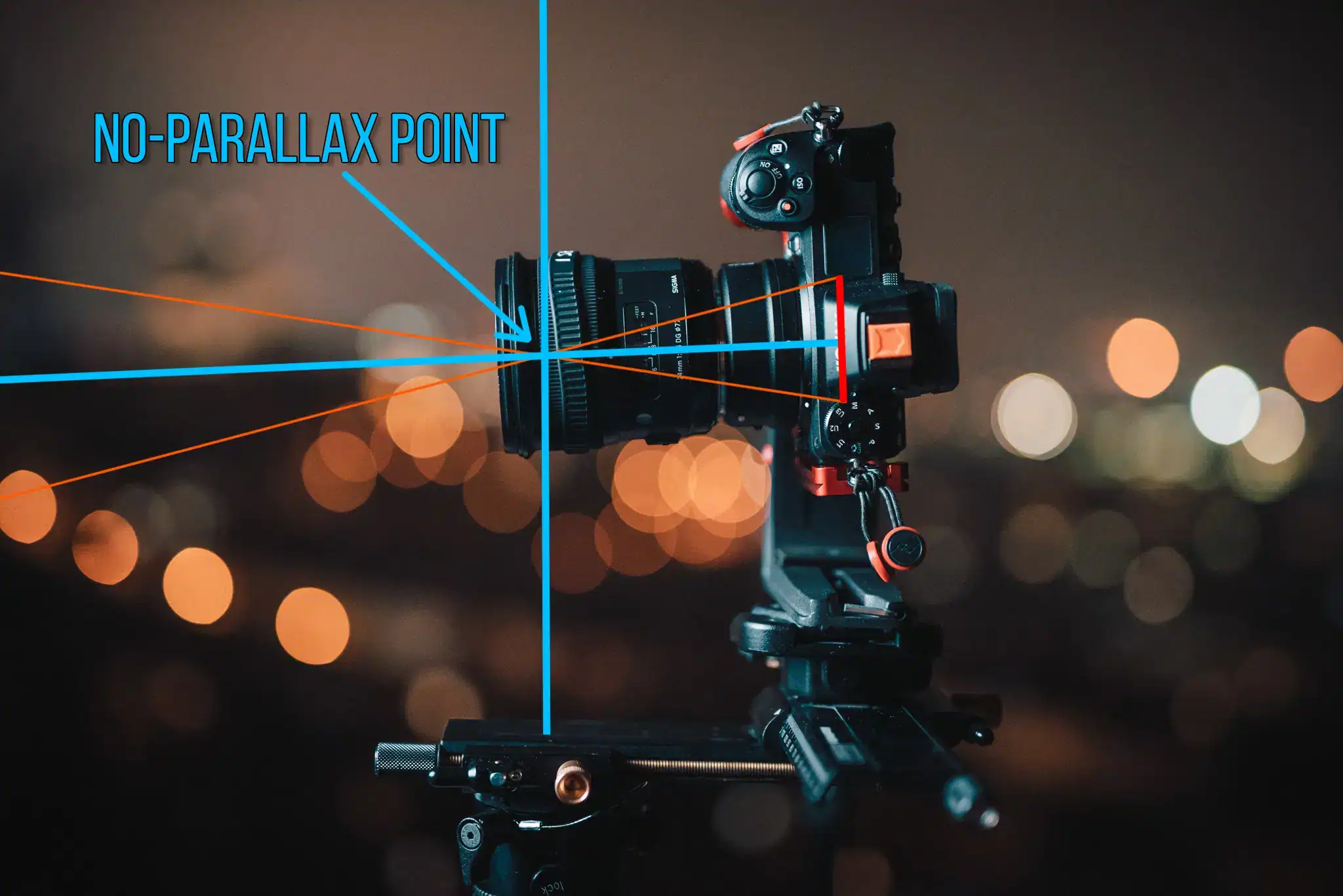
- Panoramic head: Allows precise rotation around the lens’ entrance pupil (nodal point) to eliminate parallax. Mark your rail settings for 16mm and 24mm and record them in your phone.
- Stable tripod with leveling base: Level once at the base to keep rows consistent. Avoid extending center column in wind.
- Remote trigger/app: Use Sony Imaging Edge Mobile or a simple wired remote to avoid touching the camera and causing vibrations.
Optional Add-ons
- Pole or car mount: Use safety tethers; watch wind loading; avoid high speeds; check local regulations.
- Lighting: Small LED panels for dark interiors; gel to match ambient color temperature when needed.
- Weather protection: Rain covers, lens cloths, and a microfiber towel for coastal spray or humidity.
Video: Visualizing Nodal Setup
Seeing the process makes it easier. This short video walks through core pano head setup steps that apply to the A1 + 16–35mm combo.
For a deeper dive on panoramic head fundamentals, see this comprehensive panoramic head tutorial. Panoramic head tutorial
Step-by-Step Shooting Guide
Standard Static Scenes
- Level and align: Level the tripod via the leveling base, then mount the panoramic head. Ensure the rotator’s index marks are easy to read.
- Find and set the nodal point: Slide the camera along the fore-aft rail until near objects and far objects don’t shift relative to each other when you pan. For the FE 16–35 GM at 16mm, a good starting range is 75–90 mm forward of the sensor plane; fine-tune with a near/far test. Mark this position.
- Manual exposure and WB: Switch to M mode; lock white balance (Daylight outdoors, Kelvin 3200–4500 indoors, or custom); shoot RAW. Disable auto ISO.
- Focus: Use manual focus at hyperfocal distance. At 16mm and f/8 on full frame, hyperfocal is roughly ~1.1 m; focus just beyond 1 m to render from ~0.6 m to infinity acceptably sharp. Use focus magnification to confirm.
- Capture sequence: For 16mm portrait orientation, shoot two rows at ±30–35° tilt with 8 frames per row at ~45° yaw increments (30% overlap). Then capture one zenith and one or two nadir frames. Keep a smooth cadence to reduce lighting changes.
- Nadir shot: Either shoot a handheld nadir by quickly lifting the tripod and capturing the ground from the same nodal point, or use a dedicated nadir adapter to swing the camera out and take a clean patch frame.
HDR / High Dynamic Range Interiors
- Bracket ±2 EV or ±3 EV depending on window brightness. Common sets are 3 or 5 frames per view. Keep the bracket consistent throughout the panorama.
- Lock WB and keep the same aperture for all frames (f/8 is a reliable interior sweet spot). Change shutter speed to expose brackets; do not change ISO between brackets.
- Use mechanical shutter and Anti-Flicker Shooting under LED lights to minimize banding. The A1’s electronic shutter is great, but artificial light can cause banding in some cases.
Low-Light / Night Scenes
- Use a sturdy tripod. Start at f/4–f/5.6, ISO 400–800, and let shutter run longer (1–10 s depending on the scene). Noise on the A1 is clean at ISO 800–1600 with proper exposure.
- Use a remote trigger and 2 s self-timer; turn off IBIS (SteadyShot) when on a tripod to avoid micro-blur from sensor corrections.
- Consider long exposure noise reduction only if hot pixels are problematic; otherwise, save time and handle hot pixels in post.
Crowded Events
- Shoot two complete passes: first for coverage; second to fill gaps when people move. Mark frames with a clap or voice note for easy reference.
- Use faster shutter (1/200+) and ISO 800–1600 at f/5.6–f/8 to freeze folks and reduce ghosting.
- In post, use masks to blend cleaner portions from the two passes.
Special Setups (Pole / Car / Drone)
- Pole: Keep the pole vertical; shoot slower rotations to reduce sway. Use a safety tether and check wind limits. A short timer delay helps settle vibrations.
- Car mount: Shoot on smooth roads, early mornings, or during brief stops. Avoid high speeds; use high shutter speeds to prevent blur.
- Drone: The A1/16–35 is not drone-mounted in typical workflows, but you can simulate elevated views with a mast/pole where drones are restricted.
Recommended Settings & Pro Tips
Exposure & Focus
| Scenario | Aperture | Shutter | ISO | Notes |
|---|---|---|---|---|
| Daylight outdoor | f/8–f/11 | 1/100–1/250 | 100–200 | Lock WB to Daylight; consider CPL off to avoid uneven skies |
| Low light/night | f/4–f/5.6 | 1/30–several sec | 400–800 (1600 if needed) | Tripod + remote; IBIS off; avoid electronic shutter under LED |
| Interior HDR | f/8 | Bracket ±2 EV | 100–400 | Balance windows vs room; consistent bracketing across all views |
| Action / moving subjects | f/5.6–f/8 | 1/200+ | 400–800 | Double pass; mask moving people during stitching |
Critical Tips
- Manual focus at hyperfocal: At 16mm and f/8, focus ~1.1 m. At 24mm and f/8, focus ~2.0 m. Verify with magnification.
- Nodal calibration: Use a near object (~1 m) and distant line (e.g., window frame). Pan and adjust until the relative alignment remains fixed. Record rail marks for quick repeatability.
- White balance lock: Prevent color cast mismatches across frames—especially under mixed lighting—by fixing WB.
- RAW over JPEG: Maximizes dynamic range and color latitude for HDR and interior scenes. The A1’s RAW files handle aggressive recovery well.
- Stabilization: Turn off IBIS (SteadyShot) on tripod to avoid micro-shifts; leave it on for handheld panos or pole shots if vibrations persist.
Stitching & Post-Processing
Software Workflow
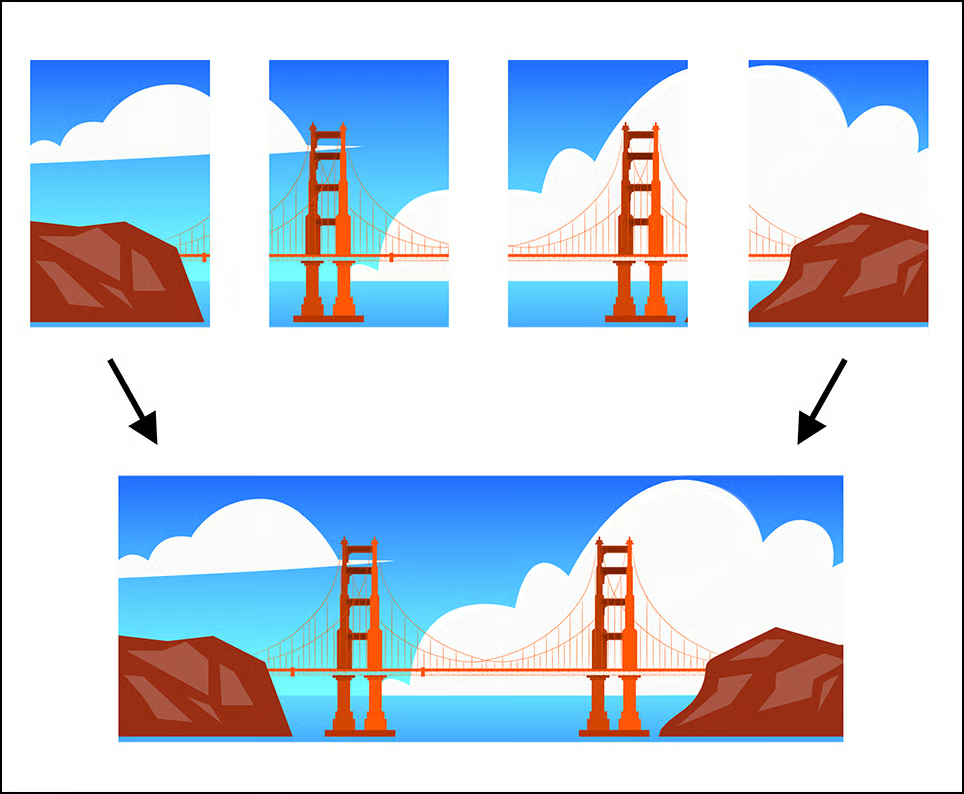
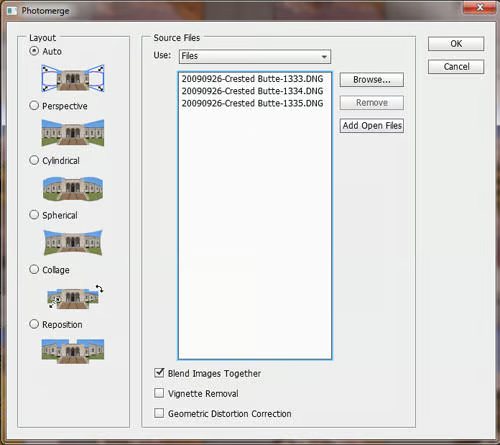
For professional control, PTGui leads in speed and alignment control for rectilinear ultra-wide workflows. Hugin is an excellent open-source alternative. Lightroom/Photoshop can stitch simple single-row panoramas, but PTGui/Hugin provide better control for multi-row, HDR, and 360 projections. With rectilinear lenses, plan on ~20–30% overlap for robust control points and reliable alignment. Fisheye lenses need fewer frames but require defishing; rectilinear needs more frames but produces straighter edges and higher effective resolution. See a comprehensive review of PTGui to understand its strengths for pro 360 work. PTGui review and workflow overview
Cleanup & Enhancement
- HDR merging: Either pre-merge brackets per view, then stitch, or use PTGui Pro’s HDR workflow to merge after alignment.
- Tripod/nadir patch: Capture a clean ground shot and patch manually, or use AI tools to remove the tripod footprint convincingly.
- Color & noise: Match white balance across the set. Apply subtle noise reduction for high-ISO night shots.
- Leveling: Use horizon tools to correct roll/pitch/yaw, ensuring a flat horizon and a true north orientation for virtual tours.
- Export: Deliver a 2:1 equirectangular JPEG/TIFF at 12K–20K pixels wide (or higher for multi-row gigapixel). Ensure EXIF and projection tags are intact for VR viewers.
If you’re new to end-to-end DSLR/mirrorless 360 workflows, this official guide from Meta (Oculus) provides an excellent primer with examples and stitching tips. DSLR/mirrorless 360 photo guide
Useful Tools & Resources
Software
- PTGui panorama stitching
- Hugin open source
- Lightroom / Photoshop
- AI tripod removal tools
Hardware
- Panoramic heads (Nodal Ninja, Leofoto, Sunwayfoto)
- Carbon fiber tripods with leveling bases
- L-bracket for quick portrait orientation
- Wireless remote shutters
- Pole extensions / car suction mounts with safety cables
For a broader perspective on DSLR pano best practices and equipment selection, this FAQ is a handy reference. DSLR virtual tour FAQ and gear guide
Disclaimer: software/hardware names provided for search reference; check official sites for specs and updates.
Common Mistakes & How to Avoid Them
- Parallax error: Always rotate around the nodal point. Recalibrate if you change focal length.
- Exposure flicker: Use full manual settings and fixed white balance; avoid auto ISO for panoramas.
- Tripod shadows and missing ground: Shoot nadir coverage and patch during post-processing.
- Ghosting from movement: Capture a second pass and mask moving subjects in post.
- Banding under LED lights: Use mechanical shutter and Anti-Flicker Shooting; avoid electronic shutter in problematic lighting.
- IBIS micro-blur: Turn off stabilization on a tripod to prevent sensor drift during long exposures.
- Insufficient overlap: Maintain at least 25–30% overlap for rectilinear wide angles; more overlap improves control points.
Real-World Case Studies with the A1 + 16–35 GM
Indoor Real Estate (Mixed Lighting)
Set f/8, ISO 200–400. Bracket ±2 EV in 3–5 frames per view. Two rows at ±30° tilt, 8 frames each, plus zenith/nadir for ~18–19 shots. Use mechanical shutter with Anti-Flicker to avoid LED banding. Merge HDR in PTGui Pro, then correct verticals and patch the nadir with a clean ground frame. Result: crisp lines and natural window balance.
Outdoor Sunset (High DR, Wind)
Mount on a sturdy carbon tripod with a leveling base. Lock WB to Daylight. Shoot two rows with 8 frames each and 3-shot brackets (0, −2, +2 EV), ISO 100–200, f/8. Use a 2 s timer or remote. If wind is strong, shorten shutter speeds by increasing ISO to 400. In PTGui, use exposure fusion or HDR merge, then global contrast in Lightroom.
Event Crowd (Movement)
Go to 20–24mm for less edge stretch of people. Use 12 shots around at 0°, plus 6 up and 6 down rows, Z/N for ~26 shots. Shutter 1/200–1/400 at f/5.6–f/8, ISO 800–1600. Shoot a second pass and mask in PTGui or Photoshop to remove overlapping moving subjects.
Rooftop or Pole (Safety First)
Always tether the rig. At 16mm, consider one-row coverage plus supplemental up/down frames to reduce time aloft. Use short shutter speeds (1/125–1/250) and burst if the pole sways. For rooftops, sandbag the tripod and avoid the edge; take a backup rotation in case a gust spoils a frame.
Frequently Asked Questions
-
Can I shoot handheld panoramas with the Sony A1?
Yes for simple, single-row scenes with distant subjects. Use fast shutter (1/250+), IBIS on, and heavy overlap (40–50%). However, for 360×180° interiors or scenes with near objects, a panoramic head is strongly recommended to eliminate parallax and ensure clean stitches.
-
Is the FE 16–35mm f/2.8 GM wide enough for a single-row 360?
Not for full spherical coverage. At 16mm rectilinear, a single row at 0° pitch won’t cover zenith and nadir. Plan on two rows (±30–35°) plus dedicated zenith/nadir frames for complete 360×180° coverage.
-
Do I need HDR for interiors with bright windows?
Usually yes. Bracket ±2 EV (3 or 5 frames) to retain highlight detail in windows while preserving interior shadows. Merge HDR either before stitching or within PTGui Pro’s HDR pipeline to keep tonal transitions consistent.
-
How do I avoid parallax issues with this lens?
Mount the camera on a calibrated panoramic head and rotate around the entrance pupil. For the 16–35 GM at 16mm, start with a fore-aft rail setting around 75–90 mm from the sensor plane, then fine-tune using a near/far alignment test. Recalibrate when changing focal length.
-
What ISO range is safe on the A1 for low light panoramas?
For best quality, aim for ISO 100–400 on a tripod. ISO 800 is still very clean; ISO 1600 remains usable with careful exposure and noise reduction. If you need more dynamic range, use HDR bracketing rather than pushing ISO higher.
-
Can I set up Custom Shooting Modes for pano on the A1?
Yes. Register your panorama settings to Memory Recall (1/2/3): Manual exposure, fixed WB, RAW, IBIS off (tripod), mechanical shutter, self-timer or remote, and your preferred bracketing mode. This speeds up on-site setup.
-
How do I reduce flare when shooting ultra-wide?
Use the lens hood, avoid direct sun near the frame edge when possible, shield with your hand or a flag, and slightly reframe to keep strong light sources just outside the frame. Bracket and blend if needed to tame veiling glare.
-
What’s the best tripod head for this setup?
A multi-row panoramic head with an adjustable fore-aft rail and vertical rotator (e.g., Nodal Ninja or similar) is ideal. Ensure it can hold the A1 + 16–35 GM securely and has indexed stops for consistent overlap.
Safety, Reliability & Backup
Always secure your gear in public and windy locations. On rooftops, use a tether and keep distance from edges; on poles or vehicle mounts, use redundant security (safety cable plus clamp). For reliability, enable simultaneous recording to both cards, and consider shooting a second complete rotation as a safety. Keep a simple naming scheme for HDR brackets (e.g., -2, 0, +2) and use voice notes or a shot list. For a solid foundation in panorama technique and planning, this community discussion summarizes many best practices across shooting scenarios. Best techniques for 360 panoramas
Wrap-Up
The Sony A1 and FE 16–35mm f/2.8 GM are a powerhouse for 360° panorama work. With careful nodal calibration, locked exposure and WB, and disciplined overlap, you’ll produce clean stitches and stunning resolution. Use two-row coverage at 16mm for speed, or zoom toward 24–35mm for ultra-detailed multi-row gigapixel panoramas. Combine that with a robust HDR workflow and safe field practices, and your panoramas will be ready for websites, virtual tours, and immersive VR platforms.