Why This Camera & Lens Are Great for Panoramas
The Sony A1 paired with the Sony FE 14mm f/1.8 GM is a powerhouse for panoramic and 360° photography. The A1’s 50.1MP full-frame stacked CMOS sensor (approx. 8640 × 5760 pixels, ~4.16 μm pixel pitch) gives you abundant detail and excellent dynamic range (roughly 14–15 stops at base ISO), which is critical for clean sky gradations, shadow recovery in interiors, and robust HDR merging. Its fast, accurate autofocus and crisp EVF make pre-shot setup painless, while the deep buffer and reliable bracketing options help when shooting HDR panoramas.
The FE 14mm f/1.8 GM is an ultra-wide, rectilinear prime (not a fisheye). Its 114° diagonal field of view, superb edge sharpness, minimized coma, and well-controlled chromatic aberrations make it a strong choice for interiors and architecture. Rectilinear projection keeps straight lines straight—great for real estate and engineered spaces—but it requires more frames than a fisheye to cover a full sphere. The GM’s wide maximum aperture (f/1.8) also helps with night scenes and low-light focusing, even if you’ll typically stop down to f/8 for maximum field sharpness.
This combination mounts natively (Sony E), balances well on most panoramic heads, and benefits from the A1’s robust build and battery life. In short: big, clean files plus an optically excellent prime equals fewer stitching headaches and more flexibility in post.
Quick Setup Overview
- Camera: Sony A1 — Full Frame (35mm), 50.1MP, stacked CMOS; ~14–15 stops DR; ISO 100–32000 (native), best quality at ISO 100–800.
- Lens: Sony FE 14mm f/1.8 GM — rectilinear ultra-wide; very sharp from f/2.8–f/8; low coma and CA; minimal distortion for 14mm.
- Estimated shots & overlap (full spherical 360×180):
- Efficient two-row: 8 shots around at +30°, 8 shots around at −30°, + 1 zenith, + 2 nadir (tripod removal) = ~19 frames, ~30–40% overlap.
- High-coverage: 10 around at +30°, 10 around at −30°, + 1–2 zenith, + 2 nadir = ~23–24 frames, for difficult interiors or precision jobs.
- Note: 14mm rectilinear usually needs at least two rows for full spherical coverage; single-row 360 is not recommended.
- Difficulty: Intermediate (requires nodal point alignment and a panoramic head for best results).
Planning & On-Site Preparation
Evaluate Shooting Environment
Survey light direction, contrast, and moving elements (people, cars, trees). Look for reflective surfaces like glass, polished floors, and metal. If shooting through glass, place the lens close (2–5 cm) to reduce reflections and ghosting. Watch for flickering LED lights that can cause banding if you use electronic shutter; the A1’s mechanical shutter is safer under artificial lighting.
Match Gear to Scene Goals
The Sony A1 & 14mm GM shine in detail-critical work: real estate, museums, commercial interiors, landscapes, and cityscapes. The A1’s dynamic range lets you retain window highlights while lifting shadows—especially helpful when bracketing HDR. For indoor shooting, ISO 100–800 is a safe quality range; ISO 1600–3200 remains usable with careful noise reduction. The rectilinear 14mm preserves straight lines, making it preferable to fisheyes for architectural accuracy, though you’ll shoot more frames than with an 8–12mm fisheye.
Pre-shoot Checklist
- Charge batteries, clear fast cards (use lossless compressed RAW for efficiency).
- Clean the front element and sensor; ultra-wide lenses make dust and flares more obvious.
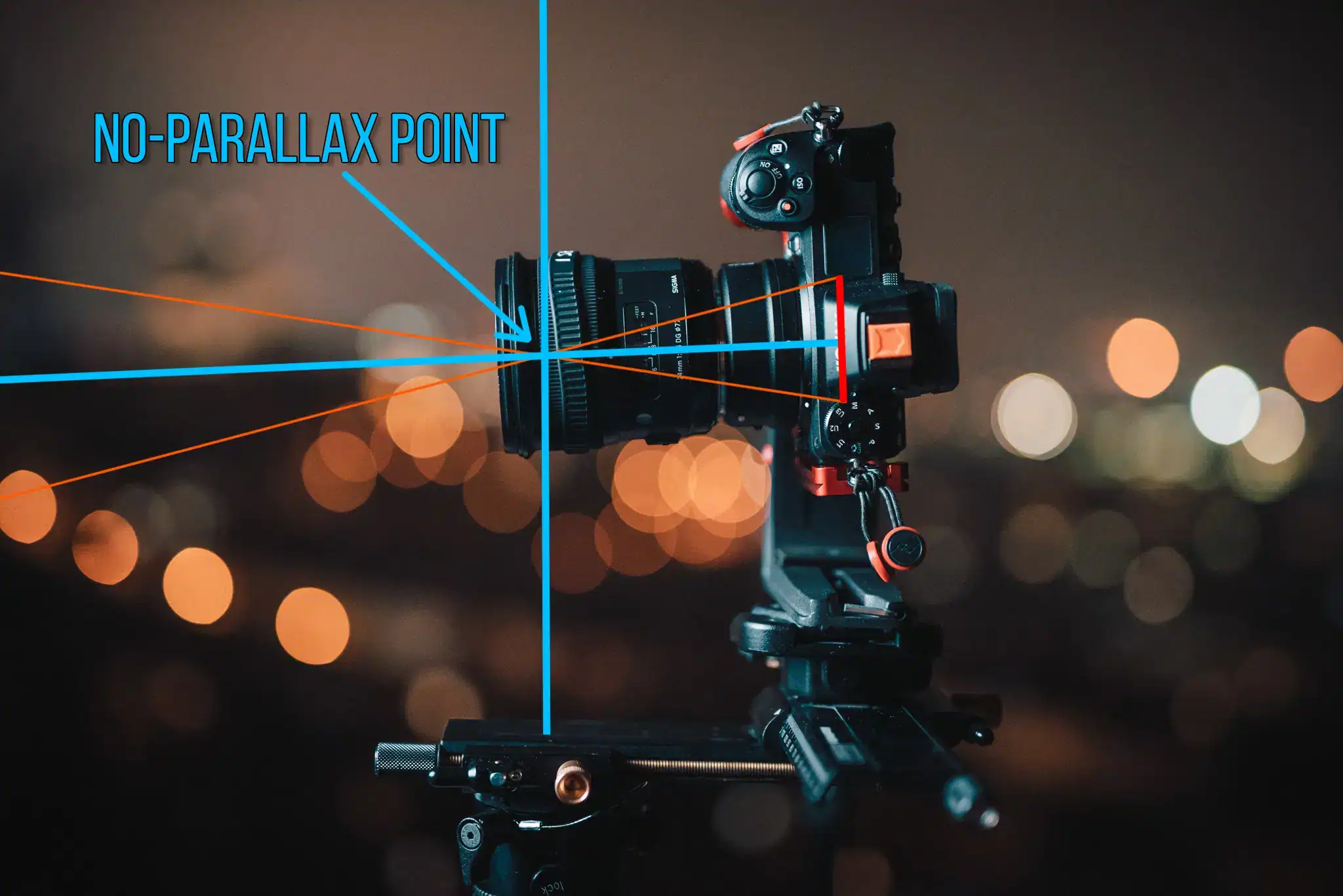
- Level the tripod; calibrate your panoramic head for the 14mm’s no-parallax point (NPP).
- Safety: check wind conditions; on rooftops and poles, use tethers; for car mounts, double up on clamps and straps.
- Backup workflow: when in doubt, shoot an extra full pass; it can save a job if one image is blurred or blocked.
Essential Gear & Setup
Core Gear
- Panoramic head with fore-aft and lateral adjustments to align the NPP precisely. Proper alignment minimizes parallax and makes stitching clean, even in tight interiors.
- Stable tripod with a leveling base. A level base lets you rotate the head without tilt creeping in, preserving horizon accuracy.
- Remote trigger or the Imaging Edge Mobile app to avoid camera shake. Use 2-sec self-timer if you don’t have a remote.
Optional Add-ons
- Pole or car mount: Always tether the rig and monitor wind. The A1 is sturdy, but ultra-wide fronts are vulnerable to impacts.
- Lighting aids: Small LED panels or bounced flash for dark corners (avoid mixing color temperatures; gel if needed).
- Weather gear: Rain cover, microfiber cloths, and a lens hood or flag to tame flare.
For a foundational primer on aligning and using a panoramic head, see this panoramic head tutorial. Panoramic head basics and setup (360 Rumors)
Step-by-Step Shooting Guide
Standard Static Scenes
- Level and align: Level the tripod using the leveling base. Mount the camera on the panoramic head and set the rotation to 30°–45° increments depending on your chosen pattern (e.g., 8 or 10 around).
- Nodal calibration (practical): Place a near object (~1 m) and a far object in alignment, then pan the camera. Adjust the fore-aft rail until the relative shift between near and far objects disappears. Repeat at different heights if you will shoot multi-row. Mark these positions on your rail.
- Manual exposure and white balance: Switch to M mode. Meter the brightest area you need to preserve (e.g., windows), choose an exposure that avoids clipping highlights, and keep it fixed for the entire pano. Lock white balance (e.g., Daylight or custom Kelvin) to prevent color shifts between frames.
- Focus: Use manual focus. At f/8 on a 14mm full-frame, the hyperfocal distance is roughly 0.8–0.9 m; focus there and you’ll keep most of the scene sharp from about 0.4–0.5 m to infinity. Use focus magnification to confirm.
- Capture sequence: For a two-row 360, shoot 8 frames at +30°, rotate to the same azimuth positions for −30°, then capture a dedicated zenith (tilt up ~90°) and 1–2 nadirs (tilt down ~90°; rotate 90° between two shots) for tripod removal.
- Recheck: If anything moved into frame mid-sequence (e.g., a person), shoot a safety pass for that row.
HDR / High Dynamic Range Interiors
- Bracket ±2 EV (3 or 5 shots). The A1 supports robust auto bracketing; choose 5 shots if windows are extremely bright.
- Keep WB locked. Changing WB between brackets complicates merges and stitching.
- Use electronic first curtain or mechanical shutter indoors to avoid LED banding. Mechanical shutter is safest under mixed artificial light.
- Stay consistent: Don’t change aperture between brackets; set f/8 and let shutter vary across bracketed exposures.
Low-Light / Night Scenes
- Use longer exposures and keep ISO as low as possible (ISO 100–800 ideal; 1600–3200 still solid on the A1 if needed).
- Disable IBIS on tripod to avoid micro-vibrations in long exposures.
- Use a remote or 2-sec timer; turn on electronic front curtain or mechanical shutter for consistency.
- Watch for moving lights and clouds; if necessary, shoot additional frames to mask in clean areas during post.
Crowded Events
- Shoot two passes per row. First pass captures composition; second pass waits for gaps in motion to minimize ghosting.
- Mark your rotation angles precisely so you can blend frames from the two passes during stitching.
- Use faster shutter (1/200 s or faster) and ISO 400–800 to freeze walking subjects if you plan to keep people in frame.
Special Setups (Pole / Car / Drone)
- Securely tether the rig. Use secondary straps and locknuts; check clamps for creep.
- Mind wind load. The 14mm’s lens body presents surface area; slow down rotations and shoot at faster shutter speeds (1/250 s+) from vehicles.
- Consider rolling shutter: prefer mechanical shutter when panning from moving platforms to reduce skew.
Recommended Settings & Pro Tips
Exposure & Focus
| Scenario | Aperture | Shutter | ISO | Notes |
|---|---|---|---|---|
| Daylight outdoor | f/8–f/11 | 1/100–1/250 | 100–200 | Lock WB (Daylight or custom Kelvin) |
| Low light/night | f/4–f/5.6 | 1/30–1/60 (or longer on tripod) | 400–800 (1600–3200 if needed) | Disable IBIS on tripod; use remote |
| Interior HDR | f/8 | Bracket ±2 EV (3–5 frames) | 100–400 | Preserve window highlights and lift shadows |
| Action / moving subjects | f/5.6–f/8 | 1/200+ | 400–800 | Double-pass; blend/mask in post |
Critical Tips
- Manual focus at hyperfocal distance: At f/8, ~0.8–0.9 m on 14mm keeps near-to-far sharp.
- Nodal calibration: Use near/far alignment tests and mark your rail for horizontal and vertical axes. Re-check if you change L-brackets or baseplates.
- White balance lock: Use Kelvin for mixed-light interiors to keep frames consistent for stitching.
- RAW capture: Shoot RAW (lossless compressed) for maximum DR and color headroom.
- Stabilization: Turn off IBIS on a tripod; it can introduce blur during long exposures.
- Shutter mode: Under LED or fluorescent light, prefer mechanical shutter to avoid banding.
- Overlap: With rectilinear 14mm, target 30–40% overlap. More overlap can help with noisy scenes or moving subjects.
Field-Proven Mini Case Studies
Indoor Real Estate
Use the two-row, 8+8 pattern at ±30° with 1 zenith and 2 nadirs. Bracket ±2 EV (5 frames) to handle windows. Keep ISO 100–200, f/8, and let shutter vary. Mask moving curtains or fans in post.
Outdoor Sunset Lookouts
Meter sky highlights and underexpose slightly to protect color. Shoot at f/8, ISO 100–200. If dynamic range is extreme, bracket 3 frames. Shoot a second sky pass if clouds move quickly.
Event Crowds
Fast shutter (1/250 s), ISO 400–800, f/5.6–f/8. Do two passes per row: one for the environment, one to catch cleaner gaps. Blend later.
Rooftop or Pole
Use faster shutter (1/250–1/500 s). Tether everything. If vibration is an issue, shoot bursts and pick the sharpest frames for each angle.
Stitching & Post-Processing
Software Workflow
Import RAWs into Lightroom or Capture One for initial WB and exposure normalization (keep settings consistent across a row). For HDR, first merge brackets per angle into 32-bit HDR DNGs, then stitch the resulting set. Use PTGui or Hugin for stitching—both support wide-angle rectilinear lenses well. With rectilinear 14mm, plan for ~30–40% overlap; fisheyes can get away with fewer shots but introduce curvilinear edges. Typical industry guidance suggests ~25–30% overlap for fisheye and 20–30% for rectilinear; with interior detail, err toward more overlap for robust control point generation. For a pro-grade overview of high-end DSLR/mirrorless 360 workflows, see this guide. DSLR/Mirrorless 360 workflow (Meta/Oculus Creator)
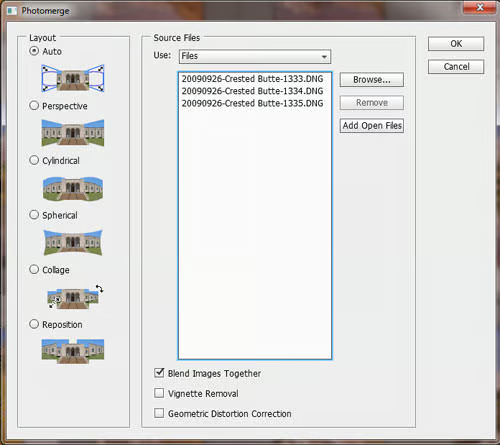
If you’re choosing a dedicated stitcher, PTGui is fast and accurate with complex scenes and HDR merges. For an independent perspective, this review is a useful read. PTGui review and workflow notes (Fstoppers)
Cleanup & Enhancement
- Nadir patch: Export a layered output from PTGui and patch the tripod with clone/heal or an AI-aware fill. A dedicated nadir shot helps.
- Color and noise: Global WB correction, local curves on windows/shadows, and moderate noise reduction for ISO 1600–3200 frames.
- Level and horizon: Use the pitch/roll/yaw tools in PTGui/Hugin; double-check straight lines in architectural scenes.
- Export: For VR, export equirectangular JPG/TIFF (2:1 ratio). Common sizes: 8000–16000 px wide for high-quality tours. For resolution expectations per lens/focal pattern, see this reference. DSLR spherical resolution (PanoTools Wiki)
Disclaimer: Always verify the latest documentation for your software version; interfaces and features evolve.
Useful Tools & Resources
Software
- PTGui panorama stitching
- Hugin (open source)
- Lightroom / Photoshop (RAW prep and finishing)
- AI tripod removal tools (Content-Aware Fill, Generative Expand)
Hardware
- Panoramic heads (Nodal Ninja, Leofoto, Sunwayfoto)
- Carbon fiber tripods with leveling base
- Wireless remote shutters or smartphone app control
- Pole extensions / car suction mounts (with safety tethers)
Disclaimer: names provided for search reference; confirm compatibility and specs on official product pages.
If you’re new to choosing a camera/lens for virtual tours, this overview is also helpful. Virtual tour camera/lens guide (360 Rumors)
Common Mistakes & How to Avoid Them
- Parallax error: Misaligned NPP causes messy stitches near the camera. Recalibrate with near/far alignment before the job.
- Exposure flicker: Auto exposure/WB varies frame-to-frame. Use Manual exposure and fixed WB.
- Tripod shadows and clutter: Shoot dedicated nadir frames and patch later.
- Ghosting from movement: Shoot double passes and mask the cleanest areas in post.
- Noise and soft corners at night: Keep ISO moderate (≤3200), use a sturdy tripod, and stop down to f/5.6–f/8 for best edge performance.
- LED banding indoors: Use mechanical shutter under artificial light sources.
Frequently Asked Questions
- Can I shoot handheld panoramas with the Sony A1?
You can for simple cylindrical panoramas, but for full 360×180 with the 14mm GM, a panoramic head is strongly recommended. Handheld shooting increases parallax errors and makes stitching interiors difficult. If you must go handheld, use high overlap (50%+), keep exposure/WB fixed, and rotate around the lens as close as possible.
- Is the Sony FE 14mm f/1.8 GM wide enough for a single-row full 360?
No. The 14mm GM is rectilinear with ~81° vertical FOV; a single row leaves large gaps at zenith and nadir. For a full sphere, use a multi-row approach (e.g., 8 around at +30°, 8 around at −30°, plus zenith/nadir).
- Do I need HDR for interiors with bright windows?
Usually yes. Bracket ±2 EV (3 or 5 shots) to capture window detail and interior shadows cleanly. The A1’s DR is excellent, but HDR still provides smoother tonality and reduces noise in lifted shadows.
- How do I avoid parallax issues with this lens?
Use a panoramic head and align the no-parallax point. Place a near object and a far object in alignment, pan, and adjust fore-aft until the relative motion disappears. Mark the rail positions for repeatability. Recheck when changing L-plates or quick-release systems.
- What ISO range is safe on the A1 in low light?
For best quality, stay ISO 100–800. ISO 1600–3200 remains usable with careful noise reduction, especially if you’re outputting to web-sized virtual tours. For critical print work, aim to keep ISO ≤1600 and lengthen shutter on a tripod.
- Can I set custom modes for pano on the A1?
Yes. Save a pano setup (Manual exposure, fixed WB, single-shot, RAW, IBIS off, EFCS/mechanical shutter) to a custom memory recall. This speeds up on-site setup and prevents missed steps.
- How can I reduce flare with an ultra-wide like the 14mm GM?
Avoid pointing directly at strong light sources; shade the lens with a flag or your hand (outside the FOV), clean the front element, and consider a slight angle change. Stopping down to f/8 can control veiling flare while preserving edge sharpness.
- What panoramic head features should I look for for this setup?
Dual-axis (tilt + pan) adjustments, clear rail markings, rigid clamps, and a reliable click-stop or degree scale. Ensure the vertical arm height accommodates the A1’s body and keeps the rotation axis passing through the lens’s NPP when tilted.
Safety, Limitations, and Workflow Reliability
The A1 & 14mm GM deliver outstanding quality, but be realistic about limits: rectilinear 14mm requires more frames than fisheye for full 360 coverage; wind and moving crowds complicate multi-row work. For rooftops and poles, prioritize safety: tether the camera, check fasteners, keep people clear below, and avoid gusty conditions. Under artificial lighting, mechanical shutter avoids banding; turn off IBIS on tripod. For data integrity, run dual-card recording (RAW to both), and back up to a laptop or SSD at breaks. Consider a “safety pass” of the entire pano—this can rescue the project if a frame is later found to be soft or blocked.
Visual Aids
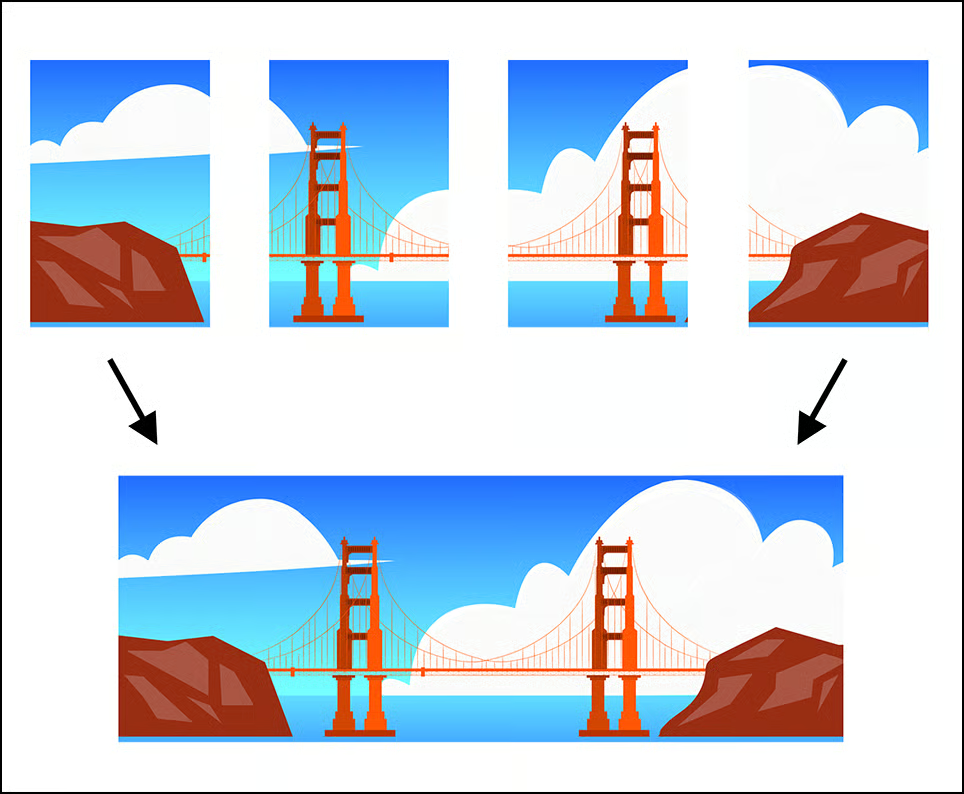
Below are a few illustrative images that match common steps in this workflow.
Further Reading
These resources expand on alignment principles, shooting sequences, and stitching strategies for consistent, professional results.