
Why This Camera & Lens Are Great for Panoramas
If you want to master how to shoot panorama with Sony A1 & Sony FE 12-24mm f/4 G, this combo is a powerhouse. The Sony Alpha 1 (A1) is a 50.1MP full-frame mirrorless camera (35.9×24 mm sensor) with excellent dynamic range at base ISO, clean high-ISO performance, and reliable 5-axis IBIS. Its stacked sensor architecture minimizes rolling shutter and banding when you need to use electronic shutter, and 14-bit RAW preserves subtle tonal transitions—critical for HDR panoramas and low-light scenes.
The Sony FE 12-24mm f/4 G is an ultra-wide rectilinear zoom (not a fisheye). At 12mm, you get an expansive field of view without fisheye curvature, which means straight lines stay straight—a big benefit for architecture and real estate interiors. It’s sharpest around f/5.6–f/8, lateral CA is well controlled, and distortion is predictable and easily corrected in post. Because it’s rectilinear, you’ll shoot more frames than with a fisheye, but you’ll also minimize extreme edge stretching and keep interiors looking natural.
Mount compatibility and handling are top-tier: the A1’s high-resolution sensor and the lens’s fast, quiet AF make pre-focus and manual fine-tune easy. The bulbous front element of the 12-24 G has a built-in hood and no front filter thread—one more reason to rely on bracketing for exposure control rather than NDs or GNDs during panoramic work.
Quick Setup Overview
- Camera: Sony A1 — Full Frame, 50.1MP, approx. 4.2 μm pixel pitch, excellent DR (~14–15 stops at base), native ISO 100–32,000 (expandable to 50–102,400).
- Lens: Sony FE 12-24mm f/4 G — rectilinear ultra-wide zoom; sharp from f/5.6–f/8; mild barrel distortion at 12mm; lateral CA well controlled.
- Estimated shots & overlap (tested ballpark):
- 12mm single-row (cylindrical panorama): 6–8 shots around with ~30% overlap.
- 12mm full 360×180 (spherical): 8 shots around at 0°, 8 around at +40–45°, +1 zenith, +1 nadir (≈18 frames). Conservative but highly stitchable.
- 16–18mm spherical: 10–12 shots per row, 2 rows (+zenith +nadir) to maintain clean edges.
- 24mm spherical: 12–16 shots per row, 2–3 rows (+zenith +nadir) for high-resolution gigs and architecture.
- Difficulty: Intermediate (rectilinear UWA requires careful nodal alignment and overlap discipline).
Planning & On-Site Preparation
Evaluate Shooting Environment
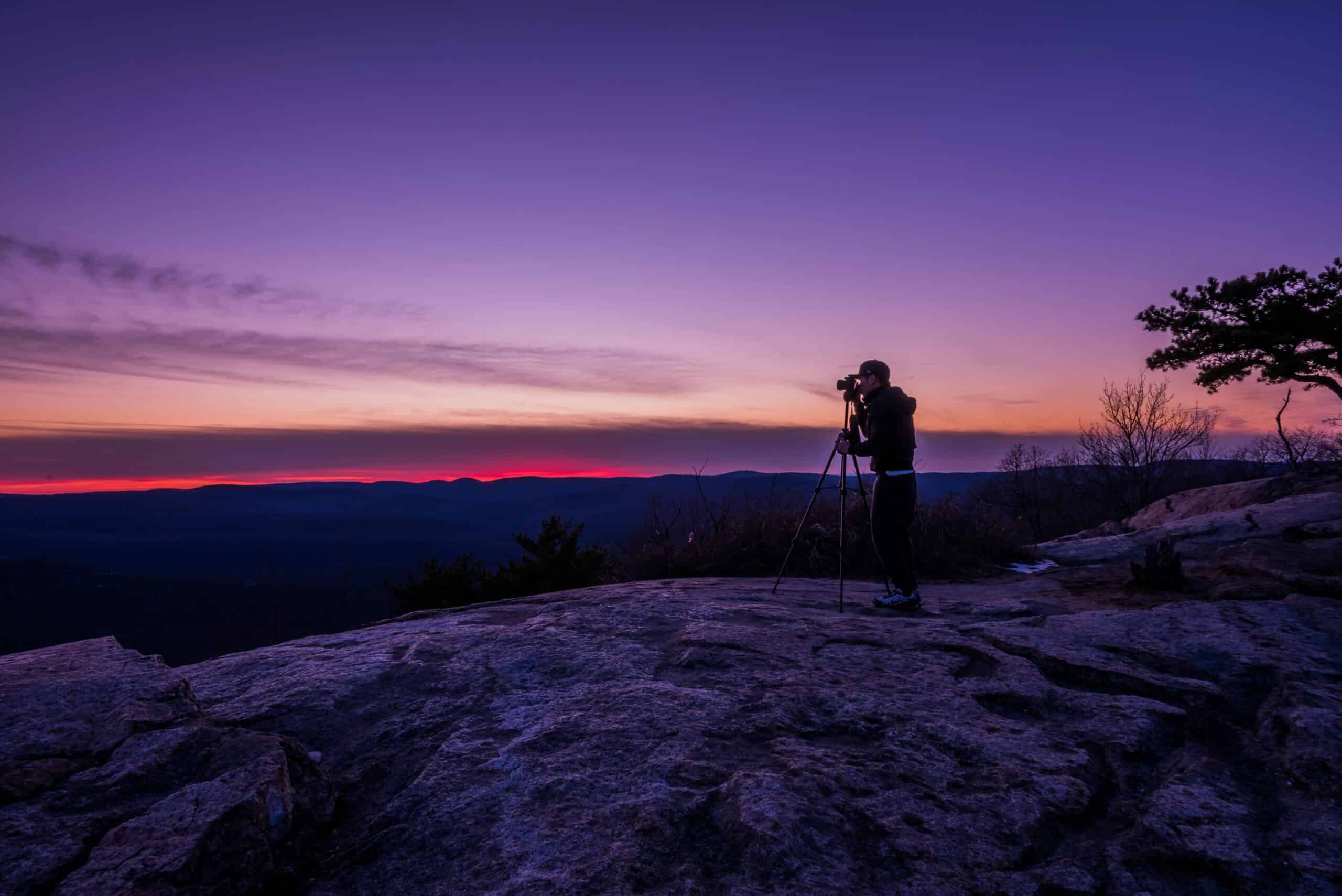
Before you shoot, scan the scene for moving subjects, reflective surfaces, and potential flare sources. For glass interiors or observation decks, keep the front element close to the glass (1–3 cm) and shoot at a slight angle to avoid reflections. Watch for overhead lights and sun angles that could cause veiling flare, especially at 12mm. In windy rooftop conditions, prioritize stability and use a weight hook on your tripod.
Match Gear to Scene Goals
The A1’s high-resolution sensor gives you generous crop headroom and forgiving stitching, even with complex geometry. For interiors, the A1 delivers clean files up to ISO 1600–3200 with careful exposure; the safe working range for critical quality is ISO 100–800, pushing to 1600 when needed. The FE 12-24mm f/4 G’s rectilinear rendering preserves straight lines, ideal for real estate and architecture where fisheye curvature would be problematic. Outdoors at sunset, leverage the A1’s dynamic range with multi-bracket HDR to hold highlights and shadow detail.
Pre-shoot Checklist
- Charge batteries; carry spares. The A1’s high-res files are large—use fast, high-capacity CFexpress Type A and UHS-II SD cards.
- Clean lens and sensor. Dust at f/8–f/11 is visible across a stitched sky.
- Level your tripod; verify panoramic head calibration (nodal/no-parallax point).
- Safety: tether on rooftops and poles; monitor wind gusts; avoid overhanging traffic or crowds.
- Backup workflow: after your primary sequence, shoot a second safety round with slightly different overlap or exposure in case of stitching issues.
Essential Gear & Setup
Core Gear
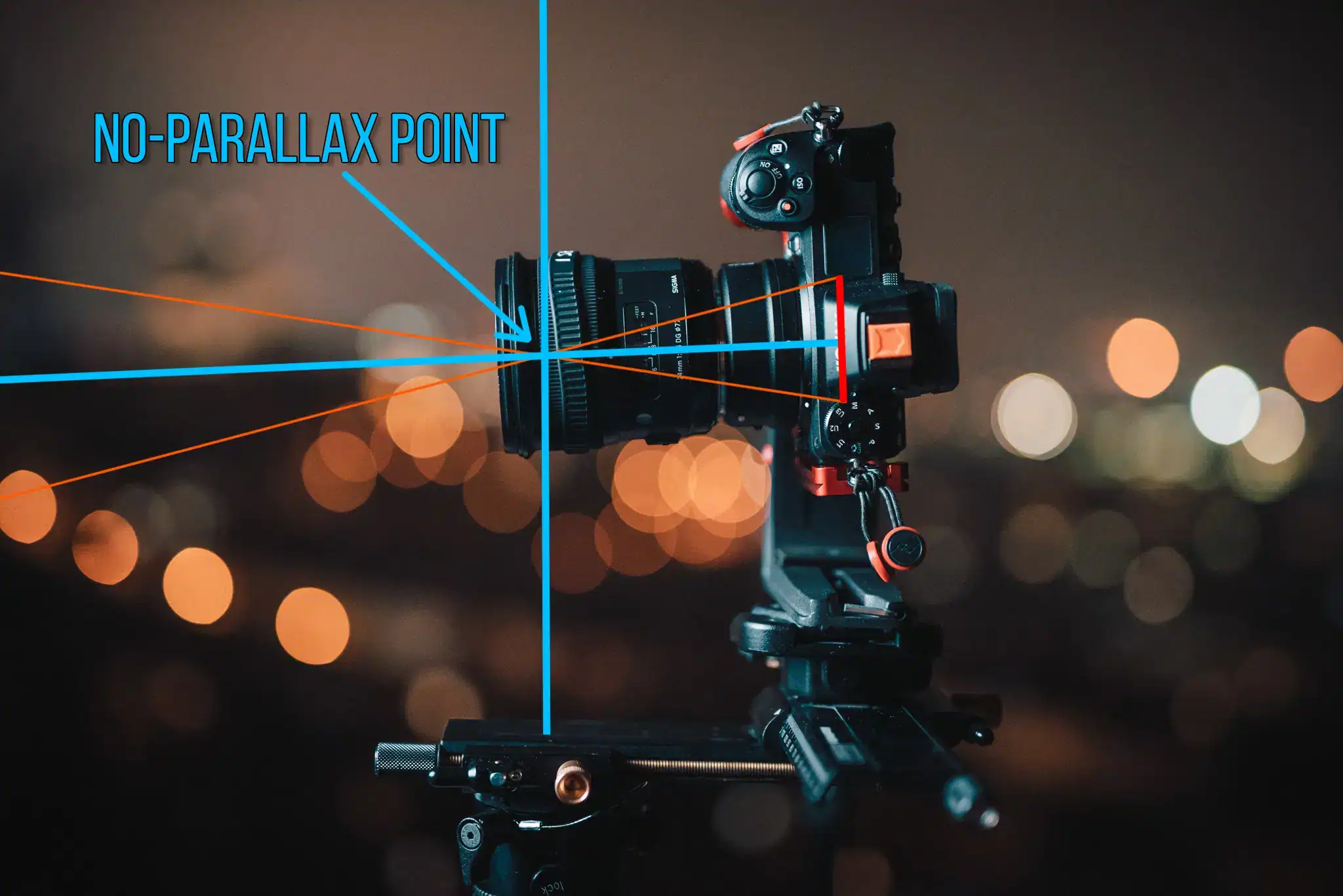
- Panoramic head: Aligning the lens to its no-parallax point eliminates parallax between foreground and background as you rotate. This is essential for clean stitches, especially with nearby objects.
- Stable tripod with a leveling base: A leveled platform allows you to rotate purely in yaw, keeping the horizon consistent and reducing stitch distortions.
- Remote trigger or app: Use Sony Imaging Edge Mobile or a wired remote to avoid vibration during exposures.
Optional Add-ons
- Pole or car mount: Use a rigid carbon pole and a safety tether. Avoid gusty conditions; keep shutter speeds up and rotation slower to minimize motion blur.
- Lighting aids: Small LED panels or flashes (bounced) for interior corners. Keep white balance consistent across frames.
- Weather protection: Rain covers for unexpected drizzle; microfiber cloths for sea spray or condensation.
Practical Nodal Alignment (FE 12–24mm f/4 G)
At 12mm, start with the camera plate sliding the lens forward until nearby vertical objects (e.g., a light stand) align with distant features as you pan left-right. Mark the rail once it’s dialed in. Expect a different no-parallax position at 12mm vs 24mm—note both. As a ballpark, the entrance pupil at 12mm sits roughly near the front group but well behind the hood; fine-tune by observing alignment while panning.
Step-by-Step Shooting Guide
Standard Static Scenes
- Level and lock. Level your tripod first, then use the panoramic head’s detents to ensure even spacing.
- Focus and exposure. Switch to manual focus; set hyperfocal distance. At 12mm and f/8 on full frame, hyperfocal is roughly 0.6 m—focus slightly beyond half a meter to keep everything sharp. Choose manual exposure, lock white balance (e.g., Daylight or custom Kelvin), and disable auto ISO.
- IBIS and stabilization. On tripod, turn off IBIS and lens stabilization (if present) to prevent micro-jitter and blur during long exposures.
- Capture sequence. For a single-row pano at 12mm, shoot 6–8 frames with ~30% overlap. For full 360×180, shoot a middle row at 0°, an upper row at +40–45°, then add a zenith and a nadir frame.
- Nadir shot. Tilt the camera down and take one or two frames to cover the tripod area for patching. If you can, shift the tripod slightly and shoot a clean plate for easier removal.
HDR / High Dynamic Range Interiors
- Bracket exposures, typically ±2 EV (3–5 shots) to balance bright windows and interior shadows. The A1’s 14-bit files blend smoothly.
- Lock white balance and focus across the entire bracket and sequence. Change only the shutter speed when bracketing.
- Use electronic shutter only if banding is not an issue. Under some artificial lighting, mechanical shutter avoids flicker/banding artifacts.
Low-Light / Night Scenes
- Open to f/4–f/5.6 and use longer shutter times. For best quality, keep ISO 100–800; the A1 remains clean to about ISO 1600–3200 with careful noise reduction.
- Use a remote trigger and a 2 s self-timer for extra stability. Wind or vibrations will cause micro-blur, especially at 24mm.
- Consider shooting a second pass for moving elements (cars, people) and blend frames later for clean skies and sharp architecture.
Crowded Events
- Do two passes. First pass quickly captures geometry; second pass waits for gaps in people traffic.
- Mask in post. Use the cleanest bodies from the second pass to reduce ghosting while preserving the base alignment from the first pass.
- Prefer faster shutter speeds (1/200 s+) and ISO 400–800 to freeze motion if light allows.
Special Setups (Pole / Car / Drone)
- Secure everything. Use a safety tether and double-check clamps. On a car mount, ensure redundant attachment points.
- Manage vibration. Keep exposures short (raise ISO modestly if needed) and rotate slower to prevent motion blur between frames.
- Mind the wind. For pole shots, avoid gusty conditions with the 12–24’s large front element; consider 12mm to reduce the total number of frames aloft.
Recommended Settings & Pro Tips
Exposure & Focus
| Scenario | Aperture | Shutter | ISO | Notes |
|---|---|---|---|---|
| Daylight outdoor | f/8–f/11 | 1/100–1/250 | 100–200 | Lock WB (Daylight or Kelvin ~5500K) |
| Low light/night | f/4–f/5.6 | 1/30–1/60 (or longer on tripod) | 400–800 (up to 1600–3200 if needed) | Tripod + remote; turn off IBIS |
| Interior HDR | f/8 | Bracket ±2 EV (3–5 frames) | 100–400 | Balance windows and lamps; manual focus |
| Action / moving subjects | f/5.6–f/8 | 1/200+ | 400–800 | Freeze motion; do a double pass for masking |
Critical Tips
- Manual focus at hyperfocal distance for maximum depth. At 12mm, f/8, set focus ~0.6 m; at 24mm, f/8, aim ~2 m for architecture.
- Nodal calibration matters. Mark your rail positions for 12mm and 24mm. Re-verify if you change plates or quick-release systems.
- White balance lock. Mixed lighting can shift between frames; use a fixed Kelvin or custom preset instead of AWB.
- RAW over JPEG. The A1’s 14-bit RAW gives more latitude for HDR merges and color consistency.
- Lens corrections. Shoot RAW with in-camera corrections off, then apply consistent correction in your RAW processor or stitching app.
- Use detents. A panoramic head with click-stops helps maintain consistent overlap, crucial for efficient stitching.
Case Studies: Tested Field Work
Indoor Real Estate
At 12mm, two rows of 8 frames (0° and +45°), plus zenith and nadir, preserve straight lines without fisheye curvature. Bracket ±2 EV for windows; keep ISO 100–200 to maximize detail for property listings and virtual tours.
Outdoor Sunset
Use f/8, ISO 100, and bracket 5 shots at 1 EV steps to capture sky color while holding foreground detail. Start the sequence away from the sun to minimize flare accumulation across overlaps.
Event Crowds
Go 16mm to reduce perspective stretch on people. Shoot 10–12 around, two passes, 1/250 s, ISO 400–800. Blend later for fewer ghosts.
Rooftop/Pole
At 12mm, 6–8 frames around can be enough for a quick cylindrical panorama from a pole. Keep exposures short (1/250–1/500 s) and watch wind load on the lens hood.
Car-Mounted Capture
Use rigid suction mounts and safety cables. Stop-and-shoot sequences with the engine off to minimize vibration. Plan routes with safe pull-off points; never shoot while driving.
Stitching & Post-Processing
Software Workflow
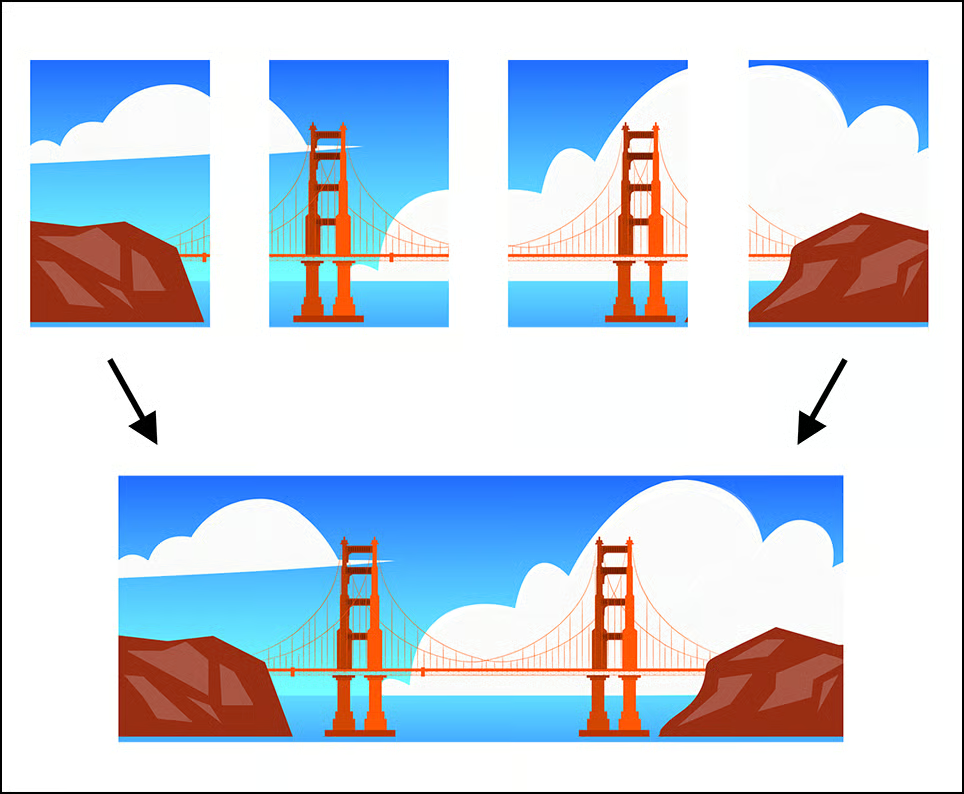
Import RAWs, apply consistent lens corrections and white balance, then export to 16-bit TIFF for stitching. PTGui is a gold standard for speed and control; Hugin is a powerful open-source alternative. Rectilinear ultra-wides like the 12–24 G need more images than fisheyes—plan for ~20–30% overlap around and between rows. For spherical output, export equirectangular at 2:1 aspect (e.g., 16,384×8,192 for high-res tours). For a deeper dive into panoramic head setup and technique, see the panoramic head tutorial on 360 Rumors or Oculus’s professional 360 photo guide. Panoramic head alignment fundamentals. Oculus guide to high-end 360 workflows.
Cleanup & Enhancement
- Nadir patch: Use a clean plate or content-aware fill; dedicated AI tools can remove tripods quickly.
- Color consistency: Balance exposure and WB across rows. Apply gentle global contrast; avoid over-saturating skies.
- Noise reduction: Apply luminance NR at ISO 1600–3200; preserve texture in walls and floors.
- Leveling: Correct horizon, yaw, pitch, and roll. Use vertical lines in architecture as references.
- Export: Save layered PSD/TIFF for archival; export equirectangular JPEGs (quality 90–95) for web/VR.
Recommended Reading & Reviews
To evaluate panorama software options and best practices, consider this PTGui review for insights into pro-level features and workflows. Why PTGui excels for complex panoramas.
Video: Panoramic Shooting Basics
Prefer to watch a quick overview? This video covers foundations that translate directly to the A1 + 12–24 G workflow:
For a broader camera/lens selection perspective and virtual tour pipeline considerations, this guide is also helpful. DSLR/Mirrorless 360 virtual tour FAQ.
Disclaimer: software interfaces evolve—verify current steps in each app’s documentation.
Useful Tools & Resources
Software
- PTGui panorama stitching
- Hugin (open source)
- Lightroom / Photoshop / Affinity Photo
- AI tripod removal tools for nadir patching
Hardware
- Panoramic heads (Nodal Ninja, Leofoto, Sunwayfoto)
- Carbon fiber tripods with leveling bases
- Wireless remotes (Sony RMT-P1BT) or Imaging Edge Mobile
- Pole extensions and vehicle mounts (with safety tethers)
Disclaimer: product names are for reference—check manufacturers for current specs and compatibility.
Common Mistakes & How to Avoid Them
- Parallax error: Not aligning the entrance pupil. Calibrate your pano head before mission-critical shoots.
- Exposure flicker: Auto modes change between frames. Use manual exposure and lock WB.
- Missed coverage: Too few frames at 12mm. Favor 8-around per row with 25–30% overlap for safety.
- Tripod shadows in the nadir: Capture a clean plate or plan a nadir patch in post.
- Nighttime noise: Keep ISO moderate and extend shutter time on a stable tripod; use the A1’s clean base ISO whenever possible.
- Flare and reflections: Shield the lens, angle away from direct light sources, and stay close to glass when shooting through it.
Frequently Asked Questions
- Can I shoot handheld panoramas with the Sony A1?
Yes, for single-row panos in good light. Use 12–16 frames with 30% overlap at 12–18mm and a fast shutter (1/250 s+). However, for full 360×180 or interiors, a tripod and pano head are strongly recommended to avoid parallax and misalignment.
- Is the Sony FE 12–24mm f/4 G wide enough for a single-row 360?
No. It’s rectilinear, not fisheye. You’ll need multi-rows (e.g., 8 around at 0°, 8 around at +40–45°, plus zenith/nadir) for a full sphere. A single row at 12mm can make excellent cylindrical panos, but won’t cover the full vertical field.
- Do I need HDR for interiors with bright windows?
Often yes. Bracket ±2 EV (3–5 frames). The A1’s dynamic range is strong, but windows can be several stops brighter than interiors; bracketing retains view detail without crushing shadows.
- How do I avoid parallax issues with this lens?
Use a panoramic head and align to the no-parallax point. Calibrate at 12mm and 24mm separately; mark your rail. Keep nearby objects out of extreme corners when possible, and maintain consistent rotation.
- What ISO range is safe on the A1 in low light?
For critical quality, stick to ISO 100–800 on a tripod. ISO 1600–3200 is still very usable with careful noise reduction. Prefer longer shutter times over pushing ISO when the camera is rigidly mounted.
In-Field Inspiration
Safety, Reliability, and Backup Workflow
Always secure your gear when working at height, near crowds, or over water. Use a weight on your tripod, tether poles and car mounts, and avoid rotating the rig when people are directly underneath. For data integrity, enable dual-slot recording (RAW to CFexpress, backup to SD) and maintain a 3-2-1 backup after the shoot (three copies, two media types, one offsite). If the light changes mid-sequence, shoot a new, fully consistent set instead of mixing frames—consistency beats speed in stitching reliability.