Why This Camera & Lens Are Great for Panoramas
If you want to master how to shoot panorama with Sony A1 & Sigma 15mm f/1.4 DG DN Diagonal Fisheye Art, this combo is a powerhouse. The Sony A1 is a 50.1MP full-frame, stacked Exmor RS mirrorless body with excellent dynamic range (~15 stops), fast readout, and strong high-ISO performance for low light. Its pixel pitch is about 4.16 µm, giving detailed files that survive aggressive post-processing and stitching. The Sigma 15mm f/1.4 DG DN Diagonal Fisheye Art is a fast, full-frame diagonal fisheye that captures a 180° field of view across the frame’s diagonal. That means you can cover a full 360×180 sphere with fewer frames than a rectilinear lens, speeding up capture and reducing ghosting in dynamic environments.
The benefits add up: a stabilized, high-resolution sensor; reliable AF for initial framing; excellent manual control; and a fisheye optic that, when carefully aligned on a panoramic head, minimizes parallax issues and keeps your stitch clean. The E-mount compatibility is native, focusing is snappy, and stopped down to f/5.6–f/8 the lens delivers crisp edges that are ideal for VR exports. As with all fisheyes, distortion is inherent by design, but modern stitching tools handle fisheye projection gracefully, letting you deliver high-quality equirectangular 360 photos or wide-format panoramas.
Quick Setup Overview
- Camera: Sony A1 — full-frame 35mm sensor, 50.1MP, ~15 stops DR, base ISO 100, native 100–32,000 (expandable), 5-axis IBIS.
- Lens: Sigma 15mm f/1.4 DG DN Diagonal Fisheye Art — full-frame diagonal fisheye (~180° diagonal FOV), fast f/1.4 for low light/astro, strong sharpness stopped down; typical fisheye flare/CA behaviors controlled well by modern coatings but still possible near bright sources.
- Estimated shots & overlap (tested guidance for 360×180):
- 6 around at 60° yaw + 1 zenith + 1–2 nadir (30–35% overlap)
- Fast option: 4 around at 90° + zenith + nadir (higher overlap required; expect tighter stitching margins)
- Difficulty: Moderate — fisheye simplifies coverage but requires careful nodal alignment.
Planning & On-Site Preparation
Evaluate Shooting Environment
Scan for moving subjects (people, cars, leaves), reflective or refractive surfaces (glass, chrome, water), strong backlight, and tight spaces. For glass, keep the lens a few centimeters away and shoot perpendicular to minimize reflections and flare. Fisheyes see everything — keep your feet, tripod legs, and nearby clutter out of the frame where possible.
Match Gear to Scene Goals
The Sony A1’s wide dynamic range and clean files at ISO 100–800 make it excellent for daylight and interiors. The Sigma 15mm fisheye cuts your shot count down dramatically versus a rectilinear lens, so it’s perfect for time-sensitive environments like events or street scenes. In dim interiors, leverage the lens’s f/1.4 for focusing and composition, then stop down to f/5.6–f/8 for the actual panorama to keep edge sharpness and reduce aberrations. When contrast is extreme (interiors with bright windows), bracket for HDR to capture the full tonal range.
Pre-shoot Checklist
- Charge batteries; format dual cards (CFexpress Type A or SD UHS-II) in-camera.
- Clean lens and sensor; carry a blower and microfiber cloth.
- Level your tripod; pre-calibrate the panoramic head’s nodal (entrance pupil) settings for this combo.
- Safety: tether on rooftops and poles, watch wind, verify clamps and plates, avoid crowds when elevating a pole.
- Backup workflow: when the scene is static, shoot a second safety round (and a few extra nadir options) to cover stitching contingencies.
Essential Gear & Setup
Core Gear
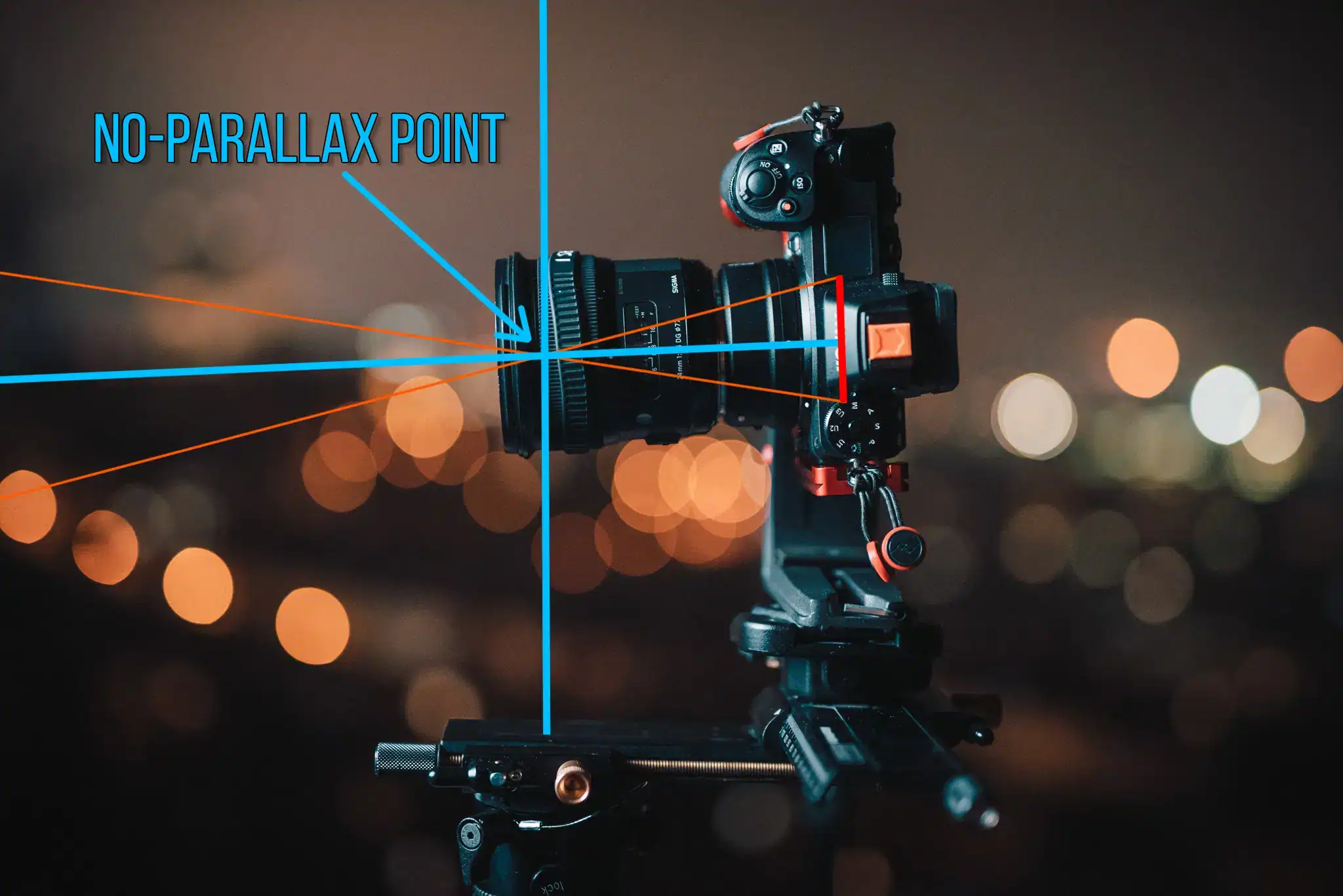
- Panoramic head: Lets you rotate the camera around the lens’s entrance pupil (nodal point) to avoid parallax. This is crucial with nearby objects (chairs, railings, architecture).
- Stable tripod with a leveling base: Quick leveling speeds up your rotation accuracy and keeps horizons true.
- Remote trigger or camera app: Avoids vibration; Sony Imaging Edge Mobile or a simple wireless remote works well.
Optional Add-ons
- Pole or car mount: Use a safety tether and check wind. With a fisheye, even slight vibrations are visible.
- Lighting aids: Small LED panels or bounced flash can tame contrast in interiors (use consistently across frames).
- Weather gear: Rain covers, lens hood, and silica gel packets help protect your investment in harsh conditions.
For a deeper primer on panoramic heads and alignment, see this panoramic head tutorial which outlines industry best practices for nodal calibration and rotation strategy. Panoramic head tutorial
Step-by-Step Shooting Guide
Standard Static Scenes
- Level and align: Level the tripod using a leveling base. Mount the camera on your panoramic head and align the entrance pupil. Use the near/far object test: place a light stand (near) and a building edge (far) in the overlap zone; rotate the camera. If their relative positions shift, adjust fore/aft on the rail until the shift disappears.
- Manual exposure and white balance: Set Manual (M) mode, spot meter the midtones, and lock a fixed Kelvin WB (e.g., 5600K daylight or a measured value). Avoid Auto WB to prevent color shifts between frames.
- Focus: Switch to manual focus. For 15mm on full-frame at f/8, the hyperfocal distance is ~1.0 m; focus slightly past 1 m so everything from ~0.5 m to infinity stays sharp. Use MF Assist and focus magnification on the A1 if needed.
- Capture sequence: Shoot 6 frames around at 60° yaw intervals for robust overlap, then a zenith (tilt up) and 1–2 nadir shots (tilt down). Mark your starting angle so you return to it precisely.
- Record margins: If objects are close (within 0.5–1.0 m), add one extra overlap shot around to give the stitcher more data.
HDR / High Dynamic Range Interiors
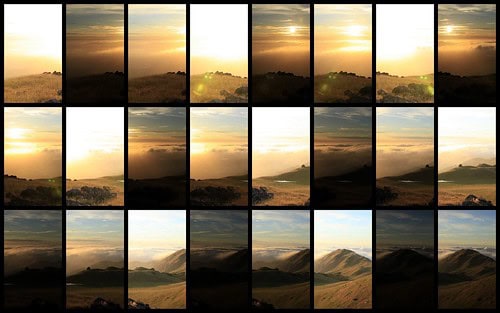
- Bracket ±2 EV: Use 3–5 bracketed shots per position (e.g., -2/0/+2, or -3/-1/+1/+3 for very bright windows). Keep aperture fixed; vary shutter speed.
- WB and profile consistency: Keep WB and picture profile identical across brackets and positions to avoid seams or color shifts.
- Workflow tip: Either merge HDR per angle first, then stitch; or stitch exposure stacks directly in PTGui. Both approaches work; test both on your scenes.
Low-Light / Night Scenes
- Stability first: Use a sturdy tripod; turn IBIS off on the A1 when on a tripod to avoid sensor micro-movements during long exposures.
- Exposure targets: f/4–f/5.6, shutter 1/15–1/60 as needed, ISO 100–800 preferred. The A1 can handle ISO 1600–3200 if required; apply noise reduction in post.
- Triggering: Use a remote release or self-timer (2s) to eliminate shake. Consider electronic first-curtain shutter to minimize shutter shock.
Crowded Events
- Two-pass strategy: First pass fast to lock composition; second pass wait for gaps. Keep the tripod planted to preserve parallax conditions.
- Masking later: In PTGui or Photoshop, blend the clean areas from each pass to minimize ghosting and moving subject artifacts.
- Fast coverage: With a fisheye, use the 4-around + Z + N sequence when the crowd is dynamic, accepting tighter stitching margins.
Special Setups (Pole / Car / Drone)
- Pole: Tether the pole and reduce rotation speed. Avoid high winds; one hand stabilizes while the other rotates the head incrementally. Consider a lighter body if lifting high for long periods.
- Car mount: Use industrial suction mounts, safety cables, and plan a low-speed route with even lighting. Vibrations can blur long frames — keep shutter speeds faster (1/200+).
- Drone: The A1 is heavy for most drones — only consider professional platforms and follow local regulations.
Real-World Mini Case Studies
- Indoor real estate: 6-around + Z + N, f/8, ISO 100–200, HDR ±2 EV. Mask out small moving items (ceiling fans, curtains).
- Outdoor sunset: Meter for highlights and bracket ±2 EV. Flares near the sun are possible with a fisheye — shade with your hand just outside frame and clone out if needed.
- Rooftop pole: 4-around + Z + N, 1/200+ shutter to fight microshake. Safety tether, check wind, and shoot a second safety pass.
Recommended Settings & Pro Tips
Exposure & Focus
| Scenario | Aperture | Shutter | ISO | Notes |
|---|---|---|---|---|
| Daylight outdoor | f/8–f/11 | 1/100–1/250 | 100–200 | Lock WB (daylight); use histogram and zebras |
| Low light/night | f/4–f/5.6 | 1/15–1/60 | 100–800 (1600–3200 if needed) | Tripod, remote; IBIS off; minimize wind |
| Interior HDR | f/8 | Bracket ±2 EV | 100–400 | Merge HDR per angle or in-stitch; keep WB fixed |
| Action / moving subjects | f/5.6–f/8 | 1/200+ | 400–800 | Two-pass strategy; mask movement in post |
Critical Tips
- Manual focus near hyperfocal: At 15mm and f/8, focus ~1 m to keep 0.5 m–∞ acceptably sharp.
- Nodal calibration: Use a near stick and distant edge, adjust fore/aft until their relative position stays fixed during yaw. Mark your rail positions for this lens on tape or with a scribe.
- White balance lock: Fixed Kelvin prevents seam discoloration across frames.
- RAW always: 14-bit RAW preserves dynamic range and color depth for HDR and aggressive corrections.
- Stabilization: Turn off IBIS on tripod. For handheld partial panos, leave IBIS on but accept more stitching variance.
- Disable in-camera corrections: Turn off distortion/vignetting corrections; stitchers prefer true optics data, especially for fisheye geometry.
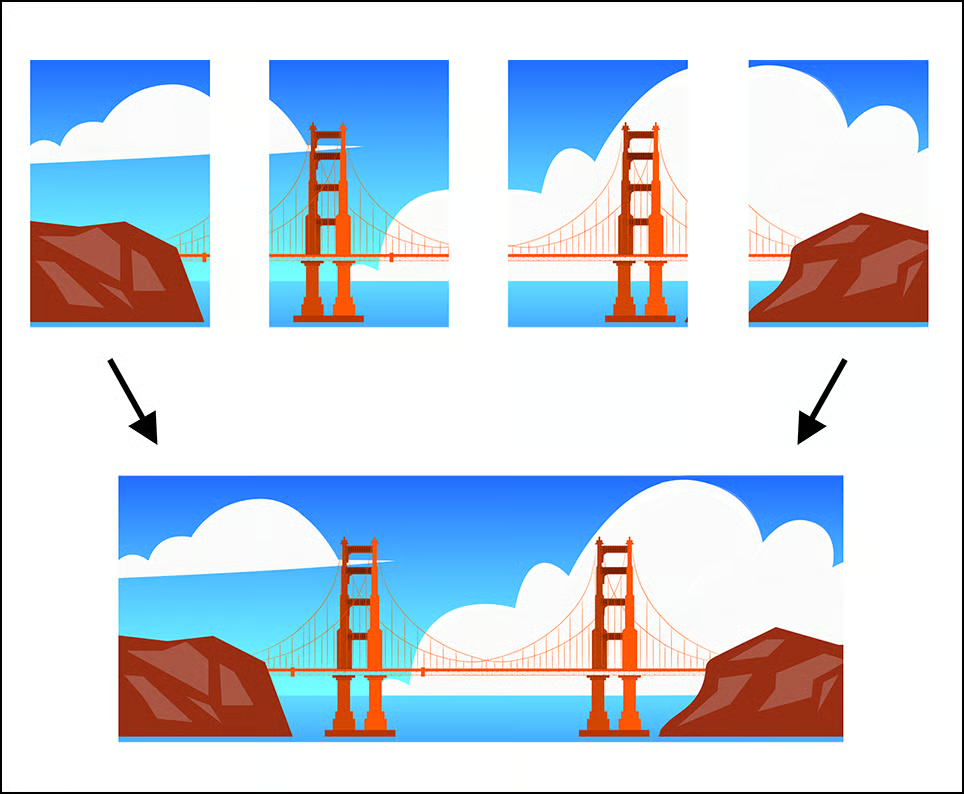
Stitching & Post-Processing
Software Workflow
Import RAWs into Lightroom or your preferred RAW developer; apply consistent baseline corrections (WB, lens profile off, color profile). Export 16-bit TIFFs for stitching. In PTGui or Hugin, set lens type to “full-frame fisheye,” focal length 15mm, and start with 25–35% overlap assumptions. Diagonal fisheyes are generally easier to stitch thanks to high coverage per frame; just ensure overlaps are sufficient and parallax is controlled. Typical industry guidance is ~25–30% overlap for fisheye, ~20–25% for rectilinear. If your scene has close foreground elements, increase overlap slightly. For an expert review of PTGui’s capabilities, see this overview. PTGui tool for creating panoramas
Cleanup & Enhancement
- Nadir patch: Shoot an extra handheld nadir or use AI-based patching. Clone/heal in Photoshop when necessary.
- Color and noise: Use selective noise reduction for shadows (especially if ISO >1600). Keep color consistency across the sphere.
- Leveling/straightening: Correct roll, pitch, and yaw; align verticals for architectural scenes.
- Export: For VR viewers, export an equirectangular JPEG or 16-bit TIFF at 8k–16k width depending on target platform. Then upload to your virtual tour platform.
For platform-specific publishing steps (and constraints such as maximum resolution and metadata), Oculus provides a solid overview of DSLR/mirrorless 360 workflows. Using a DSLR or mirrorless to shoot and stitch a 360 photo
Advanced readers who want to compare total spherical resolution per lens and shot count can consult the PanoTools Wiki for formulas and guidance. DSLR spherical resolution reference
Disclaimer: software evolves—verify the latest documentation for your versions of PTGui, Hugin, Lightroom, and Photoshop.
Useful Tools & Resources
Software
- PTGui for fast, accurate stitching with fisheye profiles.
- Hugin as a capable open-source alternative.
- Lightroom / Photoshop for RAW, HDR merges, and retouching.
- AI tools for tripod/nadir removal and seam cleanup.
Hardware
- Panoramic heads: Nodal Ninja, Leofoto, or similar with fore/aft/vertical adjustments.
- Carbon fiber tripods with a leveling base for quick setup.
- Wireless remotes or intervalometers.
- Pole extensions or vehicle mounts with safety tethers.
Disclaimer: brand names are examples only—check official sites and manuals for specifications and compatibility.
Common Mistakes & How to Avoid Them
- Parallax error: Always rotate around the entrance pupil; recalibrate if you change QR plates or lens position.
- Exposure flicker: Manual exposure and fixed WB across the entire sequence.
- Tripod shadows: Plan sun angle, capture a clean nadir, or patch later.
- Ghosting from movement: Shoot a second pass and mask; use higher shutter speeds outdoors.
- Night noise: Keep ISO low (100–800 preferred), underexpose slightly if needed and lift shadows carefully in post.
- Too few shots: With a fisheye you can get away with fewer, but 6-around + Z + N is safer for complex scenes.
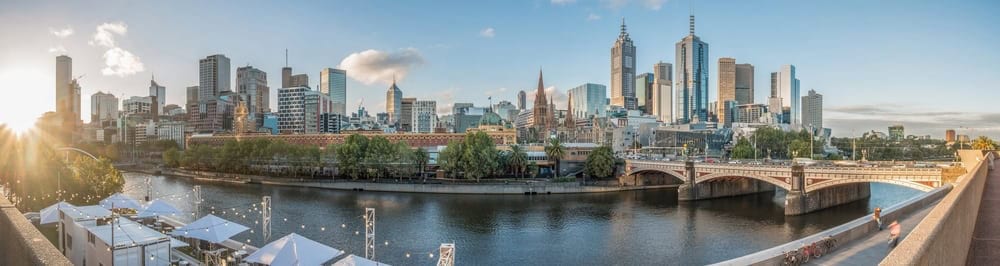
For a broad FAQ on DSLR/mirrorless virtual tour workflows, lens choices, and pitfalls, this long-form guide is a worthwhile read. DSLR virtual tour FAQ and lens guide
Frequently Asked Questions
-
Can I shoot handheld panoramas with the Sony A1?
Yes for partial panos; for 360×180, handheld is risky. The A1’s IBIS helps, but parallax from body rotation and inconsistent nodal alignment will cause stitching issues—especially with nearby objects. Use a tripod and panoramic head whenever possible.
-
Is the Sigma 15mm f/1.4 DG DN Diagonal Fisheye wide enough for a single-row 360?
Yes. A reliable pattern is 6-around at 60° plus a zenith and nadir. In simple scenes you can try 4-around, but expect tighter overlaps and more potential for stitching errors.
-
Do I need HDR for interiors with bright windows?
Usually. The A1’s DR is excellent, but direct sunlit windows exceed sensor range. Bracket ±2 EV (or ±3 for extreme contrast) and merge HDR either before or during stitching to avoid clipped highlights and muddy shadows.
-
How do I avoid parallax issues with this combo?
Use a panoramic head and calibrate the fore/aft position so rotation occurs around the lens’s entrance pupil. Perform a near/far alignment test and mark your rail for this lens so you can repeat it quickly.
-
What ISO range is safe on the A1 in low light?
ISO 100–800 is ideal. 1600–3200 is usable with careful noise reduction, especially if you expose to protect highlights and lift shadows gently in post.
-
Can I create custom modes on the A1 for pano work?
Yes. Store a manual-exposure pano preset (fixed WB, MF, IBIS off, RAW, self-timer or remote) to a custom recall mode so you can set up rapidly on location.
-
How do I reduce flare with a fisheye during sunset?
Avoid pointing directly at the sun when possible. Shade the lens with your hand just outside the frame, shoot two frames (one shaded, one not), and blend in post. Keep the front element immaculate.
-
What tripod head should I get for this setup?
Choose a panoramic head with adjustable fore/aft and vertical rails (e.g., Nodal Ninja or similar). A leveling base speeds set-up, and Arca-compatible clamps simplify mounting.
Safety, Reliability & Backup Workflow
Always weigh your tripod down in wind, tether gear when elevated (poles/rooftops), and double-check clamps. In crowds, protect your tripod’s footprint and mind privacy/safety. The A1 supports dual-card recording—use it to write RAWs to both cards. After each location, quickly review a few frames at 100% for sharpness and check your overlap. Back up your files the same day to two separate drives, and keep one off-site or in the cloud.