
Why This Camera & Lens Are Great for Panoramas
The Sony A1 paired with the Samyang 8mm f/3.5 UMC Fish-Eye CS II is a compact, budget-friendly way to create high-quality 360° panoramas. The A1’s 50.1MP full-frame stacked sensor delivers excellent detail and robust dynamic range (about 14+ stops at base ISO), while its 5-axis in-body stabilization is useful for handheld scouts and leveling on uneven ground. The Samyang is a manual, diagonal fisheye designed for APS-C, which is important: on the Sony A1 you’ll want to engage APS-C/Super 35 crop mode to avoid heavy vignetting. In APS-C mode, the A1 still yields roughly 21–22MP per frame, plenty for professional virtual tours and social media 360 photos.
The fisheye’s enormous field of view means you can cover the full sphere with fewer shots than a rectilinear lens, speeding capture and reducing stitching errors. The CS II version has a removable hood and improved coatings (UMC) to tame flare, and the fully manual aperture/focus makes it predictable for consistent exposure and focus across the set. The tradeoff is fisheye distortion—normal for 360 workflows—and the need for a panoramic head to align the nodal point for clean stitches.
Quick Setup Overview
- Camera: Sony A1 — Full-frame 35.9×24.0 mm, 50.1MP (approx. 4.16 µm pixel pitch), ~14+ stops DR at ISO 100, 5-axis IBIS.
- Lens: Samyang 8mm f/3.5 UMC Fish-Eye CS II — diagonal fisheye for APS-C, manual focus/aperture, good central sharpness at f/5.6–f/8, moderate CA toward edges.
- Estimated shots & overlap (APS-C crop mode on A1): 6 around at 60° yaw + 1 zenith + 1 nadir, 25–30% overlap. Advanced users may do 4 around + zenith + nadir if perfectly aligned.
- Difficulty: Moderate (easy acquisition, requires careful nodal alignment and good post-processing).
Planning & On-Site Preparation
Evaluate Shooting Environment
Check lighting contrast, reflective surfaces (glass, polished floors), and moving elements (people, cars, foliage). In interiors with windows, expect extreme dynamic range—plan for bracketing. Around glass, shoot with the lens as close as practical (2–5 cm) and angle slightly to avoid reflections. Outdoors, mind the sun position to minimize flare; the Samyang’s coatings help, but direct backlight can still introduce ghosts.
Match Gear to Scene Goals
The Sony A1’s low noise at ISO 100–400 makes it ideal for daylight and interiors on a tripod. In very low light, ISO 800–1600 is still usable with careful exposure and noise reduction. The fisheye’s advantage is speed: fewer shots reduce stitch failures in busy scenes. Its limitation is curvature—straight lines near the edges will bow (normal for 360). For real estate and tours, consistency matters more than absolute per-frame sharpness; the 8mm in APS-C mode balances coverage and resolution well.
Pre-shoot Checklist
- Battery and storage: A1 batteries are strong, but panoramas add up—carry at least one spare and a fast SD/CFexpress card.
- Clean both lens and sensor; fisheye front elements attract dust that becomes obvious.
- Tripod: verify the leveling base is true; pre-calibrate the panoramic head to the lens’s nodal point.
- Safety: On rooftops or poles, add a tether and watch wind. For car rigs, use redundant clamps.
- Backup: Shoot a second safety round, especially for client work or quickly changing light.
Essential Gear & Setup
Core Gear
- Panoramic head: Lets you rotate around the lens’s entrance pupil (nodal point), eliminating parallax and easing stitching. Multi-row heads add control for zenith and nadir shots.
- Stable tripod with leveling base: Leveling at the base is faster than adjusting leg lengths and keeps yaw rotations true.
- Remote trigger or app: Use Sony Imaging Edge Mobile or a simple remote to avoid vibrations; 2-second self-timer works in a pinch.
Optional Add-ons
- Pole or car mount: Great for crowds and unique perspectives. Warning: wind and vibration can ruin alignment—slow your rotation and increase overlap.
- Lighting aids: Small LED panels or bounced flash for dark interiors (keep lighting consistent between frames).
- Weather protection: Rain cover, microfiber cloths, silica gel for humid environments.

Step-by-Step Shooting Guide
Before You Start: Sony A1 + Samyang 8mm Setup
- Set APS-C/Super 35 mode: Menu → Image Size → APS-C/Super 35: ON. This avoids vignetting and yields ~21–22MP files.
- Enable “Release w/o lens”: Required for manual lenses via adapters.
- Turn off lens corrections and long exposure NR (to keep frames consistent and fast for bracketing).
- IBIS: ON for handheld scouting. OFF for tripod-based panoramas to prevent micro-shifts between frames.
- Anti-flicker: ON for LED-lit interiors to reduce banding with the mechanical shutter.
Standard Static Scenes
- Level tripod and align nodal point: Use two light stands set at different distances with a crossing line; adjust the fore-aft rail until foreground/background alignment doesn’t shift while panning.
- Set manual exposure: Meter the midtones; lock ISO, shutter, and aperture. Use a fixed Kelvin WB (e.g., 5200K daylight outdoors, 3200–3800K tungsten/LED interiors) to avoid color shifts during stitching.
- Focus: Manual focus at the hyperfocal distance. At 8mm and f/8 on APS-C, hyperfocal is about 0.4–0.5 m; set focus there and tape the ring.
- Capture sequence: 6 shots around at 60° yaw increments, level pitch (0°), with 25–30% overlap. Then 1 zenith (+90°) and 1 nadir (–90°) shot.
- Record a nadir patch shot: If possible, lift the tripod and shoot a handheld ground frame aligned to your nodal point for easy patching.
HDR / High Dynamic Range Interiors
- Bracket ±2 EV (3 or 5 exposures per angle): The A1’s dynamic range is excellent, but bright windows usually need bracketing.
- Lock WB and focus; use the 2-second timer or remote to avoid shake. Keep intervals short to minimize ghosting between brackets.
Low-Light / Night Scenes
- Use a sturdy tripod; aim for ISO 100–400 with longer shutter speeds. The A1 is clean up to ISO 800–1600 if needed, but prioritize base ISO when possible.
- Mechanical shutter can reduce banding under artificial lights; electronic shutter is fine outdoors.
- Consider 8 around instead of 6 to increase overlap for safer stitching when star fields or moving lights complicate control points.
Crowded Events
- Do two passes: one steady pass, then a second pass pausing to let crowds move. You’ll have options for clean plates in post.
- Increase overlap (30–40%) and keep rotation consistent to maintain strong control points despite motion.
Special Setups (Pole / Car / Rooftop)
- Secure all gear with tethers; use safety lines near edges or traffic. Keep the center of gravity directly over the support.
- Shorten exposures or shoot multiple fast passes; in wind, plan for extra overlap and take redundant sets.
Recommended Settings & Pro Tips
Exposure & Focus
| Scenario | Aperture | Shutter | ISO | Notes |
|---|---|---|---|---|
| Daylight outdoor | f/8–f/11 | 1/100–1/250 | 100–200 | Lock WB (Daylight ~5200K); avoid flare by shading lens |
| Low light/night | f/4–f/5.6 | 1/30–1/60 (or longer on tripod) | 100–800 | Use remote; IBIS OFF on tripod; consider 8-around for overlap |
| Interior HDR | f/8 | Bracket ±2 EV | 100–400 | Balance windows and lamps; maintain constant WB |
| Action/moving subjects | f/5.6–f/8 | 1/200+ | 400–800 | Freeze motion; do a second pass for clean plates |
Critical Tips
- Manual focus at or just beyond hyperfocal (~0.4–0.5 m at f/8, APS-C). Use focus peaking to confirm.
- Nodal point calibration: Expect the entrance pupil near the front group on this fisheye; many users start around 6.5–7.5 cm forward from the sensor plane and fine-tune by test pans.
- White balance lock: 3200–3800K for warm interiors, 5000–5600K daylight; avoid auto WB.
- RAW capture: Gives you maximum latitude for HDR merges and color work.
- IBIS: Disable on tripod; enable only for handheld scouting or if the tripod is on a vibrating surface.
- Anti-flicker/Mechanical shutter: Useful under LED lights to reduce banding.
Stitching & Post-Processing
Software Workflow
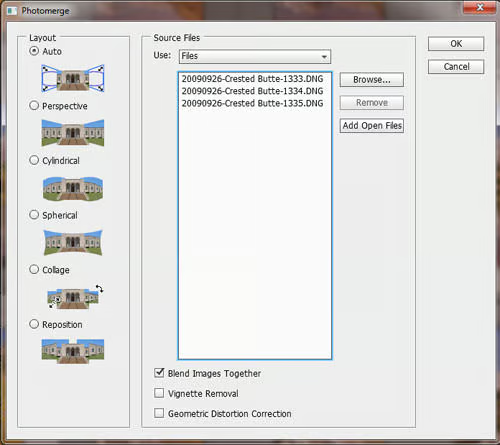
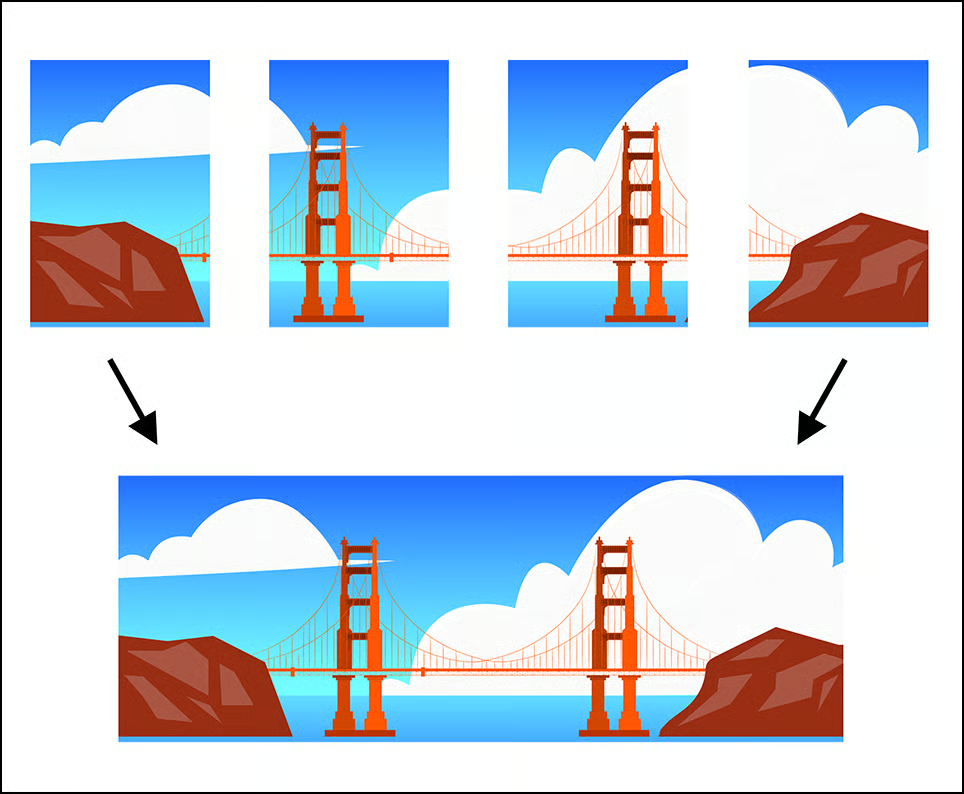
Import RAWs into Lightroom or Capture One for basic WB and exposure consistency, then stitch in PTGui or Hugin. With fisheye lenses, start by setting lens type to Fisheye (unknown projection) and let the optimizer estimate FOV; ensure proper control points across frames. Industry guidance for fisheyes is ~25–30% overlap; you used 6-around plus zenith/nadir, which is ideal for this lens. For rectilinear workflows you’d need more shots, but here the fisheye keeps it fast and reliable. For detailed pano-head setup guidance and stitching best practices, see the panoramic head tutorial by 360Rumors at the end of this paragraph. Panoramic head setup and stitching fundamentals.
PTGui/Hugin Key Steps
- Load images; group bracketed sets if HDR.
- Set lens: Fisheye, focal length 8mm, sensor crop 1.5× (APS-C). Let optimizer refine.
- Generate control points automatically; add manual points across overlapping edges if needed.
- Optimize geometry; check the panorama editor. Level horizon using vertical references.
- Nadir patch: Add the handheld nadir frame or plan to patch later in Photoshop.
- Output: Equirectangular 2:1; for the A1 APS-C + 6-around sets, expect a 10k–16k pixel-wide pano depending on overlap and quality settings.
Cleanup & Enhancement
- Tripod/nadir patch: Use a dedicated nadir shot, or clone/Content-Aware in Photoshop; AI removal tools can help.
- Color consistency: Match light sources; tame mixed lighting with local WB adjustments.
- Noise reduction: Apply after the stitch, especially for shadow areas in low-light panoramas.
- Leveling: Correct horizon and adjust yaw/pitch/roll for a level, viewer-friendly result.
- Export: Equirectangular JPEG/PNG at 8k–16k width for web/VR. Follow platform guidelines for metadata if publishing to VR players.
Want a deeper look at the end-to-end DSLR/mirrorless 360 pipeline? Oculus provides a concise creator guide. Using a DSLR or mirrorless camera to shoot and stitch a 360 photo.
For a pro review of PTGui’s strengths and workflow tips, this Fstoppers piece is a solid reference. PTGui review and workflow insights.
Useful Tools & Resources
Software
- PTGui panorama stitching
- Hugin (open source)
- Lightroom / Photoshop / Affinity Photo
- AI tripod/nadir removal tools
Hardware
- Panoramic heads: Nodal Ninja, Leofoto, Pano Maxx
- Carbon fiber tripods and leveling bases
- Wireless remote shutters
- Pole extensions / car mounts with safety tethers
Disclaimer: software/hardware names provided for search reference; check official sites for details.
Video: Panorama Shooting Basics
Prefer to see it in action? This video complements the steps above with practical demonstrations.
Common Mistakes & How to Avoid Them
- Parallax error: Always align the nodal point; re-check after moving between locations.
- Exposure flicker: Use full manual exposure and a fixed Kelvin WB across the entire set.
- Tripod shadows/footprints: Shoot a nadir frame or plan for patching.
- Ghosting from movement: Take two passes; mask in post using the cleanest frame per sector.
- High ISO noise: Prefer base ISO and longer shutter speeds on a tripod; the A1 handles ISO 800–1600, but keep it low for clean skies/interiors.
Real-World Scenarios & Tips
Indoor Real Estate
Use ISO 100–200 at f/8 with 3–5 bracketed exposures per angle. Turn on Anti-Flicker and use the mechanical shutter. Keep the lens close to windows at a slight angle to reduce reflections. With the A1’s APS-C files, a 12k-wide export looks crisp in virtual tours. If glare is unavoidable, shoot a second set with blinds partially closed and blend selectively.
Outdoor Sunset
Meter for midtones and bracket ±2 EV to protect highlights. Watch for flare—use your hand or a small flag to shade the sun edge-on. If the sky’s changing fast, shoot zenith first, then the 6-around quickly, and finish with the nadir. You’ll avoid mismatched sky exposures at the seams.
Event Crowds
Increase overlap to 30–40% and make two full passes. Later, mask moving subjects to keep one clean version of each sector. If people are too close to the lens, parallax becomes harder to fix—ask subjects to step back one meter, or slightly raise the camera height.
Rooftop or Pole
Attach a secondary tether to the pole and a wrist loop for safety. In winds above 15–20 km/h, reduce exposure time and take multiple sets. Consider 8-around to give the stitcher more control points. Always confirm the leveling base; even small tilts can make horizons tricky to fix later.
Frequently Asked Questions
- Can I shoot handheld panoramas with the Sony A1?
Yes for quick scouts, but expect stitching challenges. Use IBIS ON, shoot fast shutter speeds (1/200+), and increase overlap to 40–50%. For final work, a tripod and pano head are strongly recommended.
- Is the Samyang 8mm f/3.5 UMC CS II wide enough for single-row 360?
In APS-C crop mode: yes. A single row of 6-around + zenith + nadir covers the sphere reliably. Advanced users can sometimes get away with 4-around + Z + N when alignment is perfect and scenes are simple, but 6-around is safer.
- Do I need HDR for interiors with bright windows?
Usually. The A1 has excellent dynamic range, but high-contrast interiors still clip without bracketing. Use ±2 EV (3–5 frames) and keep WB fixed. Merge HDRs before stitching or use PTGui’s built-in HDR fusion.
- How do I avoid parallax issues with this combo?
Use a panoramic head and calibrate nodal alignment for the Samyang 8mm. Start with the rail about 6.5–7.5 cm forward from the A1’s sensor mark, then fine-tune using the near/far alignment test. This greatly reduces stitching errors.
- What ISO range is safe on the A1 for low light panoramas?
Aim for ISO 100–400 on a tripod; ISO 800–1600 is still very usable on the A1 when necessary. Keep ISO consistent across the set to avoid noise variations between frames.
- Can I save a custom pano setup on the A1?
Yes—assign a Memory recall (MR) or custom mode with manual exposure, fixed WB, APS-C mode ON, IBIS OFF (for tripod), and Anti-Flicker ON. It speeds up field work and keeps your workflow consistent.
- How do I reduce flare with this fisheye?
Avoid placing the sun just outside the frame edge; shade the lens with your hand or a flag, and clean the front element frequently. Slightly reframe and shoot a second frame to blend out flare in post if needed.
- What pano head works best with this setup?
A compact two-axis head (e.g., Nodal Ninja R series or Leofoto multi-row) is ideal. Ensure precise fore-aft adjustment, degree markings, and a leveling base. For fundamentals of setup, see this Oculus guide. Set up a panoramic head for high-end 360 photos.
Technical Notes Specific to This Combo
- Lens coverage: The Samyang 8mm f/3.5 CS II is designed for APS-C; on full-frame A1, enable APS-C/Super 35 crop mode.
- Adapters: If using Canon EF or Nikon F versions, a simple dumb adapter works (lens has manual aperture). For Sony A-mount, use LA-EA adapters; no AF is needed.
- Projection: Treat the lens as a full-frame diagonal fisheye in your stitcher; let the optimizer calibrate exact projection parameters.
- Expected output resolution: With 6-around + Z + N on the A1 APS-C (~22MP per frame) and 25–30% overlap, final equirectangulars commonly export in the 10k–16k width range depending on quality settings and scene complexity. For theoretical coverage and pixel density, see Panotools’ DSLR spherical resolution notes. DSLR spherical resolution reference.
Safety, Reliability, and Backup Workflow
On rooftops or in crowds, always tether your camera and keep a low profile. In wind, shorten the center column and keep legs wide. For car mounting, use redundant clamps and a safety line. Protect the front element of the fisheye with a cap when moving between locations. For reliability, shoot a second clean set whenever possible; card failures are rare but not zero. Back up to a second card or device the moment you finish the shoot.
