Why This Camera & Lens Are Great for Panoramas
If you’re learning how to shoot panorama with Sony A1 & Samyang 12mm f/2.8 ED AS NCS Fish-Eye, you’re already starting with a pro-grade combo. The Sony A1’s 50.1MP full-frame stacked BSI sensor delivers excellent detail, wide dynamic range (roughly 14–15 stops at base ISO), fast readout that minimizes rolling shutter, and superb color depth in 14-bit RAW. Its dual card slots (CFexpress Type A/SD UHS-II) and NP-FZ100 battery make it dependable on long shoots. In-body 5-axis stabilization is useful for handheld or pole work, and it can be disabled on tripod to prevent micro-shake loops.
The Samyang 12mm f/2.8 is a full-frame diagonal fisheye lens with an ultra-wide 180° diagonal field of view. As a fisheye, it prioritizes coverage over rectilinear straightness, enabling fewer shots per 360 while keeping edge sharpness respectable at f/5.6–f/8. It’s a manual-focus lens with a broad focus throw, making it easy to precisely set hyperfocal distance—ideal for consistent sharpness across frames. Expect some lateral CA and typical fisheye curvature, but modern stitching software handles this well. Mount compatibility is native to Sony E-mount (FE), which keeps the rig compact and lightweight.
Quick Setup Overview
- Camera: Sony A1 — Full-frame 35.9×24.0 mm sensor, 50.1MP (approx. 8640×5760), pixel pitch ~4.16 µm, ~14–15 EV DR at ISO 100.
- Lens: Samyang 12mm f/2.8 ED AS NCS Fish-Eye — diagonal fisheye, 180° diagonal FOV, manual focus, best sharpness around f/5.6–f/8, moderate CA at edges.
- Estimated shots & overlap (tested):
- Fast single-row: 5 shots around at 0° tilt (≈30–40% overlap) + zenith + nadir (7 total).
- Safe/clean edges: 6 around + zenith + nadir (8 total) for crowded/complex scenes.
- Speed approach: 4 around at +10–15° tilt + nadir (5 total). Risk of small zenith gap—use only outdoors with clean sky.
- Difficulty: Moderate — fast shooting due to fisheye coverage, but requires proper nodal alignment and careful exposure management.
Planning & On-Site Preparation
Evaluate Shooting Environment
Look for moving elements (people, cars, trees in wind), reflective surfaces (glass, water, polished metals), and light sources that may flicker (LEDs) or flare the fisheye. The Samyang’s bulbous front element is susceptible to flare; avoid direct sun angles unless intentionally artistic. For glass shooting (museums, observatories), keep the lens as close to the glass as possible without touching (1–3 cm) to reduce reflections; use a black cloth/flag to block stray light.
Match Gear to Scene Goals
Why the A1 and Samyang 12mm work: the A1’s DR handles bright windows and deep shadows, so bracketed HDR is clean and color-true. Its ISO performance is strong; for tripod work keep ISO 100–200; for handheld or moving scenes you can comfortably push ISO 800–1600. The fisheye’s coverage means fewer frames to stitch, perfect for time-sensitive situations or anywhere you want to minimize ghosting risk. The trade-off is fisheye curvature—no problem for equirectangular outputs but it’s visible in rectilinear projections if you “defish” aggressively.
Pre-shoot Checklist
- Power & media: NP-FZ100 battery charged; spare battery; two fast cards set to simultaneous write.
- Optics clean: front element and sensor dust-checked. Bring a rocket blower and microfiber cloth.
- Tripod & head: leveling base attached; panoramic head calibrated for this lens (entrance pupil marked).
- Environment: check wind, rain, rooftop safety, pedestrian traffic. Carry a tether for pole/car setups.
- Redundancy: Shoot an extra safety round if light changes or if crowds are moving.
Essential Gear & Setup
Core Gear
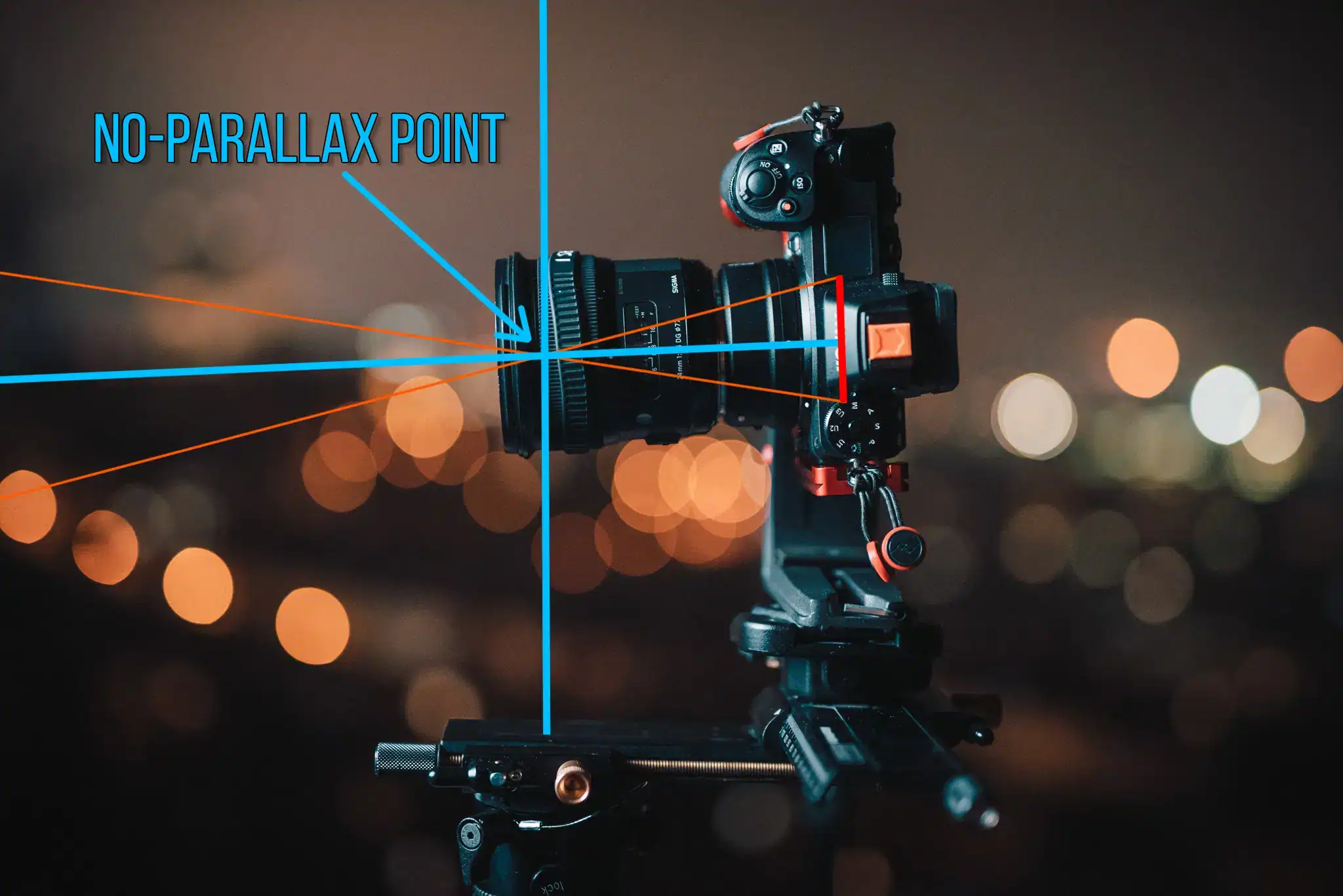
- Panoramic head: This allows rotating around the lens’s entrance pupil (“no-parallax point”). Proper alignment removes parallax, ensuring clean stitches even with near objects.
- Stable tripod with leveling base: Leveling saves time and prevents horizon tilt in the stitch.
- Remote trigger/intervalometer or app: Avoids touching the camera. The A1’s Imaging Edge Mobile app or a simple remote works well.
Optional Add-ons
- Pole or car mount: Great for high vantage points or vehicle captures. Use a safety tether, watch wind loads, and avoid overhead lines.
- Lighting aids: Small LEDs or flash for interiors; be cautious with reflections and mixed color temperatures.
- Weather protection: Rain sleeve for camera, cloth for front element, and a small umbrella to control flare/raindrops.
For in-depth panoramic head principles and calibration, see this panoramic head tutorial for best practices at the end of this section. Panoramic head setup guide
Step-by-Step Shooting Guide
Standard Static Scenes
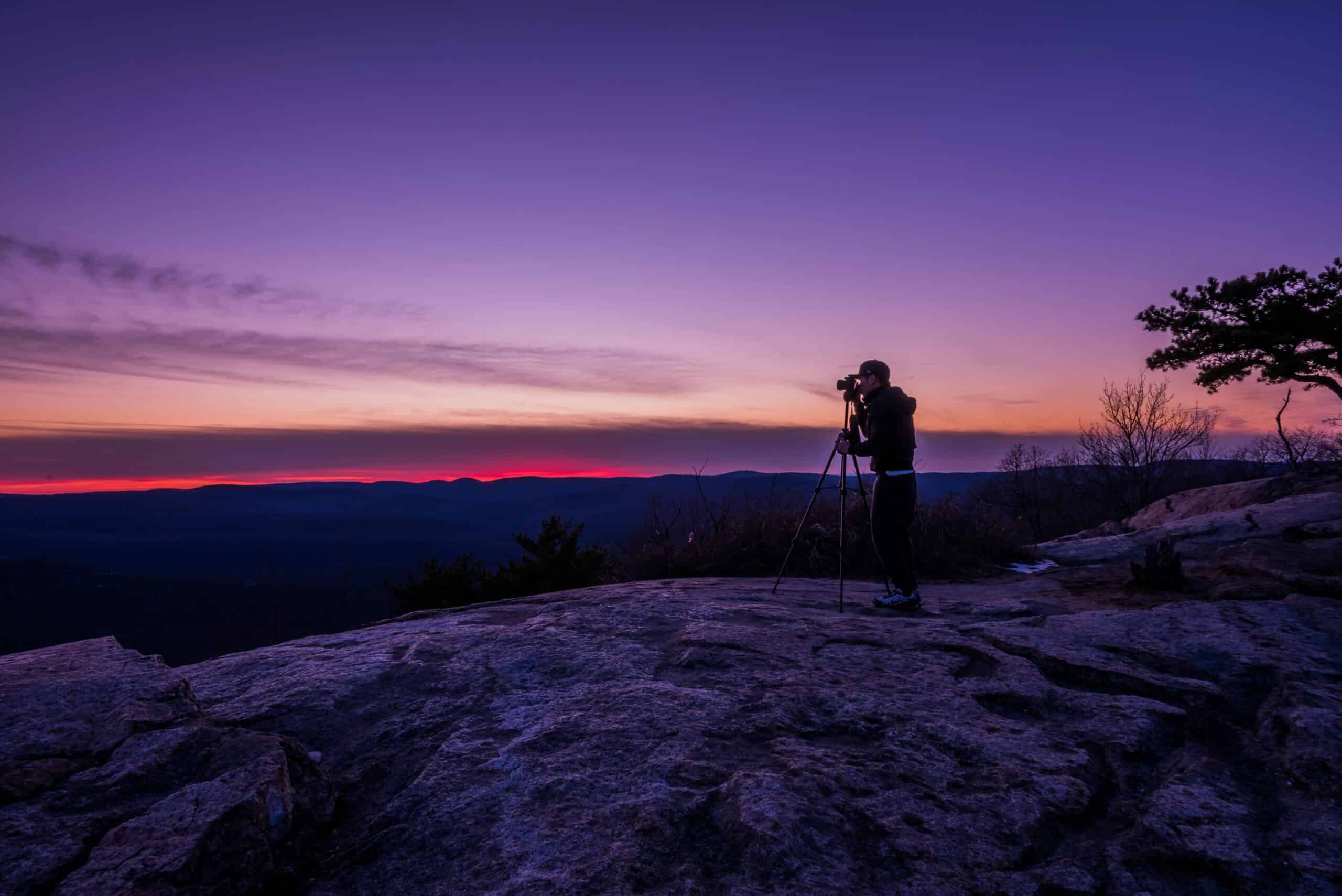
- Level the tripod and align the nodal point: On your pano head, set the fore–aft rail so the rotation is around the lens’s entrance pupil. A good starting point for the Samyang 12mm on full-frame is roughly 63–66 mm forward from the sensor plane; fine-tune with a near/far alignment test.
- Manual exposure & WB: Set Manual mode; choose aperture first (usually f/8), then shutter for correct exposure at ISO 100–200. Lock white balance (Daylight/Kelvin). Disable auto ISO, auto WB, and any exposure-compensation automation.
- Capture the ring with overlap: With this lens, 5 shots around at 0° tilt with ~30–40% overlap is a reliable baseline. If the scene has many near objects, do 6 around for extra coverage.
- Zenith and nadir: Tilt up for 1 zenith frame and down for 1 nadir frame. For the nadir, you can also offset the tripod slightly and shoot a clean tile to patch later.
HDR / High Dynamic Range Interiors
- Bracket ±2 EV: On the A1, use exposure bracketing (3 or 5 frames). Keep aperture and ISO fixed; vary shutter speed only.
- Lock WB: Keep WB consistent to avoid color shifts between brackets. Consider Kelvin-based WB (e.g., 3600–4200 K for warm interiors).
- Sequence discipline: For each camera angle, fire the whole bracket before rotating. Use a remote to minimize vibration.
Low-Light / Night Scenes
- Go long and low ISO: Tripod-mounted, use ISO 100–200 and extend shutter speed as needed. If wind or movement is an issue, ISO 400–1600 on the A1 is still very usable.
- Stabilization: Turn IBIS off on a locked tripod to avoid feedback oscillations; enable it for handheld/pole work.
- Shutter mode: Under LED lighting, prefer mechanical or EFCS to reduce banding. Enable anti-flicker if needed.
Crowded Events
- Two-pass method: First pass for full coverage, second pass to capture gaps when people move away from problem areas.
- Mask in post: Use layer masks in PTGui/Photoshop to remove ghosting by selecting cleaner regions from each pass.
- Shoot fast: The fisheye means fewer shots. Keep cadence consistent to minimize subject movement between frames.
Special Setups (Pole / Car / Drone)
- Pole: Use a lightweight carbon pole, tighten joints fully, and add a safety tether. Rotate slowly and keep your body out of the shots when possible.
- Car mounts: Use multi-cup suction rigs with a safety strap. Avoid high speeds and check local regulations.
- Drone: The A1 is heavy; consider ground-based options instead. If you must go aerial, ensure a platform rated for the weight and follow all laws.
Recommended Settings & Pro Tips
Exposure & Focus
| Scenario | Aperture | Shutter | ISO | Notes |
|---|---|---|---|---|
| Daylight outdoor | f/8–f/11 | 1/100–1/250 | 100–200 | Lock WB (Daylight/Kelvin); avoid flare |
| Low light/night | f/4–f/5.6 | 1/2–1/60 (tripod) | 100–800 (up to 1600 if needed) | IBIS off on tripod; remote trigger |
| Interior HDR | f/8 | Bracket ±2 EV (3–5 frames) | 100–400 | Expose for midtones; blend later |
| Action / moving | f/5.6–f/8 | 1/200+ | 400–1600 | Freeze motion; do a second pass |
Critical Tips
- Hyperfocal focus: At 12mm and f/8 on full frame, hyperfocal is ≈0.6 m. Set focus slightly beyond 0.6 m; you’ll cover from ~0.3 m to infinity.
- Nodal point calibration: Start around 63–66 mm forward of the sensor plane for this lens, then fine-tune. Mark your pano head rails once dialed in.
- White balance lock: Use a fixed Kelvin value to avoid color shifts that complicate stitching and blending.
- RAW format: Use lossless compressed RAW on the A1 to preserve DR and color depth; avoid JPEG for serious work.
- IBIS and shutter: Turn IBIS off on tripod. Use EFCS or a remote timer to minimize vibration; use mechanical shutter under LED/fluorescent lights.
- Lens hood orientation: Make sure any petal hood alignment is consistent across shots to minimize blending issues on edges.
Stitching & Post-Processing
Software Workflow
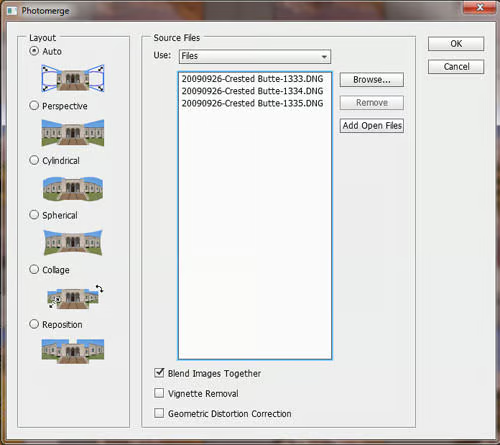
Import RAWs into Lightroom/Capture One for basic color and lens profile handling (don’t defish; let the stitcher manage geometry). Then export to PTGui or Hugin. In PTGui, set lens type to “Full-frame fisheye,” focal length 12 mm, and let it estimate the field of view; add control points automatically, optimize, and check the alignment. Fisheye panoramas typically stitch with 25–35% overlap; rectilinear lenses need more frames and consistent overlap (20–30%). For the A1 + 12mm fish, a 5+2 or 6+2 pattern yields dependable results with high final resolution. For a thorough discussion of stitching performance and tool choice, see the PTGui review linked below. PTGui deep dive and review
Cleanup & Enhancement
- Nadir patch: Export a layered panorama or a nadir-view tile. Patch the tripod with clone tools or an AI nadir patcher.
- Color & noise: Balance color with curves; apply noise reduction for high-ISO or deep-shadow areas, especially in HDR merges.
- Leveling: Use the pitch/roll/yaw controls in PTGui or Hugin to level the horizon. Align verticals for architecture.
- Export: For VR platforms, export equirectangular 2:1 JPEG or TIFF. With this setup, 12K–16K width is common; optimize based on target platform limits.
Expected resolution reference: spherical resolution depends on FOV, sensor, and overlap. A1 + 12mm fisheye can produce detailed 10K–16K equirectangular outputs. For theory and calculators, check the panotools wiki. Understanding spherical resolution
If you’re new to high-end DSLR/mirrorless 360 workflows, this official guide is a solid orientation. Using a DSLR/Mirrorless to shoot and stitch 360 photos
Video: Pano Head Setup & Stitching Basics
Watch a concise overview of panoramic head alignment and clean stitching. Embed below for quick reference on location:
Useful Tools & Resources
Software
- PTGui panorama stitching
- Hugin (open source)
- Lightroom / Photoshop / Affinity Photo
- AI tripod removal and nadir patch tools
Hardware
- Panoramic heads (Nodal Ninja, Leofoto, Sunwayfoto)
- Carbon fiber tripods with leveling bases
- Wireless remote shutters / app control
- Pole extensions and car-mount systems with safety tethers
Disclaimer: software/hardware names provided for search reference; check official sites for details. For a fundamentals refresher and popular gear considerations, this guide is also helpful. DSLR/virtual tour FAQ and lens guide
Common Mistakes & How to Avoid Them
- Parallax error: Always rotate around the entrance pupil; calibrate and mark your rails for the Sony A1 + Samyang 12mm combo.
- Exposure flicker: Use manual mode and fixed WB; avoid auto ISO and auto WB.
- Tripod shadows: Shoot a separate nadir and patch later; reposition slightly if needed.
- Ghosting from movement: Use the two-pass method and masking; increase overlap (6 around) for complex scenes.
- Night noise and banding: Keep ISO modest (100–800); use mechanical or EFCS with anti-flicker under artificial lights.
- Flare/veiling: Shield the lens from direct sun with a flag/hand or reposition your ring start to keep sun at safer angles.
Frequently Asked Questions
- Can I shoot handheld panoramas with the Sony A1?
Yes, especially with the fisheye’s coverage and A1’s IBIS. Use fast shutter speeds (1/200+), ISO 400–1600, and keep consistent overlap. Expect minor misalignments—okay for social/web but not ideal for pro VR tours. A monopod or lightweight pole improves consistency.
- Is the Samyang 12mm f/2.8 wide enough for a single-row 360?
Yes. A reliable pattern is 5 around + zenith + nadir. For safety or near objects, use 6 around. Four around + nadir can work outdoors but risks a small zenith gap.
- Do I need HDR for interiors with bright windows?
Usually, yes. Bracket ±2 EV (3–5 frames) to capture window highlights and room shadows cleanly. The A1’s DR helps, but HDR ensures clean window detail without noisy shadows.
- How do I avoid parallax issues with this lens?
Calibrate the entrance pupil on your pano head. Start around 63–66 mm forward of the sensor plane, then refine using a near/far alignment test. Mark the rails once you find the sweet spot.
- What ISO range is safe on the A1 in low light?
On tripod, stick to ISO 100–200 and lengthen shutter. If you must go handheld or manage motion, ISO 800–1600 retains good detail with modest noise. Expose to the right without clipping to maximize quality.
Real-World Scenarios & Field Advice
Indoor Real Estate (Mixed Lighting)
Use a 6+2 capture with ±2 EV bracketing to tame windows and warm practical lights. Lock WB around 3800–4200K for tungsten/LED blends, and mask ghosting where ceiling fans or curtains move. Keep the camera slightly higher (1.4–1.6 m) to reduce furniture occlusion and tripod reflection in glossy floors. Patch nadir carefully—clients notice sloppy floors.
Outdoor Sunset (High Contrast)
Start your ring so the sun lands between frames, not in the center of one. Bracket as needed (±2 EV). Use f/8, ISO 100–200, and mind flare. Consider a second pass with your hand flagging the sun, then mask flare-free regions in post.
Crowded Events (Movement Everywhere)
Do a quick 5-around pass first, then repeat selected angles when people move. In post, mask the cleanest bodies and faces from your second pass. The fisheye minimizes total frames, reducing mismatch risks.
Rooftop / Pole Shooting
Use a carbon pole with a safety tether. Watch wind—if the pole sways, boost shutter speed and ISO to freeze motion. Keep your body away from reflections and shoot a zenith while slightly bracing the pole under a stable footing. Safety first—avoid edges and overhead hazards.
If you’re just getting started with best practices and gear, this knowledge base on pano techniques and equipment selection is also worthwhile. Techniques to take 360 panoramas