Why This Camera & Lens Are Great for Panoramas
The Sony A1 is a 50.1MP full-frame, stacked-CMOS mirrorless camera that combines class-leading resolution with high-speed performance. Its sensor measures 36 × 24 mm, delivers roughly 4.16 µm pixel pitch, and offers excellent base-ISO dynamic range (about 14 EV at ISO 100). For panoramas, that means you can capture extremely fine detail with smooth tonal transitions—ideal for big environmental stitches, gigapixel mosaics, and 360 photos for VR.
The Canon RF 15–35mm f/2.8L IS USM is a professional, rectilinear ultra-wide zoom known for sharp corners, robust weather sealing, and reliable AF. At 15mm on full frame, you get an expansive field of view (approx. 100° horizontal, ~77° vertical) without the curvy lines of a fisheye. That’s excellent for architectural panoramas and interiors where straight lines must stay straight. At 24–35mm, it remains optically strong, useful when building very high-resolution multi-row panoramas.
Important compatibility note: the RF 15–35mm is designed for Canon RF mount. As of today, there is no practical RF-to-Sony E electronic adapter and the flange focal distances make a passive adapter impractical. In plain terms, you can’t mount the RF 15–35 natively on the Sony A1. If your goal is specifically “how to shoot panorama with Sony A1 & Canon RF 15–35mm f/2.8L IS USM,” you have two workable paths: (1) use the RF 15–35 on a Canon RF body (e.g., EOS R5/R6) and apply the shooting workflow below; or (2) use an equivalent rectilinear Sony E-mount lens (e.g., Sony FE 16–35mm f/2.8 GM II or FE 12–24mm f/4 G) on the A1 and follow the same settings, overlaps, and nodal techniques. The panoramic principles in this guide apply 1:1 to either scenario.
Quick Setup Overview
- Camera: Sony A1 — Full-frame 50.1MP stacked CMOS; approx. 14 EV DR at base ISO; 4.16 µm pixel pitch; excellent ISO 100–1600 performance for pano work.
- Lens: Canon RF 15–35mm f/2.8L IS USM — Rectilinear ultra-wide zoom; very sharp from f/5.6–f/8; well-controlled distortion for a UWA; in-lens IS (note: not usable on A1 due to mount mismatch).
- Estimated shots & overlap (full-frame, rectilinear):
- At 15mm (rectilinear): Multi-row needed for a full 360×180; typical plan: 3 rows (−45°, 0°, +45°) × 8 shots per row (45° yaw steps) + 1 zenith + 1 nadir = 26–28 images.
- At 20–24mm: 4 rows × 10–12 shots per row + zenith + nadir (50–60 total).
- At 35mm: 5 rows × 12–14 shots per row + zenith + nadir (70–85 total).
- Difficulty: Moderate if you’re new to nodal alignment; easy-moderate with a calibrated panoramic head.
Planning & On-Site Preparation
Evaluate Shooting Environment
Look for objects close to the camera (railings, furniture, hanging lights). Close objects increase the risk of parallax errors if your lens isn’t aligned to its no-parallax point. If you’re shooting through glass, press the lens hood gently against it or get within 3–5 cm to minimize reflections. For exteriors, note sun position to avoid flare; for interiors, identify mixed lighting sources that could shift color across frames.
Match Gear to Scene Goals
Using the A1’s high dynamic range at ISO 100–200 lets you capture deep shadows and highlight detail—handy at sunrise/sunset and bright-doorway interiors. Indoors, the RF 15–35 at f/5.6–f/8 offers strong sharpness for architecture. In darker rooms, the A1 handles ISO 400–800 cleanly, and ISO 1600–3200 remains usable if you expose to the right on a tripod. Rectilinear UWA lenses (like the 15–35) preserve straight lines but require many frames for a full 360; a fisheye would need fewer shots but introduces barrel distortion and specialized defishing. Choose based on the final output and time available on site.
Pre-shoot Checklist
- Charge batteries (bring at least one spare) and clear/format fast UHS-II or CFexpress cards.
- Clean lens front/rear elements; use the A1’s sensor cleaning and a blower if needed.
- Level the tripod and pre-calibrate your panoramic head for the lens focal length you plan to use.
- Safety: check wind load on rooftops; tether gear on poles or car rigs; verify clamps are locked.
- Backup: shoot one extra full pass around at the same settings; it can save a broken stitch later.
Essential Gear & Setup
Core Gear
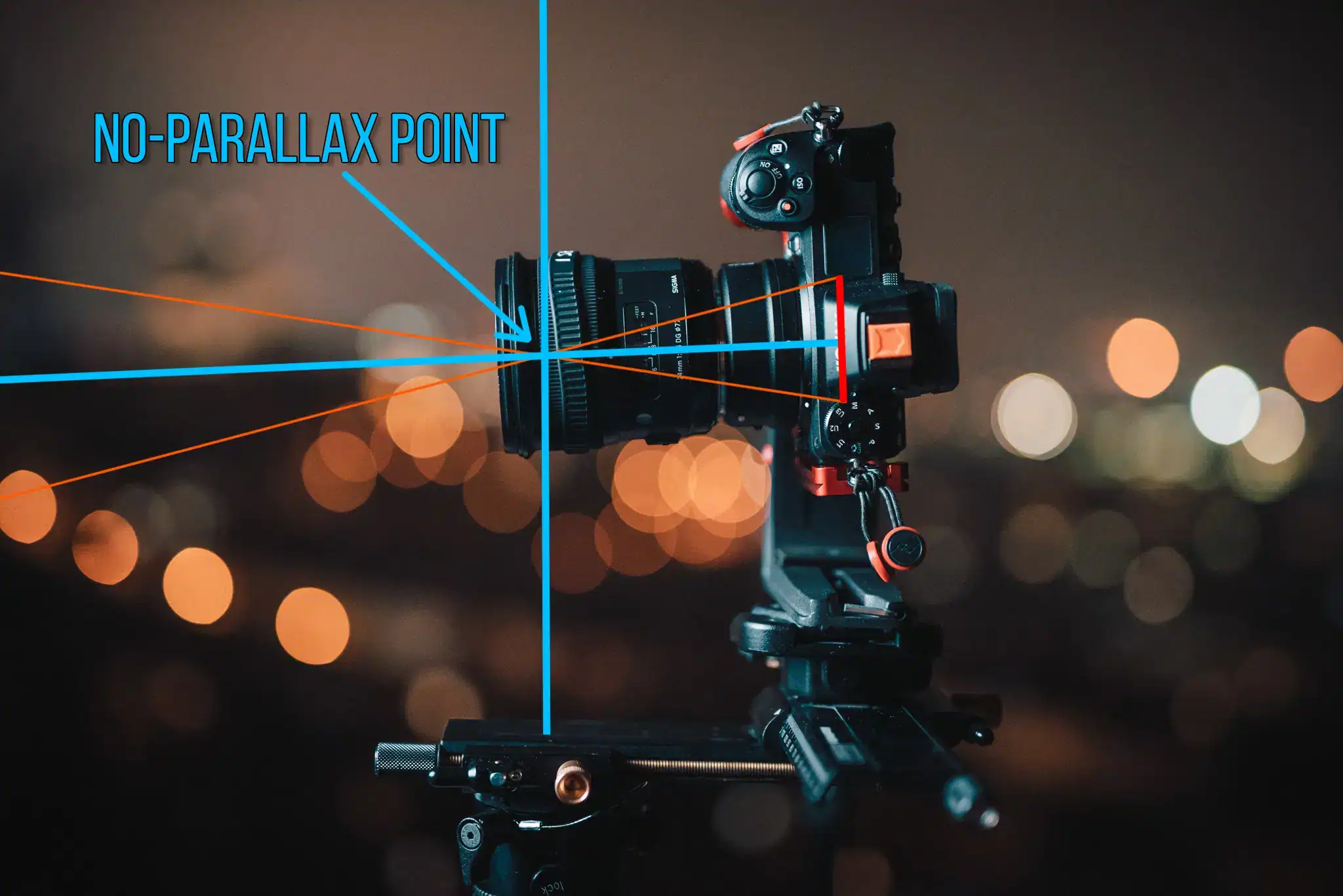
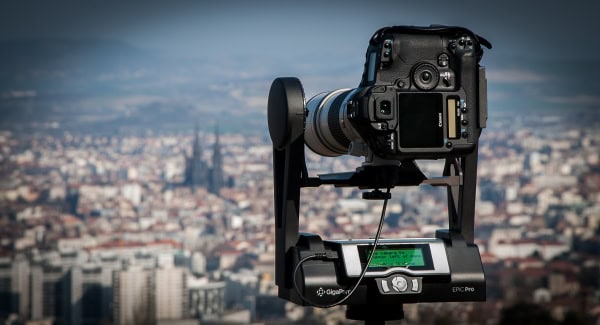
- Panoramic head: Lets you place the lens’s entrance pupil directly over the yaw/pitch axes. This eliminates parallax, critical for interiors and tight spaces. Calibrate once, then mark the rails.
- Stable tripod with leveling base: A leveling base speeds workflow. Level the base first, then the head. This ensures consistent overlap and horizon control.
- Remote trigger or app: Use Sony’s Imaging Edge Mobile or a wired remote to prevent camera shake when starting each exposure.
Optional Add-ons
- Pole or car mount: Use safety lines and double clamps. Wind amplifies vibration—keep shutter speeds higher and rotation slower.
- Lighting aids: Small LED panels for dark corners in real estate; bring CTO gels to match tungsten fixtures.
- Weather protection: Rain covers, microfiber cloths, and silica gel for humid conditions.
Step-by-Step Shooting Guide
Standard Static Scenes
- Level and align:
- Level the tripod. Adjust the leveling base until the bubble is centered.
- Set the panoramic head so the lens’s entrance pupil is directly above the rotation axis. Move the fore-aft rail until foreground/background alignment stays fixed while you yaw the camera.
- Manual exposure & white balance:
- Switch to M mode. Meter the brightest part you must retain (e.g., windows) and expose to protect highlights while keeping shadows liftable.
- Lock WB (Daylight for sunny exteriors, 3200–4000K for tungsten interiors) to avoid stitching color shifts.
- Capture with overlap:
- At 15mm, aim for ~30% overlap per frame. For a full sphere, try 3 rows (−45°, 0°, +45°) × 8 shots around (45° steps), then add one zenith and one nadir.
- Work methodically: start at a known marker (e.g., a doorway) and rotate consistently to avoid missing slices.
- Nadir patch:
- After the main rows, shoot a dedicated nadir frame by tilting down or shifting the tripod slightly to capture clean floor texture for tripod removal in post.
HDR / High Dynamic Range Interiors
- Bracket ±2 EV (e.g., 0/−2/+2) at each camera position to balance bright windows and dark rooms. The A1’s dynamic range is great, but bracketing ensures clean highlights.
- Lock white balance and keep aperture fixed (f/8 is a good baseline). Only shutter speed should change across brackets.
- Use self-timer or remote to avoid vibration between brackets; let IBIS stay OFF on the tripod to prevent micro-shake.
Low-Light / Night Scenes
- Exposure: f/4–f/5.6, ISO 100–800 whenever possible; lengthen shutter to 1–4 seconds on a sturdy tripod. The A1 is clean to ISO 800–1600; only push beyond if necessary.
- Use a remote trigger and wind-damping (hang a small weight from the tripod center) to minimize blur.
- Turn off IBIS and lens IS (if available/compatible) on a tripod to prevent sensor/element drift.
Crowded Events
- Make two passes: the main pass for complete coverage, then a second pass to capture clean plates when gaps open in the crowd.
- In post, mask moving subjects and keep the plate with the best alignment and least motion blur.
Special Setups (Pole / Car / Drone)
- Pole: Use a carbon pole and safety tether, keep shutter speeds short (1/200–1/500) to counter sway. Consider higher ISO (400–1600) instead of longer shutter.
- Car mount: Avoid high speeds; schedule at dawn for empty streets. Use vibration-damping suction mounts and re-tighten clamps every few minutes.
- Drone: If you need aerial 360s, a dedicated drone workflow is better—this guide focuses on ground-based DSLR/mirrorless rigs.
Recommended Settings & Pro Tips
Exposure & Focus
| Scenario | Aperture | Shutter | ISO | Notes |
|---|---|---|---|---|
| Daylight outdoor | f/8–f/11 | 1/100–1/250 | 100–200 | Lock WB (Daylight); ETTR without clipping sky |
| Low light/night | f/4–f/5.6 | 1/30–4s (tripod) | 100–800 (1600 if needed) | Tripod & remote; IBIS/IS OFF to prevent micro-jitter |
| Interior HDR | f/8 | Bracket ±2 EV | 100–400 | Balance windows & lamps; constant WB and aperture |
| Action / moving subjects | f/5.6–f/8 | 1/200+ | 400–800 | Freeze motion; do a second “clean plates” pass |
Critical Tips
- Manual focus: Set MF and focus about one-third into the scene or use the hyperfocal distance at your chosen aperture. Check 100% magnification on the A1’s EVF for critical focus.
- Nodal calibration: With your panoramic head, slide the lens forward/back until foreground and background don’t shift relative to each other as you pan. Mark rail positions for 15mm, 20mm, 24mm, and 35mm.
- White balance lock: Keep WB fixed across all frames to avoid cross-frame color shifts that are difficult to correct.
- RAW over JPEG: Shoot RAW for maximum DR and color latitude—especially important for HDR merges and tricky mixed lighting.
- Stabilization: Turn OFF IBIS/lens IS when tripod-mounted; leave ON only for handheld shooting.
Stitching & Post-Processing
Software Workflow
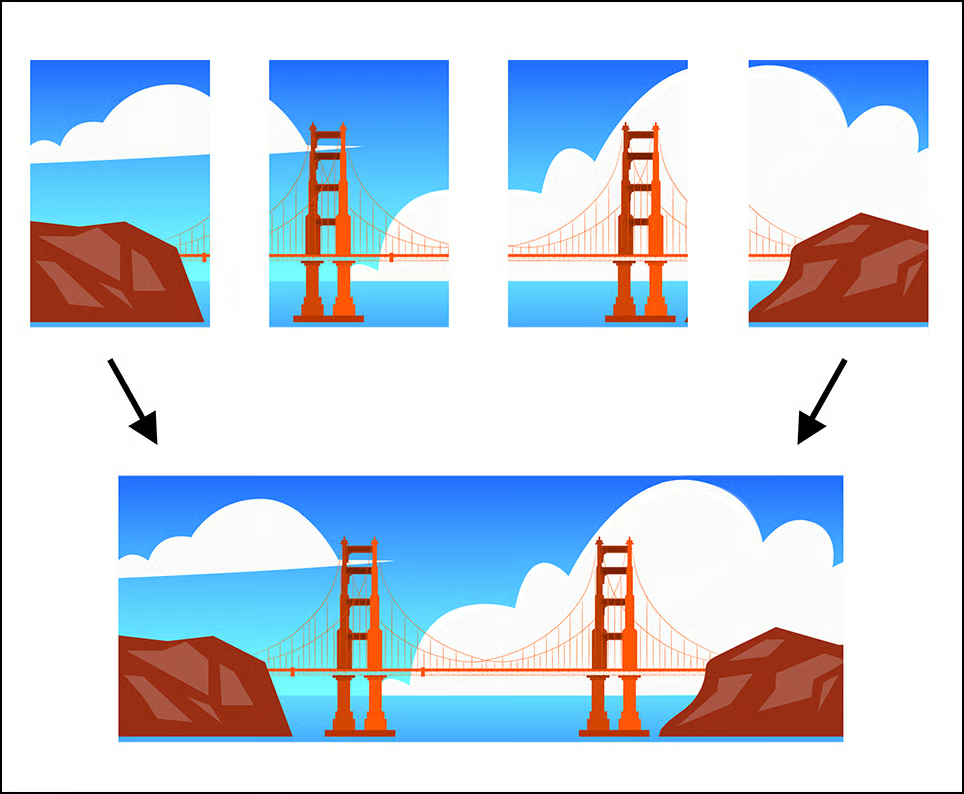
Import your RAWs into Lightroom or Capture One, apply consistent white balance and base corrections, and export 16-bit TIFFs if you plan heavy edits. For stitching, PTGui is the industry workhorse for complex multi-row spherical panoramas and HDR brackets. Hugin is a capable open-source alternative. Rectilinear ultra-wide lenses like the RF 15–35 require more frames than fisheyes, but reward you with straighter lines and fewer edge distortions. Aim for ~25–30% overlap (wide end), ~20–25% at tighter focal lengths. After stitching, export an equirectangular image for 360 viewers or a high-res flat panorama for print.
Learn more about professional pano stitching with a review of PTGui and why it’s favored for high-end work: PTGui: one of the best tools for complex panoramas.
Cleanup & Enhancement
- Nadir patch: Use a dedicated nadir shot, then patch with content-aware fill or stamp/clone. AI tools can speed this up.
- Color and noise: Match tone and color across rows; apply gentle noise reduction on shadow areas captured at higher ISO.
- Leveling: Set correct horizon and verticals; in PTGui, adjust pitch/roll/yaw for a perfectly level pano.
- Export: For VR, export 2:1 equirectangular JPEG (8–12k on the long side for web) or higher for pro VR tours.
For a deep-dive primer on head setup and precision shooting that leads to easy stitching, see this panoramic head tutorial: How to set up a panoramic head properly.
If you’re new to VR publishing, the Meta guide covers end-to-end capture and stitch fundamentals with DSLR/mirrorless systems: Using a DSLR/mirrorless to shoot and stitch a 360 photo.
Useful Tools & Resources
Software
- PTGui panorama stitching
- Hugin (open-source)
- Lightroom / Photoshop
- AI tripod/nadir removal tools
Hardware
- Panoramic heads (Nodal Ninja, Leofoto, Really Right Stuff)
- Carbon-fiber tripods and leveling bases
- Wireless/wired remote shutters
- Pole extensions / car mounts with safety tethers
Disclaimer: product names are for reference; check official specifications and documentation for current details.
Common Mistakes & How to Avoid Them
- Parallax errors: Always align the entrance pupil over the rotation axis; avoid shifting the tripod between rows.
- Exposure flicker: Use manual exposure and fixed WB across every frame and bracket.
- Tripod shadows: Plan the nadir patch, or slightly move and shoot a clean floor plate.
- Ghosting from motion: Take a second pass for clean plates and mask in post.
- Night noise: Keep ISO low and use longer shutter times on a sturdy tripod; expose to the right judiciously.
- Lens/body mismatch: Don’t rely on unproven mount adapters—use native E-mount glass on the A1 or pair the RF lens with an RF body.
Field-Proven Scenarios
Indoor Real Estate (Bright Windows)
Set f/8, ISO 100–200, bracket ±2 EV at each position. At 15–20mm you’ll need multi-row coverage; place the camera centrally in the room, away from nearby furniture to reduce parallax issues. Lock WB to a single Kelvin value (e.g., 4000K for mixed daylight/tungsten), and avoid auto WB. The A1’s base ISO files grade cleanly; pull window highlights from the −2 EV bracket and blend shadows from the +2 EV bracket.
Outdoor Sunset Overlook
Use f/8–f/11 at ISO 100, and meter for the sky to protect highlights. Consider capturing a second, slightly brighter pass for foreground detail if you want to avoid bracketed HDR. Wind can cause micro-blur on long lenses—use a weight on the tripod hook and a remote release. The A1’s dynamic range lets you recover deep shadows without banding when exposed well.
Crowded Event
At 15–24mm, shoot at 1/200–1/320, f/5.6–f/8, ISO 400–800. Take two rotations: one for geometry, another for clean plates. Keep your camera height stable and consistent; even small tilts can cause difficult stitching around heads and signs.
Rooftop / Pole Shooting
On a pole, favor faster shutters (1/200+) and higher ISO (400–1600) rather than long exposures. Tighten everything twice, add a safety tether, and rotate slowly between frames. If using a car mount, plan for low-traffic times and confirm every suction cup and clamp before each pass.
Compatibility & Practical Alternatives
Because the Canon RF 15–35mm f/2.8L IS USM is not practically adaptable to Sony E-mount (the Sony A1’s mount), you should either use:
- A Canon RF body with the RF 15–35 and follow this workflow exactly; or
- A Sony E-mount equivalent lens on the A1—such as the Sony FE 16–35mm f/2.8 GM II or FE 12–24mm f/4 G. The shooting steps, overlaps, and nodal techniques remain the same. For 16mm rectilinear, plan roughly 3 rows × 8 shots + zenith + nadir for a full 360.
For background on DSLR/mirrorless 360 capture and lens options, this guide is helpful: DSLR/mirrorless 360 lens & camera guide.
Frequently Asked Questions
- Can I shoot handheld panoramas with the Sony A1?
Yes, for simple, non-360 panos. Use high shutter speeds (1/250+), IBIS ON, and overlap 30–40%. For 360×180 or interiors with close objects, use a tripod and a panoramic head to avoid parallax errors.
- Is the Canon RF 15–35mm wide enough for single-row 360s?
No. At 15mm rectilinear on full frame, a single row won’t cover zenith and nadir. Expect multi-row captures (e.g., 3 rows × 8 shots + zenith + nadir). For fewer shots, use a fisheye lens.
- Do I need HDR for interiors with bright windows?
Often yes. Bracket ±2 EV to hold both bright exterior views and interior shadow detail. The A1 has strong DR, but brackets make window edges cleaner and reduce noise in shadow lifts.
- How do I avoid parallax issues?
Calibrate the panoramic head so the lens’s entrance pupil is centered over the rotation axis. Test by aligning a near and far object and panning; if the relative position changes, adjust the fore-aft rail until it doesn’t.
- What ISO range is safe on the A1 for low light panos?
ISO 100–800 is generally noise-free with excellent dynamic range. ISO 1600–3200 is still very usable if you expose properly. Prefer longer shutter times on a tripod over cranking ISO.
- Can I set custom modes for pano on the A1?
Yes. Assign a custom mode with Manual exposure, RAW, fixed WB, IBIS OFF (tripod), self-timer or remote trigger, and your preferred drive mode. This speeds up setup on location.
- What’s the best tripod head for this setup?
A multi-row panoramic head with fore-aft and lateral rails (e.g., Nodal Ninja or RRS) for precise entrance pupil alignment. Add a leveling base to make setup faster and more accurate.
Safety, Reliability & Workflow Tips
- Wind and edges: On rooftops or cliffs, keep a low profile and tether your gear. Don’t chase a tripod in gusts.
- Backup your files: After the shoot, immediately duplicate your cards to two separate drives. Name folders by location/date/row.
- Lens/body limits: Avoid questionable adapters. Use native mounts when possible for reliable AF, EXIF, and stabilization.
- Document calibration: Save your nodal rail positions for each focal length and lens; store them on your phone or tape them to the head.
Further Reading
For foundational concepts (coverage vs. resolution) and how focal length affects final pano size, this resource is a useful reference: Panotools: DSLR spherical resolution.