
Why This Camera & Lens Are Great for Panoramas
If you want to know how to shoot panorama with Sony A1 & AstrHori 12mm f/2.8 Fisheye, you’re pairing a top-tier full-frame body with a purpose-built ultra‑wide lens. The Sony A1’s 50.1MP stacked full-frame sensor (36×24 mm, ~4.2 μm pixel pitch) captures exceptionally clean detail with excellent dynamic range around 14–15 stops at base ISO. It handles mixed light well, offers class-leading autofocus (even though we’ll use manual focus for panos), and its fast readout minimizes rolling shutter if you ever shoot handheld or on a pole.
The AstrHori 12mm f/2.8 is a full-frame diagonal fisheye, giving approximately 180° diagonal FOV. As a manual-focus, manual-aperture lens, it’s mechanically simple and consistent—perfect for locked settings across a sequence. Diagonal fisheyes are a sweet spot for spherical panoramas: you need fewer frames than with rectilinear lenses, stitching is robust in PTGui/Hugin, and edges remain reasonably sharp by f/5.6–f/8. Expect strong barrel curvature (by design), but software handles it easily when you set the lens type to “full-frame fisheye.”
Quick Setup Overview
- Camera: Sony A1 — Full-Frame 50.1MP stacked CMOS (approx. 4.2 μm pixel pitch), excellent dynamic range (~14–15 stops) and very clean ISO 100–800.
- Lens: AstrHori 12mm f/2.8 Fisheye — full-frame diagonal fisheye, manual focus/aperture, sharpest around f/5.6–f/8, moderate CA at edges (easily corrected in post).
- Estimated shots & overlap:
- Fast single-row: 6 around at 60° spacing + 1 zenith + 1 nadir (about 30% overlap).
- Precision/near-objects: 8 around at 45° spacing + zenith + nadir for stronger control points and cleaner edges.
- Handheld/pole: 6 around, patch the nadir later.
- Difficulty: Easy–Medium (fisheye reduces shot count; nodal alignment is the key skill).
Planning & On-Site Preparation
Evaluate Shooting Environment
Survey light direction, contrast, and reflective surfaces. Glass and glossy floors amplify flare and ghosting; get close to glass (1–2 cm) at a slight angle to reduce internal reflections. Watch for moving people or foliage: plan two passes for crowds, and time exposures between wind gusts for trees and flags.
Match Gear to Scene Goals
The Sony A1’s base ISO 100 gives maximum dynamic range; ISO 100–400 is ideal on a tripod. The AstrHori 12mm fisheye covers huge FOV per frame, so you’ll usually finish a full 360×180 with 6–8 images around plus zenith/nadir. This is perfect for real estate interiors (fewer frames, less chance of people walking in), exteriors at sunset (capture the sky faster before light changes), and event coverage (shorter sequences reduce misalignment). For very dim scenes, the A1 stays clean up to ISO 800–1600 with good noise reduction in post; 3200 is usable when necessary.
Pre-shoot Checklist
- Power & storage: fully charged batteries, spacious cards (RAW + brackets can pile up fast).
- Clean optics: fisheye front elements are bulbous—clean smudges before every set.
- Level and calibrate: leveling base on tripod, panoramic head dialed to your lens’s no-parallax point.
- Safety: check wind, secure rooftop access, use tethers for poles or car mounts; never overreach.
- Backup capture: if the light is changing, shoot a quick backup round before doing complex brackets.
Essential Gear & Setup
Core Gear
- Panoramic head: Critical to align the lens’s no-parallax point (NPP), eliminating foreground/background shifts. This ensures clean stitches even with nearby objects.
- Stable tripod with leveling base: Leveling the base makes your yaw increments true—no creeping horizon.
- Remote trigger or app: Use Sony Imaging Edge or a 2–5 s self-timer to avoid vibrations.
Optional Add-ons
- Pole or car mount: Great for crowds or tight spaces. Hard rule: always tether, minimize rotation speed, and avoid high winds.
- Lighting aids: Small LED panels to lift dark interiors; keep placement consistent so it doesn’t move between frames.
- Weather gear: Rain covers, lens hood/flag to reduce flare, microfiber cloths for mist or spray.

New to nodal alignment? This concise panoramic head tutorial explains the principle and setup clearly: How to set up a panoramic head (360 Rumors).
Step-by-Step Shooting Guide
Standard Static Scenes
- Level and center: Use the leveling base to get the head perfectly level. Confirm with the in-camera level on the A1 for redundancy.
- Find/recall NPP: The AstrHori 12mm’s NPP will be somewhere forward of the sensor plane. Start with the lens entrance pupil roughly over the rotation axis and fine-tune by aligning near/far objects while panning. Mark your rail scale once found.
- Manual exposure: Set M mode. Meter a mid-tone area, then lock exposure across the entire sequence. For most daylight, f/8, 1/125, ISO 100–200 is a solid starting point. Disable Auto ISO.
- Lock white balance: Choose a fixed preset (Daylight, Tungsten) or set a custom K value to avoid color shifts between frames.
- Manual focus: Set the AstrHori to f/8. Focus at or slightly beyond hyperfocal (~0.6–0.7 m at 12mm f/8 on full-frame) to keep everything from ~0.3 m to infinity sharp. Use magnified live view to confirm.
- Capture sequence: For most scenes, shoot 6 around at 0° tilt with 60° yaw increments. Then add 1 zenith (+90° tilt) and 1 nadir (−90° tilt). If tall structures are critical, consider 8 around.
- Nadir shot: Capture a clean ground plate. Use a remote trigger and reach out of the frame to minimize shadow overlap.
HDR / High Dynamic Range Interiors
- Brackets: Use ±2 EV (3–5 frames) to balance bright windows and dark corners. Keep the tripod totally still; use the 2 s timer.
- Consistency: Same aperture and focus across the entire set. Lock WB and turn off IBIS on a tripod to avoid micro-shifts.
- Anti-flicker: In mixed artificial lighting, prefer mechanical shutter and enable anti-flicker shoot to stabilize exposure timing.
Low-Light / Night Scenes
- Stability first: Use a sturdy tripod, weigh it down, and turn off IBIS. Long exposures mean any vibration is visible when stitched.
- Exposure lane: f/4–f/5.6, ISO 200–800, shutter as needed (1–10 s or more). On the A1, ISO 800–1600 remains clean; 3200 is acceptable for dark skies with noise reduction.
- Triggering: Use a remote or 2 s timer. Consider electronic front curtain shutter to minimize internal vibrations.
Crowded Events
- Two passes: First pass quick for coverage; second pass wait for gaps. You’ll later mask moving people between passes.
- Short sequence: Do 6 around + zenith; patch nadir later. Shorter capture time reduces misalignment from motion.
- Mind the horizon: Keep the head level; horizon consistency is harder when people move.
Special Setups (Pole / Car / Drone)
- Pole safety: Use a carbon pole, wrist strap, and line tether. Rotate slowly; let vibrations settle before each frame. Avoid high winds.
- Car mount: Use vibration-damped suction mounts and a safety cable. Park, shoot, then move. Rolling captures invite parallax from motion.
- Drone note: This combo is not drone-friendly; consider a native aerial workflow if you need in-flight panos.
Recommended Settings & Pro Tips
Exposure & Focus
| Scenario | Aperture | Shutter | ISO | Notes |
|---|---|---|---|---|
| Daylight outdoor | f/8–f/11 | 1/100–1/250 | 100–200 | Lock WB (Daylight); keep exposure constant |
| Low light/night | f/4–f/5.6 | 1/30–8 s | 200–800 (1600 if needed) | Tripod & remote; IBIS off; watch for star trailing |
| Interior HDR | f/8 | Bracket ±2 EV | 100–400 | Three or five frames; minimize movement between shots |
| Action / moving subjects | f/5.6–f/8 | 1/200+ | 400–800 | Freeze motion; shoot two passes for masking later |
Critical Tips
- Manual focus at hyperfocal: At 12mm f/8 on full-frame, hyperfocal is roughly 0.6–0.7 m. Set and forget for edge-to-edge sharpness.
- Nodal calibration: With the AstrHori 12mm, start with the entrance pupil slightly forward of the tripod socket line. Fine-tune by aligning a near object against a far edge while rotating; adjust the rail until the relative position doesn’t shift.
- White balance lock: Fisheye coverage includes many light sources—locking WB prevents stitch seams with color cast jumps.
- RAW over JPEG: You’ll gain highlight recovery and better noise reduction, vital for interiors and night panoramas.
- IBIS and stabilization: Turn IBIS off on a tripod. Leave it on only if you must shoot handheld or on a pole with fast shutter speeds.
- Metadata note: The AstrHori is manual—enter lens type (Full-frame fisheye) and focal length in PTGui/Hugin for optimal matching.
Stitching & Post-Processing
Software Workflow
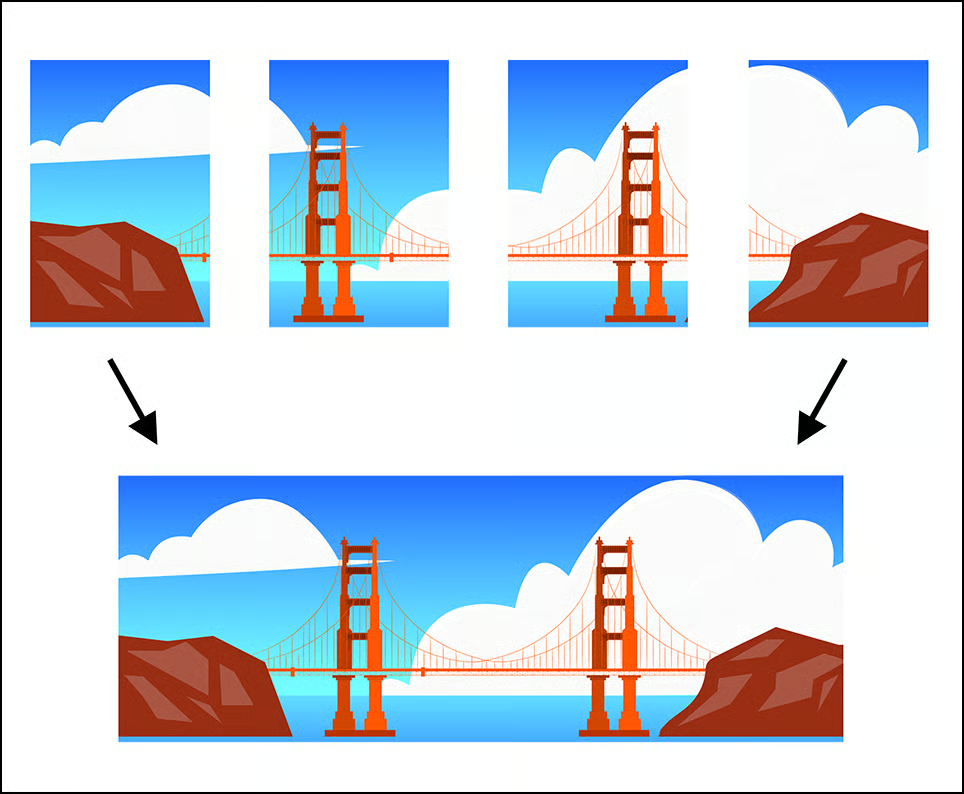
Import your RAWs, apply baseline corrections (lens CA, color, noise) and sync across the set. Export 16-bit TIFFs if you want the highest quality for stitching. In PTGui or Hugin, set the lens type to “full-frame fisheye,” focal length 12mm, and let the optimizer compute control points. Fisheyes generally stitch with 25–30% overlap. Rectilinear lenses need more shots and more overlap (~20–25% per frame) but avoid fisheye curvature. PTGui’s viewpoint correction can help remove the tripod by blending a shifted nadir frame. After stitching to an equirectangular (2:1), finish color and contrast in Lightroom/Photoshop, and export a JPEG/PNG for your 360 platform.
To see why many pros prefer PTGui for speed and control, this review is a good overview: Fstoppers: PTGui review.
Cleanup & Enhancement
- Nadir patch: Shoot a clean ground plate, or use a logo/AI patch in Photoshop. PTGui viewpoint correction helps when you can’t move the tripod.
- Color consistency: Check seams under mixed light; use HSL tools and local adjustments to even tones.
- Noise reduction: The A1 is clean, but night panos benefit from modest luminance NR and masking to protect detail.
- Level horizon: Use PTGui’s vertical line tool or Photoshop’s adaptive warp to lock the horizon and verticals.
- Export sizes: For VR and virtual tours, 12000–16000 px wide equirectangular is a good balance of detail and load time.
If you’re new to spherical workflows, this overview of DSLR/mirrorless 360 capture is helpful: Using a DSLR or mirrorless to shoot and stitch a 360 photo (Meta).
Video resource: A practical walkthrough of stitching techniques you can adapt to fisheye workflows.
Useful Tools & Resources
Software
- PTGui — fast, robust fisheye stitching with viewpoint correction.
- Hugin — open-source stitching with strong control point tools.
- Lightroom / Photoshop — RAW development, finishing, nadir patching.
- AI tripod removal tools — content-aware or generative fill for nadir cleanup.
Hardware
- Panoramic heads — Nodal Ninja, Leofoto, or similar with fore-aft and lateral rails.
- Carbon fiber tripods — lighter for travel, easier to stabilize.
- Leveling bases — quick leveling without re‑adjusting legs.
- Wireless remotes — hands-off shooting for maximum sharpness.
- Pole extensions / car mounts — use tethers and vibration control.
Disclaimer: software/hardware names provided for search reference; confirm current specs and compatibility on official websites.
For a compact FAQ about camera/lens options for virtual tours, you may also read: DSLR/virtual tour gear guide (360 Rumors).
Field-Proven Recipes & Case Studies
Indoor Real Estate (Window Contrast)
Mount the A1 on a leveled tripod with the AstrHori at f/8. Set ISO 100–200, manual exposure for the interior mid-tones, and enable ±2 EV bracketing (3 or 5 frames). Shoot 6 around, then zenith and nadir. Bracketed HDR ensures clean window views and shadow detail. Keep WB the same for the whole set (e.g., 4000–4500K if LED/tungsten mix) to avoid color seams.
Outdoor Sunset (Fast-Changing Light)
Light changes every minute, so minimize frame count: 6 around + zenith. Expose for highlights (protect the sun and clouds), then lift shadows in post. ISO 100–200, f/8, shutter floats around 1/60–1/200 depending on the sun. If the sky is moving fast, do a quick sky-only pass at higher shutter speed to blend later.
Event Crowds (Motion Management)
Do 6 fast frames at 1/200+, ISO 400–800, f/5.6–f/8. Then a second pass as people open gaps, or a separate background plate early/late when it’s empty. In post, mask people into the cleaner background to reduce ghosting.
Rooftop or Pole Shooting (Safety First)
Use a sturdy pole with a tether on the camera body and the pole. Keep rotations slow, stabilize between frames, and consider slightly higher ISO (400–800) to raise shutter speeds. Expect to patch the nadir. Always be mindful of bystanders and wind loads.
Common Mistakes & How to Avoid Them
- Parallax error → Align the no-parallax point carefully; do a test with near/far objects before your real shoot.
- Exposure flicker → Manual mode, fixed ISO, and locked WB across the sequence; avoid auto settings.
- Tripod shadows and legs → Shoot a separate nadir and patch; don’t stand where your shadow falls into the frame.
- Ghosting from movement → Capture quick sequences and a second pass; mask in post.
- Night noise and blur → Lower ISO, longer shutter, and absolute stability; IBIS off on tripod.
- Lens flare with fisheye → Use your hand or a flag just outside the frame; angle away from direct sun when possible.
If you want a broader perspective on best practices, this thread is an evergreen reference: Techniques to take 360 panoramas (StackExchange).
Frequently Asked Questions
- Can I shoot handheld panoramas with the Sony A1?
Yes, but it’s riskier. Use fast shutter speeds (1/200+), lock exposure and WB, shoot 6 around, and keep your rotation pivot near the lens’s entrance pupil. Handheld is fine for outdoor scenes with distant subjects; avoid tight interiors where parallax is unforgiving.
- Is the AstrHori 12mm f/2.8 wide enough for a single-row 360?
Yes. With a diagonal fisheye FOV around 180°, you can complete a sphere with 6 frames around plus zenith and nadir. If near objects are critical, do 8 around for more overlap and cleaner stitches.
- Do I need HDR for interiors with bright windows?
Usually yes. The A1’s dynamic range is excellent, but windows are often 4–8 EV brighter than interiors. Bracketing ±2 EV (3–5 frames) preserves highlights while maintaining clean shadows for a natural result.
- How do I avoid parallax issues with this combo?
Use a panoramic head and calibrate the no-parallax point. With the AstrHori 12mm, adjust the fore-aft rail until a near object stays aligned with a distant reference as you yaw the head. Mark that setting so you can repeat it instantly next time.
- What ISO range is safe on the A1 for low light panoramas?
Tripod-based panos are best at ISO 100–400. If you need speed, ISO 800–1600 remains very clean on the A1. ISO 3200 is usable with careful noise reduction; beyond that is possible but not ideal for high-end virtual tours.
Extra Tips: Settings You Can Save on the A1
Assign a custom mode for “Pano Tripod”: Manual exposure, ISO 100, IBIS off, electronic front curtain shutter, 2 s timer, RAW, fixed WB, focus magnifier assigned to a custom button. This makes your workflow consistent so you can concentrate on composition and overlap.
Safety, Care, and Workflow Integrity
The A1 and the AstrHori 12mm have a large, exposed front element—use a cap between locations, and keep a microfiber cloth handy. On rooftops or poles, always tether the camera and keep spectators clear. In light rain or mist, use a rain cover, and check for water spots on the fisheye frequently. Finally, protect your data: use dual slots or back up to a mobile device in the field. If the light changes dramatically, shoot a quick extra round—insurance you’ll appreciate at the computer.
For a structured, pro-grade setup walkthrough, including head alignment, see: Set up a panoramic head for high‑end 360 photos (Meta).
Wrapping Up
Now that you know how to shoot panorama with Sony A1 & AstrHori 12mm f/2.8 Fisheye, you can capture high-resolution 360 photos with fewer frames and faster on-site work. The key is repeatable technique: calibrated nodal point, locked exposure/WB, robust overlap, and a reliable stitching workflow in PTGui or Hugin. With the A1’s clean files and the AstrHori’s huge field of view, you’ll produce sharp, immersive panoramas for real estate, events, and outdoor adventures.
