
Why This Camera & Lens Are Great for Panoramas
The Pentax K-1 II is a tough, full-frame DSLR known for excellent image quality, weather sealing, and a big, comfortable optical viewfinder. Its 36.4MP full-frame sensor (approx. 35.9 × 24.0 mm, pixel pitch ~4.88 µm) delivers high dynamic range at base ISO and very clean files for detailed 360° panoramas. The Sigma 15mm f/1.4 DG DN Diagonal Fisheye Art is a state-of-the-art diagonal fisheye that covers a full-frame sensor with a 180° diagonal field of view, producing generous coverage with fewer shots compared to rectilinear lenses. A diagonal fisheye is ideal for speed and reliability in stitching because overlap is easy to maintain and control-point generation is highly robust.
Important compatibility note: the Sigma 15mm f/1.4 DG DN Diagonal Fisheye Art is built for modern mirrorless mounts (Sony E / L-Mount) and is not natively compatible with the Pentax K-1 II’s K-mount. There is no simple adapter that preserves infinity focus. If you are committed to the K-1 II, use a K-mount fisheye alternative (for example, the Sigma 15mm f/2.8 EX DG Fisheye in K-mount or the Pentax 10–17mm fisheye at the long end). The techniques, shot counts, and workflow described below still apply to any 15mm diagonal fisheye on full-frame. If you plan to use the Sigma 15mm f/1.4 DG DN, pair it with a compatible mirrorless body; otherwise, follow this guide with a K-mount fisheye of similar focal length.
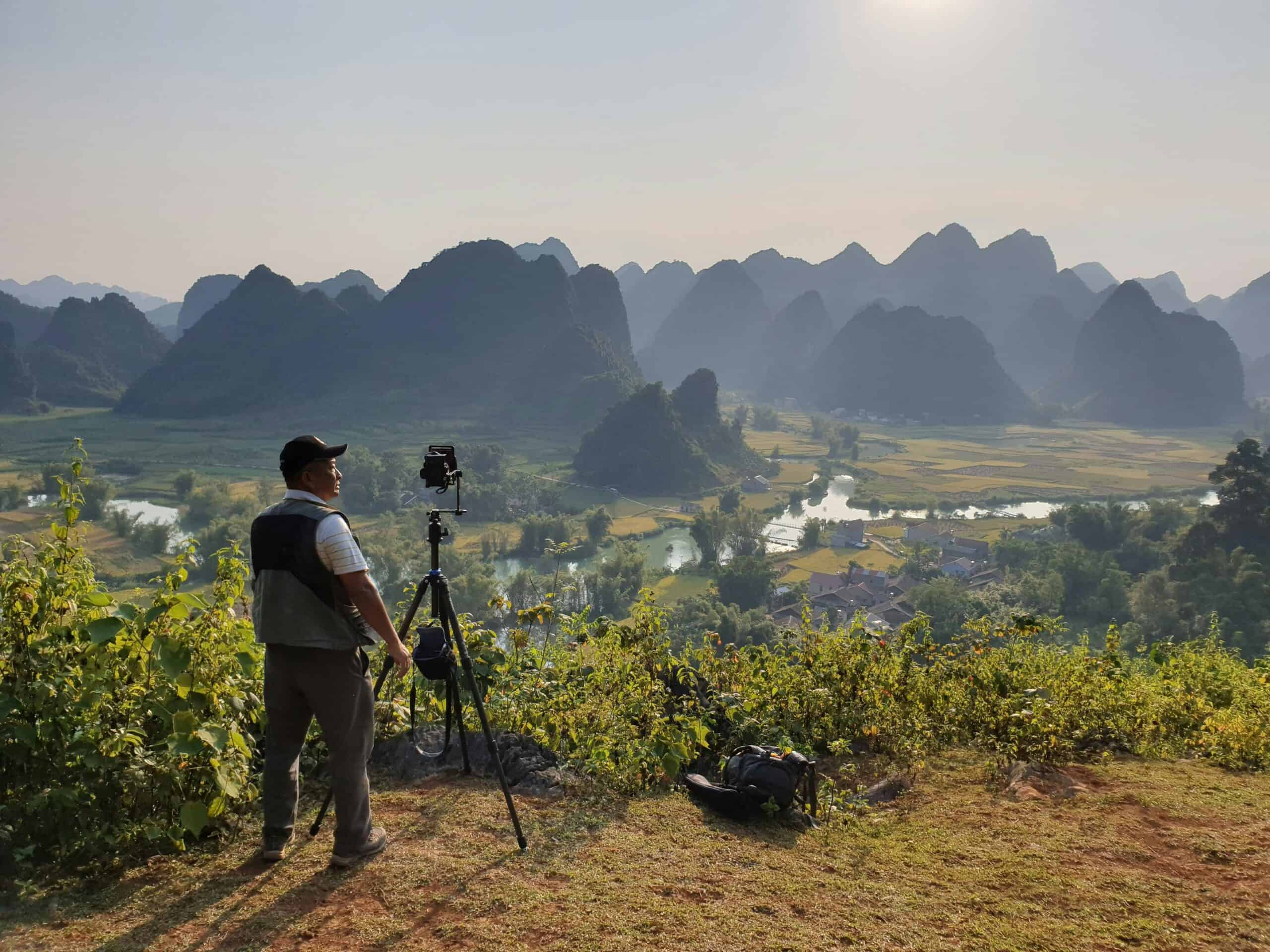
Quick Setup Overview
- Camera: Pentax K-1 II — Full-Frame 36.4MP CMOS, excellent DR at base ISO (~14+ EV), in-body stabilization (turn off on tripod), robust weather sealing.
- Lens: Sigma 15mm f/1.4 DG DN Diagonal Fisheye Art — diagonal fisheye coverage on full-frame (180° diagonal), very high sharpness, minimal axial CA, designed for mirrorless mounts (see compatibility note above).
- Estimated shots & overlap (full-frame diagonal fisheye, ~15mm):
- Speed capture: 6 around at 0° pitch (every 60°) + 1 zenith + 1 nadir; 30–35% overlap.
- High-precision: 8 around (every 45°) + zenith + nadir; 30% overlap for more control points and cleaner edges.
- Tip: tilt the single horizontal row up by 5–10° to reduce how much of the zenith you need to fill.
- Difficulty: Intermediate (easy outdoors, more demanding indoors with close objects and reflections).
Planning & On-Site Preparation
Evaluate Shooting Environment
Walk the scene before you deploy the tripod. Identify reflections (glass cabinets, windows, glossy floors), high-contrast light sources (windows, spotlights), and moving subjects (people, cars, foliage in wind). If you must face glass, shoot at a slight angle and get the lens as close as safely possible to reduce reflections and ghosting; even a few centimeters closer can help. Note objects close to the camera (chairs, railings, signs); these are where parallax errors show up most if your nodal point is off.
Match Gear to Scene Goals
The K-1 II’s base ISO files are superb. For tripod-based panoramas, prefer ISO 100–200 for maximum dynamic range and clean shadows. The body comfortably handles ISO 800–1600 if needed for low-light interiors, but keep ISO conservative since you can lengthen shutter speeds on a tripod. A diagonal fisheye greatly reduces shot count, making it ideal for fast outdoor captures, tight spaces, and crowded events. The tradeoff is fisheye distortion, which is handled in stitching—not a problem for 360° outputs.
Pre-shoot Checklist
- Power and storage: fully charged batteries and ample, fast SD cards. The K-1 II can chew through power in cold weather; bring spares.
- Clean optics: dust on a fisheye is visible; clean front element and sensor carefully.
- Tripod and head: ensure a leveled base and a calibrated panoramic head (entrance pupil aligned).
- Safety: evaluate wind; on rooftops or poles, tether the rig and avoid edges. For car mounts, confirm rated load and secure all clamps.
- Backup workflow: do a second safety round of images. It’s cheap insurance against a missed frame or an eye blink in a crucial direction.
Essential Gear & Setup
Core Gear
- Panoramic head: a dedicated pano head lets you rotate around the lens’s entrance pupil (often called nodal point) to prevent parallax error when foreground objects are close. Align once and mark your rails so repeat setup is fast.
- Stable tripod with leveling base: a leveling base speeds up setup and keeps your horizon flat across the rotation.
- Remote trigger or app: use a cable release, self-timer, or the K-1 II’s 2-second mirror-up timer to minimize vibration from mirror slap and shutter shock.
Optional Add-ons
- Poles or car mounts: great for high viewpoints or moving scenes. Always tether the camera, check wind ratings, and minimize speed/rotation to dampen vibrations.
- Lighting aids: compact LED panels or small flashes for interiors; keep lighting consistent across frames.
- Weather protection: rain covers, microfiber cloths, and silica gel. The K-1 II is weather-sealed, but your head and quick-release may not be.
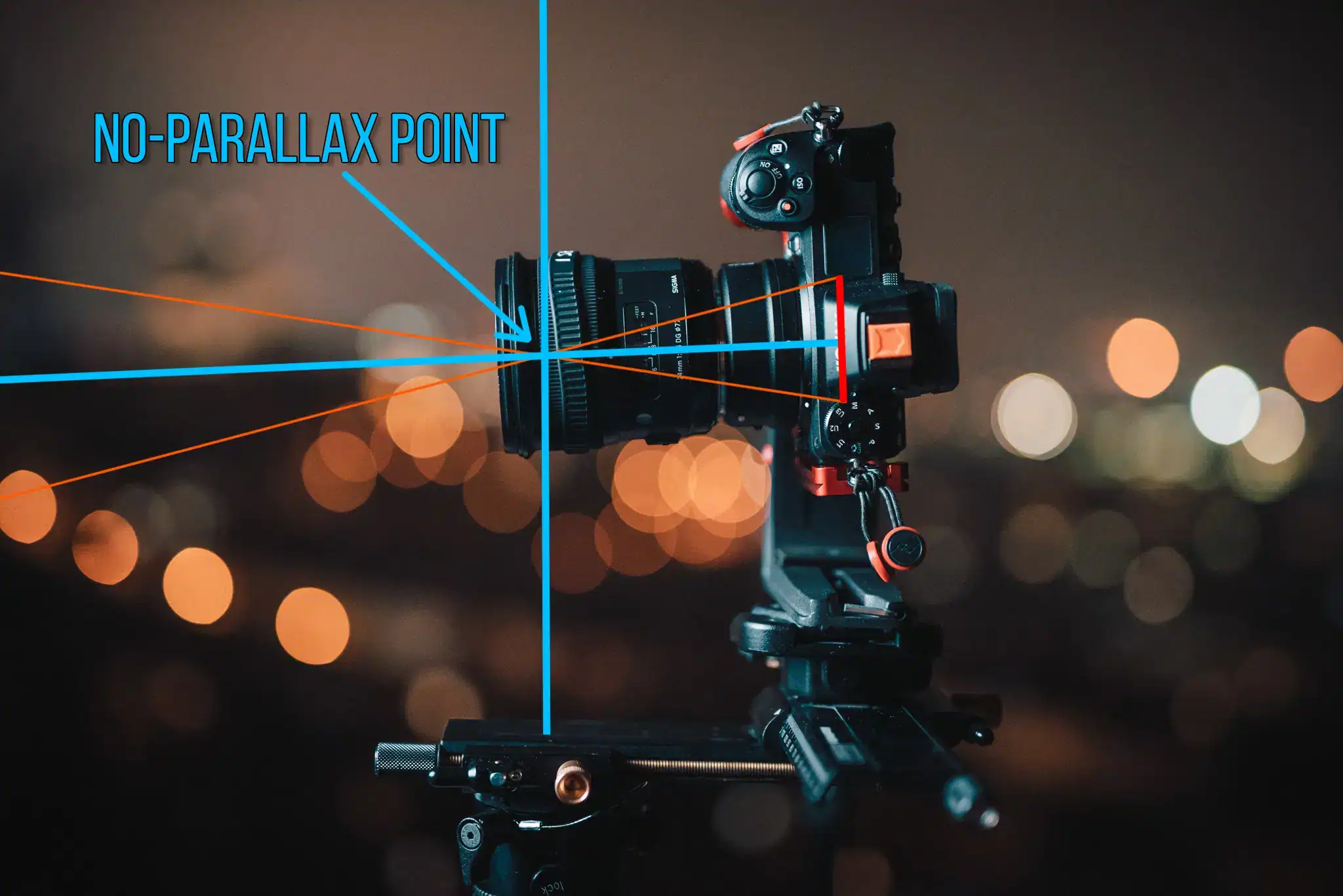
Need a primer on pano heads and nodal alignment? See this panoramic head tutorial for a visual walkthrough. Comprehensive panoramic head tutorial
Step-by-Step Shooting Guide
Standard Static Scenes
- Level and align: level the tripod using your leveling base and the K-1 II’s electronic level. Mount the pano head, and align the entrance pupil. A quick field method: place two light stands (or poles) at different distances and adjust the fore–aft rail until the relative position of the near and far objects doesn’t shift as you pan. Expect a fore–aft setting in the ~65–85 mm range from the rotation axis for many 15mm fisheyes—confirm for your specific lens.
- Manual exposure & white balance: set Manual mode for consistent exposure. Meter for midtones or slightly protect highlights in high-contrast scenes. Lock white balance (Daylight/Tungsten/Custom). Avoid Auto WB and Auto ISO for multi-frame consistency.
- Focus: switch to manual focus. Pre-focus about one-third into the scene or use a hyperfocal setting (at f/8 on a 15mm, everything from ~0.7–1 m to infinity will be acceptably sharp). Take a focus-check test shot at 100%.
- Capture sequence: shoot 6 frames around at 0° pitch (every 60°), then a zenith, then a nadir. For belt-and-suspenders coverage, do 8 frames around (every 45°) + zenith + nadir. Consider tilting the row up 5–10° for better top coverage.
- Nadir shot: after your main set, move the tripod slightly or use a nadir adapter to get a clean ground shot for tripod removal in post. Mark the tripod feet positions to maintain geometry.
HDR / High Dynamic Range Interiors
- Bracket exposures: use ±2 EV (3 or 5 frames) to capture bright windows and shadowy interiors. Keep aperture and focus fixed; vary shutter only.
- Consistency: lock WB and disable any dynamic optimization settings that vary by frame. Keep the same bracketing pattern for each direction.
- Mirror and shutter control: use the 2-second self-timer with mirror-up on the K-1 II to avoid vibration, especially at slower shutter speeds.
Low-Light / Night Scenes
- Exposure: start at f/4–f/5.6, ISO 100–400 on tripod, and lengthen shutter (e.g., 1–8 seconds) as needed. The K-1 II is clean up to ISO 800–1600, but dragging shutter on a tripod yields cleaner results.
- Stability: turn off SR (in-body stabilization) on the K-1 II when on a tripod to prevent micro-blur. Use a remote or self-timer.
- Stray light: use your body or a flag to block streetlights striking the fisheye’s front element at extreme angles.
Crowded Events
- Two-pass method: first pass quickly captures the full set for coverage; second pass you wait for gaps to capture cleaner frames, especially for key directions.
- Masking later: in PTGui or similar, blend the best frames to remove ghosts or duplicate people. Overlap helps give you options.
Special Setups (Pole / Car / Drone)
- Pole: keep the pole vertical (use a bubble level) and rotate slower to reduce motion blur. Tether the camera and watch wind ratings.
- Car-mounted: shoot on smooth roads at low speeds. Lock exposure and WB. Consider 8-around for extra overlap since alignment can vary with vibration.
- Drone: not typical with this heavy combo; if using a smaller rig, ensure consistent gimbal yaw increments and overlap.
For a standards-based overview on DSLR/mirrorless 360 capture and stitching, see this guide from Meta’s Creator resources. Using a DSLR or mirrorless camera to shoot and stitch a 360 photo
Recommended Settings & Pro Tips
Exposure & Focus
| Scenario | Aperture | Shutter | ISO | Notes |
|---|---|---|---|---|
| Daylight outdoor | f/8–f/11 | 1/100–1/250 | 100–200 | Lock WB to Daylight; consider a circular row tilted up 5–10° |
| Low light/night | f/4–f/5.6 | 1/30–8s | 100–400 (800 if needed) | Tripod + remote; SR OFF; use mirror-up timer |
| Interior HDR | f/8 | Bracket ±2 EV | 100–400 | Keep WB fixed; consistent bracket counts per view |
| Action / moving subjects | f/5.6–f/8 | 1/200+ | 400–800 | Freeze motion; consider 8-around for extra overlap |
Critical Tips
- Manual focus at or near the hyperfocal distance. On a 15mm at f/8, set focus ~1 m and you’ll cover near to infinity.
- Entrance pupil (nodal) calibration: use a near/far alignment test and mark your pano head rails for the lens. Re-check if you change focus significantly.
- White balance lock: pick Daylight/Tungsten/Custom to avoid color shifts that complicate stitching and blending.
- Shoot RAW: maximize DR and color flexibility for highlight recovery and consistent white balance across frames.
- Stabilization: on tripod, disable SR on the K-1 II. Also turn off Horizon Correction and any automatic composition correction so the pano head controls the geometry.
- Pentax-specific: use the 2s or 12s self-timer with Mirror-Up for vibration-free frames. Pixel Shift is not recommended across a multi-frame pano as the camera must move between shots.
Stitching & Post-Processing
Software Workflow
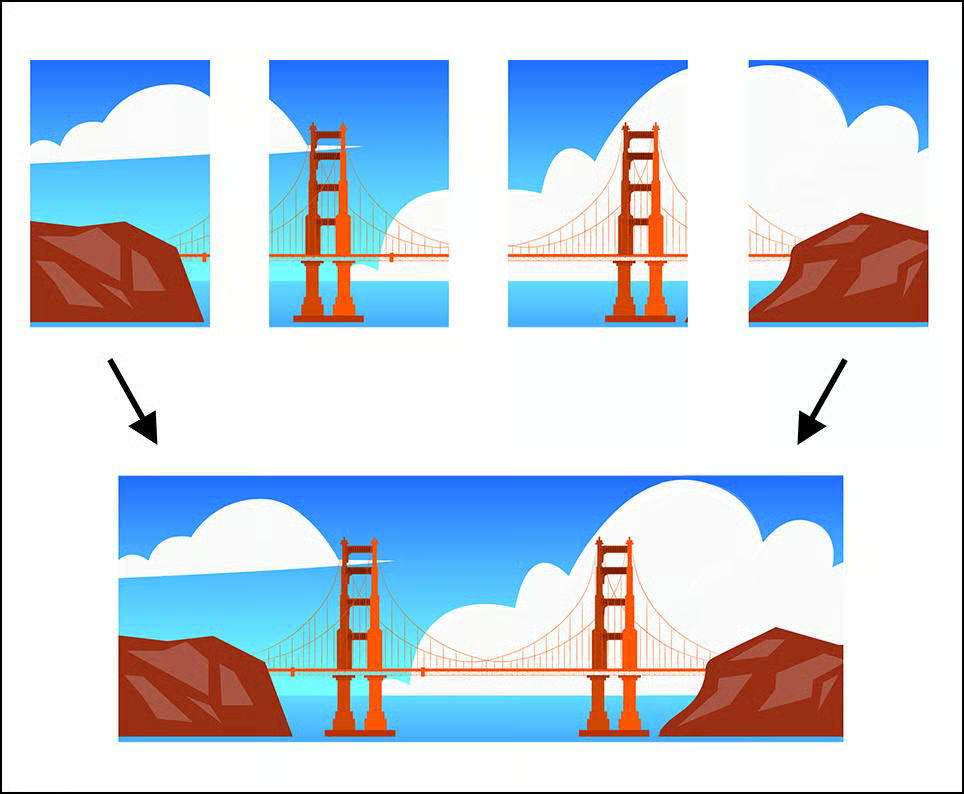
PTGui is the industry workhorse for spherical panoramas; Hugin is a capable open-source alternative. Import your fisheye frames and choose a “Full Frame Fisheye (FF)” lens type at 15mm. Set your control points automatically, then optimize yaw/pitch/roll and lens parameters. Diagonal fisheyes are generally easier to stitch than rectilinear ultrawides because fewer frames and stronger overlap lead to robust control point generation. Target overlap is ~30–35% with fisheye and ~20–25% with rectilinear. Export an equirectangular projection (2:1 aspect) for use in VR viewers or web players.
Want a second opinion on workflow and tool choice? Read this PTGui review to understand why many pros rely on it. PTGui: one of the best tools for creating panoramas
Cleanup & Enhancement
- Nadir patch: export a layered panorama from PTGui and patch the tripod with a clean nadir shot or a logo plate. Many AI tools in Photoshop or dedicated panorama software can speed this up.
- Color and tone: unify color temperature across the entire pano, especially for mixed lighting interiors. Apply gentle noise reduction for high-ISO frames.
- Leveling: set horizon and correct roll/yaw/pitch so verticals are vertical. Small corrections can dramatically improve perceived quality.
- Output: export a high-resolution equirectangular JPEG/TIFF. Common sizes: 8K (7680×3840), 12K (12000×6000), or higher if your stitch supports it. For VR platforms, keep file sizes optimized and adhere to platform limits.
For a solid overview of spherical resolution and coverage planning by focal length, the PanoTools wiki remains a trusted resource. DSLR spherical resolution and coverage
Useful Tools & Resources
Software
- PTGui panorama stitching
- Hugin (open source)
- Adobe Lightroom / Photoshop or Affinity Photo
- AI-based tripod/nadir removal tools
Hardware
- Panoramic heads (Nodal Ninja, Leofoto, Sunwayfoto)
- Carbon fiber tripods with leveling bases
- Wireless remote shutters or intervalometers
- Pole extensions and car mounts with safety tethers
Disclaimer: brand names for search convenience only; verify specs and compatibility on official sites.
Common Mistakes & How to Avoid Them
- Parallax error → Not aligning the entrance pupil. Calibrate and mark rails, especially for close interiors.
- Exposure flicker → Using Auto exposure/WB. Shoot manual and lock white balance throughout.
- Tripod shadows or footprints → Capture a dedicated nadir and patch in post.
- Ghosting from movement → Do a second pass and mask best frames in post.
- Night noise and star trailing → Keep ISO low, use longer exposures on tripod, and disable stabilization.
- IBIS artifacts on tripod → Turn off Pentax SR and Horizon Correction during pano capture.
Real-World Scenarios & Field Advice
Indoor Real Estate
Rooms often have bright windows and mixed lighting. Use f/8 for edge-to-edge sharpness, bracket ±2 EV, and keep WB to a house style (e.g., 4000–4500K for warm LEDs). Watch for close objects like chairs; if your nodal point is slightly off, you’ll see edge mismatches on table legs and doorframes. Take your time aligning the head and do 8-around for extra overlap. On the K-1 II, turn off SR and use the 2s mirror-up timer for tack-sharp frames.
Outdoor Sunset
To maximize dynamic range, expose to protect highlights and bring up shadows later (RAW is essential). The K-1 II at ISO 100–200 with 1/60 to 1/250 at f/8 is a solid starting point. Shoot quickly as the light changes; if time allows, do a second pass 2–3 minutes later for safety and blend the best frames if the sun moved.
Events and Crowds
Use the fisheye’s wide FOV to minimize frames, and work fast. A two-pass method with 6-around often suffices; choose the cleanest frames for each direction during stitching. Consider a slightly faster shutter (1/200–1/400 at ISO 400–800) to freeze motion without changing exposure across frames.
Rooftop / Pole Shooting
Wind is your biggest enemy. Use a short, stiff pole; keep the rig vertical; and avoid long exposures. If the ground is accessible afterward, capture a handheld nadir plate with the same exposure and WB to patch later. Always tether your gear—safety first.
Car-Mounted Capture
Only on secure, rated mounts and at low speed. Lock exposure/WB, take 8-around for extra redundancy, and expect to mask moving objects. Avoid rough roads that induce vibrations; even small shakes can create alignment headaches in stitching.
Frequently Asked Questions
-
Can I use the Sigma 15mm f/1.4 DG DN Fisheye on the Pentax K-1 II directly?
No. The lens is designed for Sony E and L-Mount mirrorless bodies. There is no simple adapter that keeps infinity focus for K-mount. For the K-1 II, use a native K-mount fisheye such as the Sigma 15mm f/2.8 EX DG Fisheye or adapt your workflow to a compatible mirrorless body for the DG DN lens.
-
Is a 15mm diagonal fisheye wide enough for a single-row 360?
Yes. On full frame, a 15mm diagonal fisheye typically needs 6-around + zenith + nadir. For more overlap or tricky interiors, use 8-around. Tilt the row slightly upward (5–10°) to reduce the zenith hole.
-
Do I need HDR for interiors with bright windows?
Usually. Bracketing ±2 EV (3–5 frames) lets you balance bright windows and interior shadows. Keep aperture, focus, WB, and ISO constant and vary shutter only.
-
How do I avoid parallax issues?
Calibrate the entrance pupil on your panoramic head and lock it in with rail markings. Re-check if you change focus distance significantly. Use more overlap (8-around) when objects are very close to the camera.
-
What ISO range is safe on the K-1 II for low light panoramas?
On a tripod, prefer ISO 100–400 and lengthen shutter time. ISO 800–1600 is still clean on the K-1 II, but lower ISO yields better DR and less noise for smooth sky gradients and uniform walls.
-
Can I set up Custom Modes for pano on the K-1 II?
Yes. Save a “Pano” preset with: Manual exposure, fixed WB, RAW, SR OFF, Mirror-Up + 2s timer, and your preferred aperture (e.g., f/8) and ISO (100–200). This speeds up field setup.
-
How can I reduce flare with a fisheye?
Avoid pointing directly at intense light sources; shade the lens with your hand or a flag outside the frame, and shoot a second safety frame if you suspect flare. Clean the front element meticulously—smudges cause halos with ultra-wides.
-
What’s the best tripod head for this setup?
A two-rail panoramic head with precise fore–aft and lateral adjustments (e.g., Nodal Ninja, Leofoto) and a leveling base. Ensure it supports the weight of a DSLR and fisheye comfortably.
Extras: Visual Aids for Your Workflow
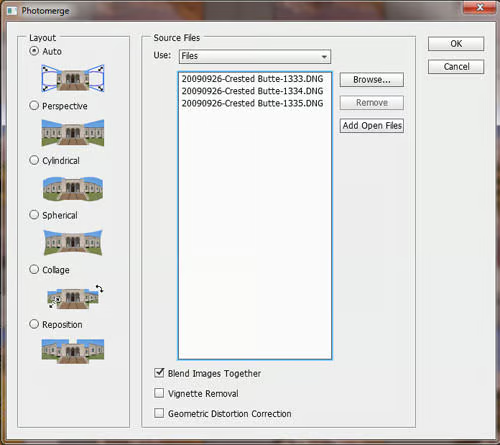
For more structured, step-by-step instruction on high-end pano head setup, this guide is excellent. Set up a panoramic head to shoot perfect high-end 360 photos