
Why This Camera & Lens Are Great for Panoramas
If you’re learning how to shoot panorama with Pentax K-1 II & Samyang 12mm f/2.8 ED AS NCS Fish-Eye, you’ve picked a powerful, field-proven combo. The Pentax K-1 II is a robust full-frame DSLR with a 36.4MP sensor, excellent color, and dependable high-ISO performance. It offers in-body stabilization (SR II), an articulated LCD, built-in GPS for horizon tools, and a rugged weather-sealed body — all benefits when you’re working outdoors, on rooftops, or in mixed conditions.
The Samyang 12mm f/2.8 is a diagonal fisheye designed for full frame. Its ~180° diagonal field of view drastically reduces the number of shots needed for a 360° capture compared to rectilinear lenses. Stopped down to f/5.6–f/8, it’s crisp across the frame, and its full manual focus/aperture design makes it predictable and easy to lock in settings for consistent stitching. Yes, it’s a fisheye — so you’ll see strong curvature — but modern stitchers model fisheye projection accurately, and the reduced shot count is a big win in tight spaces and busy scenes.
Mount compatibility is straightforward: the Samyang is available in K-mount, fits the K-1 II natively, and balances well on a panoramic head. Consider a compact, rigid pano head to keep the center of gravity over the tripod for smooth rotation and less flex.
Quick Setup Overview
- Camera: Pentax K-1 II — Full Frame (36 × 24 mm), 36.4MP, pixel pitch ~4.9 µm, excellent color and about 14 EV dynamic range at base ISO, 5-axis IBIS (turn off on tripod).
- Lens: Samyang 12mm f/2.8 ED AS NCS Fish-Eye — diagonal fisheye, sharp from f/5.6–f/8, moderate chromatic aberration that’s easy to correct in post.
- Estimated shots & overlap:
- Full 360×180: 6 shots around (0° tilt) + 1 zenith + 1 nadir (safe), ~30% overlap.
- Experienced option: 5 around + zenith + nadir; or 4 around + zenith + nadir with higher overlap and careful aim.
- Partial pano (single row): 6–8 shots around for clean coverage.
- Difficulty: Intermediate (fisheye handling is easy, but nodal alignment is critical).
Planning & On-Site Preparation
Evaluate Shooting Environment
Scan for moving subjects (people, cars, trees in wind), reflective surfaces (glass, polished floors), and direct light sources (the sun, lamps). Reflections and specular highlights are more pronounced with fisheyes. If you must shoot through glass, place the front element close to the pane (1–2 cm) and use a rubber lens hood to reduce flare and ghosting. Watch for tripod shadows or your own silhouette when the sun is low.
Match Gear to Scene Goals
The K-1 II’s high resolution and ~14-stop dynamic range at low ISO help with contrasty outdoor scenes and interiors with bright windows. Its usable ISOs up to 1600–3200 keep exposures manageable in low light, though for quality-critical work aim for ISO 100–800. The Samyang 12mm fisheye minimizes shot count — a huge advantage for crowded events or windy rooftops. The trade-off is fisheye distortion, which stitchers handle well but requires accurate lens modeling in software.
Pre-shoot Checklist
- Power and storage: One full battery covers many brackets, but spares are cheap insurance. Format a fast SD card.
- Cleanliness: Dust on a fisheye is obvious. Clean front/rear elements and check the sensor.
- Tripod leveling: Use a leveling base or the K-1 II’s electronic level. Calibrate your panoramic head beforehand.
- Safety checks: On rooftops and poles, tether the camera, watch wind gusts, and avoid overextending center columns.
- Backup workflow: Shoot an extra safety round, especially if crowds or light change during the set.
Essential Gear & Setup
Core Gear
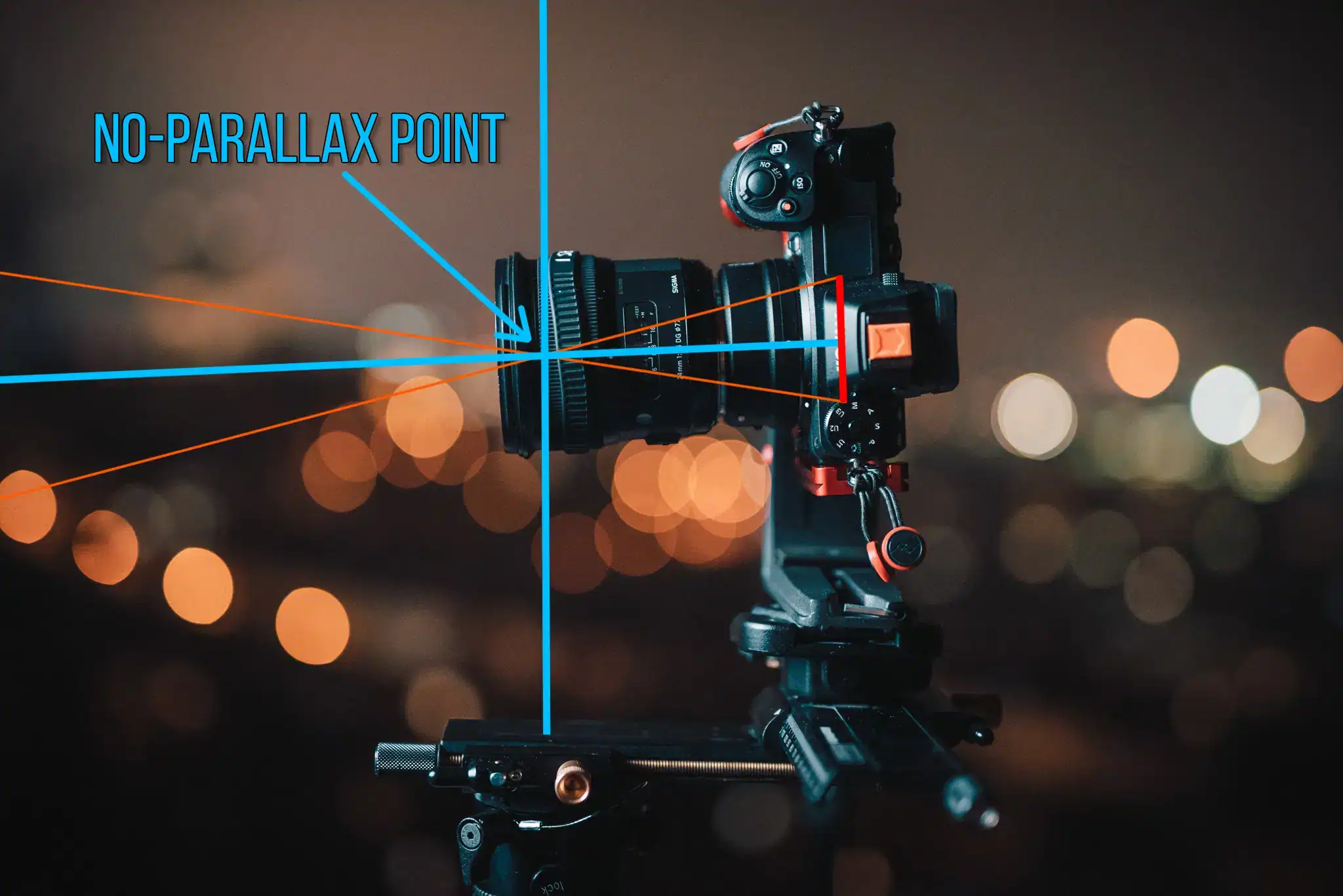
- Panoramic head: Align the lens’ entrance pupil (often called nodal point) over the rotation axis to eliminate parallax. With the Samyang 12mm, your entrance pupil will typically sit roughly 60–70 mm forward of the camera’s sensor plane — calibrate it precisely on your head and mark the rails.
- Stable tripod with leveling base: Leveling speeds up rotation steps and keeps horizons flat.
- Remote trigger/app: Use a cable release, 2-second timer, or Pentax remote app to prevent vibration. Mirror Lock-Up or Live View further reduces shake.
Optional Add-ons
- Pole or car mount: Use a rigid carbon pole with a safety tether; avoid high winds. For cars, use quality suction mounts and a safety strap, and keep speeds low.
- Lighting aids: Small LED panels or bounced flash can lift deep interior shadows (avoid mixed color temperatures if possible).
- Weather protection: Rain covers, silica gel, and a lens hood/flag to manage flare and drizzle.
Step-by-Step Shooting Guide
Standard Static Scenes
- Level and nodal alignment:
- Level the tripod using a leveling base or the K-1 II’s electronic level.
- Calibrate the entrance pupil: Place two vertical targets at different distances. Rotate the camera on the pano head — if their relative position shifts, adjust the fore-aft rail until there’s no shift. Mark the Samyang 12mm’s position on your rails for fast repeats.
- Manual exposure and WB:
- Switch to M mode. Meter the brightest frame that still needs detail (often toward a window or the sun) and set your exposure so highlights aren’t clipped.
- Set a fixed white balance (Daylight outside, Tungsten/Custom indoors). Consistency is key for stitching.
- Focus and capture:
- Turn SR (IBIS) OFF on the K-1 II when on a tripod. Disable horizon correction (it uses SR to tilt the sensor).
- Manual focus to hyperfocal: at 12mm and f/8, hyperfocal is roughly 0.6–0.8 m; set focus just above 0.7 m for front-to-infinity sharpness.
- Capture 6 shots around at 60° yaw increments with ~30% overlap. If you’re comfortable, 5 around can work; 4 around is feasible with careful aim and generous overlap, but stitch margin is tighter.
- Take a zenith shot (tilt up ~90°) and a nadir shot (tilt down ~90°). For the nadir, you can offset the camera slightly or shoot a handheld plate at the same nodal position and patch later.
- Nadir cleanup:
- After the main set, remove the tripod and quickly shoot a downward frame from the same nodal point (handheld overhead, body out of frame). This simplifies tripod removal in post.
HDR / High Dynamic Range Interiors
- Bracket exposure: Use ±2 EV (3 frames) as a starting point; for very bright windows, use 5–7 frames at 1 EV steps.
- Lock WB and focus: Keep both fixed for the entire bracket and rotation.
- Use a remote and 2-second delay: Avoid touching the camera during brackets to prevent micro-shake.
Low-Light / Night Scenes
- Use a sturdy tripod and long exposures: f/4–f/5.6 with shutter 1–8 seconds at ISO 100–400 is ideal if there’s no wind. If wind is a problem, raise ISO to 800–1600 to keep shutter near 1/2–1 second.
- Mirror Lock-Up or Live View helps; SR OFF. The K-1 II is clean up to ISO 1600, workable at 3200 with careful noise reduction.
Crowded Events
- Shoot two passes: One fast pass to capture the scene, then a second pass waiting for gaps to clean up ghosting.
- Use higher shutter speeds (1/200s+) and ISO 800–1600 to freeze motion if you want crisp people. Alternatively, embrace motion blur creatively.
Special Setups (Pole / Car / Drone)
- Pole: Keep total weight low; tether the rig; rotate more slowly to reduce oscillation. Use faster shutter (1/250–1/500) by raising ISO.
- Car-mount: Use quality suction mounts on clean glass/metal, plus a safety line. Avoid highways; park safely for shooting. Vibrations demand faster shutter speeds.
Recommended Settings & Pro Tips
Exposure & Focus
| Scenario | Aperture | Shutter | ISO | Notes |
|---|---|---|---|---|
| Daylight outdoor | f/8–f/11 | 1/100–1/250 | 100–200 | Lock WB (Daylight), SR OFF |
| Low light/night | f/4–f/5.6 | 1/2–1s (tripod) or 1/30–1/60 (wind) | 400–1600 | Use remote; consider 2s timer |
| Interior HDR | f/8 | Bracket ±2 EV (3–5 frames) | 100–400 | Fix WB; avoid flicker |
| Action / moving subjects | f/5.6–f/8 | 1/200+ | 400–800 | Double pass; mask in post |
Critical Tips
- Manual focus at hyperfocal: With 12mm at f/8, set around 0.7 m for sharpness from front to infinity.
- Nodal calibration: Expect the entrance pupil roughly 60–70 mm forward of the sensor plane with this lens; fine-tune with the two-stick method and mark your rails.
- White balance lock: Prevents odd seams when light sources vary around the scene.
- RAW over JPEG: RAW gives the dynamic range and color flexibility needed for HDR blends and consistent color mapping.
- Disable stabilization on tripod: Turn SR (IBIS) OFF and avoid horizon-correction during capture to prevent micro-shifts.
- Consider not using Pixel Shift for multi-shot panos: It lengthens each shot and can introduce alignment issues if anything moves between sub-frames.
Stitching & Post-Processing
Software Workflow
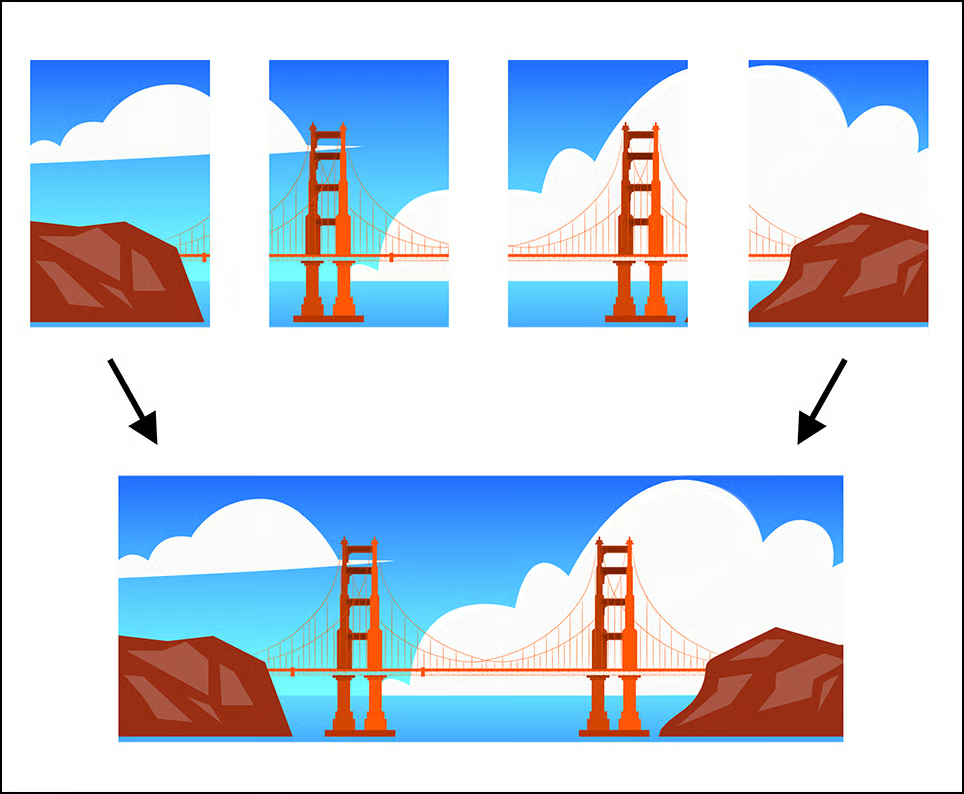
Import your images into your stitcher of choice. For fisheye lenses, PTGui and Hugin handle fisheye projection natively. In PTGui, set Lens Type to “Full-frame fisheye,” focal length 12mm, and let the optimizer refine lens parameters. For the K-1 II + Samyang 12mm, 25–35% overlap is generally sufficient; aim for 30% when in doubt. Expect fewer shots and easier control point distribution compared to rectilinear lenses. If you captured HDR brackets, either pre-merge to HDR per angle or use PTGui’s HDR mode before global optimization. For pano best practices on heads and alignment, see this panoramic head tutorial for a deeper dive. Panoramic head setup basics
Cleanup & Enhancement
- Tripod/nadir patch: Use viewpoint correction on a handheld nadir shot or clone/heal in Photoshop. Specialized AI tools can speed this up.
- Color and noise: Match white balance across frames, then apply gentle noise reduction to night shots (luminance NR first, then color NR).
- Leveling: Use the stitcher’s horizon tool. Correct yaw/pitch/roll so the image feels balanced in VR viewers.
- Export: For virtual tours, export equirectangular 2:1 at 12000×6000 or higher if your stitch supports it. The K-1 II set typically yields excellent detail in the 10–16k range depending on overlap and bracket count.
PTGui remains a top choice for reliability and speed; here’s a practical review if you’re comparing options. Why PTGui is a trusted panorama tool
Useful Tools & Resources
Software
- PTGui panorama stitching
- Hugin (open source)
- Lightroom / Photoshop for RAW, retouching, and nadir patch
- AI tripod removal or content-aware fill for fast cleanup
Hardware
- Panoramic heads: Nodal Ninja, Leofoto, Bushman, or Sunwayfoto
- Carbon fiber tripods and leveling bases
- Wireless remote shutters (or use 2-second timer)
- Pole extensions or car mounts with safety tethers
Disclaimer: brand names are for research reference only — verify compatibility for K-mount and your workflow. For a broader DSLR pano overview, this guide from Meta’s Creator portal is a helpful read. Using a DSLR to shoot and stitch a 360 photo
Video: Panorama Shooting & Stitching Fundamentals
For more DSLR virtual tour pointers (camera and lens considerations), this FAQ offers concise, practical answers. DSLR virtual tour camera & lens FAQ
Common Mistakes & How to Avoid Them
- Parallax error → Always align the entrance pupil. Even a fisheye will ghost near objects if the nodal point is off.
- Exposure flicker → Use Manual exposure and fixed WB. Avoid auto ISO/TAv for multi-shot panos.
- Tripod shadows/legs → Mind sun angle; shoot and patch a nadir plate.
- Ghosting from movement → Double-pass shooting and mask in post; time shots between moving subjects.
- Excessive noise at night → Keep ISO at 100–800 when possible; use longer shutter on a stable tripod; apply moderate NR in post.
- Leaving IBIS ON on tripod → Turn SR OFF to prevent micro-blur and alignment drift.
Field-Proven Scenarios with the K-1 II + 12mm Fisheye
Indoor Real Estate
Use 6 around + zenith + nadir. Bracket ±2 EV (3–5 frames) for windows and mix of tungsten/daylight. Set WB to a custom value (measure off a gray card). Keep tripod legs narrow to reduce footprint in mirrors or glass. The K-1 II’s clean base ISO helps preserve shadow detail when lifting in post.
Outdoor Sunset Viewpoint
Meter for the sky just below the sun to protect highlights. If dynamic range is extreme, bracket 3–5 frames. Flare is more likely with a fisheye: shield the front element with your hand or flag between shots, keeping the flag out of frame. Consider two quick rotations: one before the sun dips, one just after, to choose the cleanest sky in post.
Event Crowds
Fewer shots is gold. The Samyang’s coverage lets you capture a full sphere in a minute or less. Use 1/200s or faster and ISO 800–1600. Expect to do minor masking where people overlap between frames. If a group gathers behind you, step aside, then shoot a second pass for cleaner background plates.
Rooftop or Pole Work
Wind management matters. Keep the setup compact, lower the center column, and rotate slowly. On poles, use faster shutter (1/250–1/500) and slightly higher ISO. Always tether your camera and keep clear of edges. The K-1 II’s robust build handles the elements, but don’t rely on weather sealing for heavy rain — use a cover.
Car-Mounted Capture
Park safely and shoot stationary. If you must shoot with the engine on, expect vibration: increase shutter speed and take several frames per angle to pick the sharpest. Suction mounts require clean surfaces and a safety strap. Double-check that the nodal point remains close to the rotation axis; small car vibrations can flex cheap heads.
Frequently Asked Questions
- Can I shoot handheld panoramas with the Pentax K-1 II?
Yes, for quick single-row panos in good light. Use high shutter speeds (1/250s+), lock exposure/WB, and overlap 40–50%. For full 360×180 with clean nadir/zenith, a tripod and pano head are strongly recommended.
- Is the Samyang 12mm f/2.8 wide enough for a single-row 360?
Usually you’ll want 6 around plus zenith and nadir for a complete sphere. Some shooters manage 4–5 around with careful overlap, but coverage at the poles becomes tight; a dedicated zenith and nadir frame is the safer route.
- Do I need HDR for interiors with bright windows?
Often yes. Bracket ±2 EV (3–5 frames) to retain window detail and avoid noisy shadows. The K-1 II has solid DR, but HDR gives you cleaner, more consistent results for real estate and architectural work.
- How do I avoid parallax issues with this combo?
Calibrate the entrance pupil on your panoramic head. Expect the Samyang’s entrance pupil roughly 60–70 mm forward of the sensor plane, then fine-tune using the two-target method and mark your rails for repeatability.
- What ISO range is safe on the K-1 II in low light?
ISO 100–800 is optimal; 1600 is typically clean with modest NR; 3200 is workable for events; 6400 is last-resort. On a tripod, prefer longer shutter over high ISO when scenes are static and wind is calm.
- Can I set custom modes for pano?
Absolutely. Save a Custom mode with Manual exposure, fixed WB, SR OFF, mirror lock-up or 2s timer, and RAW. This speeds setup on location and ensures consistency between shoots.
- How do I reduce flare with a fisheye?
Avoid direct bright sources near the edge of the frame, use your hand or a flag just out of frame, and clean the front element. Slightly re-aim shots if a persistent ghost appears across frames.
- What panoramic head works best for this setup?
Any solid, two-rail head that precisely positions the entrance pupil will work (Nodal Ninja, Leofoto, Bushman). Ensure it can handle the K-1 II’s weight and allows quick, repeatable rail markings for the 12mm Samyang.
Safety, Limitations & Trust Tips
The K-1 II is sturdy, but it’s still vulnerable to drops and weather. Use a strap or tether on rooftops and poles, avoid overextending center columns, and weigh down your tripod in wind. Disable IBIS (SR) and horizon correction on a tripod to prevent micro-movements that hurt stitching. Expect some chromatic aberration and flare with the 12mm fisheye — both manageable in post. Keep a disciplined backup: duplicate to two drives after each shoot. For more principles on perfect pano head setup and capture flow, this step-by-step resource is concise and practical. Set up a panoramic head for high‑end 360 photos