
Why This Camera & Lens Are Great for Panoramas
The Pentax K-1 II paired with a diagonal fisheye like the 7Artisans 10mm f/2.8 II is a powerful, cost‑effective combo for building high‑quality 360° and ultra‑wide panoramas. The K-1 II’s 36.4MP full‑frame sensor (35.9×24mm; pixel pitch ~4.9µm) captures excellent detail and color, with robust dynamic range near base ISO and in-body stabilization for handholding between frames when needed. Its rugged, weather‑sealed body is a genuine asset for outdoor panoramas and rooftop work. For panoramas, the K-1 II also offers precise live-view magnification and focus peaking—helpful for nailing manual focus on a fisheye lens.
The 7Artisans 10mm f/2.8 II is a manual-focus diagonal fisheye delivering a ~180° diagonal field of view on full frame. The big advantage of a full‑frame fisheye for 360 photography is efficiency: you can cover the sphere with far fewer shots than a rectilinear ultra‑wide, reducing stitch seams and shooting time—especially critical for interiors, crowds, or windy pole work. Expect some edge softness wide open and noticeable lateral CA at the outer field; stopping to f/5.6–f/8 tightens performance and makes stitching easier.
Mount note: The 7Artisans 10mm f/2.8 II is commonly sold for mirrorless mounts (Sony E, Nikon Z, RF, L). If you’re using a Pentax K-1 II (K-mount DSLR), ensure you have a K‑mount–compatible version or a professionally converted copy. If not, consider a similar diagonal fisheye available for K‑mount (e.g., Samyang/Rokinon 12mm f/2.8 Fisheye). The pano techniques below remain the same for any full‑frame diagonal fisheye in the 10–12mm range.
Quick Setup Overview
- Camera: Pentax K-1 II — Full Frame 36.4MP sensor; excellent color, weather sealing, strong DR near ISO 100–200; IBIS (turn off on tripod).
- Lens: 7Artisans 10mm f/2.8 II Fish-Eye — diagonal fisheye, manual focus, best stopped to f/5.6–f/8; expect edge CA that’s fixable in post.
- Estimated shots & overlap:
- Single-row 360 (safer): 6 around at 60° increments with 30–35% overlap + 1 zenith + 1 nadir (total ~8).
- Speed run outdoors: 4 around at 90° with careful tilt and a dedicated nadir; only if you’re experienced and accept tighter coverage.
- HDR interiors: bracket each viewpoint (3–5 exposures at ±2 EV).
- Difficulty: Easy–Intermediate (manual focus + nodal alignment required).
Planning & On-Site Preparation
Evaluate Shooting Environment
Before you set up, read the light. For interiors with bright windows, you’ll likely need HDR bracketing to capture the full dynamic range. In glass or chrome-heavy spaces (showrooms, kitchens), reflections and parallax are your worst enemies—keep your camera centered, approach glass perpendicular when possible, and step back if you’re too close to reflective surfaces. Outdoors at sunset, expect fast‑changing light; lock exposure and white balance to avoid stitch seams. When shooting through glass, press a rubber lens hood or cloth against the surface to minimize flare and ghosting, and keep at least 30–50cm away from the pane if you cannot eliminate reflections.
Match Gear to Scene Goals
The Pentax K-1 II’s full‑frame sensor offers very good shadow latitude at base ISO—perfect for real estate and landscape panoramas. Usable “clean” ISO is typically 100–800; 1600 is workable; 3200 if necessary with solid noise reduction in post. The 10mm fisheye reduces shot count, which is excellent for:
- Real estate interiors where you want to minimize people movement and time on site.
- Outdoor golden hour scenes where the sun moves quickly and exposure changes every minute.
- Crowded places and events, where speed reduces ghosting.
Trade-off: fisheyes introduce heavy distortion that must be handled by the stitcher. Keep consistent overlap and precise nodal alignment to avoid stitching artifacts.
Pre-shoot Checklist
- Batteries charged and a spare; dual cards set to backup or sequential. Shoot RAW (DNG/PEF) for max DR.
- Clean lens front element; check for sensor dust—fisheyes make dust specks obvious in sky areas.
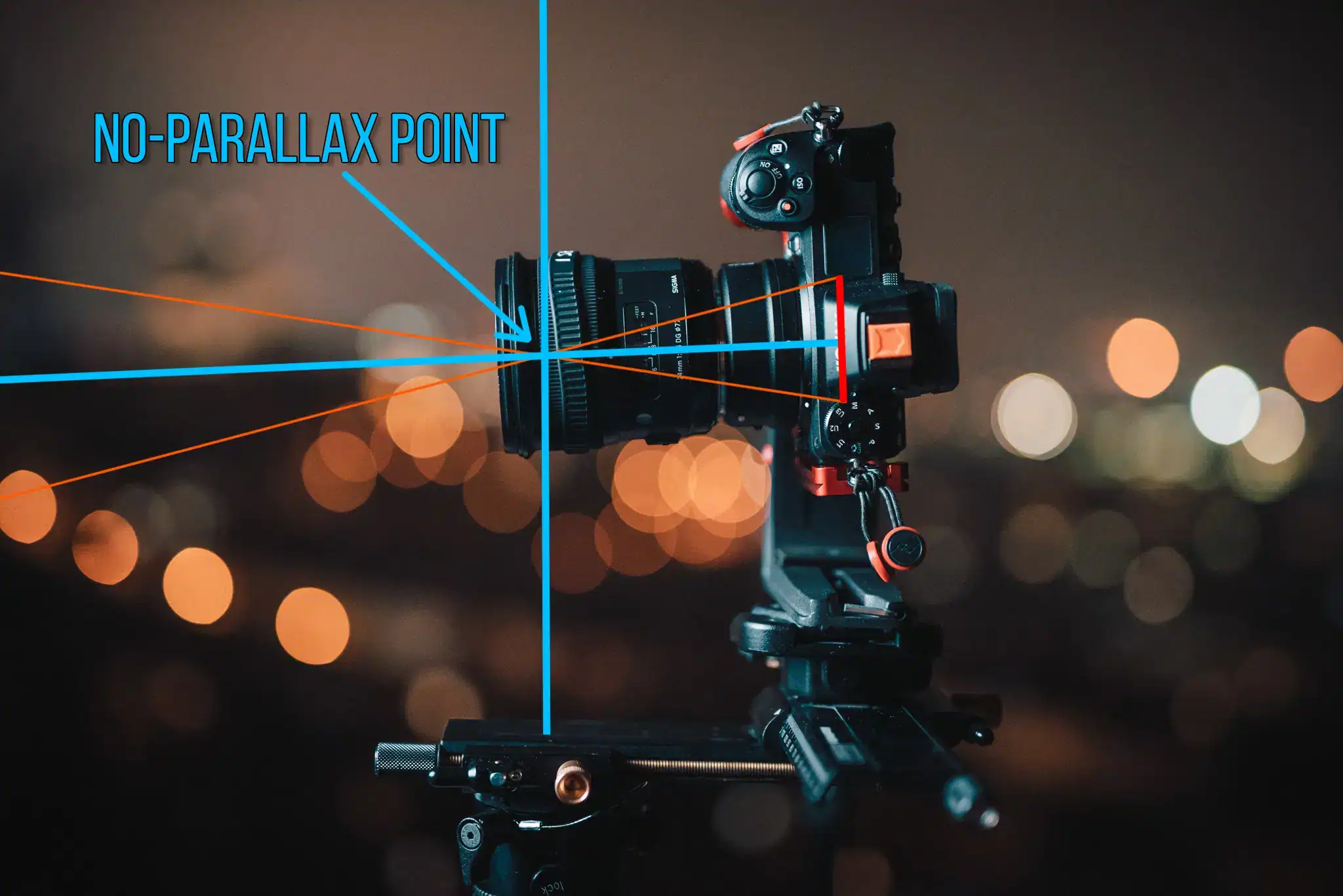
- Tripod leveled; pano head calibrated to the lens’s entrance pupil (no‑parallax point).
- Safety: On rooftops or near traffic, tether the camera to the tripod or harness; avoid wind gusts; never extend a pole near power lines.
- Backup workflow: After the first full rotation, do a second safety pass in case of people movement or stitching gaps.
Essential Gear & Setup
Core Gear
- Panoramic head: A rotator and rail system lets you align the lens on its entrance pupil to eliminate parallax when rotating. This is critical for clean stitches with foreground detail.
- Stable tripod with leveling base: Leveling the base ensures your rotation is perfectly horizontal. A levelling half‑bowl or base saves time over leg fiddling.
- Remote trigger or 2s timer: On a DSLR like the K-1 II, use mirror lock‑up or live view to avoid mirror slap; a remote prevents vibrations.
Optional Add-ons
- Carbon pole or car mount: For elevated panoramas, ensure a rigid setup and safety tether. Avoid high winds; even small vibrations degrade sharpness.
- LED panels for interiors: Subtle fill improves HDR consistency and reduces noise in dark corners.
- Weather gear: Rain cover, lens cloths, silica gel. The K-1 II is weather‑sealed, but your pano head and remote might not be.
Step-by-Step Shooting Guide
Standard Static Scenes
- Level and align: Level the tripod via the leveling base. Mount the pano head and set the lens on the rail so the rotation axis passes through the lens’s entrance pupil. Validate alignment by placing a light stand or pole close to the lens and a distant object in the background—pan left/right; if they “slide” relative to each other, refine the rail position.
- Lock exposure and white balance: Set Manual exposure (start around f/8, ISO 100–200, shutter for proper midtone exposure). Set a fixed WB (e.g., Daylight for sun; Tungsten/Custom for interiors). Disable auto ISO.
- Focus: Use live-view magnification and focus peaking. For a fisheye, set manual focus near hyperfocal distance at your chosen aperture. Re-check after temperature changes or if the focus ring is bumped.
- Capture sequence: For 10mm diagonal fisheye, shoot 6 frames around at 60° increments with 30–35% overlap. Then shoot one zenith (pitch up) and one nadir (pitch down or remove the tripod and shoot handheld for tripod removal).
- Nadir shot for patching: After the main set, shift the tripod slightly, aim at the footprint area, and capture a clean floor patch to replace the tripod in post.
- Metadata consistency: Keep the focal length set correctly (10mm) and note “Full-Frame Fisheye” in your project files for quicker PTGui setup later.
HDR / High Dynamic Range Interiors
- Bracketing: Use 3–5 exposures at ±2 EV around your base exposure to balance windows, lamps, and deep shadows. The K-1 II handles ±2 EV bracketing well.
- Workflow: Shoot the full rotation at exposure A, then B, then C (and so on) to reduce stitch inconsistencies from moving subjects. Keep WB locked.
- Stabilization: Turn off SR (IBIS) on the K-1 II when on a tripod to avoid micro-shift between brackets.
- Mirror slap: Use 2s timer with mirror lock‑up or live view to minimize vibration during long exposures.
Low-Light / Night Scenes
- Exposure: Start at f/4–f/5.6, ISO 100–400, then lengthen shutter to 1–8s as needed. The K‑1 II is usable at ISO 800–1600, but keep it lower if you can.
- Noise: Shoot RAW; apply moderate luminance NR in post and consider multi-frame blending if the scene allows reruns.
- Stability: Use a sandbag on the tripod and disable IBIS. Wind gusts cause stitch seam blur—wait out the gusts.
Crowded Events
- Two-pass strategy: Do a quick first pass for coverage; then a second pass to capture clean areas when people move. Blend in post via masking.
- Shorter shutter: Use 1/200s–1/320s and ISO 400–800 at f/5.6–f/8 to freeze motion where possible.
- Keep overlaps generous (35%): Helps the stitcher reconcile moving elements.
Special Setups (Pole / Car / Drone)
- Pole: Use a lightweight rotator and keep the pole vertical. Secure a safety line. Limit exposure times to <1/60s where possible to reduce sway blur; raise ISO to compensate.
- Car-mounted: Use high shutter speeds (1/250s+) and shoot in sheltered locations to minimize vibration. Avoid traffic and obey local laws.
- Drone note: The K‑1 II is too heavy for common drones; if you need aerial, plan a dedicated drone workflow instead.
Recommended Settings & Pro Tips
Exposure & Focus
| Scenario | Aperture | Shutter | ISO | Notes |
|---|---|---|---|---|
| Daylight outdoor | f/8–f/11 | 1/100–1/250 | 100–200 | Lock WB (Daylight ~5200K) |
| Low light/night | f/4–f/5.6 | 1/30–1/60 (tripod: 1–8s) | 200–800 | Use live view + 2s timer; IBIS off on tripod |
| Interior HDR | f/8 | Bracket ±2 EV | 100–400 | Three to five brackets per view |
| Action / moving subjects | f/5.6–f/8 | 1/200+ | 400–800 | Two-pass capture for clean masks |
Critical Tips
- Manual focus at hyperfocal: At 10mm and f/8 on full frame, set focus a little before infinity; verify via live-view magnification. Disable focus peaking after confirming focus to reduce distractions.
- Nodal calibration: Mark your pano rail with a paint pen once you’ve found the entrance pupil for this lens. Re-check if you add filters or change the mount plate.
- White balance lock: Mixed lighting (tungsten + daylight) can cause visible seams. Set a custom Kelvin or use a gray card shot and sync in the RAW converter.
- RAW over JPEG: The K-1 II’s DNG gives you more latitude for highlight recovery and noise control—essential for HDR and night panoramas.
- IBIS and mirror: Turn off SR (IBIS) and use mirror lock‑up or live view on a tripod to avoid sub‑pixel shifts that complicate stitching.
- Pixel Shift: Leave it off for panoramas—movement between frames and sub‑pixel registration can cause misalignments between tiles.
- GPS: If enabled for geo‑tagging, be aware it marginally increases power draw; carry spare batteries for long sessions.
Stitching & Post-Processing
Software Workflow
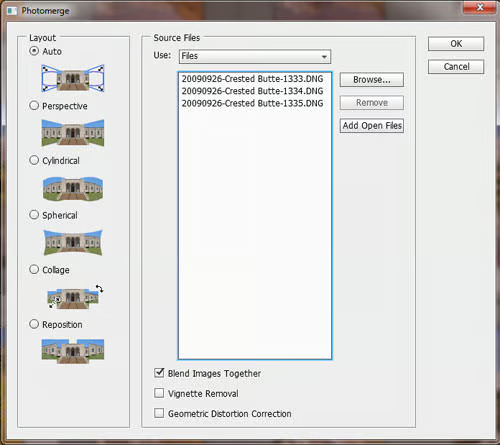
Fisheye panoramas stitch very well in PTGui, Hugin, and other modern tools. In PTGui, set Lens Type to Full‑Frame Fisheye, focal length 10mm, crop factor 1.0. Add the images for each viewpoint (or pre‑merge HDR brackets to EXR). Run control points, then Optimize. For consistent results, maintain ~30% overlap with a fisheye. Rectilinear lenses require more tiles (20–50% overlap), but fisheyes strike a sweet balance between speed and quality. If you’re new to pano heads, review a concise panoramic head setup tutorial to grasp no‑parallax alignment. Panoramic head basics on 360 Rumors
PTGui is a mature, industry‑standard stitcher known for robust fisheye support, mask-based deghosting, and nadir patching tools. For a second opinion and more examples of its strengths with challenging scenes, see this in‑depth review. Why PTGui excels at complex panoramas
Cleanup & Enhancement
- Nadir patch: Export a layered panorama and replace the tripod area with your clean nadir shot using masks and Clone/Heal. Some AI tools can accelerate this step.
- Color consistency: Sync white balance and camera profiles across tiles in Lightroom or Capture One before stitching. Correct any corner CA or vignetting.
- Noise reduction: For low-light sets, use moderate NR and retain detail; denoise luminance first, then color.
- Leveling: In PTGui’s panorama editor, set the horizon and verticals straight. Fine-tune yaw/pitch/roll until lines look natural.
- Export: For VR players, output equirectangular 2:1 (e.g., 12,000×6,000 px JPEG or 16-bit TIFF/EXR for high-end workflows).
If you’re delivering for VR or virtual tours, Oculus provides clear guidance on DSLR 360 capture and stitching considerations. DSLR/mirrorless 360 capture recommendations
Disclaimer: Software evolves—verify the latest documentation for your version of PTGui, Hugin, or other tools.
Useful Tools & Resources
Software
- PTGui panorama stitching
- Hugin (open-source alternative)
- Lightroom / Photoshop for RAW prep and retouching
- AI tripod removal and content-aware fill tools
Hardware
- Panoramic heads: Nodal Ninja, Leofoto, Sunwayfoto
- Carbon fiber tripods with leveling bases
- Wireless remote shutters or intervalometers
- Pole extensions and car mounts with safety cords
Disclaimer: product names are suggestions for research. Check official sites for compatibility, mounts, and current models.
Prefer a visual walkthrough? This video covers practical capture techniques that apply directly to fisheye-based spherical panoramas.
Common Mistakes & How to Avoid Them
- Parallax error: Not aligning the entrance pupil causes stitching seams near foreground objects. Calibrate your pano head and keep the camera level.
- Exposure flicker: Auto modes change per frame. Use full Manual exposure and locked WB.
- Tripod shadows or missing nadir: Always take a dedicated nadir shot for clean floor patching.
- Motion ghosting: For people and trees, shoot a second pass and mask the clean frames in post.
- High ISO noise: On the K-1 II, stay at ISO 100–800 when possible; use a tripod and longer shutter instead of pushing ISO.
- IBIS left on: Sensor shift can misalign tiles. Disable SR for tripod work.
- Insufficient overlap: With a fisheye, aim for ~30% overlap to give the stitcher enough matching features.
For a deeper dive into classic panorama pitfalls and solutions, this community Q&A compiles excellent field-tested advice. Techniques to shoot 360 panoramas
Frequently Asked Questions
-
Can I shoot handheld panoramas with the Pentax K-1 II?
Yes, for quick multi-image ultrawides outdoors. Use IBIS on, a fast shutter (1/250s+), and keep the camera rotated around your body as consistently as possible. However, for full 360×180 with foreground elements, a pano head on a tripod is strongly recommended to avoid parallax.
-
Is the 7Artisans 10mm f/2.8 II wide enough for a single-row 360?
Yes, on full frame it’s a diagonal fisheye. Plan for about 6 shots around with 30–35% overlap plus zenith and nadir. Experienced users sometimes get by with 4 around outdoors, but coverage at the poles becomes tight.
-
Do I need HDR for interiors with bright windows?
Usually. The K-1 II has strong base ISO DR, but window-to-room contrast can exceed 14 EV. Bracket ±2 EV (3–5 exposures) for each view to capture clean window detail and low-noise shadows.
-
How do I avoid parallax issues with this lens?
Mount the camera on a pano head and slide the lens on the rail until near/far objects don’t shift relative to each other during rotation. Mark that rail position. Keep the tripod perfectly level and avoid shifting the tripod between frames.
-
What ISO range is safe on the K-1 II in low light?
For critical work, ISO 100–800 is “clean.” ISO 1600 is usable with careful noise reduction; 3200 only when needed. Prefer longer shutter times on a tripod with IBIS off.
-
Can I set up Custom Modes for panorama on the K-1 II?
Yes. Save a Panorama preset (Manual, fixed WB, IBIS off, 2s timer with mirror lock‑up, RAW, focus peaking on). Create a second HDR preset with bracketing enabled. This speeds on-site work.
-
How do I reduce flare with a fisheye?
Keep the sun just out of frame when possible, shade the front element with your hand or a flag, and clean the glass meticulously. Slightly reposition the camera if a strong flare lands across stitch seams.
-
Which tripod head is best for this setup?
A compact panoramic head with a vertical rail and rotator—e.g., Nodal Ninja or Leofoto models—works well. Ensure it supports the K-1 II’s weight and allows precise fore–aft adjustment for entrance pupil alignment.
Want an end-to-end view on DSLR/mirrorless 360 capture standards? Oculus’s guide covers planning, capture, and delivery considerations for spherical content. Set up a panoramic head for high‑end 360 photos
Field-Proven Scenarios
Indoor Real Estate (Bright Windows)
Use tripod + pano head, f/8, ISO 100, and 5 brackets at ±2 EV. Six around + zenith + nadir. Turn off all auto features (auto ISO/WB). Keep the camera away from mirrors, and shoot a clean nadir after moving the tripod.
Outdoor Sunset
Time is tight—exposure can shift a full stop between passes. Lock WB at Daylight, shoot 6 around quickly, then go back for a second pass if needed. If the sun is in-frame, accept a flare in one image and plan to blend from an adjacent pass.
Event with People Flow
Go for 1/250s+, f/5.6–f/8, ISO 400–800. Shoot two rotations and mask in post, prioritizing frames where main subjects look best. Keep your tripod footprint minimal and your rotation smooth.
Rooftop on a Breezy Day (Pole)
Keep exposures at 1/60s or faster; raise ISO if necessary. Take three quick rotations and pick the sharpest frames per yaw angle. Always use a safety tether, and never extend near power lines.
Resolution Planning and FOV Notes
Diagonal fisheye lenses at 10–12mm on full frame yield excellent coverage for high‑quality 360s with relatively few shots. For deeper math on spherical resolution with DSLRs and lens FOV, see this classic reference. Panotools: DSLR spherical resolution