Why This Camera & Lens Are Great for Panoramas
This guide shows you exactly how to shoot panorama with Olympus OM-1 & Tamron 17-28mm f/2.8 Di III RXD, focusing on reliable, field-tested techniques that work for 360 photos and high-resolution panoramas. Before we dive in, an important compatibility note: the Tamron 17-28mm f/2.8 Di III RXD is a Sony E-mount, full-frame rectilinear ultra-wide zoom and is not natively mountable on the Micro Four Thirds (MFT) Olympus OM-1. There is no standard passive adapter for E-to-MFT because of flange distance constraints. If you don’t have a specialty optical adapter (rare), use a comparable rectilinear MFT ultra-wide, such as the OM System M.Zuiko Digital ED 8–25mm f/4 PRO (16–50mm FF equivalent) or M.Zuiko 7–14mm f/2.8 PRO. This tutorial still applies 1:1 because the core technique depends on angle of view and overlap, not the mount.
Why the combo concept works: the OM-1’s 20.4MP stacked BSI Micro Four Thirds sensor (approx. 17.3 × 13.0 mm; ~3.3 µm pixel pitch) delivers excellent detail, strong noise performance for its size, and outstanding in-body image stabilization (IBIS) for handheld and pole work. At base ISO (native ISO 200; “Low” ISO is extended), dynamic range is around the 12 EV class in practical shooting, which is plenty for outdoor panos and good for HDR interiors. The Tamron 17–28mm f/2.8 (or an MFT equivalent focal length) gives you a crisp, rectilinear field of view with low distortion and internal zoom, which keeps the balance stable on a panoramic head.
In short: the OM-1 is a compact, rugged, weather-sealed body with superb ergonomics and dependable AF/manual controls; the 17–28mm-class rectilinear zoom is a proven workhorse for multi-row spherical panos where you want high resolution and minimal fisheye distortion. If you need fewer shots and faster capture, a fisheye is better; if you want cleaner straight lines (architecture/real estate), rectilinear is the right choice.
Quick Setup Overview
- Camera: Olympus OM-1 — Micro Four Thirds, 20.4MP stacked BSI sensor (~3.3 µm pixel pitch), robust weather sealing, excellent IBIS (turn off on tripod).
- Lens: Tamron 17-28mm f/2.8 Di III RXD — rectilinear ultra-wide (Sony E-mount). Sharp center-to-corner stopped down, controlled CA, internal zoom; for OM-1, use an MFT rectilinear ultra-wide with similar angles of view (e.g., 8–9 mm for ~17–18 mm FF equiv.).
- Estimated shots & overlap (rectilinear, 30% overlap, spherical pano):
- At 17mm FF (≈8–9 mm MFT): two rows of 8 around (+30° and −30°) + 1 zenith + 1–3 nadir = 18–20 shots total.
- At 20mm FF (≈10 mm MFT): two rows of 10 around + Z + N = 22–24 shots.
- At 28mm FF (≈14 mm MFT): two rows of 12 around + Z + N = 26–28 shots.
- Difficulty: Intermediate (rectilinear multi-row requires good nodal alignment and consistent exposure).
Planning & On-Site Preparation
Evaluate Shooting Environment
Scan the scene for moving elements (people, leaves, traffic), reflective surfaces (glass, polished floors), and light extremes (bright windows vs deep shadows). If shooting through glass, press the lens hood gently against it to minimize reflections and keep the lens as perpendicular as possible. Step back from glass by a few centimeters if you see ghosting; angle slightly to keep your body reflection out. Outdoors, note wind direction for tripod stability and avoid direct sun striking the front element to reduce flare.
Match Gear to Scene Goals
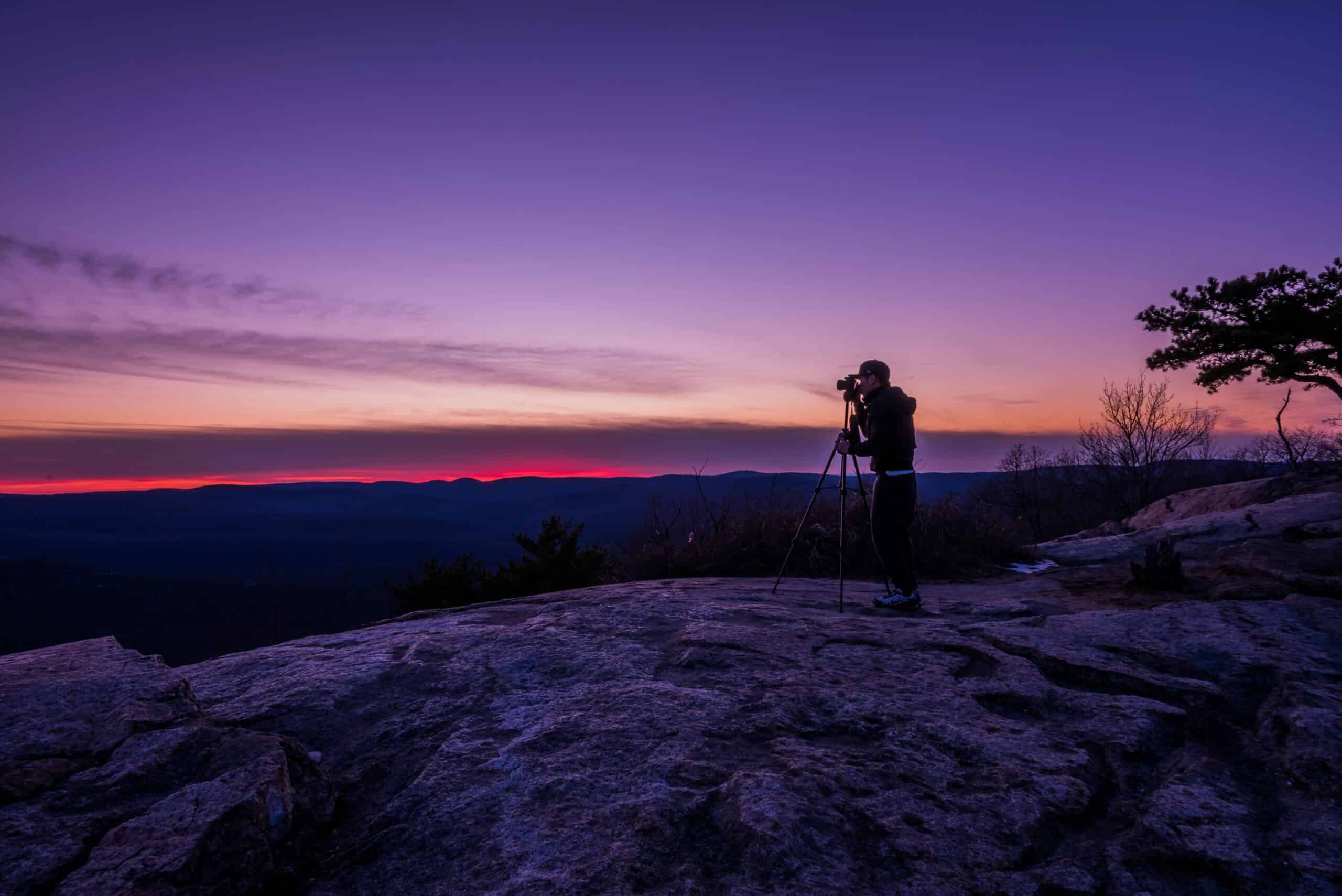
For clean architectural lines, a rectilinear ultra-wide (like a 17–28mm FF or MFT equivalent) is ideal. The OM-1’s dynamic range and noise control handle wide day-to-night scenarios, and you can rely on ISO 200–800 for most panos, pushing to ISO 1600 when needed. For interiors with windows, plan an HDR panorama with ±2 EV brackets. Fisheye lenses reduce shot count but can complicate vertical lines; rectilinear takes more frames but keeps distortion minimal—a better fit for real estate and virtual tours.
Pre-shoot Checklist
- Power: Fully charged batteries; pack a spare (long pano sequences drain power).
- Storage: Fast UHS-II cards, with headroom for RAW brackets (think 64–128 GB minimum).
- Clean optics: Front/rear elements and sensor; dust spots are extra work on sky/nadir.
- Leveling: Level the tripod; a leveling base accelerates multi-row accuracy.
- Pano head: Calibrate nodal point for your chosen focal length before the job.
- Safety: Sandbags or hooks for windy rooftops; tether on poles; avoid traffic lanes for car mounts.
- Backup: Shoot a second, slightly different overlap series as insurance (especially for crowds).
Essential Gear & Setup
Core Gear
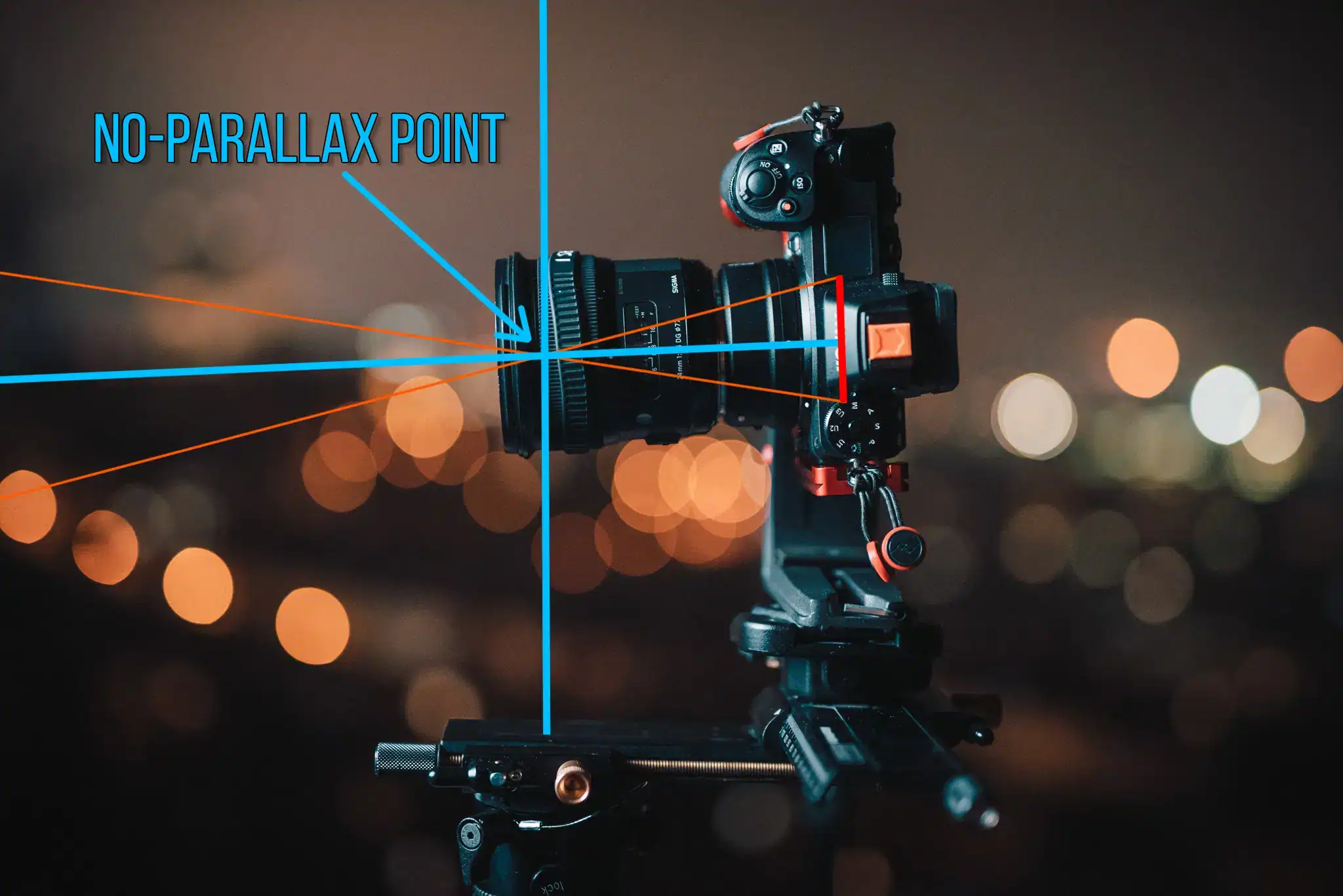
- Panoramic head: A proper panoramic head lets you align the no-parallax (nodal) point over the rotation axis to eliminate parallax errors when stitching. This is non-negotiable for rectilinear multi-row work.
- Stable tripod with leveling base: Keeps horizons level and rows consistent. Carbon fiber reduces vibration and weight.
- Remote trigger or mobile app: Fire the shutter without touching the camera. Delay timer works in a pinch, but a remote is faster.
Optional Add-ons
- Pole or car mount: Great for elevated views or vehicle capture, but mind wind load and vibrations; always tether and keep a hand on the pole.
- Lighting for interiors: Small LED panels or bounce flash for even lighting; keep it consistent across frames.
- Weather protection: Rain cover for the OM-1 (even though it’s weather-sealed), silica packs for humidity, and gloves for winter work.
Video: How a Panoramic Head Works (Recommended)
Seeing the nodal alignment process once makes everything simpler. Here’s a concise video demonstration worth watching before your first field session.
For a deeper dive into hardware selection and setup, this panoramic head tutorial is an excellent reference at the end of your read. Panoramic head best practices
Step-by-Step Shooting Guide
Standard Static Scenes
- Level tripod & align the nodal point: On a flat surface, level the tripod, then the head. Use a vertical reference (like a light stand) close to the lens and a distant object. Rotate the camera; adjust fore-aft rail until foreground and background don’t shift relative to each other. Repeat for your selected focal length.
- Manual exposure & white balance: Switch to M mode. Meter the brightest area you must retain detail in (typically sky or window), then set exposure to protect highlights; expose to the right but avoid clipping. Lock WB (e.g., Daylight for outdoor, custom Kelvin for interiors). Disable auto ISO.
- Focus: Use manual focus. On MFT, set at or near hyperfocal for your aperture. For 8–9 mm MFT at f/8, setting focus around 1–1.5 m typically keeps everything sharp from near foreground to infinity. Use magnified live view to confirm.
- Capture with consistent overlap: For 17mm FF (~8–9 mm MFT), shoot two rows of 8 frames each at +30° and −30°, rotating ~45° per step for ~30% overlap. Add one zenith shot (+90°) and 1–3 nadir frames to patch the tripod.
- Lens hood & flare control: Keep the hood on, shield with your hand if necessary, and avoid shooting directly into the sun unless intentional (bracket if you do).
- Nadir capture & patching: After the main rows, tilt down to −90° for a dedicated ground shot. If the tripod obstructs, move the rig aside keeping the lens in roughly the same position and shoot a clean patch plate.
HDR / High Dynamic Range Interiors
- Bracket ±2 EV: For each view in the pano, capture 3–5 exposures (e.g., −2/0/+2 EV). The OM-1’s AEB is responsive; use a remote to speed up.
- WB lock: Keep white balance fixed across all brackets and frames to prevent color shifts panel-to-panel in the stitch.
- Shutter discipline: On a tripod, turn IBIS off to avoid sensor micro-movements. Let the rig settle after each movement.
- Windows first: If windows are extremely bright, bias your base exposure toward preserving exterior detail; shadow recovery is safer in RAW/HDR.
Low-Light / Night Scenes
- Exposure: Start at f/4–f/5.6, ISO 200–800, and adjust shutter speed to taste (1/30–1/60 for crowds, slower for static). The OM-1’s files hold up well to ISO 800; ISO 1600 is usable with careful noise reduction.
- Stability: Turn off IBIS on a tripod. Use a remote or 2-sec timer to prevent shake. Shield the rig from wind between frames.
- Glare: Watch for sodium lamps and LED striping. Use a lens hood and avoid smearing oils on the front element.
Crowded Events
- Two-pass strategy: First pass for composition and exposure, second pass waiting for gaps to reduce ghosting. Mark your starting angle so you can restart precisely.
- Faster shutter: Use 1/200s or faster to freeze people if you want a crisp look. Otherwise, longer exposures can artistically blur moving subjects.
- Masking in post: Plan to mask frames with the cleanest subject positions during stitching.
Special Setups (Pole / Car / Drone)
- Pole work: Tether your camera, keep the pole vertical, rotate more slowly, and shoot extra overlap (35–40%). Enable IBIS and use faster shutters.
- Car-mounted capture: Use vibration-damping suction mounts and safety tethers. Avoid highways; drive slowly in a safe area. Expect more stitching cleanup from motion.
- Drone note: This guide focuses on OM-1, but many principles carry to drones—consistent overlap and manual exposure are still key.
Real-World Mini Case Studies
Indoor Real Estate
Rectilinear at an equivalent of 17–20 mm FF gives straight walls and minimal distortion. Use f/8, ISO 200, bracket ±2 EV, two rows of 8–10 around, plus zenith/nadir. Keep all lights on for warmth but fix WB to custom Kelvin for consistency.
Outdoor Sunset
Meter for highlights to preserve sky color. Start at f/8, ISO 200, 1/100–1/250s. Expect flare near the sun—shade with your hand. Consider a quick second pass 5 minutes later to hedge against fast-changing light.
Event Crowd
Capture a “clean plate” of the background when the aisle clears, then re-shoot people clusters. In PTGui, mask to keep the clean background while preserving the best-looking people positions.
Recommended Settings & Pro Tips
Exposure & Focus
| Scenario | Aperture | Shutter | ISO | Notes |
|---|---|---|---|---|
| Daylight outdoor | f/8–f/11 | 1/100–1/250 | 100–200 (Low/200) | Lock WB (Daylight ~5500K) |
| Low light/night | f/4–f/5.6 | 1/30–1/60 (static) / 1/125–1/250 (people) | 200–800 (1600 if needed) | Tripod & remote; IBIS off on tripod |
| Interior HDR | f/8 | Bracket ±2 EV | 200–400 | Protect window highlights, lock WB |
| Action / moving subjects | f/5.6–f/8 | 1/200+ | 400–800 | Double pass, mask in post |
Critical Tips
- Manual focus at hyperfocal: On MFT ultra-wide at f/8, focus ~1–1.5 m for end-to-end sharpness.
- Nodal point calibration: Mark your rail positions for each focal length you use (e.g., 8, 10, 12, 14 mm MFT). Always return to the exact marks before paid shoots.
- White balance lock: Never use Auto WB for panos; fix Kelvin or shoot a gray card and set WB in post uniformly.
- RAW over JPEG: Shoot RAW (12-bit on OM-1) for dynamic range and color latitude; it’s crucial when blending HDR.
- IBIS on/off: Off on tripod to avoid micro-jitter; on for handheld/pole work to stabilize frames.
- Diffraction awareness: With ~3.3 µm pixels, diffraction softening becomes noticeable past f/8–f/11. Prefer f/5.6–f/8 for critical sharpness.
Stitching & Post-Processing
Software Workflow
Popular options include PTGui (fast, robust control points), Hugin (open-source), and Adobe Lightroom/Photoshop for simpler single-row work. Rectilinear lenses require more shots than fisheye but deliver straighter lines which stitch cleanly with good nodal alignment. As a rule of thumb, use about 25–30% overlap for ultra-wide rectilinear and at least 30–35% when shooting handheld or in wind. For a thorough look at PTGui’s strengths, see this review. Why PTGui is a top-tier panorama tool
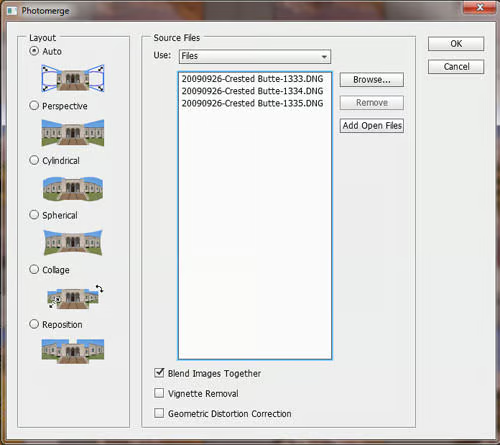
Export your final pano as an equirectangular JPEG/PNG for virtual tours or a 16-bit TIFF for detailed retouching. For best practices on turning DSLR/mirrorless captures into VR-ready images, this workflow overview is helpful. Creating VR-ready 360 photos from a mirrorless setup
Cleanup & Enhancement
- Nadir/tripod patch: Clone manually or use a logo patch. Many AI tools help remove tripod legs quickly.
- Color consistency: After stitching, globally fine-tune white balance and tint; match brightness between panels if needed.
- Noise reduction: Apply modest NR selectively to shadow areas; don’t smear fine detail.
- Horizon leveling: Use the stitching software’s horizon tool; then fine-adjust roll/yaw/pitch to level the scene.
- Sharpening: Apply capture sharpening lightly; avoid halos in high-contrast edges, especially architecture.
- Output: For web VR, 8192×4096 (8K equirect) is common; for high-end tours, 10–16K is typical if your source frames support it. For resolution planning by focal length, see the spherical resolution reference. Spherical resolution vs focal length
Disclaimer: features and interfaces evolve; verify your software’s latest documentation before a paid job.
Useful Tools & Resources
Software
- PTGui — fast stitching with robust control point and masking tools.
- Hugin — open-source alternative with deep controls.
- Lightroom/Photoshop — global color and retouching after stitch.
- AI tripod removal tools — for quick nadir cleanup.
Hardware
- Panoramic heads: Nodal Ninja, Leofoto, Sunwayfoto, and other Arca-compatible multi-row heads.
- Carbon fiber tripods: stable and light, with a good center hook for weight.
- Leveling bases: speed up setup and maintain perfect rows.
- Wireless remotes: reliable, tactile control without touching the camera.
- Pole extensions / car mounts: for elevated or vehicular capture; always tether.
Disclaimer: product names for research only; check official sites for specs and compatibility. For an additional primer on overall panorama technique, this Q&A compilation is a solid knowledge base. Best techniques to shoot 360 panoramas
Common Mistakes & How to Avoid Them
- Parallax error → Align the nodal point exactly for your focal length; test with a close foreground object and a distant background.
- Exposure flicker → Manual exposure and locked white balance; avoid auto ISO and auto WB.
- Tripod shadows/legs → Shoot a dedicated nadir or capture a clean patch plate for editing.
- Ghosting from movement → Shoot a second pass and mask frames in PTGui/Hugin.
- Night noise → Keep ISO as low as practical (200–800), use longer shutters on a stable rig, and apply selective NR in post.
- IBIS artifacts on tripod → Turn off IBIS when mounted to prevent sensor micro-movements.
- Changing focal lengths mid-pano → Avoid zooming mid-sequence; if you must, recalibrate nodal and restart.
Frequently Asked Questions
- Can I shoot handheld panoramas with the Olympus OM-1?
Yes, for partial panos or quick single-row 360s in bright light. Use higher overlap (35–40%), faster shutters (1/250s+), and enable IBIS. For precise, multi-row 360s—especially interiors—use a tripod and panoramic head.
- Is the Tamron 17-28mm f/2.8 wide enough for single-row 360?
At 17mm FF, a single row won’t cover zenith/nadir. You typically need two rows (about +30° and −30°) plus zenith and nadir frames. On MFT, use ~8–9 mm to match 17mm FF field of view.
- Do I need HDR for interiors with bright windows?
Usually yes. Bracket at ±2 EV (3–5 frames) to retain exterior views while keeping interior shadows clean. This approach balances the limited dynamic range a single exposure can capture, even on modern sensors.
- How do I avoid parallax issues with this setup?
Calibrate the nodal point for your chosen focal length on a panoramic head and lock it in. Don’t change focus distance or zoom between frames. A quick test with a nearby vertical stand and distant object will confirm correct alignment.
- What ISO range is safe on the OM-1 for low light panoramas?
Plan for ISO 200–800 on a tripod. ISO 1600 is usable with careful exposure and noise reduction, but prioritize longer shutters over cranking ISO whenever possible for maximum detail.
- Can I set up Custom Modes for fast pano work?
Yes—assign a Custom Mode with M exposure, fixed WB, RAW, IBIS off (tripod), bracketing off/on depending on job, and a preferred aperture (e.g., f/8). Save a second Custom Mode for handheld with IBIS on and faster shutter.
- What’s the best panoramic head for this rig?
Choose a multi-row, Arca-compatible head with fore-aft and lateral rails, easy angle detents, and a leveling base. Internal-zoom lenses (like the Tamron 17–28) keep balance consistent, making head setup smoother.
If you want a concise, pro-level overview of setting up a DSLR/mirrorless to shoot 360 photos for VR, this guide by Meta is a great companion. Set up a panoramic head for high-end 360 photos
Important Compatibility Note
Because the Tamron 17–28mm f/2.8 Di III RXD is Sony E-mount (short flange) and the Olympus OM-1 is Micro Four Thirds, there isn’t a straightforward passive adapter to mount the lens on the OM-1. If you don’t have a specialty optical solution, use an MFT rectilinear ultra-wide that offers a similar field of view. All the framing, overlap, and stitching advice in this article remains valid—only the exact focal length setting changes to match the coverage. When in doubt, match the FF equivalent: 17mm FF ≈ 8–9 mm on MFT; 28mm FF ≈ 14 mm on MFT.
Safety, Limitations & Backup Workflow
Always stabilize your rig in wind, keep one hand on elevated poles, and tether when above people or traffic. Weather sealing helps, but protect your equipment from rain spray and dust. The OM-1’s RAW files are robust, yet pushing ISO too high or stopping down past f/11 can reduce detail. For critical jobs, shoot a second overlap pass and backup your card to a portable SSD on-site. Keep a small microfiber cloth handy—one smear on an ultra-wide front element can ruin a whole row of frames.
Final Thoughts
Now you know how to shoot panorama with Olympus OM-1 & Tamron 17-28mm f/2.8 Di III RXD in a way that’s both practical and high quality—even when you’re substituting an MFT ultra-wide to match the field of view. Start with careful nodal alignment, lock exposure and WB, capture with consistent overlap, and stitch in PTGui or Hugin. With a solid workflow, the OM-1’s compact reliability and an ultra-wide rectilinear zoom will give you clean, high-resolution 360 photos for tours, real estate, events, or dramatic outdoor scenes.
Further reading on camera and lens choices for virtual tours is available here. Camera and lens guide for virtual tours