
Why This Camera & Lens Are Great for Panoramas
If you’re searching for how to shoot panorama with Olympus OM-1 & Sony FE 16-35mm f/2.8 GM, you’ve picked a robust, pro-level combination in terms of optics and capability. However, there’s a practical caveat: the Sony FE 16–35mm f/2.8 GM is a full-frame E‑mount lens and cannot be mounted natively on the Micro Four Thirds (MFT) Olympus OM‑1. There is no fully functional E‑mount to MFT adapter that preserves focus/aperture control and infinity focus due to flange distance and electronics. So you have two workable paths:
- Use the OM‑1 with a MFT ultra‑wide zoom that matches the field of view of a 16–35mm full-frame zoom (for example, 8–18mm or 7–14mm MFT), and follow this guide’s settings and shot counts.
- If you specifically want the Sony FE 16–35mm GM look, pair it with a Sony E‑mount camera body. All technique in this guide still applies 1:1.
Why the OM‑1 is excellent for panoramas: It’s a 20.4 MP stacked BSI Micro Four Thirds sensor (approx. 17.3 × 13 mm) with fast readout, excellent in-body stabilization (up to 7–8 stops with Sync‑IS; 5–6 stops typical), and rugged weather sealing. Pixel pitch is about 3.3 μm; dynamic range at base ISO is roughly 12 EV, which is ample for most daylight and many twilight scenes, especially with bracketing. The Sony FE 16–35mm f/2.8 GM is a top-tier rectilinear ultra-wide: very sharp from f/4–f/8, well-controlled coma/astigmatism, minimal lateral CA, and an 82 mm filter thread for ND/polarizer work—ideal traits for high-res, stitchable frames.
In this article, we’ll give you field-tested, focal-length-specific shot plans and settings. Where we mention “16 mm on full frame,” use ~8 mm on Micro Four Thirds to match field of view. Likewise, 24 mm FF ≈ 12 mm MFT, 35 mm FF ≈ 17–18 mm MFT. The rest—tripod technique, nodal point alignment, overlap, HDR bracketing, and stitching—transfers directly.
Quick Setup Overview
- Camera: Olympus OM‑1 — Micro Four Thirds, 20.4 MP stacked BSI Live MOS; approx. 12 stops DR at base ISO; strong IBIS for non-tripod work.
- Lens: Sony FE 16–35mm f/2.8 GM — rectilinear ultra-wide zoom; razor-sharp center and strong corners by f/5.6–f/8, low coma, minimal lateral CA, 82 mm filters. Note: Not natively mountable on OM‑1; use MFT alternatives to match FOV.
- Estimated shots & overlap (rectilinear, 30% overlap, 360×180):
- 16 mm FF (≈ 8 mm MFT): 8 shots per row × 3 rows (−45°, 0°, +45°) + zenith + nadir = 26 total.
- 24 mm FF (≈ 12 mm MFT): 12 × 3 + zenith + nadir = 38 total.
- 35 mm FF (≈ 17–18 mm MFT): 16 × 3 + zenith + nadir = 50 total.
- Difficulty: Intermediate (tripod + pano head recommended; easy once nodal point is calibrated).
Planning & On-Site Preparation
Evaluate Shooting Environment
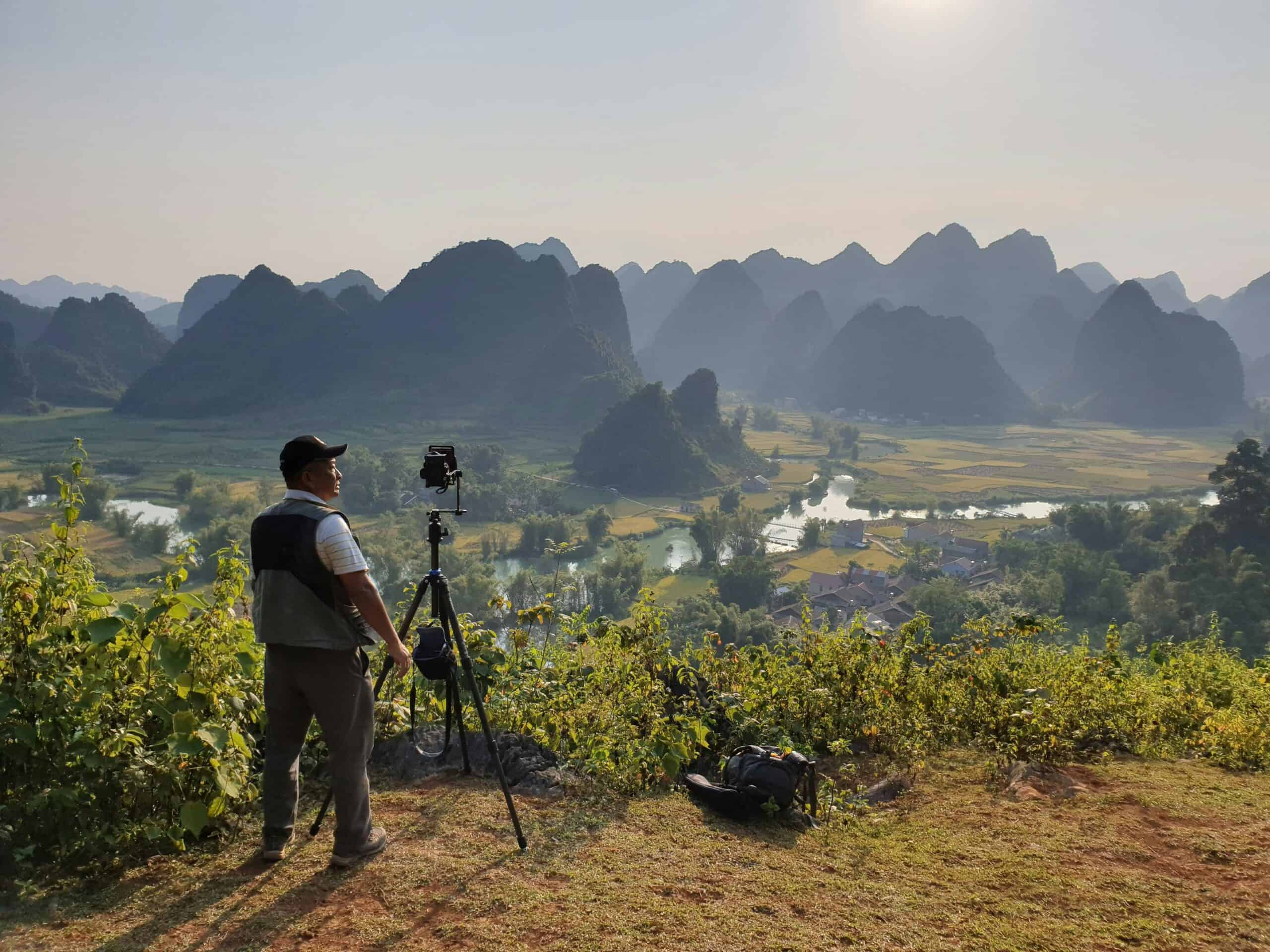
Before you set up, scan the scene. Look for strong light sources, reflections (glass, polished floors, water), and moving elements (people, cars, trees in wind). If you must shoot through glass, back off 10–20 cm and use a rubber lens hood pressed gently against the glass to minimize flare and ghosting. For sunsets or high-contrast interiors, plan to bracket (±2 EV) to protect highlights and lift shadows later. If you expect motion, plan double passes for easy masking.
Match Gear to Scene Goals
The OM‑1’s stacked sensor handles moderate ISO well; ISO 200–800 is the “safe zone” for most pano work, with ISO 1600 acceptable in a pinch when you want to shorten shutter speeds (e.g., windy rooftops). The Sony FE 16–35 GM excels anywhere you need clean edges and low distortion. On OM‑1, use an MFT zoom that matches the FE’s FOV: 8–18mm, 7–14mm, or 9–18mm. Rectilinear zooms mean more frames than fisheye but cleaner architecture lines and easier perspective control in multi-row stitches.
Pre-shoot Checklist
- Power and storage: at least two batteries and ample card space; panoramas stack up quickly. Shoot RAW.
- Glass clean: front/rear element and sensor. Dust becomes a nightmare during stitching.
- Tripod: level with a leveling base; verify pano head scales and nodal alignment are locked.
- Safety: on rooftops or poles, tether the camera; evaluate wind. For car mounts, use ratchet straps and secondary safeties.
- Backup plan: shoot a second safety round or a wider focal length row in case of stitching issues.
Essential Gear & Setup
Core Gear
- Panoramic head: A proper panoramic head lets you rotate around the lens’s entrance pupil (nodal point) to eliminate parallax in overlaps—a must for interior lines and objects near the camera.
- Sturdy tripod with leveling base: Speeds setup and ensures rows align without tilt. Carbon fiber helps reduce vibration on rooftops.
- Remote trigger or camera app: Avoid touching the camera. On OM‑1, enable a 2 s self-timer if you don’t have a remote.
Optional Add-ons
- Pole or car mount: Great for crowds or unique vantage points. Always tether your rig and keep shutter speeds faster than 1/200 when possible to fight vibrations and wind.
- Lighting aids: Small LEDs for interior accents; avoid moving lights during brackets.
- Weather protection: Rain cover, microfiber cloths, silica packets for humidity.
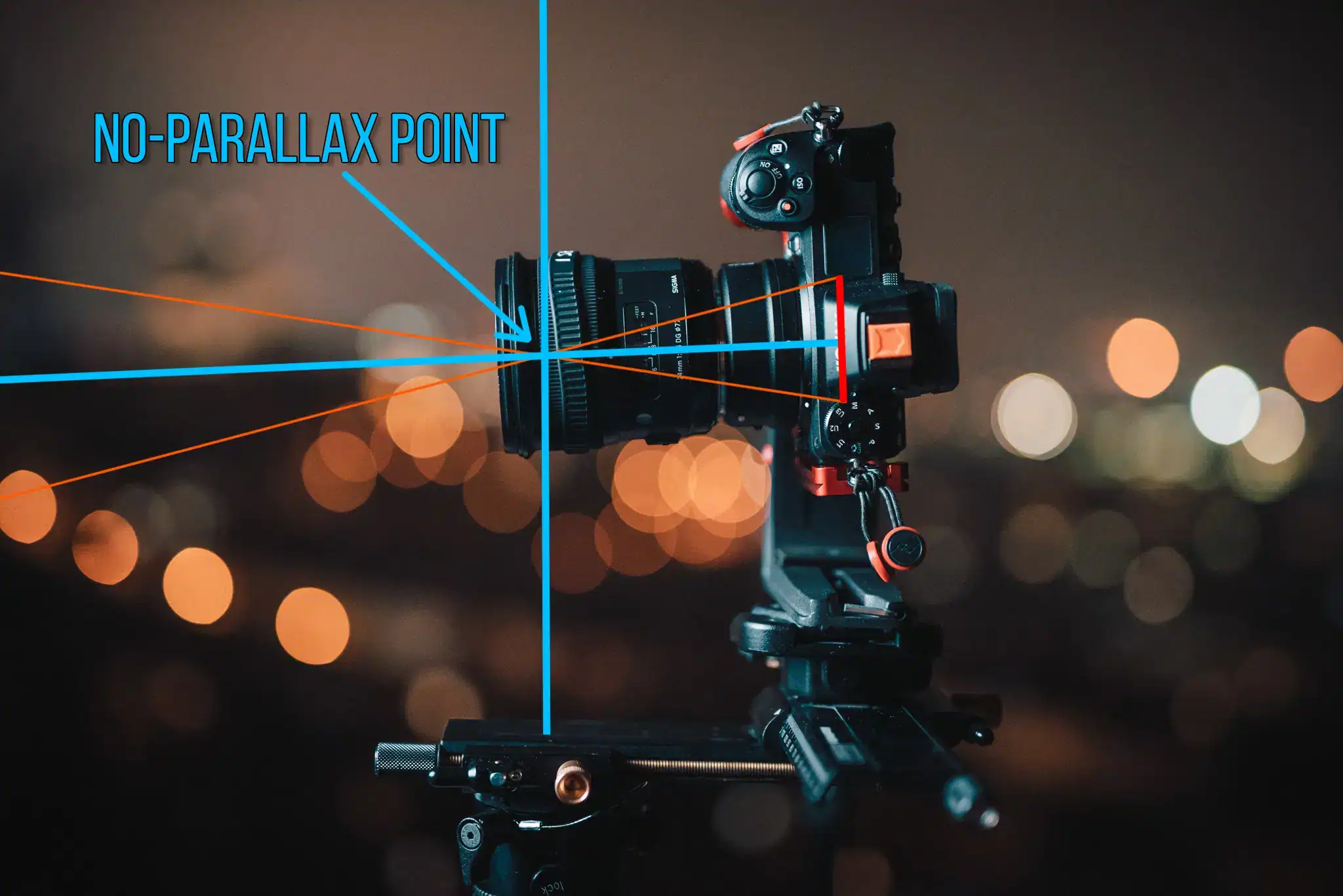
For rectilinear zooms, this point shifts slightly across the zoom range—mark your most used focal length.
Step-by-Step Shooting Guide
Standard Static Scenes
- Level tripod and align the nodal point. Calibrate by placing a near and far object in the frame and rotating; adjust the rail until there’s no relative shift. Mark the rail for your focal lengths (e.g., 8 mm MFT ≈ 16 mm FF).
- Switch to manual exposure and lock white balance. Meter the brightest portion you need to preserve (e.g., sky) and expose slightly to the right without clipping. Choose a fixed WB (Daylight/Tungsten) to avoid color shifts between frames.
- Focus: Use manual focus. At 8 mm MFT, f/8 hyperfocal is roughly 0.53 m (circle of confusion ~0.015 mm), giving near focus at ≈ 0.27 m to infinity. Repeatable sharpness beats AF hunting across frames.
- Capture with tested overlap: For 16 mm FF (≈ 8 mm MFT), shoot 8 frames around at 0°, then 8 at +45°, 8 at −45°, plus dedicated zenith and nadir frames.
- Take the nadir: After the main set, angle the camera down or shift the tripod slightly to shoot a clean ground plate for tripod patching.
HDR / High Dynamic Range Interiors
- Bracket ±2 EV (3 or 5 frames per view). Keep exposure increments identical for every camera position.
- Lock WB and keep all camera settings constant between brackets and positions.
- Use a 2 s timer or remote release. Avoid touching the camera—tiny shifts cause ghosting when merging HDR and stitching.
- For window pulls, prioritize preserving highlight detail in the brightest bracket.
Low-Light / Night Scenes
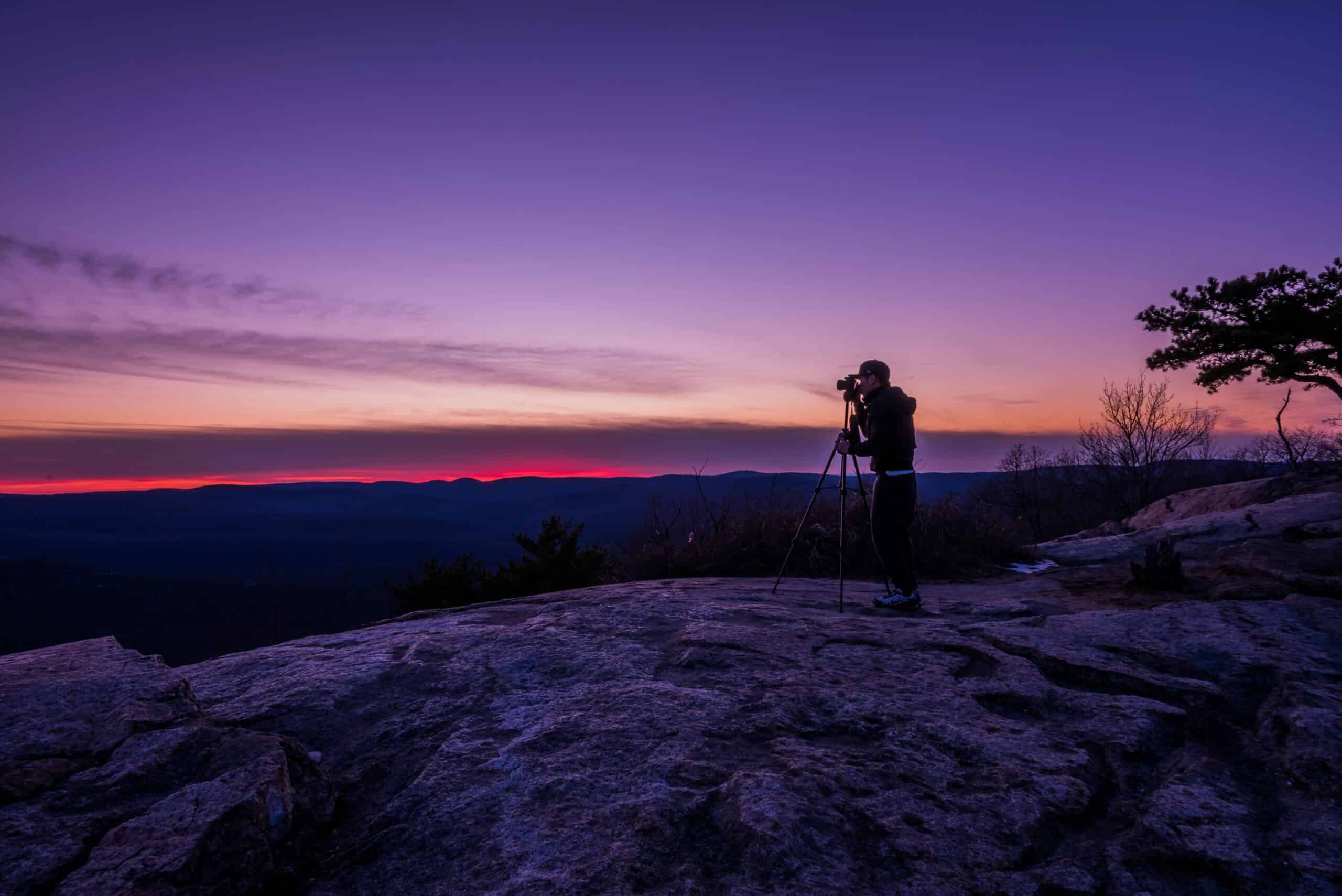
- Use longer exposures with IBIS OFF on a tripod. The OM‑1’s base ISO is 200; prefer ISO 200–400 and extend shutter time. Only push to ISO 800–1600 if wind or subject motion forces it.
- Open to f/4–f/5.6 for optimal sharpness with reasonable shutter speeds. The FE 16–35 GM is sharp by f/4–f/5.6; most MFT ultra-wides also peak around f/5.6–f/8.
- Trigger via remote. Use electronic shutter to reduce vibrations, but watch for artificial light banding—switch to mechanical if needed.
Crowded Events
- Shoot two passes: an initial quick pass for geometry and a second pass where you wait for gaps in moving people. This gives clean background plates for masking.
- Use faster shutters (1/200+) at ISO 400–800 to freeze motion. Accept a little noise—it’s easier to clean than ghosts.
Special Setups (Pole / Car / Drone)
- Secure everything and tether your camera. On poles, keep rotation deliberate and slower; pre-level the head and mark your row angles with tape.
- Increase overlap to 35–40% to give the stitcher more latitude when vibrations blur edges.
Recommended Settings & Pro Tips
Exposure & Focus
| Scenario | Aperture | Shutter | ISO | Notes |
|---|---|---|---|---|
| Daylight outdoor | f/8–f/11 | 1/100–1/250 | 100–200 | Lock WB (Daylight); manual focus at hyperfocal |
| Low light/night | f/4–f/5.6 | 1/30–multi-second | 200–800 | Tripod, IBIS OFF; use remote to avoid shake |
| Interior HDR | f/8 | Bracket ±2 EV | 200–400 | Balance window highlights and interior shadows |
| Action / moving subjects | f/5.6–f/8 | 1/200+ | 400–800 | Double pass for easy masking of moving people |
Critical Tips
- Manual focus and mark the ring. For 8 mm MFT at f/8, hyperfocal ≈ 0.53 m; for 12 mm MFT at f/8, hyperfocal ≈ 1.2 m.
- Nodal point calibration: Use a near object (1–2 m) and a far object. Rotate the rig; adjust the rail until their relative position doesn’t shift. Mark the rail for each focal length you use.
- White balance lock: Mixed lighting? Choose a Kelvin value (e.g., 4000–4500 K for tungsten/LED interiors) instead of Auto.
- RAW over JPEG: Gives you latitude for highlight recovery, WB tuning, and noise reduction.
- IBIS on/off: On tripod, turn IBIS OFF to prevent micro-blur. Handheld panos? IBIS ON can help for cylindrical or partial panoramas.
Stitching & Post-Processing
Software Workflow
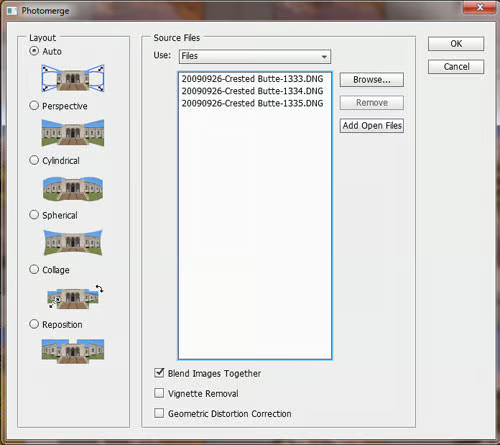
Ingest and cull in Lightroom, then stitch with PTGui or Hugin. Rectilinear zooms (like Sony FE 16–35 GM or MFT 7–14/8–18/9–18) typically need 20–35% overlap. Fisheyes need fewer frames but require defishing and careful zenith/nadir handling. For highest quality VR output, aim for consistent exposure/WB and sufficient overlap so the stitcher can find robust control points across rows. Read reviews and best-practice guides to pick your stitcher; PTGui remains a gold standard among pros for speed and control. PTGui deep-dive review
Cleanup & Enhancement
- Nadir patch: Use a clean ground plate frame or clone/heal. Some AI tools speed up tripod removal.
- Color and noise: Match color temperature across brackets first; apply noise reduction conservatively to avoid plastic textures.
- Horizon leveling: Use PTGui’s vertical/horizontal line tools to fix yaw/pitch/roll; ensure verticals are true in architectural panos.
- Export: For VR, export equirectangular 2:1 (e.g., 12000 × 6000 px or higher). Keep a 16-bit master TIFF; deliver JPEG for web.
For deeper technique on head setup and 360 workflow, check these authoritative resources: Panoramic head setup tutorial and Oculus Creator 360 photo workflow.
Useful Tools & Resources
Software
- PTGui panorama stitching
- Hugin (open-source)
- Lightroom / Photoshop for RAW processing and retouch
- AI tripod removal tools for fast nadir patches
Hardware
- Panoramic heads: Nodal Ninja, Leofoto, Sunwayfoto
- Carbon fiber tripods with leveling bases
- Wireless remote shutters or intervalometers
- Pole extensions and car/suction mounts with safety tethers
Disclaimer: brand names provided for research only—verify compatibility and specs on official sites.
Common Mistakes & How to Avoid Them
- Parallax error: If near/far objects shift between frames, your entrance pupil is not aligned. Recalibrate and lock the rails.
- Exposure flicker: Auto exposure/WB changes mid-pano. Shoot in full Manual and fixed WB.
- Tripod shadows: Capture a dedicated nadir and patch, or move the tripod slightly for a clean ground plate.
- Ghosting from movement: Shoot double passes and mask moving people/cars in post.
- Excess noise at night: Keep ISO low and extend shutter. Use bracketing to protect shadows rather than pushing ISO too high.
Real-World Case Studies
Indoor Real Estate (Bright Windows)
Use 12 mm MFT (≈ 24 mm FF) to keep verticals tighter. Tripod, pano head, Manual mode, WB fixed. Shoot 12 × 3 rows + Z/N with ±2 EV brackets. Expose the base shot for mid-tones; ensure at least one bracket protects window detail. In PTGui, enable HDR fusion and set vertical control lines to keep walls straight.
Outdoor Sunset Overlook
Use 8 mm MFT (≈ 16 mm FF) for broader coverage and fewer frames. Meter for highlights and bracket if the foreground is dark. Shoot 8 × 3 + Z/N. For color, lock WB around 5200–5600 K; deliver a wide-gamut 16‑bit TIFF master and create web JPEGs later.
Event Crowd (Town Square)
Use 12 mm MFT (≈ 24 mm FF). First pass quickly to capture geometry; second pass waiting for gaps and fewer moving people. Aim for 1/200 or faster, ISO 400–800. In post, use the cleaner pass to mask over motion-blurred subjects in the busier pass.
Rooftop or Pole
Use 8 mm MFT (≈ 16 mm FF). Increase overlap to 35–40%. Use faster shutters (1/200–1/400) to fight micro‑vibration. Tether all gear. Avoid gusty conditions if possible; your stitch quality depends on consistent frame sharpness.
Compatibility Note: OM‑1 with Sony FE 16–35mm GM
Because the Sony FE 16–35mm f/2.8 GM is designed for Sony E‑mount and the Olympus OM‑1 uses Micro Four Thirds, there is no practical, fully functional adapter that preserves AF, aperture control, and infinity focus. To follow this guide with the OM‑1, use an MFT rectilinear ultra‑wide such as 7–14mm f/2.8, 8–18mm f/2.8–4, or 9–18mm f/4–5.6. To use the Sony FE 16–35mm GM lens itself, pair it with a Sony body (e.g., A7 IV, A7R series) and apply the same techniques, shot counts (based on focal length), and stitching workflow.
Frequently Asked Questions
- Can I shoot handheld panoramas with the Olympus OM‑1?
Yes—for single-row cylindrical panos in good light. Use IBIS ON, fast shutter (1/250+), and 30–40% overlap. For full 360×180 VR panos, a tripod and panoramic head are strongly recommended to avoid parallax and alignment issues.
- Is the Sony FE 16–35mm f/2.8 GM wide enough for single‑row 360?
Not for a full sphere. At 16 mm FF (≈ 8 mm MFT), you’ll usually need multi‑row (e.g., 8 shots per row × 3 rows) plus zenith and nadir. A diagonal fisheye can do 4 around + up + down, but that’s a different lens type.
- Do I need HDR for interiors with bright windows?
Most of the time, yes. Bracket ±2 EV (3–5 frames). Merge HDR either before or during stitching (PTGui can fuse brackets). This preserves window highlights and retains clean interior detail.
- How do I avoid parallax issues?
Rotate around the entrance pupil using a panoramic head and calibrated rails. Place a near and far object in the frame; adjust the fore‑aft position until their relative position doesn’t shift while rotating. Lock it down and don’t bump the rig.
- What ISO range is safe on the OM‑1 in low light?
ISO 200–800 is the sweet spot. 1600 is usable, but prioritize tripod and longer shutter times to keep noise and banding risks low. For interiors, bracket rather than pushing ISO too high.
- Can I create Custom Modes for pano on the OM‑1?
Yes. Save a custom mode with Manual exposure, fixed WB, manual focus, IBIS OFF (for tripod), 2 s timer, and RAW. It makes setup fast and consistent.
- What’s the best tripod head for this setup?
A multi-row panoramic head with fore‑aft and lateral adjustment (e.g., Nodal Ninja or Leofoto). Look for indexed rotators (5°, 7.5°, 10°, 15° detents) and solid clamps to hold your marks.
Want a deeper dive into pano head specifics and best practices? This roundup is a solid starting point: Panoramic gear and virtual tour FAQ.
Safety, Limitations & Trust Tips
- Lens/body compatibility: The FE 16–35 GM isn’t mountable on OM‑1. Use MFT ultra‑wide equivalents or a Sony body for the GM lens.
- Weather and wind: Secure and tether on rooftops, poles, and car rigs. If it’s unsafe or too windy, don’t risk your kit—or yourself.
- Backup workflow: Shoot a second round, and keep a wider safety row. Back up cards on-site to dual memory or a portable SSD.
- Honest limits: The OM‑1’s 20 MP sensor is superb, but for giant wall-sized prints you may want more frames or an 80 MP High-Res mode per view (then stitch), accepting longer capture time.
Bonus: Visuals to Guide Your Shoot
More Learning
If you prefer a structured walk-through from setup to stitch, this step-by-step is helpful for refining your workflow: Set up a panoramic head for high-end 360 photos.