Why This Camera & Lens Are Great for Panoramas
If you’re learning how to shoot panorama with Olympus OM-1 & Samyang 12mm f/2.8 ED AS NCS Fish-Eye, you’ve picked a highly capable combo for both creative 360 photos and traditional wide panoramas. The OM System/Olympus OM-1 is a weather-sealed, Micro Four Thirds mirrorless body with a 20.4MP stacked BSI sensor (approx. 17.3 × 13.0 mm; pixel pitch ~3.3 μm). It offers fast readout, excellent IBIS, and very usable dynamic range around base ISO (roughly 12 stops at ISO 200 in practical use). The Samyang 12mm f/2.8 is a manual-focus diagonal fisheye with a bright aperture, low coma for night scenes, and predictable distortion that stitching apps handle well when set as a fisheye lens model.
On Micro Four Thirds, the 12mm fisheye does not reach a 180° diagonal field of view like on full frame, but it still captures a significantly wider field than a rectilinear 12mm. That means fewer shots than a standard wide-angle, while retaining good sharpness stopped down. The OM-1’s manual focus aids (magnification and focus peaking), high-precision exposure tools, and excellent battery life make it painless to shoot multi-frame panoramas in the field. Whether you’re creating an HDR panorama of an interior, a sunset 360 on a tripod, or a pole-mounted aerial-like perspective, this setup is robust, fast, and reliable.
Quick Setup Overview
- Camera: Olympus OM-1 — Micro Four Thirds (20.4MP stacked BSI), base ISO 200 (LOW available), strong IBIS. Weather-sealed and lightweight.
- Lens: Samyang 12mm f/2.8 ED AS NCS Fish-Eye — manual-focus diagonal fisheye; sharpest around f/5.6–f/8; moderate CA easily corrected; predictable fisheye distortion ideal for pano software.
- Estimated shots & overlap:
- Minimal outdoor 360: 6 around (0° tilt) + zenith + 1–3 nadir patch shots (30–35% overlap).
- Reliable full coverage: 8 around (0°) + 1 zenith + 2–3 nadir patches.
- Maximum quality/tricky interiors: 2 rows × 8 around (0° and +45°) + zenith + 2–3 nadir patches (25–35% overlap).
- Difficulty: Intermediate (manual focus fisheye + pano head alignment).
Planning & On-Site Preparation
Evaluate Shooting Environment
Before you set up, scan the scene. Note moving elements (people, trees, traffic), reflective surfaces (glass, polished floors), and light direction. For interiors with glass, shoot with the lens as perpendicular as possible to avoid strong reflections. If you must shoot through glass, place the front element close to the pane (1–2 cm) and use a rubber lens hood to minimize flare and ghosting.
Match Gear to Scene Goals
The OM-1’s stacked sensor and effective noise handling make it great for HDR panorama work and low-light scenes. Expect clean files at ISO 200–800; ISO 1600 is workable; ISO 3200 is an emergency limit if you plan heavy noise reduction later. The Samyang 12mm fisheye’s advantage is coverage: fewer frames than a rectilinear lens, with stitching software modeling the fisheye projection. The trade-off is curved lines near edges, which is fine for equirectangular exports and VR but may not suit architectural stills unless you correct the projection in post.
Pre-shoot Checklist
- Power and storage: two batteries minimum; fast UHS-II cards; format cards in-camera.
- Clean optics: blower + microfiber for lens and sensor. Dust is very noticeable in skies.
- Tripod setup: level base; verify pano head scales; bring hex keys/spares.
- Calibrate nodal point: pre-mark your rails for the OM-1 + 12mm combo to save time.
- Safety checks: tether gear on rooftops/poles; avoid high winds; keep clear of edges.
- Backup workflow: shoot a second pass if time allows; it saves projects when people or cars move through frames.
Essential Gear & Setup
Core Gear
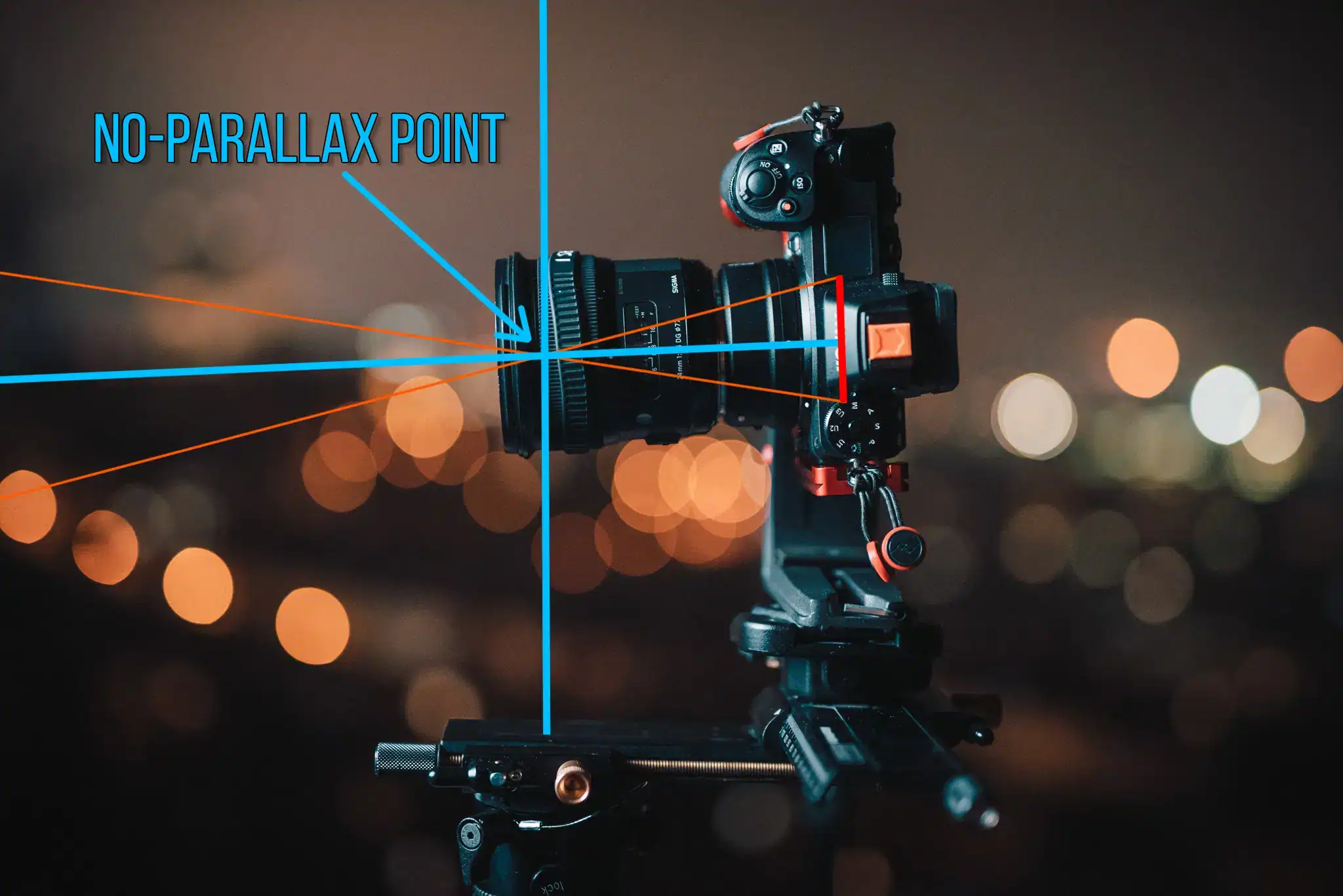
- Panoramic head: Align the lens’s entrance pupil (no-parallax point) over the rotation axis to eliminate foreground/background shifts. This is the single most important factor for clean stitches.
- Stable tripod with leveling base: A flat base lets you pan without drift and keeps your horizon true in the stitch.
- Remote trigger or app: Use a cable release or the OM Image Share app to avoid touching the camera. A 2-second self-timer is a good fallback.
Optional Add-ons
- Pole or car mount: Great for elevated 360s or drive-bys. Safety first — tether everything, beware wind load, and avoid high speeds. Expect more shots to compensate for micro-shake.
- Lighting for interiors: Small LED panels or bounced flash for balancing dark rooms (avoid mixed color temps where possible).
- Weather protection: Rain cover for the OM-1 and a microfiber towel. The body is weather-sealed, but dry optics are essential.
For deeper background on panoramic heads and nodal calibration, this concise tutorial is excellent at the end of your prep: Panoramic head fundamentals and setup.
Step-by-Step Shooting Guide
Standard Static Scenes
- Level and align: Level the tripod with a leveling base. On the pano head, align the entrance pupil of the Samyang 12mm so that nearby and distant objects do not shift relative to each other when you pan.
- Manual exposure and WB: Set M mode, choose a stable exposure based on mid-tones, and lock white balance (Daylight for sun, Tungsten for warm interiors, or a custom Kelvin). This prevents flicker and color shifts across frames.
- Focus: Switch to manual focus. Set focus near the hyperfocal distance. At f/8 on a 12mm, hyperfocal is about 1.2 m; everything from roughly 0.6 m to infinity will be acceptably sharp.
- Capture sequence:
- Efficient outdoor set: 6 shots around at 60° yaw steps, tilt 0°, ~30–35% overlap. Then 1 zenith and 1–3 nadir patch shots by shifting the camera around the tripod (or using a nadir adapter).
- Tricky interiors: 8 around at 0° plus 1 zenith. If ceilings are detailed, add a +45° row (8 shots). Finish with 2–3 nadir patches.
- Log your step angle: Note the detent click or rotator index so you can reproduce the pattern for batch shooting.
HDR / High Dynamic Range Interiors
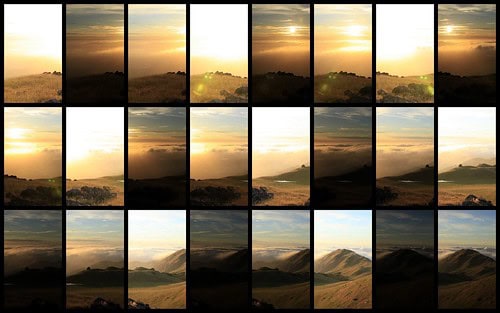
- Bracket exposure: Use AEB at ±2 EV (3 or 5 frames). The OM-1’s bracketing is quick; keep WB locked. Expose for windows on the bright frame; the darkest frame should hold the highlights.
- Consistent sequence: Shoot all brackets per yaw position before rotating to the next. Keep your hands off the tripod — use a remote. Later, fuse in PTGui or your HDR tool before stitching if preferred.
- Check histogram: Ensure you’re not clipping channels in the highlight frame. Recover shadows from the lower exposures.
Low-Light / Night Scenes
- Stable exposure: Start at f/4–f/5.6, 1/30–1/60s, ISO 400–800. If stars or city lights require it, extend shutter instead of pushing ISO beyond 1600 on the OM-1 for cleaner results.
- Disable IBIS on tripod: The OM-1’s IBIS is outstanding handheld, but on a tripod it can introduce micro-shifts. Turn it off to keep frames perfectly aligned.
- Avoid flicker: Under LED or mixed lighting, prefer mechanical or EFCS shutter over fully electronic to reduce banding, and keep WB fixed.
Crowded Events
- Two passes strategy: Shoot one full sequence quickly to lock coverage, then repeat as people move to capture cleaner background zones.
- Masking plan: In post, blend the best frames for each area. Prioritize consistent exposure and camera position to ease masking.
- Faster shutter: Use 1/200s+ and ISO 800–1600 if you must freeze motion; noise is easier to fix than ghosting.
Special Setups (Pole / Car / Drone)
- Pole: Use a lightweight carbon pole. Keep the set short in wind. A single-row 6–8 around may suffice, but shoot extra for safety. Always tether the pole and protect bystanders.
- Car mount: Shoot in a controlled area at low speeds. Expect vibration; increase shutter speed to 1/500s+ and consider slightly higher ISO. Leave IBIS on only if testing shows improved sharpness and no frame-to-frame shift issues.
- Drone: If adapting the workflow to drones, lock exposure and WB, and shoot overlapping rows; stitch as equirectangular later.
Recommended Settings & Pro Tips
Exposure & Focus
| Scenario | Aperture | Shutter | ISO | Notes |
|---|---|---|---|---|
| Daylight outdoor | f/8–f/11 | 1/100–1/250 | 100–200 | Lock WB (Daylight); manual focus near hyperfocal |
| Low light / night | f/4–f/5.6 | 1/30–1/60 | 400–800 | Tripod + remote; turn IBIS off on tripod |
| Interior HDR | f/8 | Bracket ±2 EV | 100–400 | Balance windows and lamps; fix WB |
| Action / moving subjects | f/5.6–f/8 | 1/200+ | 400–800 (1600 if needed) | Freeze motion; consider two-pass shooting |
Critical Tips
- Manual focus: Use magnification to set the Samyang at ~1.2 m at f/8. Tape the ring to prevent drift.
- Find and mark the nodal point: With your pano head, place a nearby vertical object and a far object in the frame; pan and adjust the rail until their relative position doesn’t shift. Mark those rail measurements for the OM-1 + 12mm combo.
- White balance lock: Mixed lighting kills stitches. Set Kelvin or a preset; do not use Auto WB.
- RAW over JPEG: The OM-1’s RAW files give better highlight recovery for HDR panoramas and cleaner color across frames.
- IBIS and shutter modes: IBIS off on tripod; use EFCS or mechanical to avoid LED banding indoors.
- File management: Name and group sequences. For HDR, keep bracket orders consistent (e.g., 0, -2, +2).
Want a visual walkthrough of setting up a panoramic head? This step-by-step video pairs well with the method above:
For a deeper dive on professional head setup, also see: Oculus guide to setting up a panoramic head.
Stitching & Post-Processing
Software Workflow
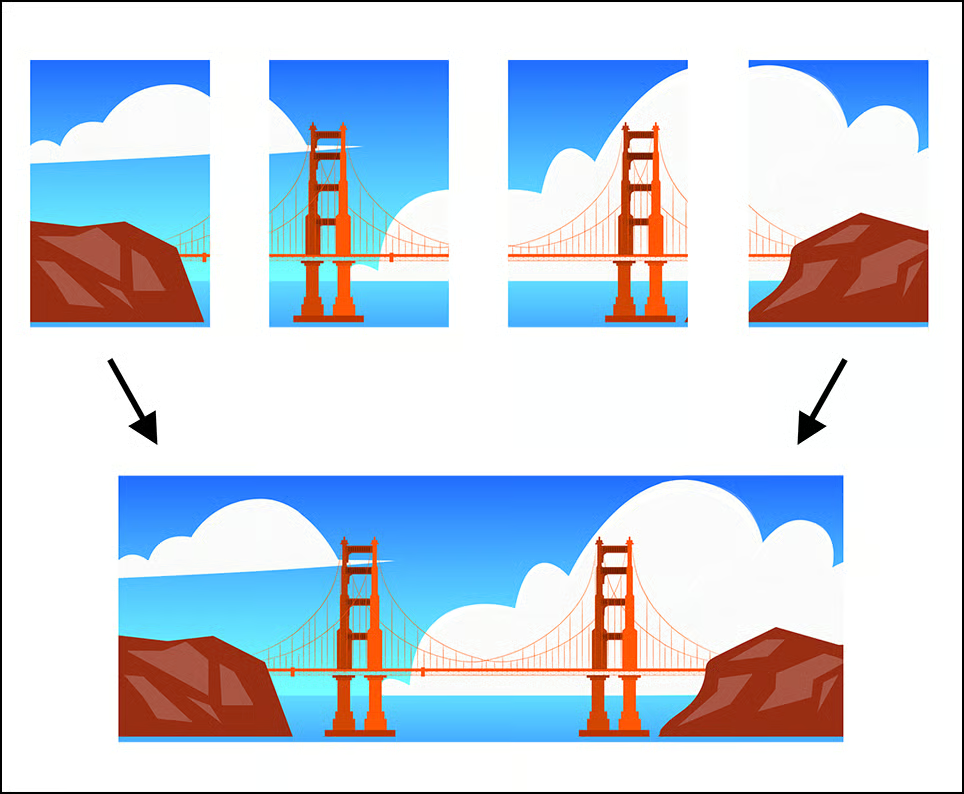
Import RAWs into Lightroom or your preferred converter. Apply consistent color and lens corrections (avoid auto vignetting changes frame-to-frame), then export to 16-bit TIFF. In PTGui or Hugin, set the lens type to fisheye and let the optimizer detect the projection. Fisheye captures usually need fewer frames but require correct lens modeling; rectilinear lenses need more frames but yield straighter lines. Aim for 25–35% overlap with fisheye and 20–25% with rectilinear. PTGui’s control point generator is excellent, and its HDR fusion is robust if you bracketing in-camera. For a balanced overview of PTGui’s strengths, see this review: PTGui reviewed for pro panoramas.
Cleanup & Enhancement
- Nadir patch: Use a dedicated nadir shot aligned in PTGui, or export to Photoshop for content-aware fill and cloning.
- Color consistency: Equalize white balance and remove color casts before stitching where possible; minor tweaks after stitching are easier.
- Noise reduction: For night panoramas, apply moderate NR in RAW, then finish with a subtle pass after stitching.
- Level horizon: Use the “Straighten” tool or set vertical control points so your equirectangular is level.
- Export: For VR, use 2:1 equirectangular at 8K–12K on this setup. If you shot dense multi-rows, 12K–16K is achievable.
If you’re new to DSLR/mirrorless 360 workflows, this platform guide is a practical primer: Using a DSLR or mirrorless to shoot and stitch a 360 photo.
Disclaimer: software updates change features and UI. Always check the latest documentation for PTGui, Hugin, and your RAW processor.
Useful Tools & Resources
Software
- PTGui panorama stitching
- Hugin open-source panorama toolkit
- Lightroom / Photoshop for RAW and retouch
- AI tripod removal or content-aware tools for nadir patches
Hardware
- Panoramic heads: Nodal Ninja, Leofoto multi-row gimbals
- Carbon fiber tripods with leveling bases
- Wireless remote shutters or intervalometers
- Pole extensions / car mounts with proper safety tethers
Disclaimer: brand names provided for search reference; please check official specs and current availability.
Real-World Case Studies with the OM-1 + 12mm Fisheye
Indoor Real Estate (Windows + Mixed Light)
Mount on a leveled pano head. Shoot 8 around at 0° tilt with ±2 EV bracketing, plus a zenith and 2–3 nadir patches. Lock WB (around 3800–4200K if warm lights dominate). In PTGui, enable HDR fusion and set lens type to fisheye. Result: clean window detail without halos, straight verticals maintained by setting vertical control points.
Outdoor Sunset Overlook
Use 6 shots around at 0°, 1 zenith, and a nadir patch. Expose for the mid-tones; if the sun is in-frame, bracket ±2 EV. The OM-1’s base ISO 200 keeps noise low. In post, blend to an equirectangular 12K if you want high detail. Add a soft gradient to manage the horizon contrast.
Event Crowd
Two-pass method: first pass for coverage at 1/250s, ISO 800, f/5.6. Second pass as people clear sections. In PTGui, use masks to reveal the cleaner pass for each sector. The fisheye’s wide coverage reduces the number of frames you need to juggle.
Rooftop Pole Shot
Telescoping pole with tether. Keep the shutter at 1/500s+, ISO 800–1600 if necessary. Shoot 6–8 around with small yaw increments for overlap. Expect small parallax due to flex — overshoot overlap to compensate and let the optimizer in PTGui resolve minor shifts.
Common Mistakes & How to Avoid Them
- Parallax error: Not aligning the entrance pupil on the pano head. Solution: calibrate and mark the rail once; recheck when changing plates.
- Exposure flicker: Shooting in auto mode or Auto WB. Solution: lock manual exposure and WB across the sequence.
- Tripod in frame: No nadir management. Solution: plan nadir patches with a shifted shot or a nadir adapter, then patch in post.
- Ghosting: People/trees moving across frames. Solution: two-pass shooting and use masks in the stitcher to pick clean regions.
- High-ISO noise: Pushing ISO too far at night. Solution: favor longer shutter and steady support; keep ISO ≤1600 when possible.
Frequently Asked Questions
-
Can I shoot handheld panoramas with the Olympus OM-1?
Yes for quick, non-critical results. Use high shutter speeds (1/250s+) and overlap 40–50%. However, for clean 360 stitches and precise VR output, a tripod with a panoramic head and proper nodal alignment is strongly recommended.
-
Is the Samyang 12mm f/2.8 Fish-Eye wide enough for single-row 360s on Micro Four Thirds?
It’s wide, but not as wide as a 180° MFT fisheye (e.g., 7.5mm). Outdoors you can often cover with 6 around + zenith + nadir. For detailed interiors or tight spaces, plan 8 around and consider an extra +45° row for the ceiling.
-
Do I need HDR for interiors with bright windows?
Usually yes. Bracket ±2 EV (3 or 5 frames) to preserve window views and clean shadow detail. The OM-1’s RAW files handle HDR merging well, and PTGui can fuse HDR during stitching.
-
How do I avoid parallax issues with this lens?
Use a panoramic head and align the entrance pupil: place a near object and a far object, pan the camera, and adjust the rail until their relative position stays fixed. Mark those rail positions for the OM-1 + Samyang 12mm for quick repeatability.
-
What ISO range is safe on the OM-1 in low light?
For professional 360 outputs, ISO 100–800 is ideal, ISO 1600 is acceptable, and ISO 3200 is an emergency upper bound. Prefer longer shutter speeds on a tripod to keep noise and banding controlled.
Further Reading
For more panoramic background and gear considerations, this thorough guide is worth a read: DSLR/mirrorless 360 FAQ and gear guide. You can also explore the math behind spherical resolution here: PanoTools: DSLR spherical resolution.