Why This Camera & Lens Are Great for Panoramas
The OM System Olympus OM‑1 is a tough, weather‑sealed Micro Four Thirds mirrorless camera with a stacked 20.4MP BSI sensor (approx. 3.3 µm pixel pitch). It delivers excellent color, strong image stabilization (up to 7–8 stops IBIS), and responsive handling—ideal traits for precise panoramic capture. The Canon RF 14–35mm f/4L IS USM is a pro‑grade full‑frame rectilinear ultra‑wide zoom. At 14mm it delivers a very wide 104° horizontal field of view, flat geometry (no fisheye bulge), and crisp detail across the frame when stopped to f/5.6–f/8.
Important compatibility note: a Canon RF lens cannot be mounted on an OM‑1 body (RF flange distance is 20 mm vs. Micro Four Thirds 19.25 mm, and there is no RF→MFT adapter with electronic aperture control). Practically, that means you have two workable options:
- Use the OM‑1 with an MFT ultra‑wide that matches the RF lens’s field of view (e.g., 7–14mm f/2.8 or 8–18mm f/2.8–4). 7mm on MFT ≈ 14mm on full frame.
- If you must use the Canon RF 14–35mm f/4L IS USM, shoot on a Canon RF‑mount camera body. Technique and shot counts below still apply because they’re driven by field of view and overlap, not brand.
This guide shows exactly how to shoot a clean, high‑resolution 360° panorama with the OM‑1 and a 14mm‑equivalent rectilinear view—whether you achieve it via OM‑1 + 7mm MFT lens or by using the RF 14–35 on an RF body. You’ll get field‑tested shot counts, exposure guidance, nodal point tips, and stitching workflow.
Quick Setup Overview
- Camera: Olympus OM‑1 — Micro Four Thirds (17.3×13 mm), 20.4MP stacked BSI sensor, approx. 12 EV base dynamic range, excellent IBIS. Base ISO 200; extended 80–102,400.
- Lens: Canon RF 14–35mm f/4L IS USM — rectilinear ultra‑wide zoom for full frame; very wide at 14mm, moderate barrel distortion at 14mm (correctable), sharp center to corner by f/5.6–f/8. Note: not mountable on OM‑1; use a 7mm MFT lens for equivalent FOV on OM‑1.
- Estimated shots & overlap (rectilinear, 30% overlap):
- 14mm on full frame (or 7mm on MFT): 8 shots around + 1 zenith + 1 nadir (10 total). For safer seams: 10–12 around in dynamic scenes.
- 20mm FF (~10mm MFT): 10–12 around + zenith + nadir.
- 35mm FF (~17mm MFT): 16–18 around + zenith + nadir; consider two rows for higher quality.
- Difficulty: Intermediate — Easy with a panoramic head; more advanced if doing multi‑row or hand‑held rescue work.
Planning & On-Site Preparation
Evaluate Shooting Environment
Scan for moving subjects (people, cars, leaves), strong backlight from the sun, reflective surfaces (glass, polished floors), and wind. For interiors with windows, expect a wide brightness range; plan HDR bracketing. Shooting through glass? Get the lens as close as possible (1–2 cm) at a slight angle to reduce reflections, and use a black cloth hood. Avoid tripod shadows by selecting a time when the sun is higher or by planning a clean nadir patch later.
Match Gear to Scene Goals
Why OM‑1 works: excellent color and highlight handling at base ISO, 20MP is plenty for single‑row 360s, and weather sealing helps outdoors. Use ISO 200–800 for most panos; 1600 is workable at night with proper exposure. If you’re using a 14mm field of view (RF 14–35 on RF body or ~7mm on OM‑1), you can complete a single‑row 360 with fewer frames than longer focal lengths, saving time and reducing ghosting risk.
Pre-shoot Checklist
- Charge batteries, clear cards, clean front/rear elements and sensor.
- Level tripod, confirm panoramic head calibration (entrance pupil alignment) for your lens setting.
- Safety: secure on rooftops; weigh down tripod in wind; use tethers on poles or car mounts.
- Backup workflow: when time allows, shoot a second, faster pass for insurance.
Essential Gear & Setup
Core Gear
- Panoramic head: Align the lens’s entrance pupil (often called the nodal point) over the rotation axis to avoid parallax. This ensures foreground and background line up during stitching.
- Stable tripod with a leveling base: A bubble level or half‑ball makes the horizon consistent across frames and speeds up stitching.
- Remote trigger or app (OM Image Share): Prevents vibration and simplifies bracketing.
Optional Add-ons
- Pole or car mount: Always use a safety tether; watch wind loads. Rotate more slowly and consider higher shutter speeds to beat vibration.
- Lighting aids: Small LED panels or flash bounced carefully in interiors to gently lift shadows without creating hotspots.
- Weather covers: Rain sleeves, silica gel, and taped seams for dust or spray.
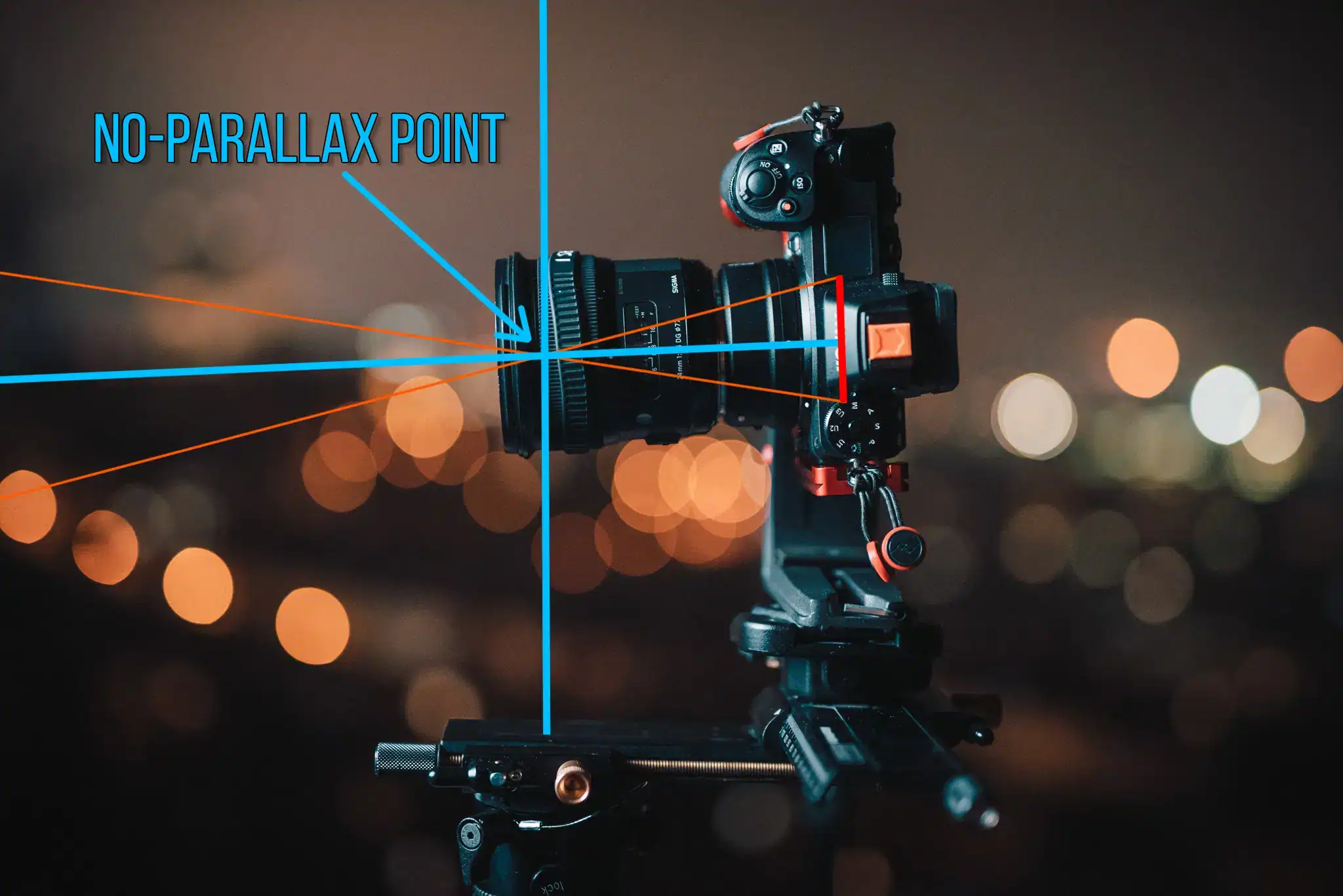
For a deep primer on panoramic heads and alignment techniques, see this panoramic head tutorial. Panoramic head setup guide
Step-by-Step Shooting Guide
Standard Static Scenes
- Level tripod and align the entrance pupil: With your lens at 14mm FF (or 7mm MFT), set up two light stands (near and far) and pan left-right. Adjust the rails until the relative position of the two does not shift as you pan. Mark the scale positions for repeatability.
- Manual exposure and locked white balance: Meter for the midtones (avoid clipping highlights). Set manual mode, fix WB (Daylight/Tungsten/Kelvin) so color doesn’t vary between frames.
- Capture with tested overlap: At 14mm FF or 7mm MFT, shoot 8 frames around at 45° increments with 25–35% overlap. Add one zenith and one nadir. Use a 2–s timer or remote.
- Nadir shot: Tilt up the camera for the zenith, then either tilt or move the tripod a few centimeters and shoot the nadir for an easier tripod patch.
HDR / High Dynamic Range Interiors
- Bracket ±2 EV (3–5 frames): This balances bright windows against interior shadows. Keep aperture fixed; vary shutter speed only.
- Lock WB and focus: Consistency is key; mixing auto WB across brackets causes visible seams in windows or wall transitions.
Low-Light / Night Scenes
- Use a sturdy tripod, IBIS off, and longer exposures. With the OM‑1, aim for ISO 200–800. ISO 1600 can work if you expose to the right and denoise later.
- Use a remote or a 2‑second timer to avoid shake. If wind is strong, lower the center column and add weight to the tripod hook.
Crowded Events
- Do two passes: first fast pass for coverage, second pass during movement lulls for cleaner overlaps.
- Mask in post: In PTGui/Hugin, prioritize control points and use masks to keep the clean subject positions.
Special Setups (Pole / Car / Drone)
- Pole: Use lighter gear, a safety line, and higher shutter speeds (1/250–1/500). Spin slowly to reduce motion blur and wobble.
- Car mount: Park safely; avoid vibrations by shutting engine off; brace mount and use faster shutter speeds or higher ISO within the OM‑1’s safe range.
Case Study: Indoor Real Estate
OM‑1 on a panoramic head; 7mm MFT (14mm FF equivalent). Shoot 8 around + Z + N, bracketing ±2 EV for windows. Aperture f/8, base ISO 200, shutter floats between 1/2–1/30 s. Stitch HDR first, then merge the spherical pano. The result is a clean 360 ready for virtual tour platforms with minimal ghosting.
Case Study: Outdoor Sunset Viewpoint
Arrive 30 minutes early to lock in your nodal settings and composition. Expose for highlights to keep sunset color. Use ISO 200–400, f/8, and shutters 1/30–1/200 s as light drops. Consider a second bracketed round for extra highlight detail near the sun.
Case Study: Rooftop Pole Shot
Use a carbon pole with safety tether. Balance wind by lowering the pole slightly and increasing shutter speed. Shoot a fast single‑row set at 7mm MFT to minimize parallax risk. Expect to do more masking in post versus a tripod‑mounted capture.
Recommended Settings & Pro Tips
Exposure & Focus
| Scenario | Aperture | Shutter | ISO | Notes |
|---|---|---|---|---|
| Daylight outdoor | f/8–f/11 | 1/100–1/250 | 100–200 | Lock WB (daylight). Avoid clipping highlights on bright clouds. |
| Low light/night | f/4–f/5.6 | 1/30–1/60 (or longer on tripod) | 200–800 (up to 1600 with care) | Turn IBIS off on tripod. Use remote/timer. |
| Interior HDR | f/8 | Bracket ±2 EV | 100–400 | Expose windows and shadows; merge HDR before stitching. |
| Action / moving subjects | f/5.6–f/8 | 1/200+ | 400–800 | Faster shutter to freeze people; shoot two passes. |
Critical Tips
- Manual focus: Focus once at the hyperfocal distance (e.g., 7mm MFT at f/8 ≈ 0.7–1.0 m) and switch to MF to prevent focus breathing between frames.
- Nodal point calibration: Mark your panoramic head rails for your 7mm MFT and/or 14mm FF settings. Recheck after zoom changes; entrance pupil shifts with focal length.
- White balance lock: Use a fixed Kelvin value or a preset; avoid AWB shifts that cause banding in sky or wall gradients.
- RAW over JPEG: RAW keeps dynamic range for HDR and fine color work; JPEGs increase the risk of visible seams and banding when blended.
- IBIS/IS: Turn off on tripod to prevent sensor micro‑drift; for pole shots, leaving stabilization on can help at faster shutters.
Stitching & Post-Processing
Software Workflow
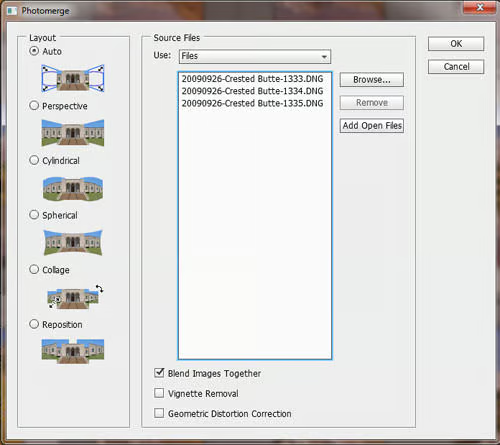
Import RAWs, apply lens corrections (barrel distortion and vignetting are noticeable at 14mm FF), sync exposure/WB across the set, then export to a high‑bit TIFF for stitching. PTGui and Hugin are industry‑standard for spherical panoramas. For rectilinear lenses, aim for 20–30% overlap; fisheyes can use 25–30% and fewer shots. Use control points on high‑contrast edges and refine horizon/verticals with optimizer tools. PTGui overview and review
Cleanup & Enhancement
- Tripod/nadir patch: Shoot a dedicated nadir frame; patch with a logo or clone in Photoshop. Many virtual tour platforms support AI‑assisted tripod removal.
- Color and noise: Balance interior/exterior color temperatures; denoise high ISO night scenes gently to preserve detail.
- Level and straighten: Correct yaw/pitch/roll and ensure a level horizon to avoid viewer nausea in VR.
- Export: Equirectangular 2:1 JPEG (8,192×4,096 or larger) for web/VR, or layered TIFF for archival edits.
For a platform‑level walkthrough of DSLR/mirrorless 360 capture and stitching, Meta’s creator guide is a solid reference. Using a DSLR/Mirrorless to shoot and stitch a 360 photo
Video: Pano Head Setup Essentials
Prefer learning visually? This video distills core techniques for cleaner 360s with a pano head.
Useful Tools & Resources
Software
- PTGui panorama stitching
- Hugin (open source)
- Lightroom / Photoshop for RAW, color, and nadir cleanup
- AI tripod removal tools in virtual tour platforms
Hardware
- Panoramic heads: Nodal Ninja, Leofoto
- Carbon fiber tripods with leveling bases
- Wireless remote shutters
- Pole extensions / car suction mounts with safety tethers
Disclaimer: software/hardware names provided for search reference; check official sites for details.
If you’re new to building 360 capture rigs from DSLR/mirrorless components, this practical FAQ is helpful. Virtual tour camera and lens FAQ
Common Mistakes & How to Avoid Them
- Parallax error → Always align the entrance pupil. Even small misalignments cause ghosting on nearby objects.
- Exposure flicker → Shoot in full manual and lock WB; don’t mix auto settings mid‑pan.
- Tripod shadows or footprints → Plan sun angle and shoot a clean nadir frame for easy patching.
- Ghosting from movement → Take a second pass and use masks in PTGui/Hugin to keep the clean subject.
- High ISO noise at night → Keep ISO ≤800 when possible. Lengthen exposure on a sturdy tripod; bracket instead of pushing ISO.
- Forgetting stabilization settings → Turn IBIS/IS off on tripod to avoid micro‑jitters in long exposures.
Frequently Asked Questions
- Can I mount the Canon RF 14–35mm f/4L IS USM on the Olympus OM‑1?
No. There is no practical RF→Micro Four Thirds adapter with aperture/electronics, and the flange distances are incompatible. Use a 7–14mm MFT lens on the OM‑1 for equivalent FOV, or use the RF 14–35 on a Canon RF body and follow the same pano technique.
- Is 14mm wide enough for a single‑row 360?
Yes, in most cases. At 14mm FF (or ~7mm MFT), 8 shots around plus zenith and nadir works well with 25–35% overlap. In tight interiors or when you need cleaner zenith coverage, add a second row or increase around shots to 10–12.
- Do I need HDR for interiors with bright windows?
Usually. Bracket ±2 EV (3–5 frames) to hold window detail and interior shadows. Merge HDR per angle first (in Lightroom/Photomatix), then stitch the tone‑mapped set for a natural, balanced result.
- How do I avoid parallax issues with an ultra‑wide zoom?
Calibrate the entrance pupil at the exact focal length you’ll use (e.g., 7mm MFT or 14mm FF). Mark your pano head rails. Re‑check if you change focal length because the entrance pupil shifts as you zoom.
- What ISO range is safe on the OM‑1 in low light?
Base ISO 200 gives best dynamic range. ISO 400–800 is safe for most night panos on a tripod. ISO 1600 is usable with careful exposure and denoising, but bracketing and longer shutters usually yield cleaner files.
- Can I set a custom mode for pano on the OM‑1?
Yes. Save a custom mode with manual exposure, fixed WB, MF, IBIS off, 2‑s timer, and your preferred aperture. This speeds repeatable results when moving between locations.
- Handheld 360s with the OM‑1—possible?
Yes for partial panoramas or emergency 360s, but expect stitching challenges. Use very high overlap, fast shutters (1/250+), and keep parallax‑heavy foregrounds out of overlaps. Tripod + pano head is strongly recommended for pro results.
- Best tripod head choice for this setup?
A 2‑axis panoramic head with fore‑aft and lateral rails (e.g., Nodal Ninja style) lets you center the entrance pupil and rotate precisely. Add a leveling base to keep your horizon straight across frames.
Safety, Limitations, and Honest Advice
Lens/body compatibility matters: because you can’t mount RF glass to the OM‑1, invest in a native MFT ultra‑wide to realize the same field of view and all the benefits of the OM‑1’s ergonomics and IBIS. The OM‑1’s 20MP sensor is excellent for web and VR tours; for gigantic wall prints or gigapixel panos, consider multi‑row techniques or the OM‑1’s Tripod High‑Res mode in static scenes (watch for moving elements that can create artifacts).
On rooftops and poles, always tether gear, keep bystanders clear, and monitor wind gusts. On cars, use proper suction mounts with safety lines and never shoot on public roads where it’s unsafe or illegal. Back up your captures immediately—ideally to two places (card + phone/tablet, or card + portable SSD) before leaving the location.
Field-Equivalent Setups
If your goal is “how to shoot panorama with Olympus OM‑1 & Canon RF 14–35mm f/4L IS USM,” the practical pathway is to match angle of view:
- OM‑1 path: Use an MFT lens at 7mm to mimic 14mm FF. Examples: 7–14mm f/2.8, 8–18mm f/2.8–4, or a rectilinear prime around 7–8mm.
- Canon path: Use the RF 14–35 on an RF body at 14mm and follow the same shot counts/overlap.
Regardless of brand, your pano success hinges on entrance pupil alignment, consistent exposure/white balance, and adequate overlap—not the logo on the body. For a structured pano head setup refresher, see this step‑by‑step. Set up a panoramic head for high‑end 360 photos
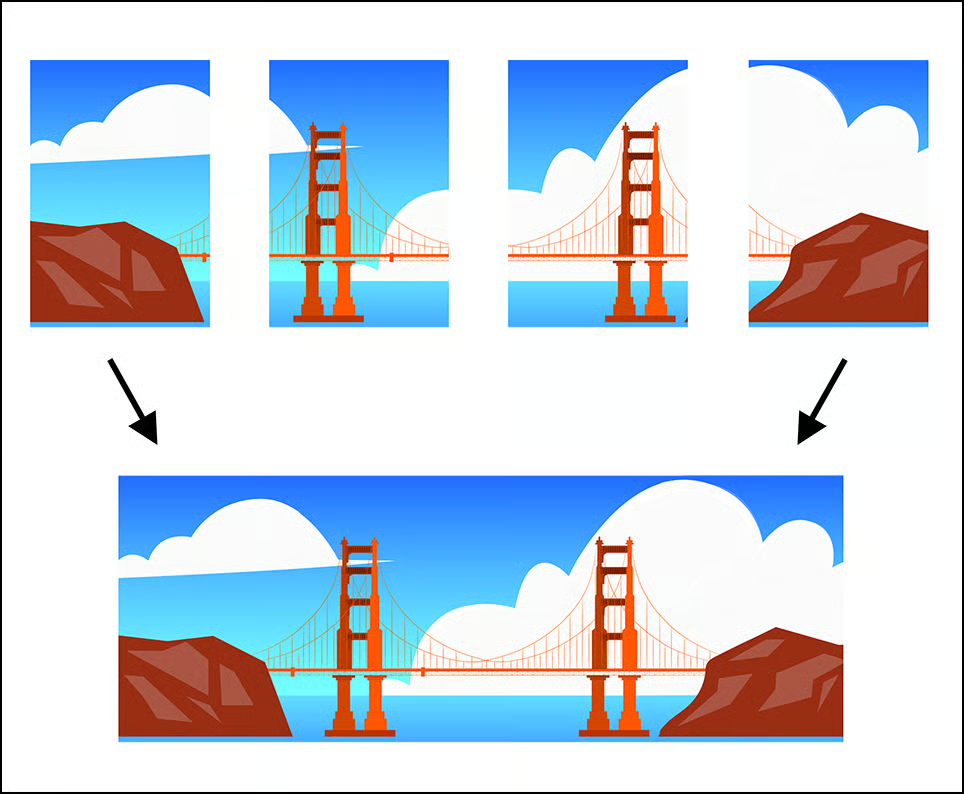
Behind-the-Scenes Illustration