Why This Camera & Lens Are Great for Panoramas
If you’re wondering how to shoot panorama with Olympus OM-1 & Canon EF 8-15mm f/4L Fisheye USM, the short answer is: it’s a compact, high-quality, highly flexible combo when you use the right adapter and technique. The OM SYSTEM Olympus OM-1 is a 20.4MP Micro Four Thirds mirrorless camera with a stacked BSI sensor, excellent in-body image stabilization (IBIS), and reliable ergonomics for tripod work. Its sensor (17.3 × 13.0 mm) provides about 12 stops of usable dynamic range at base ISO, and its pixel pitch is approximately 3.3 µm—enough to resolve fine detail in a stitched 360 photo without bloating file sizes.
The Canon EF 8–15mm f/4L Fisheye USM is an ultra-wide fisheye zoom. On a full-frame body it can produce a circular 180° image at 8mm and a diagonal fisheye at 15mm, but on the OM-1 (2× crop) it behaves as a diagonal fisheye across the zoom range with a somewhat narrower field of view than on full frame. The fisheye projection is a major advantage for 360 photography because it reduces the number of images you need to capture, which speeds up shooting and lowers the risk of moving objects causing stitching errors. Expect some lateral chromatic aberration (typical of fisheyes) and strong perspective curvature at the edges—both manageable in post.
Compatibility note: You’ll need an EF-to-Micro Four Thirds electronic adapter to control aperture (e.g., Metabones EF–MFT Smart Adapter, Viltrox EF–M1/M2). Autofocus is not necessary for panoramas; manual focus is best. With the adapter, the combo is slightly longer and heavier than native MFT fisheyes, but still tripod-friendly.
Quick Setup Overview
- Camera: Olympus OM-1 — Micro Four Thirds, 20.4MP stacked BSI CMOS, strong IBIS, base ISO 200 (LOW available), ~12 EV DR at base.
- Lens: Canon EF 8–15mm f/4L Fisheye USM — fisheye zoom, sharp from f/5.6–f/8, moderate lateral CA, no IS; requires EF–MFT electronic adapter for aperture control.
- Estimated shots & overlap on OM-1:
- At 8mm: 6 around (60° steps) + zenith + nadir (≈8 total), ~25–30% overlap.
- At 10–12mm: 8 around + zenith + nadir (≈10 total), ~30% overlap.
- At 15mm: 10–12 around + zenith + nadir (≈12–14 total) for higher resolution.
- Difficulty: Moderate (easy capture, but requires nodal alignment and clean post-processing).
Planning & On-Site Preparation
Evaluate Shooting Environment
Read the light, the motion, and the reflective surfaces before you set up. For interiors, look for mixed lighting (tungsten + daylight) and bright windows that will require HDR bracketing. Near glass walls, keep the lens 30–50 cm away to reduce double reflections. Outdoors, check sun position—flares are common with fisheyes. For crowds, anticipate movement and plan double passes around the pano head to capture clean plates for masking.
Match Gear to Scene Goals
The OM-1’s DR and low-noise ISO 200–800 range suit both daylight and interior HDR work. The EF 8–15mm fisheye reduces shot count—great for events, rooftop poles, or car-mounted captures where time is critical. The trade-off is fisheye curvature; straight lines will bow, but this has negligible impact in an equirectangular 360 photo. For architecture where straight edges are crucial, consider shooting at 12–15mm and increasing shot count to raise effective resolution and reduce edge stretching.
Pre-shoot Checklist
- Charge batteries and bring spares; format fast UHS-II cards.
- Clean front element carefully; fisheye glass is exposed and prone to fingerprints.
- Level the tripod; verify panoramic head calibration marks for this lens/adapter.
- Safety: secure tripod with a weight bag in wind; tether gear on rooftops/poles/car mounts.
- Backup plan: shoot an extra full rotation at a different exposure or slightly different yaw to save a take if people or cars cause ghosting.
Essential Gear & Setup
Core Gear
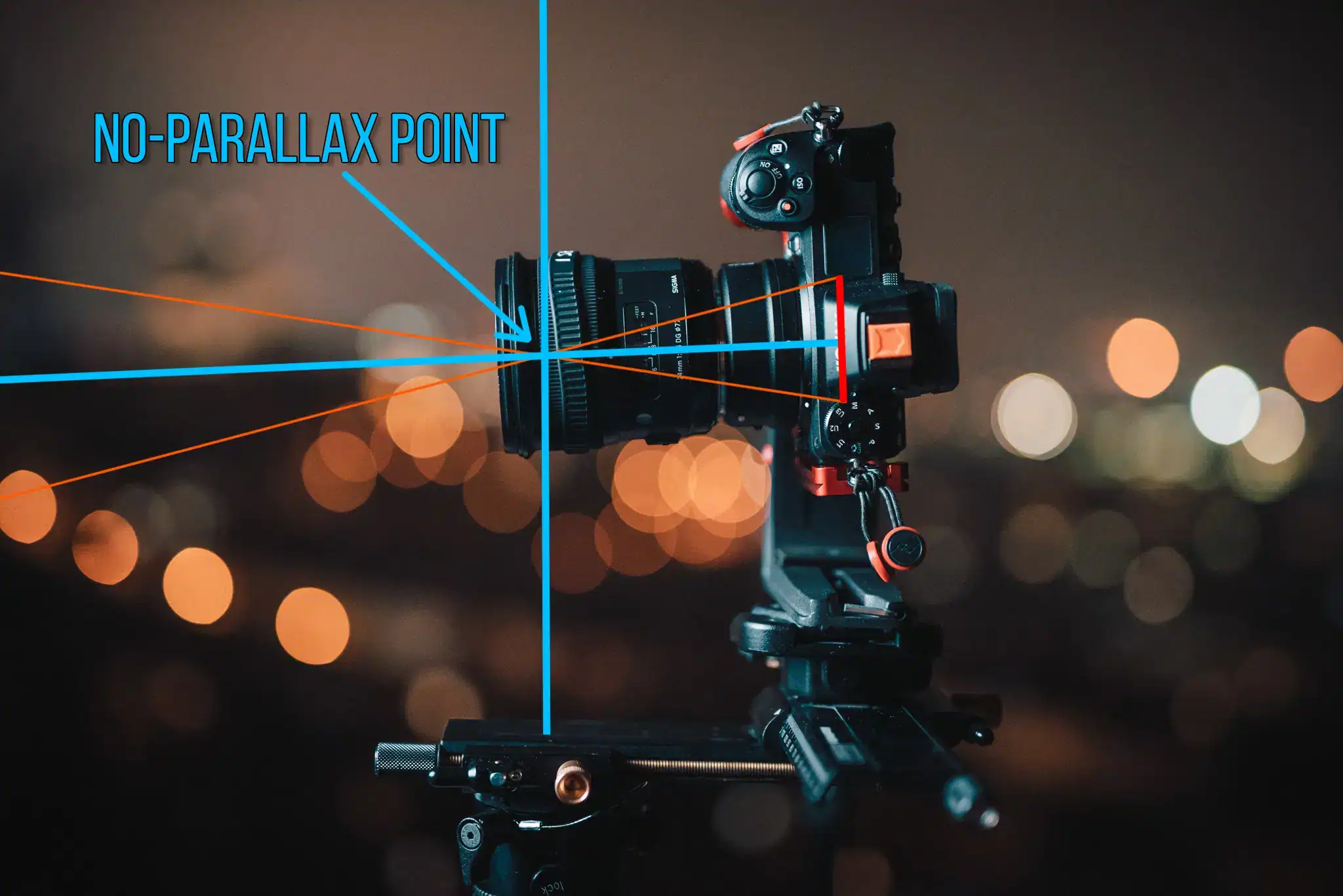
- Panoramic head: A two-axis head lets you place the lens’s entrance pupil (nodal point) over the rotation axis to eliminate parallax. This is critical when foreground objects are near.
- Stable tripod with leveling base: A leveling base speeds setup and keeps horizons straight, simplifying stitching.
- Remote trigger or mobile app: Fire the shutter without touching the camera to avoid blur. A 2-second delay also works.
Optional Add-ons
- Pole or car mount: Fantastic for elevated or moving viewpoints. Use a safety tether. Beware wind and vibration; use higher shutter speeds.
- Lighting aids: Small LED panels for interiors; keep intensity consistent and avoid mixing color temperatures.
- Weather protection: Rain covers, lens hood (if it doesn’t vignette), microfiber cloths for mist or sea spray.
Calibration tip: With the EF 8–15mm on an EF–MFT adapter, your fore-aft rail settings differ from native MFT lenses. As a starting point, at 8mm we’ve found the entrance pupil to be roughly 6 cm in front of the sensor plane mark (Φ), and slightly farther (~7–7.5 cm) toward 12mm. Fine-tune on-site with the classic near/far alignment test.
Further reading on panoramic head setup: Comprehensive panoramic head tutorial (360 Rumors).
Step-by-Step Shooting Guide
Standard Static Scenes
- Level and align: Level the tripod with a bubble or leveling base. Mount the pano head. Adjust fore-aft so the entrance pupil is above the yaw axis. Confirm with the near/far test: rotate left/right while watching if near and far objects shift relative to each other—if they do, adjust and test again.
- Manual exposure and WB: Meter the brightest part you must preserve (e.g., sky or window) and set manual exposure. Lock white balance (daylight/tungsten/kelvin) to avoid color shifts between frames.
- Capture sequence:
- At 8mm: 6 shots around (every 60°), then tilt up for a zenith, and down for a nadir.
- Rotate consistently; overlap edges by 25–30% minimum.
- Nadir capture: Either shoot an extra offset nadir frame after moving the tripod slightly, or plan to patch the tripod in post.
HDR / High Dynamic Range Interiors
- Bracket ±2 EV (3–5 frames): Keep shutter speed as the bracketing variable. Aperture and ISO must stay fixed across the set.
- Lock WB and focus: Inconsistent WB across brackets can confuse the stitcher; keep it locked and use manual focus.
- Workflow: Shoot the entire rotation at middle exposure, then repeat for under/over, or use in-camera bracketing if it’s consistent and fast.
Low-Light / Night Scenes
- Use tripod stability: Disable IBIS on tripod to prevent micro-blur from sensor movement. Use a remote release or 2-sec timer.
- Exposure guidance on OM-1: Start at f/4–f/5.6, ISO 200–800, and lengthen shutter as needed. ISO 1600 is usable in a pinch but prefer longer shutter at ISO ≤800 for cleaner skies and shadows.
- Watch for LED banding under electronic shutter; use mechanical shutter if you see stripes.
Crowded Events
- Two passes strategy: First pass quickly captures all angles; second pass waits for gaps to get a “clean plate.”
- High shutter speed: 1/200s or faster reduces ghosting of moving people/flags.
- Mask in post: Blend clean areas from pass two over ghosted regions from pass one.
Special Setups (Pole / Car / Drone)
- Pole: Use a light carbon pole; keep the rig as light as possible. Use a safety tether. Start with 1/250s at ISO 400 to counter pole flex and wind.
- Car mount: Ensure robust suction mounts and a safety line. Increase overlap slightly (30–40%) to tolerate motion between shots. Avoid busy traffic for fewer moving occlusions.
- Drone: This lens is not drone-compatible; for aerials, use native gimbal setups with automated spherical programs.
Field-Tested Mini Case Studies
Indoor Real Estate
At 8mm, shoot 6 around + Z + N, bracketed ±2 EV. Lock WB to a Kelvin value (e.g., 4000–4500K for mixed LED/tungsten). Keep the camera at ~1.3 m height to avoid heavy ceiling/floor dominance.
Outdoor Sunset
Expose for highlights; bracket if necessary. Shield the lens with your hand off-frame to reduce flare. Consider doing the sky as a separate, quicker pass in case the sun drops fast.
Rooftop on a Pole
Use 6 around only (skip zenith if the sky is clean and you can fill it in post). Shutter at 1/250–1/500s, ISO 400–800; accept a bit more noise for sharpness.
Recommended Settings & Pro Tips
Exposure & Focus
| Scenario | Aperture | Shutter | ISO | Notes |
|---|---|---|---|---|
| Daylight outdoor | f/8–f/11 | 1/100–1/250 | 200 | Set WB to Daylight or 5600K |
| Low light/night | f/4–f/5.6 | 1/30–1/60 (tripod) | 200–800 | Remote trigger; disable IBIS on tripod |
| Interior HDR | f/8 | Bracket ±2 EV | 100–400 | Preserve window highlights |
| Action / moving subjects | f/5.6–f/8 | 1/200+ | 400–800 | Freeze motion; do a second clean pass |
Critical Tips
- Manual focus at hyperfocal: At 8mm f/8 on Micro Four Thirds, hyperfocal distance is roughly 0.6 m. Set focus just shy of 1 m and everything from ~0.3 m to infinity is sharp.
- Nodal calibration: Mark your fore-aft rail once dialed in (e.g., ~6 cm from sensor plane at 8mm; ~7–7.5 cm near 12mm). Re-check after changing focal length.
- White balance lock: Use a fixed Kelvin value to avoid stitching seams from color shifts.
- Shoot RAW: You’ll need the latitude for HDR merges, defringing CA, and evening out sky gradients.
- IBIS on/off: On tripod, turn IBIS off. Handheld panos are possible, but expect more stitching errors—use faster shutter and more overlap.
- Avoid Hi-Res Shot for panos: Sensor-shift composites change between frames and complicate stitching.
Stitching & Post-Processing
Software Workflow
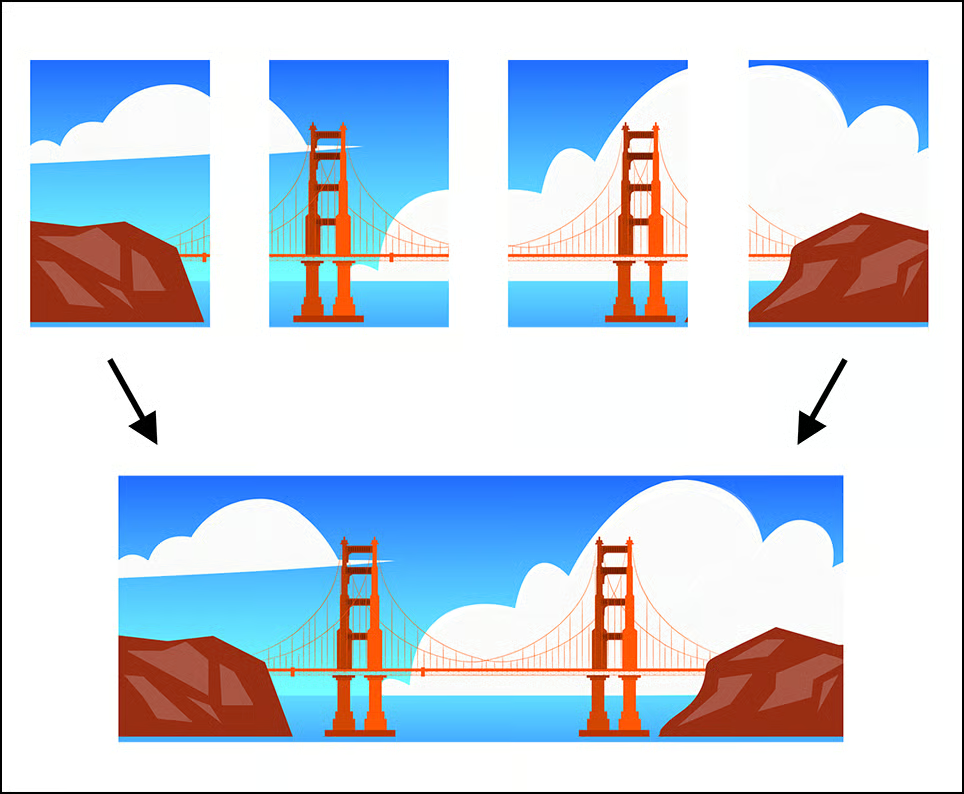
Import RAWs, apply consistent lens corrections and WB, then export to 16-bit TIFF for stitching. PTGui is the industry standard for speed and control; Hugin is a capable open-source alternative. With a fisheye, the stitcher finds control points easily, but you still need adequate overlap (aim for 25–30%). Once stitched, level the horizon and set the panorama center. For a deeper dive into software pros/cons, see this review: PTGui as a professional panorama tool (Fstoppers).
Cleanup & Enhancement
- Nadir patch: Use a separate nadir shot or AI-based patching. Clone/heal remaining tripod shadows.
- Defringe and denoise: Remove lateral CA typical of fisheyes; for low-light, apply moderate noise reduction at the end.
- Color and contrast: Balance sky and ground; avoid over-saturating the horizon.
- Export: 8K–12K equirectangular JPEG for web/VR; keep a master 16-bit TIFF for archive. Many VR platforms accept standard 2:1 equirectangular images.
Performance note: The EF 8–15mm on OM-1 reduces required frames compared to rectilinear lenses, which speeds stitching and lowers error rates, especially for handheld or crowd scenes. For background on capture geometry and resolution trade-offs, see Panotools: DSLR spherical resolution.
Video: From Capture to Stitch
Prefer to see the process? This practical walkthrough covers a full capture-to-stitch flow with a panoramic head and fisheye lens.
For an alternative step-by-step guide written for creators, see: Using a DSLR or mirrorless camera to shoot and stitch a 360 photo (Meta/Oculus Creator).
Useful Tools & Resources
Software
- PTGui panorama stitching
- Hugin open source stitcher
- Lightroom / Photoshop for RAW and cleanup
- AI tripod removal tools (Content-Aware Fill, generative remove)
Hardware
- Panoramic heads (Nodal Ninja, Leofoto)
- Carbon fiber tripods with leveling bases
- Wireless remote shutters
- Pole extensions / car mounts with tethers
Disclaimer: software/hardware names provided for search reference; check official sites for details.
Common Mistakes & How to Avoid Them
- Parallax error: Misaligned entrance pupil. Solution—calibrate and lock your pano head settings.
- Exposure flicker: Different exposures or WB between frames. Solution—manual exposure and locked white balance.
- Tripod shadows: Plan a nadir shot or patch it later with a clean plate.
- Ghosting from moving subjects: Shoot two passes; mask in post.
- Night noise: Keep ISO ≤800 when possible; use longer shutter on tripod and turn off IBIS.
- Adapter missteps: Without an electronic EF–MFT adapter you can’t set aperture on the EF 8–15. Confirm control before heading out.
Frequently Asked Questions
- Can I shoot handheld panoramas with the Olympus OM-1?
Yes, but expect more stitch errors. Use faster shutter speeds (1/200s+), more overlap (35–40%), and keep the camera rotating around your body as steadily as possible. For professional results, a tripod and pano head are strongly recommended.
- Is the Canon EF 8–15mm wide enough for single-row 360s on OM-1?
At 8mm on Micro Four Thirds, it’s effectively a diagonal fisheye that covers a lot, but not as much as an 8mm circular on full frame. A single row of 6 around plus zenith and nadir is reliable. For maximum quality, consider 8 around if you have complex foregrounds.
- Do I need HDR for interiors with bright windows?
Usually, yes. Bracket ±2 EV (3–5 exposures) to preserve window highlights and interior shadow detail. Merge HDR before or during stitching depending on your software workflow.
- How do I avoid parallax issues with this lens and adapter?
Use a calibrated panoramic head. Start with the entrance pupil roughly 6 cm forward of the sensor plane at 8mm (adjust for your adapter), then fine-tune with the near/far test. Mark your rails so you can repeat the setup quickly.
- What ISO range is safe on the OM-1 in low light?
For tripod-based panoramas, keep ISO 200–800 for clean results. ISO 1600 is usable in a pinch, but plan for more noise reduction. If possible, lengthen the shutter instead of pushing ISO.
Safety, Limitations, and Final Thoughts
This setup can deliver excellent 360 photos: the OM-1 is rugged and compact, and the EF 8–15mm fisheye keeps shot counts low. Always verify that your EF–MFT adapter gives you reliable aperture control before the shoot, protect that front element (no front filters), and tether your gear on rooftops or poles. Avoid Hi-Res sensor-shift modes for panos, and disable IBIS on a locked tripod.
If you want to go deeper into best practices for panoramas with DSLRs and mirrorless bodies, check this overview: Best techniques to take 360 panoramas (Photo.SE). For a structured pan-head setup playbook, the principles here are rock solid: Set up a panoramic head for high-end 360 photos (Meta/Oculus).