Why This Camera & Lens Are Great for Panoramas
The Olympus OM-1 paired with the AstrHori 12mm f/2.8 Fisheye is a compact, lightweight, and highly capable combo for shooting immersive 360° photos and gigapixel panoramas. The OM-1’s stacked BSI 20MP Micro Four Thirds sensor (approx. 17.3×13mm, ~3.3 µm pixel pitch) delivers clean files with good dynamic range at base ISO, while its class-leading in-body stabilization (IBIS) helps for hand-held tests and low-light composition. The AstrHori 12mm f/2.8 is a manual-focus diagonal fisheye that gives an ultra-wide field of view on Micro Four Thirds—wide enough to reduce shot count versus rectilinear lenses, yet still sharp across most of the frame when stopped down to f/5.6–f/8. This means faster capture, fewer stitch seams, and simpler post.
Fisheye lenses trade geometric linearity for coverage: they bend straight lines but capture much more scene in each frame. For 360° work, that’s a plus—you’ll take fewer images and stitching software can handle fisheye projections well. The OM-1 is mirrorless with precise live-view magnification and focus peaking, which makes manual focus easy. The lens is fully mechanical, so exposure and focus consistency are in your hands—perfect for panoramas where we want repeatable frames, locked white balance, and consistent overlap.
Quick Setup Overview
- Camera: Olympus OM-1 — 20MP stacked BSI Micro Four Thirds sensor; strong IBIS; excellent weather sealing; good dynamic range at base ISO 200.
- Lens: AstrHori 12mm f/2.8 Fisheye — manual focus; diagonal fisheye projection; best sharpness around f/5.6–f/8; minor chromatic aberration typical of fisheyes, correctable in post.
- Estimated shots & overlap (tested guidance):
- Single row: 6 shots around at 60° yaw spacing with ~25–30% overlap, plus 1 zenith and 1 nadir.
- Safety set for complex scenes: 8 shots around at 45° spacing, plus zenith/nadir.
- For tight interiors or detailed ceilings: 2-row approach (6–8 around at 0° + 6–8 around at +30°), plus nadir.
- Difficulty: Moderate — simple once nodal point is calibrated; manageable learning curve for first-time fisheye users.
Planning & On-Site Preparation
Evaluate Shooting Environment
Assess the light, movement, and reflective surfaces. Glass and glossy floors can double reflections and create ghosting during stitching. If you must shoot through glass, press a rubber lens hood lightly against it and shoot at a slight angle to reduce reflections. In crowded spaces, plan to do two passes, timing frames between moving people. For sunset exteriors, expect high contrast—plan HDR bracketing to balance sky and foreground.
Match Gear to Scene Goals
The OM-1’s dynamic range is solid for a Four Thirds sensor and performs best at ISO 200–400. For interiors or twilight, ISO 800–1600 is usable with careful exposure and noise reduction. The AstrHori 12mm fisheye saves time: fewer shots, faster rotations, and fewer seams. That’s critical for scenes with motion (streets, events). The trade-off is fisheye distortion—fine for spherical 360 and virtual tours, but architectural lines will appear curved in individual frames. Let the stitcher handle geometric projection; you focus on sharpness and coverage.
Pre-shoot Checklist
- Charge 2+ batteries; format fast UHS-II cards; clean lens and sensor.
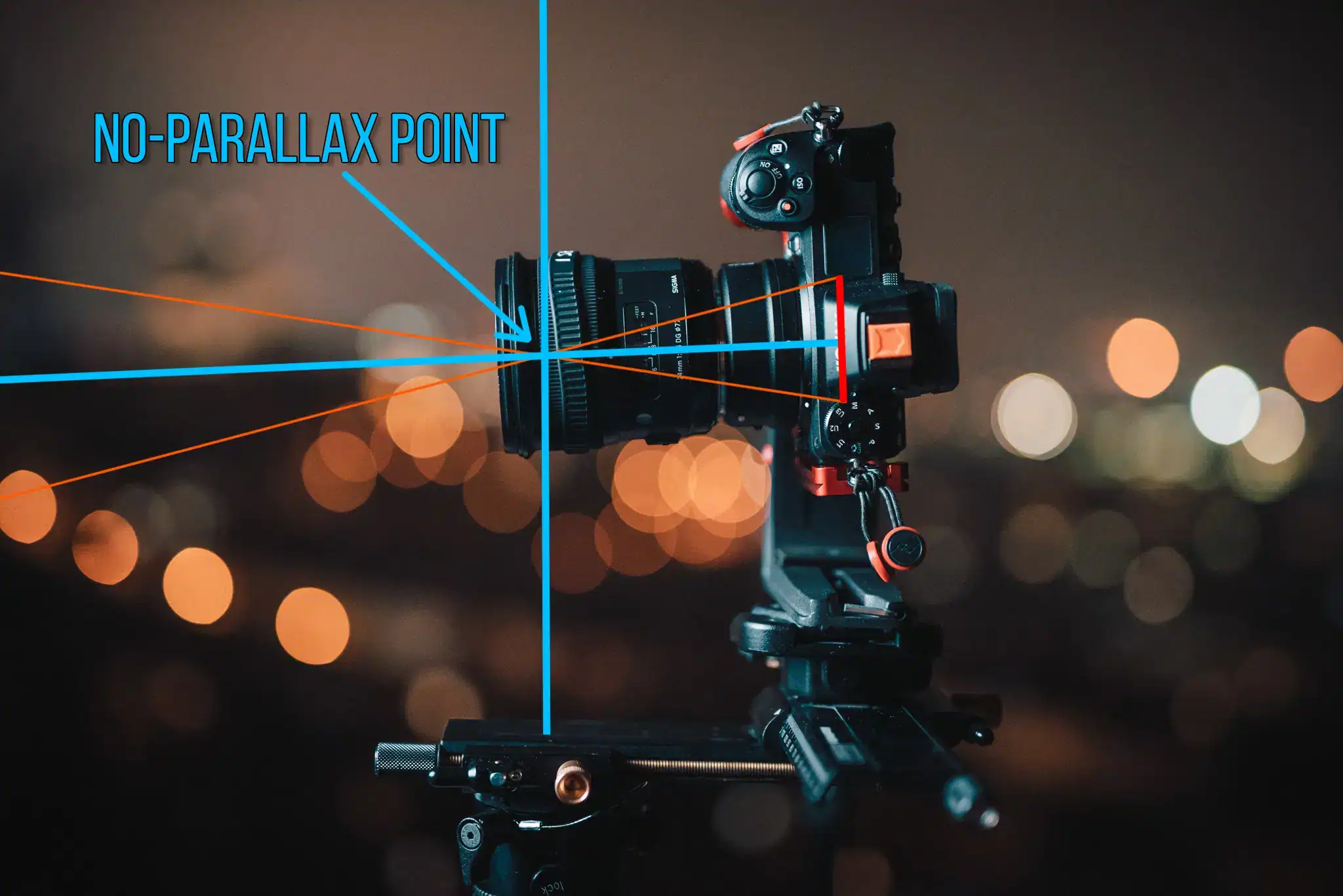
- Level your tripod; pre-calibrate the pano head to the lens’s no-parallax (entrance pupil) point.
- Safety: weigh down tripod in wind; tether gear on rooftops or poles; avoid public obstructions; carry microfiber and rain covers.
- Backup workflow: shoot a second full round for safety, especially indoors where stitching can be tricky.
Essential Gear & Setup
Core Gear
- Panoramic head: Align the no-parallax point so foreground and background don’t shift between frames. This prevents stitching errors on close objects.
- Stable tripod with a leveling base: A bubble or half-ball leveling base speeds up setup and keeps yaw rotation true.
- Remote trigger or OM System app: Fire the shutter without touching the camera to prevent micro-blur.
Optional Add-ons
- Pole/car mount: Use a safety tether; monitor wind; avoid high speeds; shoot at faster shutter speeds to combat vibrations.
- Continuous lights or flashes: For dark interiors, add fill but keep positions consistent frame-to-frame.
- Weather gear: Raincover and silica packets for humid or misty locations; lens hood to manage flare.
Step-by-Step Shooting Guide
Standard Static Scenes
- Level tripod and set nodal alignment: On a calibrated pano head, slide the camera so the rotation axis aligns with the lens’s entrance pupil. Test with a near object and distant background—pan slowly; if relative motion occurs, adjust fore-aft until motion disappears.
- Set manual exposure and lock white balance: Use M mode, meter a mid-tone, then lock in exposure across all frames. Set WB to Daylight/Tungsten/etc. to keep color consistent.
- Focus and aperture: Use manual focus with magnification or peaking. Set around f/5.6–f/8 for optimal sharpness and depth. Focus at or slightly beyond hyperfocal to keep near-to-far sharp.
- Capture with overlap: With the AstrHori 12mm fisheye on OM-1, shoot 6 frames around at 60° yaw increments, ~25–30% overlap. Add one zenith (tilt up) and one nadir (tilt down) if needed.
- Take a clean nadir: After the main set, lift the tripod or rotate around the center to capture a patch image for tripod removal.
HDR / High Dynamic Range Interiors
- Bracket ±2 EV (3–5 frames) to balance windows, lamps, and shadows. Keep aperture constant; vary shutter speed.
- Lock WB and focus for all brackets and all positions to maintain consistency.
- Consider exposure fusion in PTGui or merge brackets to 32-bit HDR first, then stitch.
Low-Light / Night Scenes
- Use the tripod and remote. Turn IBIS off on the tripod to avoid sensor drift during long exposures.
- Settings guide: f/4–f/5.6, 1–4 sec, ISO 200–800. If you must raise ISO, 1600 is workable on OM-1 with careful denoise.
- Avoid star trailing or light streaks by adapting shutter and shooting multiple rounds if needed for masking.
Crowded Events
- Shoot two passes: first for complete coverage, second for clean plates where you wait for gaps in people flow.
- Keep overlap generous (30–40%). In post, mask moving subjects using the cleaner frames.
- Use faster shutter (1/200–1/400) and ISO 400–800 to freeze motion if light allows.
Special Setups (Pole / Car / Drone)
- Secure tether and clamp. For poles, avoid extended length in strong wind; for cars, use low speeds and avoid sudden stops.
- Use higher shutter speed (1/250–1/1000) and shoot more overlap. Consider burst mode for redundancy.
- Trigger remotely and review coverage before tearing down.
Recommended Settings & Pro Tips
Exposure & Focus
| Scenario | Aperture | Shutter | ISO | Notes |
|---|---|---|---|---|
| Daylight outdoor | f/8–f/11 | 1/100–1/250 | 200 | Lock WB (Daylight); maximize sharpness with mid apertures |
| Low light/night | f/4–f/5.6 | 1/30–4s | 200–800 | Tripod; remote; IBIS off on tripod; expose to protect highlights |
| Interior HDR | f/8 | Bracket ±2 EV | 200–400 | Merge/fuse brackets; match WB and exposure across all frames |
| Action / moving subjects | f/5.6–f/8 | 1/200+ | 400–800 | Double pass to mask motion; keep overlap generous |
Critical Tips
- Manual focus at hyperfocal: With a 12mm fisheye on MFT, focusing around 1–1.5 m at f/8 gives deep DOF. Confirm with magnified live view.
- Nodal calibration: Tape-mark the fore-aft rail position that eliminates parallax for this lens. Recheck after changing focus distance or filters.
- White balance lock: Avoid AWB. Choose a fixed preset or Kelvin value (e.g., 5600K daylight) across the whole sequence.
- RAW over JPEG: You’ll need the latitude of RAW files for color, noise, and stitching corrections.
- IBIS: Keep it off on a tripod. Use it only handheld for scouting frames, not for the stitched set.
- Lens hood and flare: Fisheyes see everything—shield the front element from direct sun with your hand or a flag just outside the frame.
Stitching & Post-Processing
Software Workflow
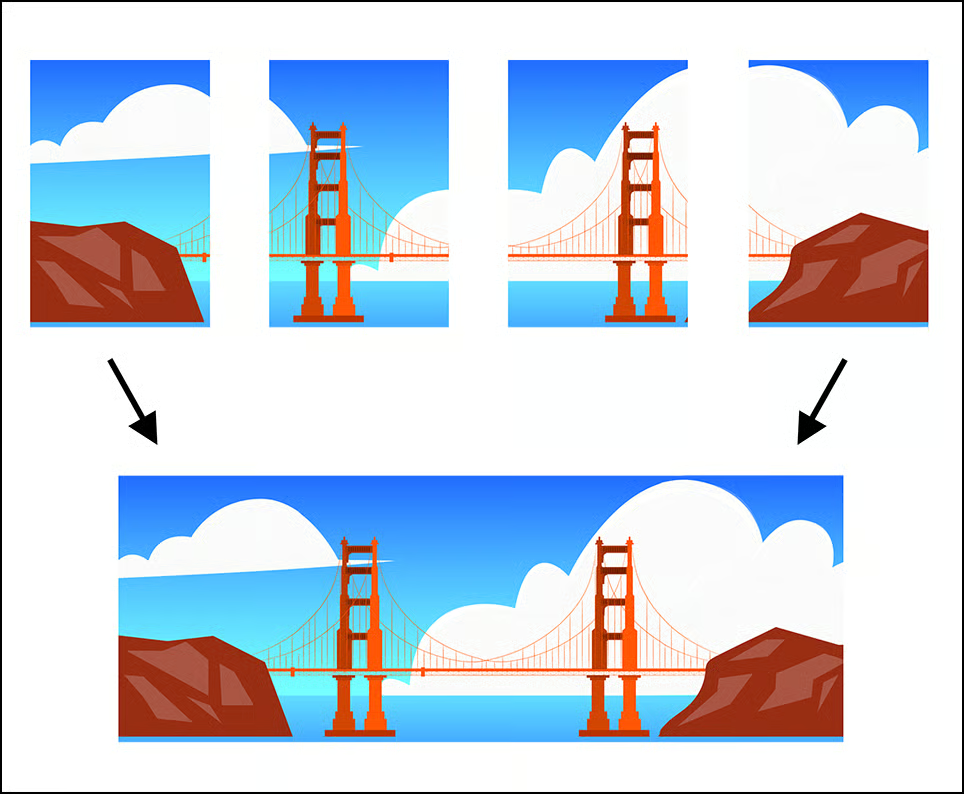
Import your RAW files into Lightroom or your preferred RAW editor. Apply consistent color profile and lens CA correction (avoid geometric correction that de-fishes unless you plan rectilinear pano outputs). Export 16-bit TIFFs or DNGs to your stitcher. PTGui and Hugin both handle fisheye projections well. With a 12mm fisheye, use 25–30% overlap and let the stitcher auto-detect lens type. Set the panorama type to spherical/equirectangular for 360 outputs. PTGui’s control point editor and optimizer excel at complex indoor scenes, and its exposure fusion can blend HDR brackets cleanly. For a full primer, see this practical PTGui overview by Fstoppers. PTGui review: strengths for complex panoramas
Cleanup & Enhancement
- Nadir/tripod removal: Patch with a dedicated nadir shot or clone in Photoshop. Many virtual tour builders also offer AI tripod removal tools.
- Color and noise: Apply consistent white balance and gentle noise reduction, especially if you shot at ISO 800–1600.
- Level horizon: Use the stitcher’s horizon tool; tweak yaw/pitch/roll for a perfectly leveled 360.
- Export: Save equirectangular 2:1 JPEG (8–12k width for web) or 16-bit TIFF for archival. For VR platforms, follow their size/metadata guidelines. Oculus guide to shooting and stitching DSLR 360 photos
Video: Visualizing a Pro Pano Head Setup
New to nodal calibration and multi-row capture? This walkthrough helps you visualize the process from setup to stitch.
For a deeper dive into panoramic head alignment principles, see this step-by-step tutorial. Panoramic head tutorial and no-parallax basics
Useful Tools & Resources
Software
- PTGui panorama stitching (fast, robust control points; HDR fusion)
- Hugin (open-source, excellent lens model support)
- Lightroom / Photoshop (RAW development and cleanup)
- AI tripod removal tools in modern virtual tour platforms
Hardware
- Panoramic heads: Nodal Ninja, Leofoto, or equivalent low-profile rotators
- Carbon fiber tripods (stability-to-weight advantage)
- Leveling bases (faster, more accurate setup)
- Wireless remote shutters / intervalometers
- Pole extensions / car suction mounts with tethers
Disclaimer: brand names are examples for search reference—confirm compatibility for OM-1 and Micro Four Thirds.
Common Mistakes & How to Avoid Them
- Parallax error: Failing to shoot around the entrance pupil leads to stitching seams. Calibrate and tape-mark your rail.
- Exposure flicker: Using auto exposure or auto WB. Lock both before shooting the set.
- Tripod in frame: Forgetting a nadir shot. Always capture a clean ground patch or plan to patch later.
- Ghosting: Moving people, flags, or trees. Use two passes and mask the clean frames in post.
- Night noise: Pushing ISO too high. Prefer longer shutter on a tripod at ISO 200–800; denoise gently.
- Flare and veiling: Fisheyes are flare-prone. Shade the lens and avoid bright sources near the edge of the frame.
Real-World Case Studies
Indoor Real Estate (Mixed Lighting)
With the OM-1 + AstrHori 12mm, set f/8, ISO 200–400, bracket ±2 EV, and shoot 6 around + zenith + nadir. Lock WB around 4000–4500K to balance tungsten and daylight. Fuse brackets (exposure fusion) before stitching. Watch for reflective surfaces—shoot extra frames for problematic mirrors so you can mask in a cleaner reflection later.
Outdoor Sunset Overlook
Dynamic range spikes at golden hour. Meter for highlights and bracket where needed. Try 6 around at f/8, ISO 200, 1/60–1/250 depending on light. Consider a separate sky set if the sun is in-frame to blend a clean sunstar and a detailed foreground in post.
Event Crowd
Speed matters. Use 6 around, f/5.6, 1/200, ISO 400–800. Do a second pass for clean plates. In PTGui, mask in the quieter frames to minimize ghosting.
Rooftop or Pole Capture
Keep the rig lightweight. The OM-1’s small body helps. Secure a tether and shoot at 1/500+ to beat micro-shake. Consider 8 around for added overlap since poles can flex slightly and shift alignment.
Frequently Asked Questions
- Can I shoot handheld panoramas with the OM-1?
You can for quick tests, but for production-quality 360s use a tripod and pano head. Handheld fisheye sets can stitch if you keep the camera roughly in one position and use lots of overlap, but parallax with near objects will cause seams.
- Is the AstrHori 12mm f/2.8 wide enough for a single-row 360?
Yes, in most scenes. Plan 6 shots around plus zenith and nadir. For tight interiors or very detailed ceilings, add a second row or shoot 8 around for safety.
- Do I need HDR for interiors with bright windows?
Usually yes. Bracketing ±2 EV (3–5 frames) preserves window detail and clean shadows. Fuse or merge to HDR before stitching or let PTGui blend exposure.
- How do I avoid parallax issues?
Use a calibrated panoramic head and rotate around the lens’s entrance pupil (no-parallax point). Mark your rail setting for this lens so you can set it instantly next time. Keep nearby objects out of the immediate foreground when possible.
- What ISO range is safe on the OM-1 in low light?
For tripod-based panoramas, ISO 200–800 is ideal. ISO 1600 is workable with careful exposure and noise reduction. Prefer longer shutter over higher ISO when your scene is static.
- Can I create custom shooting presets to speed up pano work?
Yes. Program MyMenu and custom modes for manual exposure, fixed WB, RAW, IBIS off, and a mid aperture. Save another preset for HDR bracketing.
- How do I reduce flare with a fisheye?
Don’t point directly into the sun when possible. Shade the lens with your hand or a flag just outside the frame, and shoot a second clean frame without the hand if needed for masking.
- Which tripod head is best for this setup?
A compact panoramic head with an adjustable nodal rail (e.g., Nodal Ninja or low-profile rotator) is ideal. Ensure it supports Micro Four Thirds weight with smooth indexed clicks at 45°/60°.
Additional Reading and Standards
If you’re building a repeatable workflow for client work or virtual tours, the following resources align with industry best practices on capture and stitching, including optimal overlaps and projection decisions. Principles for high-end 360 photo capture
Safety, Data Integrity, and Quality Control
Panoramas are unforgiving of small errors. Do a quick test spin to verify overlap and exposure before committing to the full set. In wind, hang a weight from the tripod. On rooftops and poles, use redundant straps. Back up cards immediately after shooting—ideally to two places. Keep a “safety round” of the scene (a second full set) to hedge against stitching surprises or ghosting problems in post. For final delivery, export an 8–12k equirectangular for web and keep a 16-bit TIFF master for archive.
Helpful External Guides
For alternative perspectives and deeper explanations of focal length choices, shooting technique, and software decisions, these succinct resources are worth bookmarking. Best techniques for 360 panoramas (community knowledge)
Wrap-Up: Reliable, Fast, and Lightweight
The Olympus OM-1 and AstrHori 12mm f/2.8 Fisheye form a practical 360° kit: small, weather-sealed, and fast to deploy. Calibrate your nodal point once, shoot 6-around plus zenith/nadir with consistent settings, and you’ll get clean stitches with minimal post. For challenging scenes, bracket for HDR and add a safety round. With careful exposure and overlap, this combo delivers professional virtual tours, social 360s, and immersive web panoramas without the bulk of full-frame rigs.