Why This Camera & Lens Are Great for Panoramas
The Olympus E‑M1 Mark III paired with the Tokina ATX‑i 11–20mm f/2.8 is a surprisingly capable combo for panoramic and 360 photo work—especially if you prefer rectilinear rendering over fisheye curvature. The E‑M1 Mark III’s 20.4MP Micro Four Thirds sensor (17.3×13.0 mm, ~3.3 μm pixel pitch) delivers solid dynamic range at base ISO, dependable color, and excellent ergonomics. Its 5‑axis IBIS is top-tier for handheld shooting, and the body’s deep buffer and responsive controls make methodical multi-shot capture smooth. For tripod work, IBIS can be disabled to avoid micro-corrections during long exposures.
The Tokina ATX‑i 11–20mm f/2.8 is a fast, rectilinear ultra-wide designed for APS‑C. Adapted to Micro Four Thirds, it provides an effective full-frame equivalent field of view of ~22–40mm (standard adapter) or ~15.6–28.4mm with a 0.71× focal reducer (Speed Booster). While not as wide as a dedicated MFT fisheye, its rectilinear projection keeps lines straight—great for architecture, real estate, and any environment where fisheye defishing is undesirable. It’s respectably sharp stopped to f/5.6–f/8, with manageable lateral CA and mild barrel distortion at the wide end (both easily corrected in post). Autofocus via adapter may vary; for panoramas, manual focus at hyperfocal is both fast and consistent.
Quick Setup Overview
- Camera: Olympus E‑M1 Mark III — Micro Four Thirds (20.4MP), ~12+ stops of DR at base ISO, robust controls, top-tier IBIS.
- Lens: Tokina ATX‑i 11–20mm f/2.8 — rectilinear zoom; sharpest at f/5.6–f/8; moderate CA at 11mm; good flare control when shaded.
- Estimated shots & overlap (tested, rectilinear, ~30% overlap):
- 11mm on standard adapter (≈22mm FF eq): ~7 shots around per row; 2–3 rows + zenith + nadir (≈16–23 total).
- 11mm with 0.71× focal reducer (≈15.6mm FF eq): ~6 shots around; 2–3 rows + zenith + nadir (≈14–20 total).
- 20mm on standard adapter (≈40mm FF eq): ~11 shots per row; 4–5 rows + zenith + nadir (50+ total—only when you need high resolution of specific details).
- Difficulty: Moderate (requires careful nodal alignment and consistent exposure; easier than telephoto, more frames than fisheye).
Planning & On-Site Preparation
Evaluate Shooting Environment
Assess light direction and intensity, fast-moving subjects, reflective surfaces (glass, polished floors), and wind. For glass-fronted scenes, keep the lens close (2–5 cm) and shoot slightly off-axis to reduce reflections and ghosting. For outdoor sunsets, plan for bracketed exposures to handle bright skies and deep shadows. In crowds, anticipate movement and plan for two passes to give you extra frames for masking.
Match Gear to Scene Goals
The E‑M1 Mark III provides consistent color and solid dynamic range—ideal for interiors and exteriors with contrasty light. Base ISO (200 on Olympus) yields the cleanest files. Safe ISO range for critical pano work is ISO 200–800; ISO 1600 is usable with careful noise reduction. The Tokina 11–20mm’s rectilinear rendering preserves straight lines in architecture, but results in more frames than a fisheye 360 photo setup. If speed and minimal shot count are paramount (e.g., windy rooftop, moving crowds), consider adding a 0.71× focal reducer to widen the FOV or plan on fewer, larger rows with more vertical tilt.
Pre-shoot Checklist
- Charge batteries and bring a spare; format fast UHS‑II cards.
- Clean lens front/rear elements and check the sensor for dust (panos are unforgiving of spots).
- Level your tripod; verify panoramic head calibration (entrance pupil set for 11mm and 20mm marks).
- Safety: weigh down the tripod in wind; tether the rig on rooftops/poles; avoid traffic lanes for car-mounted capture.
- Backup: shoot a redundant pass around the horizon so you can replace any soft/blurred frame later.
Essential Gear & Setup
Core Gear
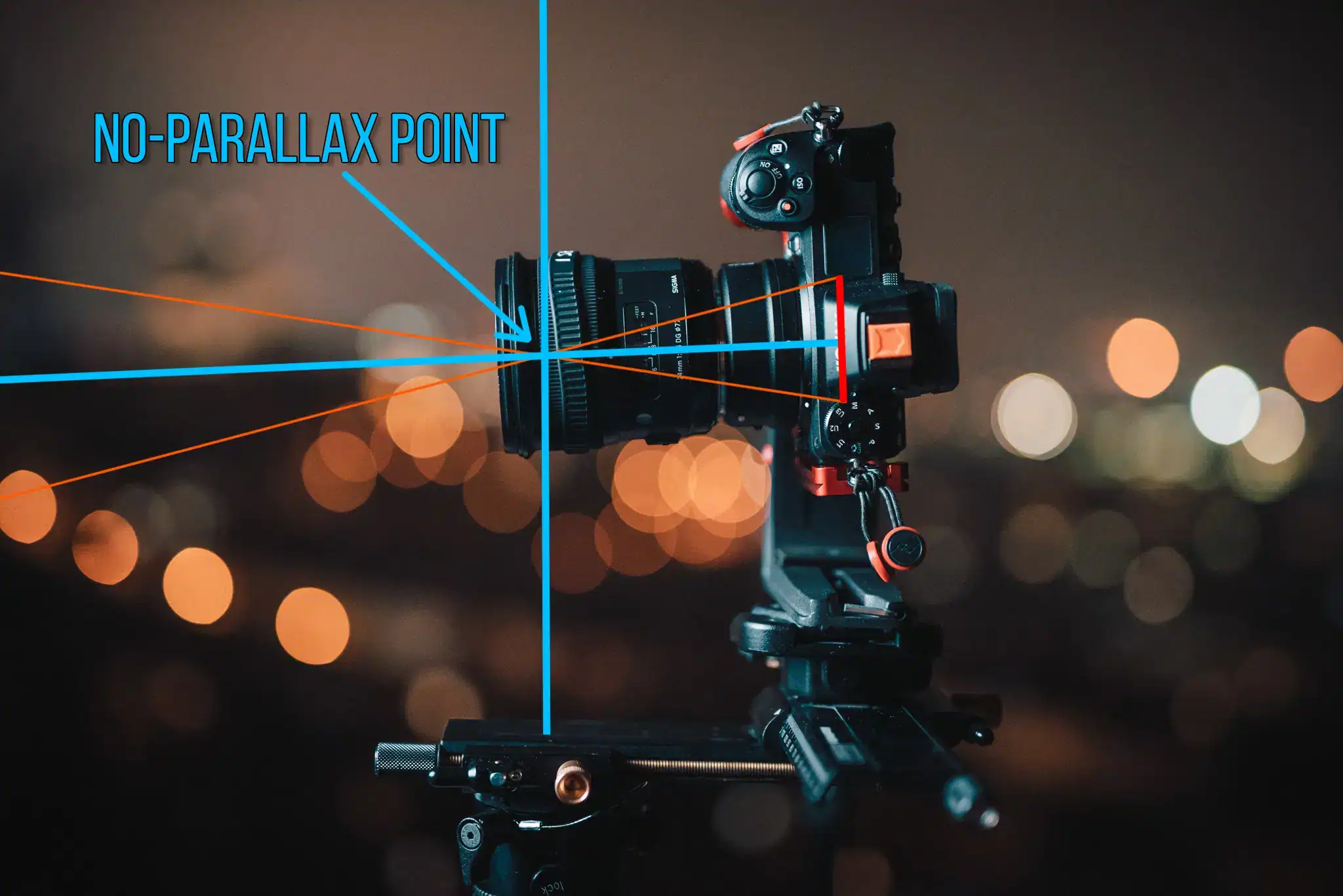
- Panoramic head: Allows rotation around the lens’s entrance pupil (nodal point), eliminating parallax and making stitching clean. Multi-row heads help you cover zenith and nadir with fewer total shots.
- Stable tripod with leveling base: A leveling base speeds setup and keeps your rows consistent.
- Remote trigger or smartphone app: Prevents vibration; the E‑M1 Mark III’s 2s anti-shock or a Bluetooth remote also works.
Optional Add-ons
- Pole or car mount: Use safety tethers and guy lines. Be mindful of wind vibration; increase shutter speed and shoot multiple redundant frames.
- Lighting aids: Small LEDs for interiors; avoid mixed color temperatures that complicate white balance.
- Weather protection: Rain covers and microfiber towels; wipe before every critical frame in mist or spray.
Step-by-Step Shooting Guide
Standard Static Scenes
- Level the tripod and align the entrance pupil. On your pano head, slide the rail until foreground and background features do not shift relative to each other when panning. Re-check at 11mm and 20mm; mark the rail for both.
- Set manual exposure and lock white balance. For daylight, use WB Daylight or a fixed Kelvin (e.g., 5600K). Manual exposure prevents flicker between frames.
- Focus manually at hyperfocal. At 11mm f/8 on MFT, hyperfocal is roughly 1.0 m; at 11mm f/5.6 it’s ~1.45 m. With a 0.71× focal reducer at 7.8mm f/8, hyperfocal is ~0.5 m. Use magnification and peaking to nail it.
- Capture with tested overlap:
- 11mm standard adapter: ~7 shots around per row, 2–3 rows; add zenith (+90°) and nadir (−90°).
- 11mm with 0.71×: ~6 shots around per row; often 2 rows plus zenith/nadir is enough.
- Take a clean nadir shot for tripod removal. Either shoot a dedicated handheld nadir after lifting the tripod or use a nadir offset on your pano head.
HDR / High Dynamic Range Interiors
- Bracket ±2 EV (3–5 frames per viewpoint) to balance bright windows against interior shadows. The E‑M1 Mark III’s AEB is reliable; shoot RAW for flexibility.
- Lock WB across the bracket. Changing WB between exposures can create color seams and complicate stitching.
- Keep the total bracket count consistent for every frame in the sequence; it simplifies batch HDR merging before stitching.
Low-Light / Night Scenes
- Use longer shutter speeds with a sturdy tripod. Start around f/4–f/5.6, ISO 200–800, and 1–10s depending on light. Turn IBIS off on tripod to avoid micro-jitters.
- Use anti-shock or a remote trigger. Mechanical shutter with a 2s delay avoids shutter shock and rolling artifacts.
- Take an extra pass at slightly higher ISO (e.g., 800–1600) as a safety set if wind or vibrations are present.
Crowded Events
- Shoot two passes: a fast pass to capture the whole sphere, then a slow pass waiting for gaps in movement at critical seams.
- Mask in post. Use the quieter frames to replace ghosted people or cars at stitch lines.
Special Setups (Pole / Car / Drone)
- Secure everything. Use safety tethers, limit speed, and avoid sudden starts. For poles, keep the center of gravity low and stabilize with guy lines.
- Increase shutter speed and redundancy. On moving platforms, faster exposures (1/250–1/500) and extra frames increase your chances of clean stitches.
Recommended Settings & Pro Tips
Exposure & Focus
| Scenario | Aperture | Shutter | ISO | Notes |
|---|---|---|---|---|
| Daylight outdoor | f/8–f/11 | 1/100–1/250 | 200 | Lock WB (Daylight or 5600K); IBIS off on tripod |
| Low light/night | f/4–f/5.6 | 1/2–10s | 200–800 | Use remote or 2s anti-shock; avoid banding with mechanical shutter |
| Interior HDR | f/8 | Bracket ±2 EV | 200–400 | Balance windows and lamps; merge HDR before stitching |
| Action / moving subjects | f/5.6–f/8 | 1/200+ | 400–800 | Double pass; mask moving subjects later |
Critical Tips
- Manual focus at hyperfocal. For 11mm f/8 on MFT, set ~1.0 m. With a 0.71× reducer (7.8mm), ~0.5 m. Confirm with magnification.
- Nodal (entrance pupil) calibration: Put a near object and a distant object in the same vertical line; pan and adjust the rail until they don’t shift relative to each other.
- White balance lock: In mixed lighting, choose a balanced Kelvin (e.g., 4000–4500K) and correct in RAW later.
- RAW over JPEG: The E‑M1 Mark III’s RAWs give better DR and color recovery for HDR panoramas.
- Stabilization: Turn IBIS off for tripod work; leave it on for handheld cylindrical sweeps if you must shoot without a tripod.
Stitching & Post-Processing
Software Workflow
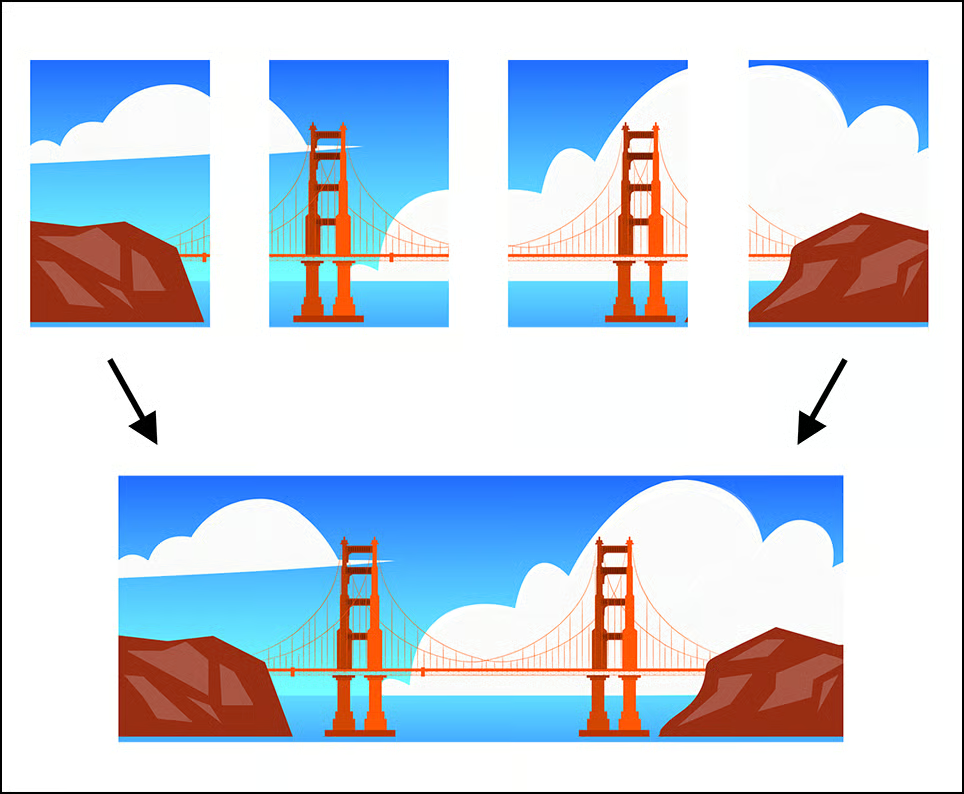
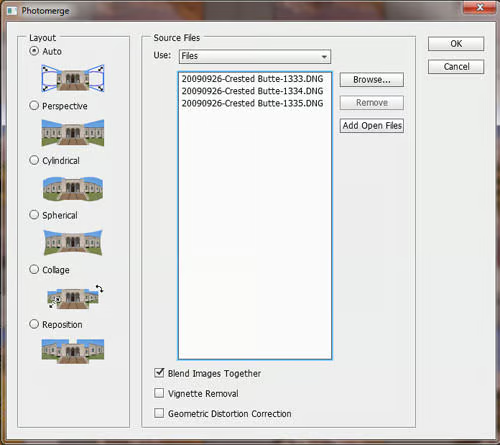
For rectilinear ultra-wide panoramas, PTGui is consistently fast and robust, and Hugin is a capable open-source alternative. Merge HDR brackets per viewpoint first (e.g., in Lightroom or PTGui’s exposure fusion), then stitch the merged frames. Fisheye lenses typically need 25–30% overlap; rectilinear needs slightly more careful alignment but 20–30% overlap still works well. For the Tokina at 11mm, 30% overlap is a safe starting point. After stitching, export an equirectangular 2:1 image (e.g., 12000×6000) for web VR.” See a field review of PTGui for complex panoramas.
Cleanup & Enhancement
- Nadir patch: Use a handheld nadir shot or clone/AI tools to remove the tripod footprint cleanly.
- Color match: Sync white balance and tone across all frames; apply local HSL adjustments to correct cast from mixed lighting.
- Noise reduction: Apply moderate NR for ISO 800–1600 shots; Olympus RAWs respond well to modern denoisers.
- Horizon leveling: Ensure zero roll and consistent pitch/yaw; straighten verticals for architecture.
- Export formats: For VR/tours, export equirectangular JPEG (quality 90–95) and keep a 16‑bit TIFF master for archival edits.
For a foundation on panoramic heads and shooting discipline, this concise guide is helpful: Panoramic head basics and no‑parallax setup. For broader DSLR/mirrorless 360 capture and stitching, see this platform-neutral overview: Shooting and stitching a 360 photo with DSLR/mirrorless.
Field-Proven Scenarios
Indoor Real Estate
At 11mm f/8, ISO 200, start with 7 shots around, two rows (−35°, +35°), plus zenith/nadir. Bracket ±2 EV for windows. Keep WB fixed at 4000–4500K if mixing daylight and warm interiors. Mind reflections in glass and stainless appliances; step slightly off-axis and shield the lens from bright light sources with your hand.
Outdoor Sunset
Use a 3–5 shot AEB at base ISO, f/8, on a stable tripod. Aim to complete all horizon frames within a minute to minimize sky gradient changes. If wind is strong, increase shutter speed and repeat the horizon ring to ensure at least one clean set.
Event Crowds
Set 1/250–1/500, f/5.6–f/8, ISO 400–800. Do a fast 360 sweep first, then a second pass waiting for gaps in motion at your planned seams. In PTGui, mask moving people and prefer frames with less motion for final assembly.
Rooftop or Pole Shooting
Attach a tether, add weight to the tripod or pole base, and reduce the rig’s profile to the wind. Use higher shutter speeds (1/250+) and take multiple redundant frames around the horizon. Consider a 0.71× focal reducer to cut the total frame count and exposure time.
Car-Mounted Capture
Only on private roads or controlled environments. Keep speed low, damp vibrations, and shoot shorter exposures. Plan seams where the environment is simpler (e.g., sky or open road) to ease masking.
If you’re building high-end 360s for VR, a structured panoramic head workflow is essential. This step-by-step primer is a good complement to the video: Set up a panoramic head for high‑end 360 photos.
Useful Tools & Resources
Software
- PTGui panorama stitching
- Hugin (open source)
- Lightroom / Photoshop for HDR merge and retouching
- AI tripod/nadir removal tools
Hardware
- Panoramic heads: Nodal Ninja, Leofoto
- Carbon fiber tripods with leveling base
- Wireless remotes or intervalometers
- Pole extensions and vehicle mounts (with safety tethers)
Disclaimer: Names provided for research; confirm compatibility with your adapter and camera system.
Common Mistakes & How to Avoid Them
- Parallax error: Always align the entrance pupil for your chosen focal length; re-check after any height change.
- Exposure flicker: Manual exposure and WB across all frames and brackets.
- Tripod shadows: Shoot a dedicated nadir; avoid harsh side light creating strong tripod shadows.
- Ghosting: Take multiple passes; mask moving subjects in post.
- Night noise: Keep ISO at 200–800 when possible; use longer shutter and stable support.
- IBIS artifacts on tripod: Turn stabilization off for long exposures and multi-shot pano work.
Frequently Asked Questions
- Can I shoot handheld panoramas with the E‑M1 Mark III?
Yes, for cylindrical or partial panoramas in good light. Use IBIS on, high shutter speed (1/250+), and overlap generously (40%+). For full 360×180 and interiors, a tripod and panoramic head produce far better results and cleaner stitches.
- Is the Tokina 11–20mm wide enough for a single-row 360?
Not for a full spherical 360×180 with clean coverage; you’ll typically need multiple rows plus zenith and nadir. With a 0.71× focal reducer, you can often manage two rows plus zenith/nadir, which significantly lowers the total shot count.
- Do I need HDR for interiors with bright windows?
Usually yes. Bracket ±2 EV (3–5 exposures) at each viewpoint to capture window detail and interior shadows. Merge HDR first, then stitch the merged frames to keep color/contrast uniform.
- How do I avoid parallax issues with this adapted lens?
Calibrate the entrance pupil on your pano head at 11mm and 20mm and mark rail positions. Use a near object and a distant background aligned vertically; adjust until there’s no relative shift when panning.
- What ISO range is safe on the E‑M1 Mark III for low light panoramas?
ISO 200–800 is the sweet spot. ISO 1600 is usable with good noise reduction, but prioritize longer shutter times on a tripod to keep ISO lower.
- Can I set custom modes for pano on the E‑M1 Mark III?
Yes. Assign a Custom Mode with manual exposure, WB lock, IBIS off, 2s anti-shock, and manual focus. You can store a second mode for HDR (AEB enabled) to switch quickly on site.
- How can I reduce flare with a rectilinear ultra-wide?
Shade the front element with your hand just outside the frame, avoid pointing directly at the sun, and clean the glass. Shoot an extra frame when sun is just off-frame to patch potential ghosts later.
- What panoramic head should I pick for this setup?
A compact multi-row head (e.g., Nodal Ninja, Leofoto) with precise fore–aft and lateral adjustment. Ensure it supports the combined weight of the E‑M1 Mark III, adapter, and Tokina lens with margin.
Safety, Limitations & Data Management
The Tokina 11–20mm plus adapter is front-heavy for MFT. Always clamp securely and check your quick-release plate tension. On rooftops or poles, tether the rig, keep your body clear of ledges, and monitor wind gusts. The E‑M1 Mark III’s electronic shutter can reduce vibrations, but watch out for banding under artificial lights—mechanical shutter with 2s delay is safer indoors. Maintain a redundant workflow: shoot a backup ring around the horizon, and back up your card to a phone or SSD in the field when possible.