
Why This Camera & Lens Are Great for Panoramas
If you’re searching for how to shoot panorama with Olympus E‑M1 Mark III & Tamron 17–28mm f/2.8 Di III RXD, you’re looking at a capable body with a fast, sharp ultra‑wide zoom. The Olympus E‑M1 Mark III is a 20.4MP Micro Four Thirds mirrorless camera with outstanding in‑body stabilization (IBIS up to ~7.0–7.5 stops with compatible lenses), robust weather sealing, and a sensor that offers roughly 12 stops of dynamic range at base ISO. Pixel pitch is approximately 3.3 µm, which favors detailed stitching when you keep ISO low. The camera’s manual controls, custom modes (C1–C4), and reliable live view magnification make nodal calibration and exposure locking straightforward.
About the lens: the Tamron 17–28mm f/2.8 Di III RXD is a rectilinear ultra‑wide designed for Sony FE. It’s praised for sharpness even wide open, low coma, and controlled chromatic aberration. Important compatibility note: this lens cannot be adapted to Micro Four Thirds at infinity focus because Sony E‑mount’s flange distance is shorter than MFT’s; there’s no practical E‑to‑MFT focal‑reducer/adapter solution for infinity focus. If you own this Tamron lens, use it on a Sony E‑mount body. If you’re committed to the Olympus E‑M1 Mark III, pick an equivalent MFT ultra‑wide (e.g., M.Zuiko 7–14mm f/2.8 PRO, M.Zuiko 8–25mm f/4 PRO, or Laowa 7.5mm f/2). The techniques below apply directly to the E‑M1 Mark III with any rectilinear ultra‑wide; focal length “translations” are provided so you can transfer the guidance to 17–28mm on full frame or roughly 9–14mm on MFT.
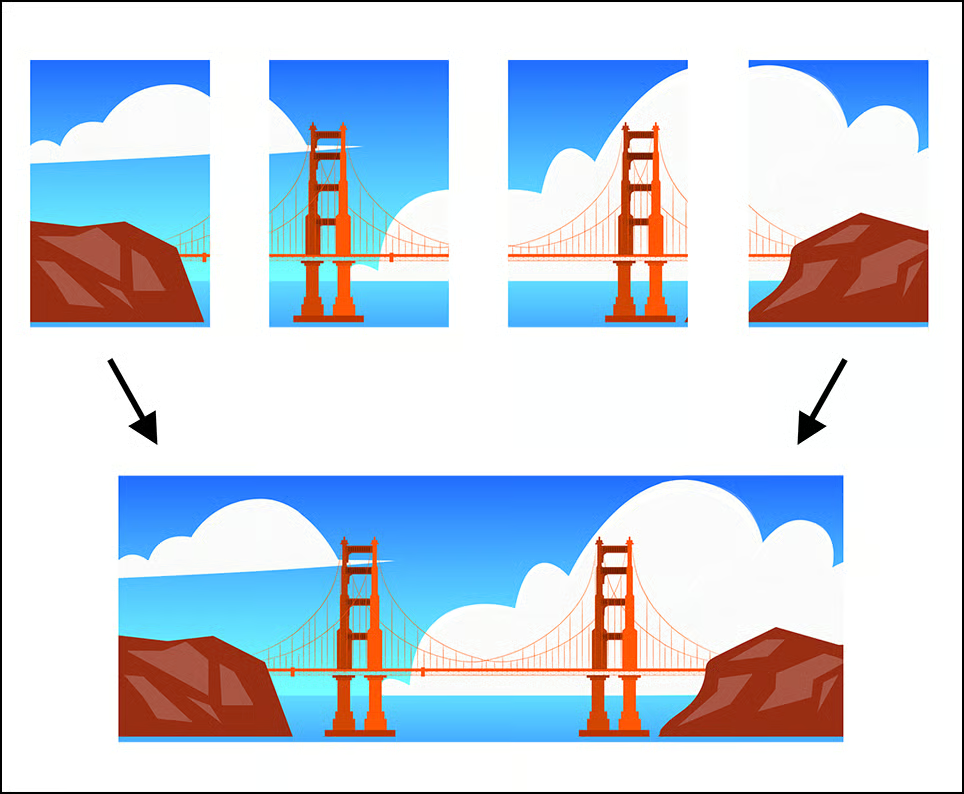
Rectilinear ultra‑wides are excellent for high‑quality 360 photos: fewer lines are bent compared to fisheye, you keep straight architecture, and you can stitch clean, high‑resolution equirectangular outputs. The trade‑off is you’ll need more frames than a fisheye. With careful nodal alignment and consistent exposure/white balance, the E‑M1 Mark III delivers extremely clean pano sets even in mixed lighting or at night.
Quick Setup Overview
- Camera: Olympus E‑M1 Mark III — Micro Four Thirds sensor (17.3 × 13.0 mm), 20.4MP Live MOS, approx. 12 EV DR at base ISO 200, pixel pitch ~3.3 µm, IBIS up to ~7 stops.
- Lens: Tamron 17–28mm f/2.8 Di III RXD — rectilinear UWA zoom, sharp across the frame by f/4–f/5.6, low CA/flare when shaded; note: not natively compatible with MFT bodies.
- Estimated shots & overlap (rectilinear):
- Full frame at 17mm: 2 rows of 8 (45° yaw spacing) + zenith + nadir (≈18 frames total) with 25–30% overlap.
- Full frame at 28mm: 3 rows of 10–12 + zenith + nadir (≈32–38 frames) with 25–30% overlap.
- Micro Four Thirds equivalents: 9mm MFT ≈ 18mm FF; 14mm MFT ≈ 28mm FF. Use similar counts above for 9–14mm on MFT.
- Difficulty: Moderate. Rectilinear 360s require more shots than fisheye but yield straighter lines—great for real estate and architecture.
Planning & On-Site Preparation
Evaluate Shooting Environment
Scan for moving subjects (people, cars, flags), reflective surfaces (glass, polished stone), and light direction. Outdoors, avoid pointing directly into the sun with rectilinear glass to reduce veiling flare; use your hand or a flag just out of frame when possible. Indoors, estimate the contrast between windows and interior shadows—if it’s 6–8 stops or more, plan to bracket. If shooting against glass (observation decks), get the lens as close as safely possible (1–3 cm) to minimize reflections, and shoot perpendicular to the glass to avoid ghosting.
Match Gear to Scene Goals
The E‑M1 Mark III’s IBIS is excellent for handheld panos, but for 360 VR output a tripod and panoramic head are the standard. The sensor’s sweet spot is ISO 200–800; ISO 1600 is usable with good noise reduction, but keep ISO as low as practical if you plan large prints or high‑res VR. Rectilinear ultra‑wides like the Tamron 17–28 (or MFT equivalents around 7–14/8–25mm) produce straight architecture with minimal distortion. Fisheyes cut shot count dramatically but bend lines; pick rectilinear if you deliver to clients who demand straight walls and clean door frames.
Pre-shoot Checklist
- Batteries charged, dual cards formatted; pack a microfiber cloth and blower.
- Tripod leveled; panoramic head calibrated to the lens’s no‑parallax point (NPP).
- Safety: If on a rooftop or using a pole, tether everything; avoid winds above ~20–25 km/h with pole rigs.
- Backup workflow: Shoot a second full rotation at slightly different yaw offsets as insurance against stitching gaps.
Essential Gear & Setup
Core Gear
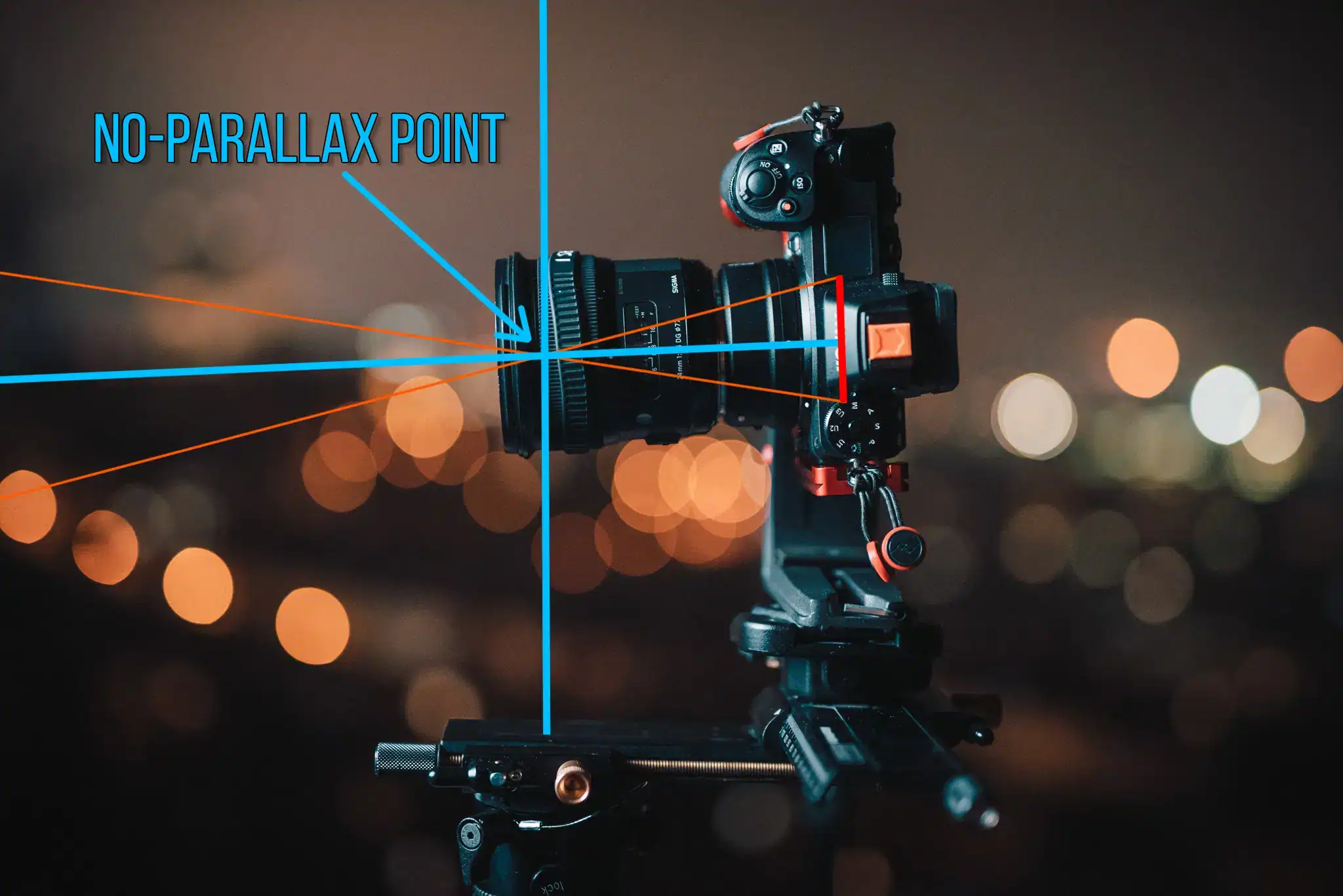
- Panoramic head: Align the lens entrance pupil (NPP) over the rotation axes to eliminate parallax. This is crucial when foreground objects are within 1–3 m.
- Stable tripod with leveling base: A half‑ball leveling base makes your rotations perfectly level without fussing with leg lengths.
- Remote trigger or app: Use the Olympus OI.Share app or a wired remote to avoid touching the camera.
Optional Add-ons
- Pole or car mount: Great for crowds or aerial‑like views. Watch wind loads; use safety lines. Expect micro‑vibration; increase shutter speed.
- Lighting aids: Small LED panels for dark interiors; use subtle bounce to avoid hotspots.
- Weather protection: Rain covers, desiccants, and gaffer tape for ports and seams in light rain.
If the Tamron 17–28 cannot be mounted on your E‑M1 Mark III, substitute an MFT rectilinear UWA. Nodal Ninja, Leofoto, and similar panoramic heads have rail systems for easy NPP calibration.
Step-by-Step Shooting Guide
Standard Static Scenes
- Level and calibrate: Level the tripod via the leveling base. Align the lens NPP above the rotation axis. To calibrate, place two light stands (near/far) and rotate—adjust fore/aft on the rail until their relative position doesn’t shift. See the illustration below.
- Manual exposure and WB: Switch to M mode. Set ISO 200–400 in daylight; use f/8–f/11; adjust shutter for proper exposure. Lock white balance (Daylight/Tungsten/Custom) to avoid color shifts between frames.
- Focus: Use manual focus. For 9mm MFT at f/8, set focus ~0.7 m (near‑to‑infinity sharpness). For 12mm MFT at f/8, ~1.2 m hyperfocal. Use magnification to confirm.
- Capture sequence with overlap:
- At ~9mm MFT (≈18mm FF): 2 rows at ±30° tilt, 8 shots each at 45° yaw spacing, then one zenith and one nadir (≈18 shots total).
- At ~14mm MFT (≈28mm FF): 3 rows (e.g., +45°, 0°, −45°) of 10–12, plus zenith/nadir (≈32–38 shots).
Use 25–30% overlap horizontally and vertically.
- Take a nadir: Tilt straight down to capture a clean floor patch for tripod removal later.
HDR / High Dynamic Range Interiors
- Bracket exposures: Shoot ±2 EV or even ±3 EV when windows are extremely bright. Use the E‑M1 Mark III’s exposure bracketing (AEB) for 3–5 frames per angle.
- Consistency: Keep WB locked. Keep aperture constant; change shutter speed for brackets. Avoid aperture changes mid‑pano to keep consistent depth of field.
- Workflow: Either merge HDR per angle first, then stitch; or stitch each bracket set as stacks in PTGui/Hugin. Both workflows work—pick one and stick to it for consistency.
Low-Light / Night Scenes
- ISO & shutter: The E‑M1 Mark III is clean at ISO 200–800; 1600 is workable with noise reduction. Use f/4–f/5.6 and a tripod; typical shutters range 1/4–4 s per frame.
- Stability: Turn IBIS OFF on a tripod to prevent micro‑vibrations. Use a remote or 2 s self‑timer and electronic first‑curtain or mechanical shutter to avoid rolling‑shutter artifacts during rotation.
- Color temperature: Use a fixed Kelvin WB (e.g., 3200–3800 K for tungsten/LED mix) to avoid inconsistent tones across frames.
Crowded Events
- Two passes: First pass quickly for coverage; second pass wait for gaps to minimize ghosting in overlap areas.
- Prioritize overlaps: Time your shots to keep moving subjects mostly within single frames rather than overlaps; mask later in the stitcher.
Special Setups (Pole / Car / Drone)
- Pole: Use a carbon fiber pole with guy lines and a safety tether. Keep shutter ≥1/250 s to counter sway. Take an extra redundancy pass.
- Car‑mounted: Use suction rigs on clean panels, add safety lines, and shoot when parked. Minimize vibration; avoid electronic shutter if there’s rolling shutter distortion.
Recommended Settings & Pro Tips
Exposure & Focus
| Scenario | Aperture | Shutter | ISO | Notes |
|---|---|---|---|---|
| Daylight outdoor | f/8–f/11 | 1/100–1/250 | 200 | Lock WB (Daylight); use mechanical shutter for consistent timing |
| Low light/night | f/4–f/5.6 | 1/4–1 s | 200–800 | Tripod; IBIS OFF; remote trigger or 2 s timer |
| Interior HDR | f/8 | Bracket ±2 EV | 200–400 | Merge HDR per angle or stack in the stitcher |
| Action / moving subjects | f/5.6–f/8 | 1/200+ | 400–800 | Freeze motion; do a second clean pass if possible |
Critical Tips
- Manual focus at hyperfocal: 9mm MFT at f/8 ≈ 0.7 m; 12mm MFT at f/8 ≈ 1.2 m. Confirm with live view magnification.
- Nodal point calibration: Mark your rail setting for each focal length on tape. Re‑use the marks so you can set up in minutes.
- White balance lock: Use a fixed Kelvin or preset to avoid stitching seams from WB shifts.
- RAW capture: Always shoot RAW for maximum DR and color latitude, especially when blending HDR or mixed lighting.
- IBIS usage: Off on tripod. On if you must shoot handheld rows, but keep shutter ≥1/125 s and use a leveled, smooth pan.
- Shutter choice: Mechanical or electronic first‑curtain preferred for consistency. Avoid full electronic when panning fast with moving elements.
- High Res Shot: Not needed for multi‑image panos; use standard RAW to keep files uniform and stitching predictable.
Stitching & Post-Processing
Software Workflow
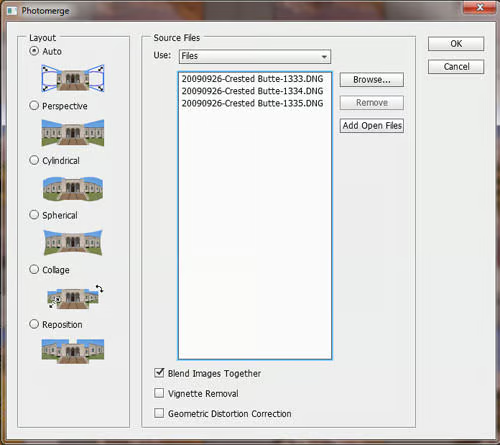
Import RAWs to Lightroom, apply a consistent base profile, lens corrections, and synced WB. Export to a stitcher such as PTGui or Hugin. Rectilinear lenses require more shots than fisheyes but provide straighter lines and fewer “bulb” distortions. Aim for 25–30% overlap for fisheye and 20–30% for rectilinear; with multi‑row rectilinear, err on the higher side vertically to improve zenith blending. PTGui’s control point generation and optimizer handle rectilinear sets well; Hugin is an excellent open‑source alternative. For a deeper look at PTGui’s strengths, see this review by Fstoppers. PTGui: strengths and workflow considerations
Cleanup & Enhancement
- Nadir patch: After stitching, export layers or use PTGui’s Viewpoint correction; patch remaining tripod shadows via clone/heal or AI tools.
- Color finishing: Harmonize interior lighting tints; apply selective HSL to even out mixed LEDs vs daylight.
- Noise reduction: For MFT night sets, do luminance NR conservatively and add a touch of sharpening afterward.
- Horizon and geometry: Level roll/pitch; ensure verticals are straight—especially for real estate and architectural delivery.
- Export: For VR platforms, export an equirectangular 2:1 JPEG at 8,000–12,000 px width. Keep a 16‑bit TIFF master for archiving.
Standards evolve. Always check the latest docs for your stitcher and hosting platform to match projection, file size, and metadata requirements.
Useful Tools & Resources
Software
- PTGui panorama stitching — fast control points, robust optimizer.
- Hugin open source — capable and free; great for learning control points.
- Lightroom / Photoshop — RAW development and finishing.
- AI tripod removal tools — speed up nadir cleanup.
Hardware
- Panoramic heads: Nodal Ninja, Leofoto — precise rails and rotators.
- Carbon fiber tripods — great stiffness‑to‑weight.
- Leveling bases — quick horizon leveling.
- Wireless remote shutters — eliminate touch vibration.
- Pole extensions / car mounts — for special vantage points (tether for safety).
Disclaimer: Names provided for search reference; verify specs and compatibility on manufacturers’ sites.
If you’re new to panoramic heads, this hands‑on primer covers setup and alignment. Panoramic head basics and NPP alignment
Field‑Tested Case Studies
Indoor Real Estate (Bright Windows)
At 9–10mm MFT (≈18–20mm FF), shoot two rows at ±30° (8 frames each), plus zenith and nadir. Set f/8, ISO 200–400, and bracket ±2 EV (3–5 shots). Merge HDR per angle before stitching for clean window detail. Lock WB to 4000–4500 K for modern LEDs. Deliver 10K×5K equirectangulars; clients appreciate straight lines rectilinear glass provides.
Outdoor Sunset View
Use f/8, ISO 200, shutter around 1/60–1/125 for the bright band, and bracket ±2 EV for safety. Flare can be severe—use your hand as a flag just out of frame when the sun is near the lens. Stitch in PTGui with “optimize exposure and vignetting” disabled if you already matched exposures to prevent brightness pumping.
Crowded Event Floor
Shoot a fast single row at 0° tilt to lock in the architecture, then a slower second row waiting for gaps in traffic near overlap zones. At 12–14mm MFT (≈24–28mm FF), use 12 around at 30° spacing if you’re single‑row only, then add zenith/nadir. Mask moving people in the overlaps during post.
Rooftop Pole Shot
Mount a lightweight head on a carbon pole; tether everything. Use 1/250 s at f/5.6, ISO 400–800 to combat sway. Spin slower, pause a count of two between shots. Expect to patch a larger nadir due to the pole footprint.
For more on DSLR/mirrorless 360 capture workflows (including export for VR viewers), Meta’s creator documentation is concise and practical. Mirrorless-to-360 photo pipeline: planning to export
Common Mistakes & How to Avoid Them
- Parallax error → Always calibrate the no‑parallax point. Even a 5–10 mm misalignment shows up with nearby objects.
- Exposure flicker → Manual exposure and locked WB only. No auto ISO, no Auto WB.
- Tripod shadows/footprints → Capture a clean nadir and plan on patching.
- Ghosting from movement → Time overlaps carefully; do a second pass and mask in post.
- High ISO noise at night → Keep ISO ≤800 when possible; lengthen shutter on a tripod and consider modest HDR.
- IBIS artifacts on tripod → Turn IBIS OFF for locked‑down panos.
Frequently Asked Questions
- Can I shoot handheld panoramas with the E‑M1 Mark III?
Yes for partial panos or quick environments. Use IBIS ON, 1/125 s or faster, and generous overlap (35–40%). For high‑end 360 VR, a tripod and panoramic head are strongly recommended to avoid parallax and stitching errors.
- Is the Tamron 17–28mm wide enough for single‑row 360?
At 17mm on full frame, a single row won’t cover zenith/nadir. Plan on at least two rows plus zenith and nadir. On MFT equivalents (≈9–10mm), you’ll also need multi‑row coverage for a full sphere.
- Do I need HDR for interiors with bright windows?
Usually yes. Bracketing ±2 EV (3–5 frames) preserves both window views and interior shadow detail. Merge per angle or stack in PTGui for best results.
- How do I avoid parallax issues?
Calibrate the entrance pupil on a panoramic head and keep it fixed. Mark the rail with your focal length positions so you can repeat the setup quickly.
- What ISO range is safe on this camera in low light?
ISO 200–800 is the sweet spot. ISO 1600 is usable with careful noise reduction; prefer lengthening shutter on a tripod over pushing ISO further for 360 VR deliverables.
- Can I store a “pano setup” on the mode dial?
Yes. Use C1/C2/C3/C4 to save Manual exposure, fixed WB, RAW, IBIS OFF, 2 s timer, and focus magnify settings. This speeds up on‑site work.
- Does the Tamron 17–28mm mount on the E‑M1 Mark III?
No. It’s a Sony E‑mount lens and cannot be adapted to MFT at infinity focus. Use an MFT rectilinear ultra‑wide for this Olympus body; techniques and shot counts here apply directly.
Watch: Practical Panorama Shooting Tips
This video covers foundational techniques (overlap, nodal alignment, and consistent exposure) that translate directly to the E‑M1 Mark III workflow.
For an in‑depth, step‑by‑step panoramic head setup walkthrough, the meta tutorial is excellent. Set up a panoramic head for high‑end 360 photos
Safety, Limitations & Trust Notes
Weather and height demand caution. Always tether your camera on rooftops or poles. Avoid opening the card door in rain or dust. The E‑M1 Mark III’s weather sealing is strong, but water can still wick through interfaces under wind. For car‑mounted work, add redundant safety lines and never shoot while driving. Back up immediately after each location: two cards in camera, then duplicate to a portable SSD; if time allows, add a cloud backup via hotspot. Finally, be transparent with clients about the lens/body pairing: if you need the Tamron 17–28’s exact look, use a Sony E‑mount body, or match the field of view with an MFT ultra‑wide on your Olympus for indistinguishable results in the final pano.
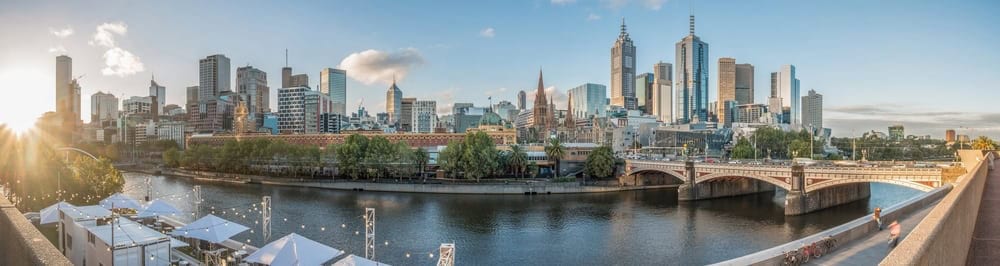
Want more perspective on DSLR/mirrorless pano choices and standards? This overview is a solid reference for decision‑making. Camera and lens choices for virtual tours