Why This Camera & Lens Are Great for Panoramas
If you’re looking for a fast, reliable way to capture immersive 360° photos, the Olympus OM-D E‑M1 Mark III paired with the Sigma 8mm f/3.5 EX DG Circular Fisheye is a compact powerhouse. The E‑M1 Mark III’s 20.4MP Micro Four Thirds sensor (17.4 × 13.0 mm, pixel pitch ~3.3 μm) delivers clean files with excellent color and a practical dynamic range around 12 EV at base ISO. Its class-leading in-body image stabilization (IBIS, up to 7–7.5 stops with compatible lenses) and robust weather sealing make it a dependable choice for outdoor panoramas and on-location real estate work.
Despite the Sigma lens’ “Circular Fisheye” name, on Micro Four Thirds the smaller sensor crops the image, so it behaves like a diagonal fisheye with very wide coverage (near-180° across the frame when you use the Four Thirds-mount version via an adapter). This is ideal for 360 work because you can complete a full sphere with fewer shots compared with rectilinear lenses—saving time on location and reducing stitching complexity. Fisheye distortion is expected and handled gracefully by panorama software; the key is solid nodal (entrance pupil) alignment to avoid parallax.
Quick Setup Overview
- Camera: Olympus OM-D E‑M1 Mark III — Micro Four Thirds, 20.4MP; base ISO 200 (Low 64), mechanical 1/8000s, electronic up to 1/32000s; IBIS rated up to 7+ stops; weather-sealed magnesium alloy body.
- Lens: Sigma 8mm f/3.5 EX DG Circular Fisheye — behaves as a diagonal fisheye on Micro Four Thirds; best sharpness around f/5.6–f/8; moderate CA easily corrected in post.
- Estimated shots & overlap:
- Safe baseline: 6 around at 60° yaw + 1 zenith + 1 nadir (≈30% overlap).
- Speed run (experienced): 4 around at 90° yaw (tilt up ~10–15°) + nadir patch (careful overlap).
- For complex interiors or crowd scenes: 8 around for extra control points.
- Difficulty: Easy–Moderate (easier than rectilinear setups thanks to fewer frames).
Planning & On-Site Preparation
Evaluate Shooting Environment
Walk the scene before you mount the camera. Note bright window/sky vs. shadow ratios (for HDR decisions), reflective surfaces like polished floors and glass (watch for flare and ghosting), and moving elements (people, cars, foliage). If shooting through glass, get as close as possible (1–2 cm) to reduce reflections and use a rubber lens hood if available.
Match Gear to Scene Goals
The E‑M1 Mark III handles mixed lighting and handheld moments well thanks to IBIS, but for 360s use a tripod. ISO 100–200 is ideal outdoors; indoors you can safely push to ISO 800–1600 with good noise reduction in RAW. The Sigma 8mm fisheye minimizes shot count, making it great for tight interiors, rooftops, and quick event captures. Distortion is expected and corrected by the stitcher; this trade-off is worth it when time is tight or space is limited.
Pre-shoot Checklist
- Charge batteries and carry at least one spare; empty and format fast SD cards.
- Clean front element and sensor; fisheyes are unforgiving with dust and smudges.
- Level your tripod; calibrate the panoramic head’s nodal alignment for this combo.
- Safety: check wind loads on rooftops; use tethers on poles/cars; never stand under the pole when extended.
- Backup workflow: shoot an extra full rotation; if crowds move, capture a second pass for clean plates.
Essential Gear & Setup
Core Gear
- Panoramic head with fore–aft and vertical rail adjustment. Align the lens to rotate around its entrance pupil (no-parallax point) to avoid stitching issues.
- Stable tripod with a leveling base or leveling half-ball so yaw rotations stay level.
- Remote trigger or the OM Image Share app for vibration-free shooting and bracketing control.
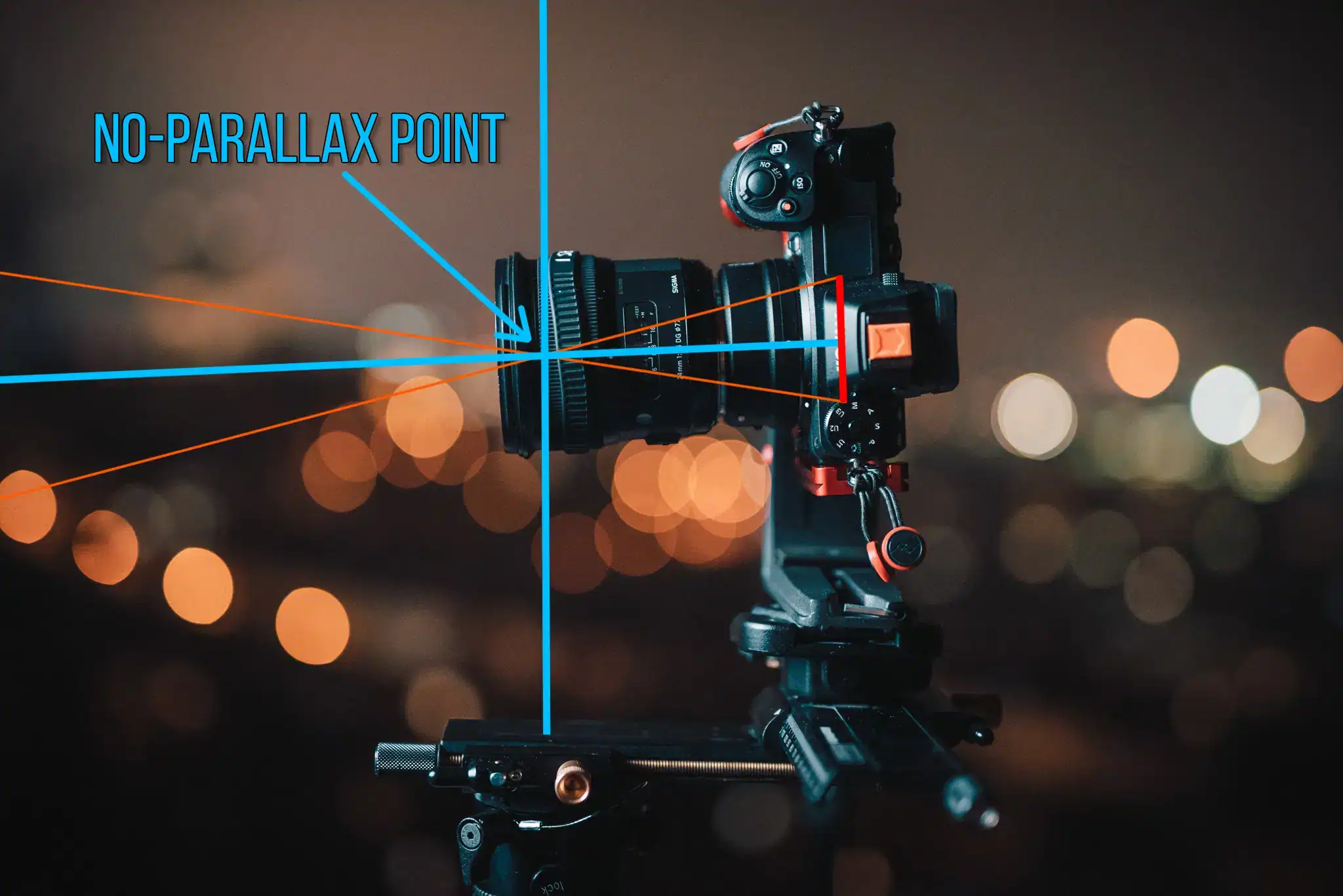
For a deeper primer on panoramic heads and alignment techniques, this panoramic head guide is a solid reference at the end of your first practice session. Panoramic head tutorial
Optional Add-ons
- Pole/car mount: essential for high viewpoints or drive-by mapping. Use safety lines, check every clamp, and limit speed/wind exposure to reduce vibration.
- Continuous lights or flashes for dim interiors. Keep lighting consistent across frames.
- Rain covers and microfiber cloths for weather protection; water spots are very visible on fisheyes.
Step-by-Step Shooting Guide
Standard Static Scenes
- Level tripod and align nodal point. Start with the lens’ entrance pupil roughly 45–55 mm forward of the rotation axis (typical starting range for compact fisheyes on Micro Four Thirds). Fine-tune using the near–far alignment test: place a light stand close and a building edge far; rotate the camera—if relative positions shift, adjust the rail until they don’t.
- Switch to manual exposure. Meter a mid-tone in the scene and lock shutter, aperture, ISO. Set white balance to a fixed preset (Daylight, Tungsten) or a custom Kelvin to keep color consistent across frames.
- Focus: use manual focus and magnify Live View. With an 8mm fisheye at f/8, hyperfocal distance is roughly 0.6 m—focus there and you’ll cover from ~0.3 m to infinity sharply. Disable face/subject tracking.
- Capture the rotation. For a safe baseline: 6 shots around at 60° yaw. If you know your overlap is solid, 4 shots around at 90° with a slight upward tilt is faster. Keep a consistent rotation direction.
- Zenith and nadir: tilt up ~45° and shoot a zenith frame; then tilt down for the nadir (or shoot an offset nadir by moving the tripod slightly and patch later).
HDR / High Dynamic Range Interiors
- Bracket ±2 EV (3–5 frames) to balance bright windows and interior shadows. The E‑M1 Mark III can automate AEB; use RAW for maximum latitude.
- Lock WB and focus across the bracket. If your head supports it, trigger bracketed bursts via remote to avoid bumping the rig.
- Keep people movement minimal between brackets. If necessary, photograph static plates for later masking.
Low-Light / Night Scenes
- Use tripod and remote. Turn IBIS Off when on a tripod to prevent micro-drift during long exposures.
- Start at f/4–f/5.6, ISO 200–800, and lengthen shutter to taste (1–10 s). The E‑M1 Mark III’s “Live Time/Bulb/Composite” can help monitor exposure creatively for light trails and star fields.
- Enable electronic first curtain or silent shutter to reduce vibration. Beware rolling shutter artifacts with moving elements in silent mode.
Crowded Events
- Shoot two passes: a quick first pass to lock composition, and a second pass waiting for gaps to reduce ghosting.
- Use 6–8 shots around for more stitching choices and better masking in post.
- Keep the lens hood away from bright stage lights to minimize flare; block stray light with your hand just outside the frame if needed.
Special Setups (Pole / Car / Drone)
- Secure all mounts and add a safety tether. Check clamps every few minutes; fisheyes see everything—keep yourself out of frame where possible.
- Allow for vibration: shoot at slightly higher shutter speeds (1/250–1/500) or shoot bursts per angle and pick the sharpest frame in post.
- Rotate slower in wind. If the pole sways, wait for it to settle before each shot.
Field-tested Scenarios
Indoor Real Estate
Mount the camera at eye level (1.4–1.6 m). Use 6 around + zenith + nadir with ±2 EV brackets. Set WB to 4000–4500K for mixed daylight/tungsten interiors and refine later.
Outdoor Sunset
Expose for highlights (sky) and bracket for shadows. Capture zenith right after the around shots while the sky color is consistent, then grab the nadir last.
Event Crowds
Position the tripod slightly elevated to reduce foreground heads. Use 8 around for better control points and plan to mask moving subjects in post.
Rooftop / Pole
Keep the rig light and compact. Use faster shutters, lock exposure, and consider 4 around + nadir patch to minimize time aloft.
Recommended Settings & Pro Tips
Exposure & Focus
| Scenario | Aperture | Shutter | ISO | Notes |
|---|---|---|---|---|
| Daylight outdoor | f/8–f/11 | 1/100–1/250 | 100–200 | Lock WB to Daylight; avoid flicker |
| Low light/night | f/4–f/5.6 | 1/30–10s | 200–800 | Tripod + remote; IBIS Off on tripod |
| Interior HDR | f/8 | Bracket ±2 EV | 100–400 | Even spacing; maintain WB + focus |
| Action / moving subjects | f/5.6–f/8 | 1/200+ | 400–800 | Freeze motion; shoot two passes |
Critical Tips
- Manual focus at or slightly beyond hyperfocal (~0.6 m at f/8) to keep everything sharp.
- Nodal calibration: mark your rail once dialed in for the E‑M1 Mark III + Sigma 8mm combo so you can reassemble quickly on site.
- White balance lock: using a fixed WB avoids color banding around the stitch, especially across windows and mixed lights.
- RAW over JPEG: 12-bit RAW from the E‑M1 Mark III gives far more latitude for HDR merges and color correction.
- IBIS on/off: turn Off on tripod; turn On for quick handheld scouting or pole shots where microshake is likely.
- Custom modes: store pano settings (Manual exposure, WB, MF, IBIS Off) in C1/C2 for instant recall.
Stitching & Post-Processing
Software Workflow
Import RAWs and apply basic color/noise corrections consistently. For stitching, PTGui and Hugin are industry standards. Set lens type to “fisheye” and let the software optimize lens parameters automatically; add control points on overlapping features if needed. Fisheye workflows are typically easier because you shoot fewer frames—just ensure at least 25–35% overlap. Export as an equirectangular 2:1 panorama for web/VR. For a comprehensive pro-level overview, Meta/Oculus has a concise DSLR 360 guide. Using a mirrorless camera to shoot and stitch a 360 photo
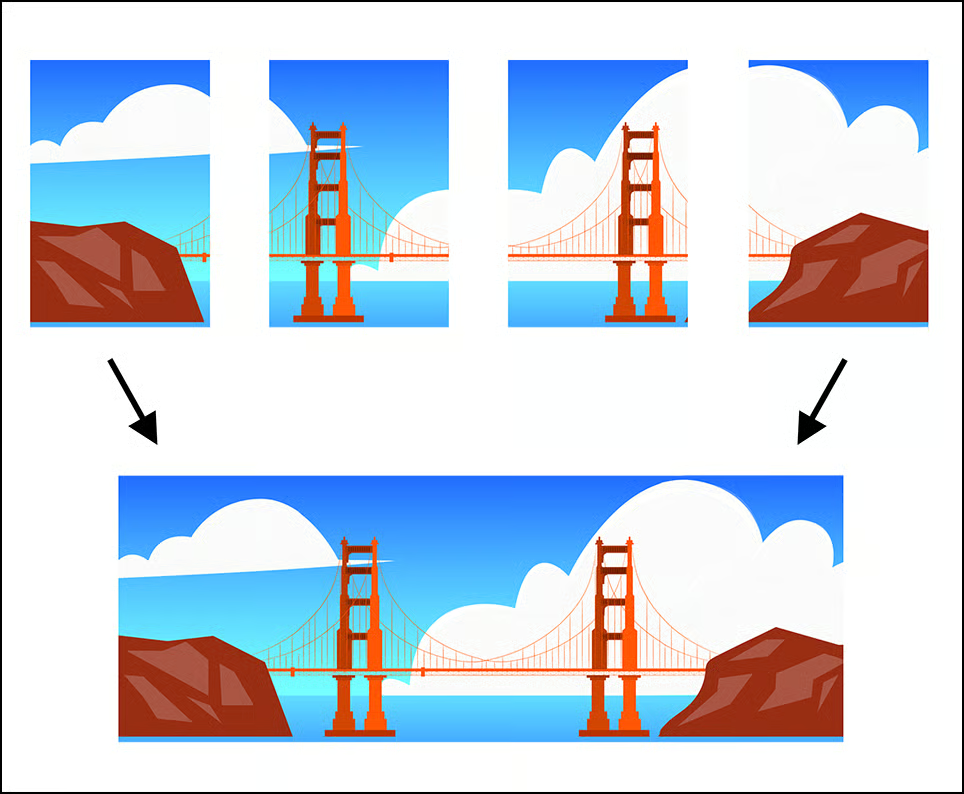
If you’re deciding on a stitcher, this review explains why PTGui remains a top choice for speed and control point handling. PTGui in-depth review
Cleanup & Enhancement
- Nadir patch: clone/Heal in Photoshop or use an AI patching tool; you can also shoot a handheld ground plate to patch seamlessly.
- Color match: equalize temperature/tint across brackets and frames; use HSL to tame mixed lighting.
- Noise reduction: apply global NR at low strength; mask selectively in deep shadows for night scenes.
- Level the horizon: set the vertical line and horizon in the stitcher so viewers don’t feel tilted in VR.
- Export: create a high-quality JPEG (quality 90–95) for web and keep a 16-bit TIFF master for archival/retouch.
Video: A visual walkthrough
Watch a practical overview of setting up and shooting panoramas; it pairs well with the written checklist above.
Useful Tools & Resources
Software
- PTGui (fast, robust control point optimizer)
- Hugin (open-source, flexible)
- Lightroom / Photoshop (RAW development, cleanup)
- AI nadir removal tools (for quick tripod patching)
Hardware
- Panoramic heads: Nodal Ninja, Leofoto, Bushman Panoramic
- Carbon fiber tripods with leveling base
- Wireless remote shutters / smartphone app (OM Image Share)
- Pole extensions / car mounts with safety tethers
Disclaimer: software/hardware names provided for search reference; check official sites for details.
For a structured run-through on head setup and shot planning, this pro-oriented guide is worth bookmarking. Set up a panoramic head for high-end 360 photos
Common Mistakes & How to Avoid Them
- Parallax error → Align the entrance pupil precisely; add more overlap (6–8 around) in tight interiors.
- Exposure flicker → Manual exposure and locked WB across all frames and brackets.
- Tripod shadows in nadir → Shoot an offset nadir and patch, or time your capture when the sun is higher.
- Ghosting from moving subjects → Shoot two passes; mask in post using the clean plate.
- High ISO noise → On E‑M1 Mark III, aim for ISO 100–800 whenever possible; use longer exposures on tripod.
- Flare with fisheye → Avoid pointing directly at the sun or bright fixtures; shield with your hand out of frame.
Frequently Asked Questions
- Can I shoot handheld panoramas with the E‑M1 Mark III?
Yes, in a pinch. The excellent IBIS helps, but expect reduced stitching reliability and more ghosting, especially indoors. Keep shutter at 1/200+ and shoot extra overlap (8 around). For professional results, use a tripod and panoramic head.
- Is the Sigma 8mm f/3.5 wide enough for a single-row 360 on Micro Four Thirds?
Yes. On MFT it behaves like a diagonal fisheye; 6 around + zenith + nadir is a safe baseline. Experienced users can do 4 around + nadir patch outdoors with careful overlap and coverage.
- Do I need HDR for interiors with bright windows?
Often, yes. Bracket ±2 EV (3–5 frames) to preserve detail inside and outside. Merge brackets per angle before stitching or use your stitcher’s exposure fusion.
- How do I avoid parallax issues with this setup?
Align the lens’ entrance pupil on your pano head: perform a near–far alignment test and mark the exact rail position for the E‑M1 Mark III + Sigma 8mm combo. Reuse those marks each time you set up.
- What ISO range is safe on the E‑M1 Mark III in low light?
ISO 100–800 is clean; ISO 1600 is workable with noise reduction; ISO 3200–6400 is emergency-only for tripod-based work. Prefer longer shutters over higher ISO when on a tripod.
- Can I set up Custom Modes for pano?
Yes. Save Manual exposure, MF, fixed WB, IBIS Off, and bracketing in C1/C2 for instant recall. It speeds up on-site work and reduces mistakes.
- How do I reduce flare with a fisheye?
Keep strong lights just outside the frame, use your hand as a flag, and clean the front element frequently. Slightly adjust yaw to move flare artifacts into overlapped regions you’ll mask out later.
- What’s the best tripod head for this setup?
A lightweight two-rail panoramic head (e.g., Nodal Ninja or Leofoto) with precise scales. Ensure it supports fore–aft and vertical adjustments to align the entrance pupil perfectly.
Safety, Workflow, and Real-World Tips
Weather-sealed gear helps, but fisheyes are exposed—carry a microfiber cloth and shoot quickly in rain. On rooftops, weigh down the tripod or use a sandbag. For car-mounted work, use redundant clamps and a safety line, and keep speeds low on uneven roads. Always shoot a spare rotation and a clean nadir plate; if something goes wrong in stitching, those extra frames save the job.
Want to go deeper into lens choice, overlap, and control points? This photographer-focused Q&A pulls together proven techniques from years of field use. Best techniques to take 360 panoramas