Why This Camera & Lens Are Great for Panoramas
The Olympus OM-D E‑M1 Mark III paired conceptually with a rectilinear ultra‑wide such as the Sigma 14–24mm f/2.8 DG DN Art delivers crisp, low‑distortion frames that stitch cleanly into professional 360 photos and high‑resolution panoramas. The E‑M1 Mark III’s 20.4MP Micro Four Thirds (17.4 × 13.0 mm) sensor offers excellent per‑pixel acuity (approx. 3.3 μm pixel pitch), robust weather sealing, and reliable ergonomics. Its in‑body 5‑axis stabilization is excellent for handheld shooting and pole work, while the TruePic IX processor provides responsive bracketing and consistent white balance controls—key for HDR panoramas. The Sigma 14–24mm f/2.8 DG DN Art is a full‑frame, rectilinear ultra‑wide that’s well‑known for low distortion, high corner sharpness from f/4–f/8, and solid flare resistance for a bulbous‑front lens.
Important mount note for trustworthiness: the Sigma 14–24mm f/2.8 DG DN Art is not natively compatible with Micro Four Thirds and cannot be adapted to MFT with a simple mechanical adapter while retaining infinity focus. In practice, for the E‑M1 Mark III you’ll want an equivalent rectilinear ultra‑wide in the 7–12mm range (to match the 14–24mm full‑frame angle of view), such as the Olympus 7–14mm f/2.8 PRO, Panasonic 8–18mm, or Laowa 7.5mm. All the overlap numbers, nodal alignment steps, and exposure strategies below apply directly to that equivalent focal length on Micro Four Thirds. If you do use the Sigma on a full‑frame body in your kit, the same techniques and shot counts apply at the corresponding 14–24mm focal lengths.
Quick Setup Overview
- Camera: Olympus OM-D E‑M1 Mark III — Micro Four Thirds (20.4MP), base ISO 200, approx. 12 EV dynamic range at base, robust weather sealing.
- Lens: Sigma 14–24mm f/2.8 DG DN Art (rectilinear ultra‑wide) — very low geometric distortion, sharp from f/4–f/8, mild vignetting wide open, good CA control. On MFT, use a 7–12mm rectilinear to match the field of view.
- Estimated shots and overlap (rectilinear, spherical 360):
- At 14mm FF equiv. (≈7mm on MFT): 8–10 around at 0°, plus 1 zenith and 1–2 nadir; or 2 rows of 8 around (±30°) + zenith + nadir for cleaner zenith coverage.
- At 18–20mm FF equiv. (≈9–10mm MFT): 12–14 around + zenith + nadir.
- At 24mm FF equiv. (≈12mm MFT): 16–20 around + zenith + nadir; consider two rows for best results.
Target 25–35% overlap for reliable stitching.
- Difficulty: Moderate. Rectilinear UWA needs careful nodal alignment and enough overlap, but stitches very cleanly.
Planning & On-Site Preparation
Evaluate Shooting Environment
Start by noting light direction and contrast. Indoors, bright windows against dim rooms will require bracketing. Watch for reflective surfaces (glass, polished stone, glossy tables) that can create flare or double reflections; shoot at a slight angle to glass and keep the front element clean. For glass panoramas, try to keep the lens 3–5 cm away and shade stray light with your hand or lens hood substitute to reduce ghosting. Outdoors, check for wind that may sway tripods or poles, and consider the sun’s position to minimize lens flare.
Match Gear to Scene Goals
The E‑M1 Mark III’s base ISO 200 and roughly 12 EV of dynamic range provide clean files for daylight panoramas. Indoors or at dusk, stay in the ISO 200–800 range when possible; on Micro Four Thirds, it’s better to add bracketing or longer shutter times than to push ISO above 1600. Rectilinear ultra‑wides like a 7–12mm MFT or 14–24mm FF require more frames than a fisheye but deliver straighter walls and minimal distortion—ideal for real estate, architecture, and cityscapes.
Pre-shoot Checklist
- Charge BLH‑1 batteries; carry spares. Format fast UHS‑II cards and label by job.
- Clean lens and sensor; bring a blower and microfiber cloth.
- Level the tripod and verify pano head calibration for the chosen focal length.
- Safety: weigher your tripod in wind; tether camera when shooting rooftops, poles, or car mounts; never work near edges without a harness.
- Backup workflow: shoot one complete “safety” rotation before experimenting with different exposures or compositions.
Essential Gear & Setup
Core Gear
- Panoramic head: Enables rotation around the lens’s entrance pupil (nodal point) to eliminate parallax. Mark the rail positions for your focal lengths (e.g., 7, 9, 12mm on MFT).
- Stable tripod with a leveling base: Quick, precise leveling prevents sloping horizons and minimizes post‑corrections.
- Remote trigger or camera app: The E‑M1 Mark III supports remote control via OI.Share. A remote prevents vibrations during long exposures or bracketing.
Optional Add-ons
- Pole or car mount: Always use a safety tether, watch for vibrations, and avoid high wind. Keep shutter speeds at or above 1/250 for moving platforms.
- Lighting aids: Small LED panels for interiors to lift deep shadows without raising ISO.
- Weather protection: Rain cover or plastic sleeve in drizzle; a microfiber towel for the front element if waves or mist are nearby.
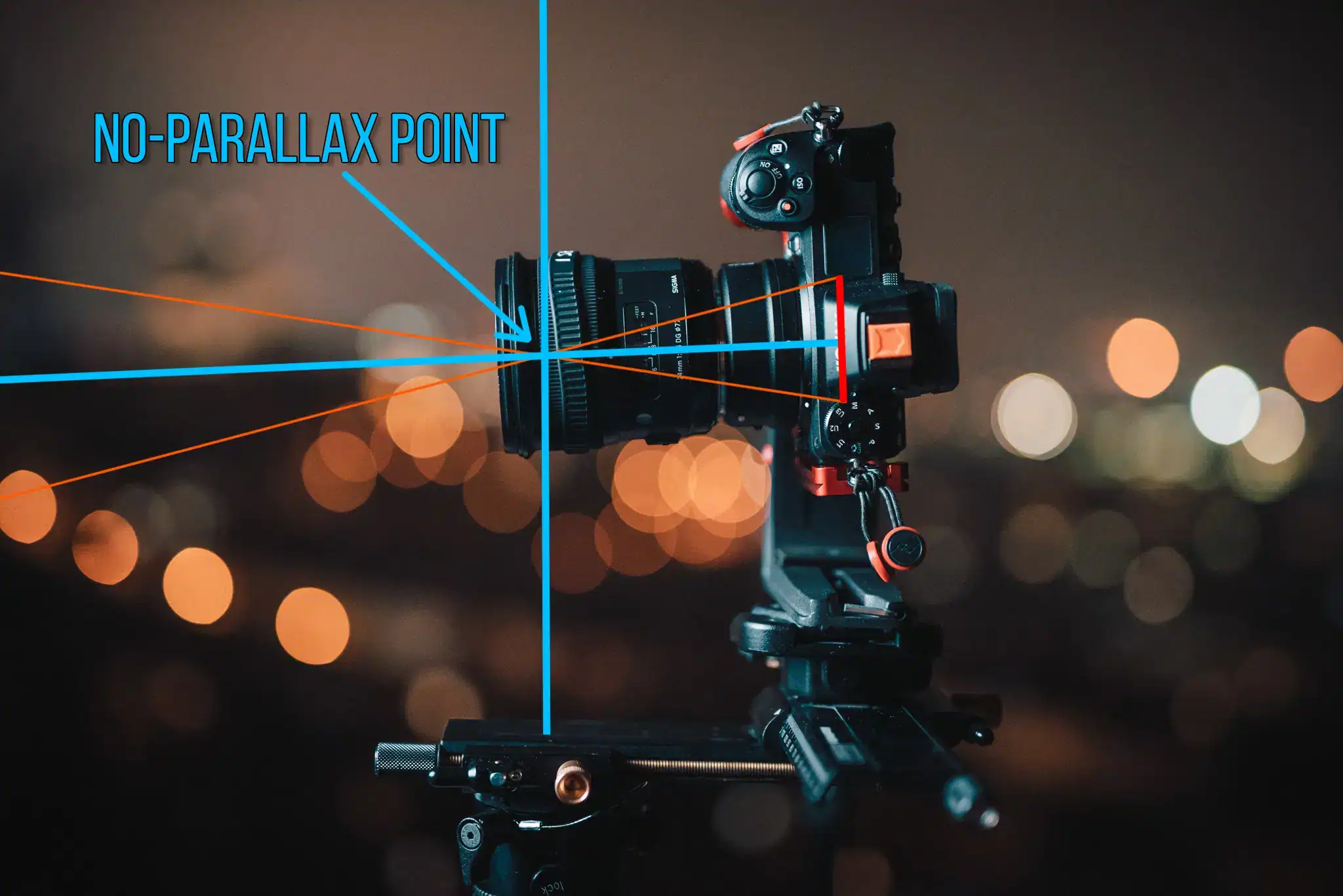
For a deeper primer on panoramic heads and nodal alignment, see this panoramic head tutorial. Read the panoramic head basics at 360Rumors
Step-by-Step Shooting Guide
Standard Static Scenes
- Level tripod and align the nodal point: On your panoramic head, slide the camera until near‑foreground objects do not shift relative to the background as you pan. Mark this rail position for each focal length you use.
- Manual exposure and locked white balance: Set M mode, expose for midtones at base ISO (200) if possible. Lock white balance (Daylight outdoors, custom Kelvin indoors) so color remains consistent across frames.
- Capture with appropriate overlap: For 7mm MFT (≈14mm FF), shoot 8–10 frames around with 30% overlap. If you need a perfectly clean zenith, add a second row (+30° pitch) of 8 frames.
- Take a nadir (ground) frame: After the main sweep, tilt down and shoot 1–2 nadir frames to patch out the tripod in post. Consider a “tripod shift” technique (move the tripod slightly and reshoot the nadir) for an easy patch.
HDR / High Dynamic Range Interiors
- Bracket exposures: Use ±2 EV, 3 to 5 frames. The E‑M1 Mark III can auto‑bracket; use exposure bracketing rather than in‑camera HDR to preserve RAWs.
- Keep white balance fixed: Mixed lighting varies across a room. Locking WB (e.g., 4000–4500K for tungsten/LED mix) ensures consistent stitching and tonemapping.
- Minimize movement between brackets: Use a remote and a 2s self‑timer if needed to avoid vibration.
Low-Light / Night Scenes
- Use longer exposures with tripod: f/4–f/5.6, ISO 200–800, shutter 1–8s depending on scene. Disable IBIS on a locked‑down tripod to avoid sensor micro‑movements.
- Beware of star movement: For astro‑panos, keep individual exposures short (e.g., 10–15s at 7–9mm) to limit star trails if you require pinpoint stars.
- Consider stacking for noise reduction later: Multiple exposures per angle can be median‑stacked before stitching.
Crowded Events
- Two passes: Shoot one fast pass to capture the environment, then a second pass timing gaps in foot traffic.
- High shutter speed: 1/200–1/500 to freeze motion; raise ISO to 800–1600 if necessary and reduce noise in post.
- Mask in post: Use PTGui’s masking to resolve moving subjects and avoid ghosting.
Special Setups (Pole / Car / Drone)
- Secure everything: Use clamps rated above your rig’s weight, a steel safety tether, and double‑check quick‑releases.
- Manage vibration and wind: Short exposures (1/250+), higher ISO if needed. Rotate slower and make extra passes in case of motion blur.
- Plan the nadir: For poles, shoot a handheld nadir after lowering the rig; for car mounts, capture a clean road patch from a safe stop to clone later.
Real‑World Mini Case Studies
- Indoor real estate: 7mm MFT at f/8, ISO 200, bracket ±2 EV (5 frames), 10 around + zenith + nadir. Lock WB at 4000–4500K.
- Outdoor sunset: 9–10mm MFT, f/8, ISO 200, 1/60–1/125s; consider 2 rows to capture the sky gradient. Add a 3‑shot bracket if the sun is in frame.
- Event crowd: 12mm MFT, f/5.6–f/8, 1/250s, ISO 800–1600; two fast passes and mask people in post.
- Rooftop/pole: 7–9mm MFT, f/5.6–f/8, 1/250–1/500s. Safety tether; avoid gusty conditions; take an extra full rotation.
Recommended Settings & Pro Tips
Exposure & Focus
| Scenario | Aperture | Shutter | ISO | Notes |
|---|---|---|---|---|
| Daylight outdoor | f/8–f/11 | 1/100–1/250 | 200 | Lock WB (Daylight); aim for 30% overlap |
| Low light/night | f/4–f/5.6 | 1/30–8s (tripod) | 200–800 | Turn IBIS off on tripod; use remote |
| Interior HDR | f/8 | Bracket ±2 EV (3–5 frames) | 200–400 | Balance windows vs. room; fixed WB |
| Action / moving subjects | f/5.6–f/8 | 1/200+ | 400–800 (up to 1600 if needed) | Two passes; later mask movement |
Critical Tips
- Manual focus at hyperfocal: On MFT, at 7mm and f/8, hyperfocal is roughly 0.4–0.5 m; at 12mm and f/8 it’s about 1.2 m. Prefocus and switch to MF so focus doesn’t shift mid‑pan.
- Nodal point calibration: With the camera on the pano head, align the rail so a nearby vertical object doesn’t shift relative to the distant background as you pan. Mark rail stops for your key focal lengths.
- White balance lock: Mixed lighting can cause color seams. Use a fixed Kelvin value or a custom WB card shot; avoid Auto WB for 360s.
- RAW over JPEG: RAW gives you headroom to equalize frames, correct CA, and recover highlights—vital for window scenes.
- IBIS on or off: On a solid tripod, turn IBIS off. On poles or handheld, leave IBIS on to counter small vibrations.
Stitching & Post-Processing
Software Workflow
Import and cull in Lightroom or your DAM. Develop a baseline color/exposure preset and sync across the set (keep WB fixed). For stitching, PTGui is the industry workhorse; Hugin is a capable open‑source option. Rectilinear ultra‑wides typically need 20–35% overlap; two‑row captures improve zenith coverage. For HDR sets, you can feed brackets directly to PTGui for HDR merging or pre‑merge to 32‑bit and stitch afterward. See a pro review of PTGui’s strengths
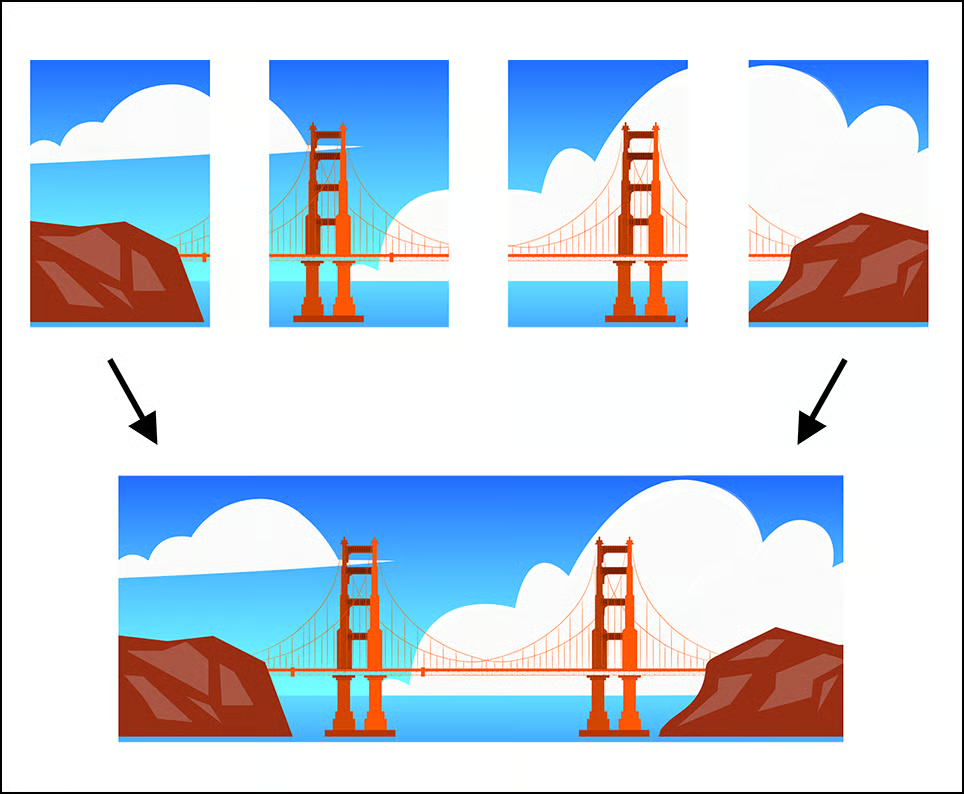
If you’re new to end‑to‑end 360 workflows with mirrorless/DSLR, this concise guide from Meta’s Creator docs is a great orientation. Using a DSLR or mirrorless to shoot and stitch a 360 photo
Cleanup & Enhancement
- Nadir patch: Use PTGui Viewpoint Correction or clone/heal in Photoshop. A dedicated clean nadir shot speeds up patching.
- Lens corrections: Apply lens profile for your chosen MFT ultra‑wide. For the Sigma on full frame, PTGui/Lightroom often auto‑detects correction metadata.
- Color matching: Use HSL and selective color to gently equalize tricky mixed‑light interiors.
- Noise reduction: Apply luminance NR sparingly to shadows; consider multi‑frame stacking before stitching for night scenes.
- Leveling: Set the horizon and correct yaw/pitch/roll in PTGui’s panorama editor for a comfortable VR viewer experience.
- Export: For VR, export equirectangular 2:1 JPEG; 8000×4000 is a solid baseline, 10000–16000 px wide for premium tours.
Video: Panorama Head Setup Basics
Seeing the nodal alignment process once makes everything easier. The following video complements the steps above.
For more on building a high‑end 360 photo workflow with panoramic heads, see this step‑by‑step primer. Set up a panoramic head for high‑end 360 photos
Useful Tools & Resources
Software
- PTGui panorama stitching (robust HDR, masking, viewpoint correction)
- Hugin (open‑source alternative)
- Lightroom / Photoshop (global edits, cloning, nadir patch)
- AI tripod removal tools (content‑aware fill, generative AI)
Hardware
- Panoramic heads (Nodal Ninja, Leofoto) with fore/aft and lateral rails
- Carbon fiber tripods for stiffness and low weight
- Leveling bases to speed setup
- Wireless remote shutters or app control
- Pole extensions / car mounts with safety tethers
Disclaimer: hardware/software names are provided for research; check official sites for compatibility and updates.
Common Mistakes & How to Avoid Them
- Parallax error: Not aligned to the entrance pupil. Fix with proper pano head calibration and rail marks.
- Exposure flicker: Auto exposure or Auto WB between frames. Use Manual exposure and fixed WB.
- Insufficient overlap: Less than ~25% can miss control points. Shoot 30% overlap and take a safety pass.
- Tripod shadows/presence: Always shoot a nadir or plan a patch; be aware of harsh sun angles.
- High ISO noise: Keep ISO low (200–800). Lengthen shutter or bracket rather than push ISO to 3200+ on MFT.
- Wind vibration: Weight the tripod, use a remote, and add a second rotation for safety.
Frequently Asked Questions
- Can I shoot handheld panoramas with the E‑M1 Mark III?
Yes for single‑row panos in good light. Use IBIS on, 1/250s or faster, and 30–40% overlap. For 360s or interiors, a tripod with a panoramic head is strongly recommended to control parallax and improve stitch quality.
- Is the Sigma 14–24mm f/2.8 DG DN Art wide enough for single‑row 360s?
At 14mm on full frame (≈7mm MFT equivalent), you can attempt a single row (~10 around) plus zenith/nadir, but two rows (±30°) produce cleaner poles (zenith/nadir). On Micro Four Thirds, use a 7mm rectilinear for the same coverage.
- Do I need HDR for interiors with bright windows?
Usually yes. Bracket ±2 EV (3–5 frames). This preserves window detail and interior shadows so you can fuse to a natural look without banding or halos.
- How do I avoid parallax issues with ultra‑wides?
Use a panoramic head and align the entrance pupil. Slide the rail until a near object doesn’t shift against the far background as you pan. Mark your positions for 7, 9, and 12mm MFT equivalents for fast setups.
- What ISO range is safe on the E‑M1 Mark III in low light?
ISO 200–800 is the sweet spot; up to 1600 is usable if needed. Prefer longer shutter times or HDR bracketing over pushing ISO when the camera is on a tripod.
- Can I save a custom panorama setup on the E‑M1 Mark III?
Yes. Assign Manual mode, fixed WB, your typical aperture, MF focus, self‑timer/remote, and bracketing to a Custom Mode (C1/C2). You’ll be ready to shoot in seconds.
- What’s the expected final resolution of a 360 from this setup?
Depends on overlap and rows. A 20MP MFT sensor with 10–20 frames can produce 8K–12K‑wide equirectangulars routinely; multi‑row captures can push beyond 14K with careful technique. For theoretical guidance, see the PanoTools spherical resolution notes. Read about spherical resolution on PanoTools
- Best tripod head choice for this combo?
A compact panoramic head with fore/aft rails (e.g., Nodal Ninja, Leofoto) is ideal. Make sure it can support a heavier front element lens and allows precise nodal alignment.
Safety, Compatibility, and Trust Notes
Compatibility: The Sigma 14–24mm f/2.8 DG DN Art is not native to Micro Four Thirds and lacks a practical optical adapter path that preserves infinity focus. For Olympus E‑M1 Mark III, choose an MFT rectilinear ultra‑wide (7–12mm) to match the field of view and follow all techniques here. If your team also uses a full‑frame body with the Sigma, you can apply the exact same shooting plan at 14–24mm on that body.
Safety: Always tether gear when shooting from edges, rooftops, poles, or vehicles. In wind, lower your center column, add weight to the tripod, and slow down. If in doubt, don’t deploy a pole or car mount—no shot is worth risking injury or property damage.
For a broader panorama FAQ and gear guidance that complements this article, this overview provides practical perspective across systems. Read a DSLR/mirrorless virtual tour FAQ
Visual Inspiration