Why This Camera & Lens Are Great for Panoramas
If you’re wondering how to shoot panorama with Olympus E-M1 Mark III & Samyang 12mm f/2.8 ED AS NCS Fish-Eye, you’re pairing a rugged, pro-grade Micro Four Thirds body with a fast, manual fisheye that keeps shot counts low and stitching reliable. The Olympus E‑M1 Mark III uses a 20.4 MP Micro Four Thirds sensor (approx. 17.3 × 13.0 mm; pixel pitch ~3.3 μm). It’s known for excellent 5‑axis IBIS, reliable color, and practical dynamic range in the 12+ EV class at base ISO (200). You also get weather sealing, a responsive EVF, and an efficient control layout—ideal for field work in tough conditions.
The Samyang 12mm f/2.8 ED AS NCS Fish‑Eye is a manual-focus, diagonal fisheye. On full frame it covers 180° diagonal, but on Micro Four Thirds (2× crop) expect a substantially narrower diagonal field of view—roughly in the ~110–120° range depending on projection. In practice, that means more frames are needed than with a native 7.5mm MFT fisheye, but you still get the fisheye advantages: fewer rows than rectilinear lenses, robust overlap, and generally painless stitching in PTGui/Hugin. The f/2.8 max aperture is handy for night scenes and indoor work, and Samyang’s NCS coatings help tame flare. Mounting is typically via an adapter if your copy isn’t native to MFT; just ensure solid, play‑free mounting to keep your nodal alignment consistent.
Quick Setup Overview
- Camera: Olympus E‑M1 Mark III — 20.4 MP Micro Four Thirds sensor (17.3 × 13.0 mm), 5‑axis IBIS up to ~7 stops, base ISO 200, solid DR (~12 EV+ at base), weather sealed.
- Lens: Samyang 12mm f/2.8 ED AS NCS Fish‑Eye — diagonal fisheye, manual focus, sharpest around f/5.6–f/8, good center sharpness and usable corners on MFT after stopping down; flare controlled via NCS coating.
- Estimated shots & overlap (field‑tested on MFT): 6–8 shots around at 30% overlap + zenith + nadir (safe set: 8 around, 1 up, 1 down). For ultra‑clean stitches or moving crowds, shoot a second safety pass.
- Difficulty: Intermediate (manual focus, nodal calibration, and careful exposure discipline).
Planning & On-Site Preparation
Evaluate Shooting Environment
Before setting up, scan your scene: note moving elements (people, trees, traffic), reflective surfaces (glass, polished floors), and bright light sources (sun, streetlights). If shooting through glass, place the lens as close as possible (without touching) to minimize reflections and double images; use a rubber hood if available. For sunsets or city lights, plan for bracketing to control the wide dynamic range. Check clearances for tripod legs and a safe area to stand during rotation.
Match Gear to Scene Goals
The E‑M1 Mark III’s IBIS is great for hand‑held shooting, but turn it off on a tripod for absolute consistency. Its DR and noise control are best in the ISO 200–800 range; ISO 1600 is usable in a pinch with good noise reduction. The Samyang 12mm fisheye reduces total frames versus rectilinear lenses and makes stitching easier, at the cost of fisheye distortion (which is fine because stitching software expects that). If you want fewer frames than ~8 around, consider a wider native MFT fisheye (e.g., 7.5mm) for future projects.
Pre-shoot Checklist
- Charge batteries and carry a spare; format high-speed cards; clean lens, filter, and sensor.
- Level the tripod; calibrate your panoramic head’s nodal (entrance pupil) for this lens + adapter.
- Safety checks: avoid setting up on slick tiles, near edges, or under strong wind gusts; tether gear if shooting from rooftops, poles, or vehicles.
- Backup workflow: shoot a second 360° pass; store to dual slots if possible; keep an extra microfibre cloth and a rain cover handy.
Essential Gear & Setup
Core Gear
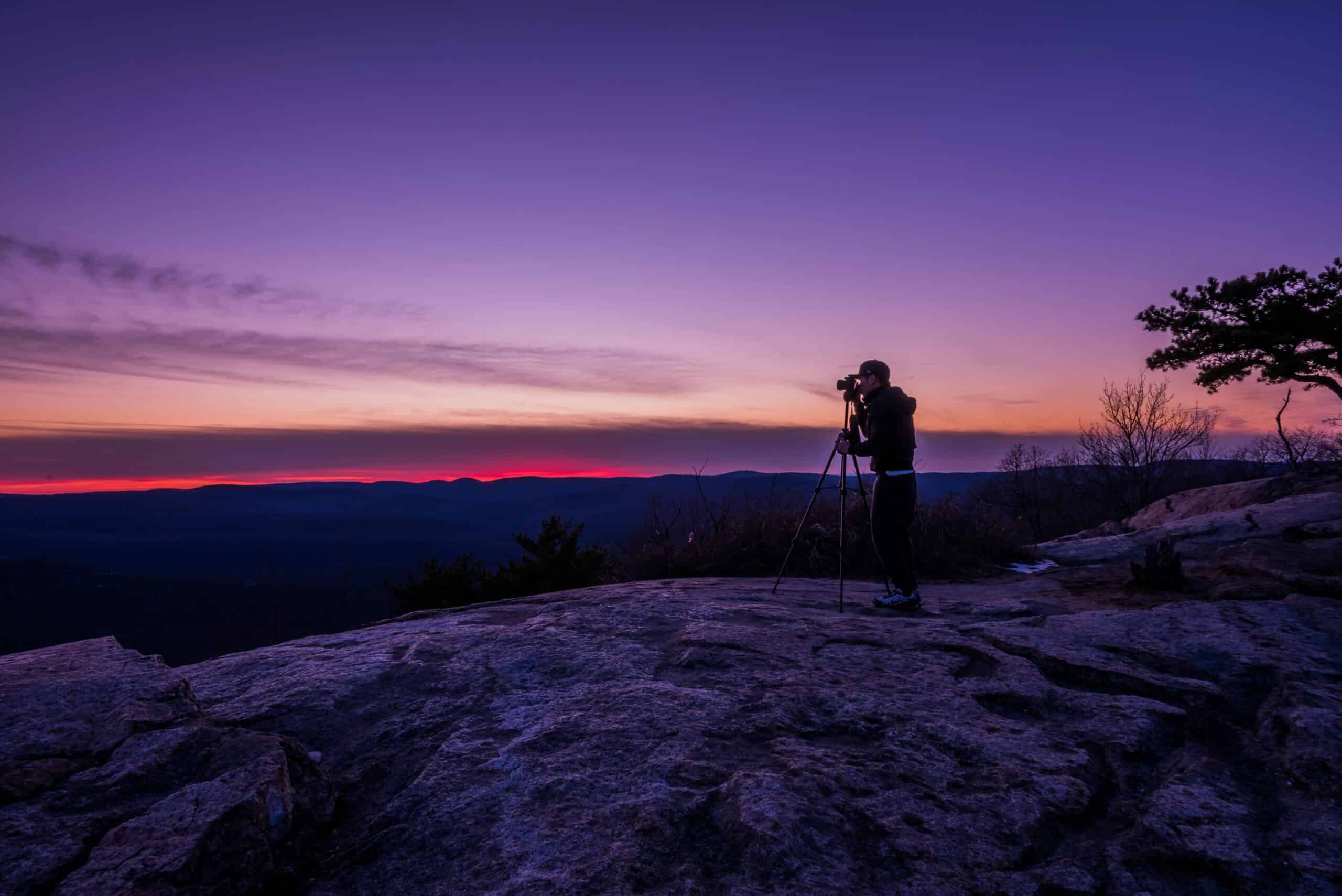
- Panoramic head: Align the rotation around the lens’s entrance pupil (nodal point) to eliminate parallax. This ensures near and far objects overlap cleanly when rotating; it’s the single biggest factor in painless stitching.
- Stable tripod with a leveling base: A leveling base lets you level the head quickly; this keeps frames evenly spaced and reduces post‑leveling corrections.
- Remote trigger or the Olympus OI.Share app: Use a 2s self‑timer, Anti‑Shock, or Silent (electronic) shutter to reduce micro‑vibrations. On tripod, disable IBIS.
Optional Add-ons
- Pole or car mount: Use safety tethers and verify clamp torque. Wind increases leverage on poles—avoid gusty days or lower your extension.
- Lighting aids: Small LED panels or bouncing a flash into white ceilings for interiors; keep light consistent across frames.
- Weather protection: Rain cover for camera, gaffer tape to secure cables, microfibre for the fisheye dome/front element.
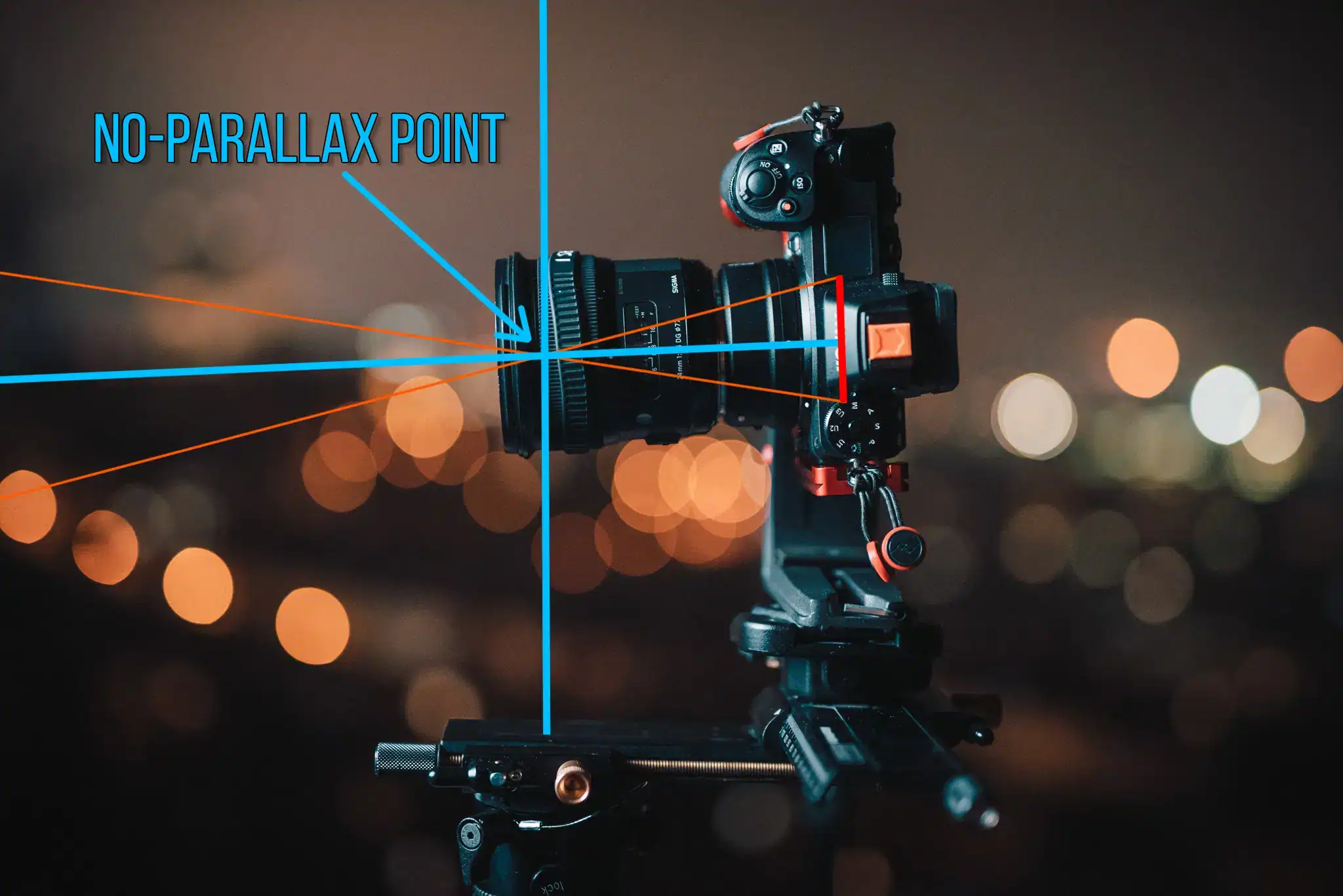
For a deeper walkthrough on panoramic heads and entrance pupil alignment, see this panoramic head tutorial (a trusted industry guide). Panoramic head setup guide
Step-by-Step Shooting Guide
Standard Static Scenes
- Level and nodal alignment: Level the tripod using the leveling base. On the pano head, set fore‑aft and left‑right rails so the rotation axis passes through the lens’s entrance pupil. Start with the lens centered; fine‑tune by observing a near vertical object against a far background while rotating—parallax should vanish.
- Manual exposure + locked WB: Set Manual mode. Meter a mid‑tone area; lock exposure so every frame matches. Set a Kelvin WB (e.g., 5200K daylight or 3400K tungsten) to avoid color shifts between frames.
- Capture sequence with consistent overlap: For this combo on MFT, use 6–8 shots around with ~30% overlap, then a zenith (straight up) and a nadir (straight down). Rotate evenly—e.g., 45° increments for 8 shots. If you plan to patch the tripod later, capture an extra handheld nadir after moving the tripod.
- Log your position: Mark your start frame and keep a mental or physical tally so you don’t miss a spot. Consistency makes stitching automatic.
HDR / High Dynamic Range Interiors
- Bracket ±2 EV (3–5 frames): The E‑M1 Mark III can bracket easily. Use 3, 5, or 7 frames depending on the scene’s DR (bright windows vs dark corners). Keep WB locked.
- Keep ISO low: Aim for ISO 200–400. Aperture around f/8; let shutter speeds vary. Use remote or self‑timer; disable IBIS on tripod.
- Maintain sequence: Shoot all brackets for each yaw position before rotating. Label sets if needed to avoid mix‑ups.
Low-Light / Night Scenes
- Use longer exposures: f/4–f/5.6, ISO 200–800, expose as long as needed for clean shadows. The E‑M1 Mark III tolerates ISO 1600 in a pinch; 3200 is possible but expect more noise.
- Stability first: Tripod, no IBIS, 2s timer or remote, and avoid windy locations. Consider electronic shutter to remove shutter shock.
- Watch for moving lights: Cars or people can create ghosting; capture a second “clean” frame when the area clears for later masking.
Crowded Events
- Two passes: First pass captures the whole 360 quickly. Second pass repeats frames when gaps appear in the crowd so you have clean plates to mask.
- Faster shutter: 1/200s+ at f/5.6–f/8, ISO 800–1600 if needed to freeze motion. Accept a bit more noise for fewer ghosts.
Special Setups (Pole / Car / Rooftop)
- Secure gear: Use safety tethers and check every clamp. For cars, use vibration‑isolating mounts and plan short exposures.
- Wind management: Lower pole height or add a guy line. Rotate slower to reduce sway and motion blur.
- Parallax still matters: Even on a pole, keep rotation about the entrance pupil; aim for clean overlap to make stitching predictable.
Recommended Settings & Pro Tips
Exposure & Focus
| Scenario | Aperture | Shutter | ISO | Notes |
|---|---|---|---|---|
| Daylight outdoor | f/8–f/11 | 1/125–1/250 | 200–400 | Set WB to Daylight (5200K); disable IBIS on tripod |
| Low light/night | f/4–f/5.6 | As needed (1/2–10s) | 200–800 | Tripod + remote; use electronic shutter to avoid shock |
| Interior HDR | f/8 | Bracket ±2 EV (3–5 frames) | 200–400 | Balance windows and lamps; keep WB locked |
| Action / moving subjects | f/5.6–f/8 | 1/200+ | 800–1600 | Freeze motion; shoot a second pass for clean plates |
Critical Tips
- Manual focus and hyperfocal: The Samyang is manual—enable focus peaking. At 12mm on MFT, setting ~1–1.5 m at f/8 often renders from ~0.7 m to infinity acceptably sharp. Verify with magnified live view.
- Nodal calibration workflow: Put a light stand close to the lens and a distant pole/building in the background. Rotate slightly; adjust rails until the near object doesn’t shift against the far object. Mark your rail positions for this lens + adapter.
- White balance lock: Use Kelvin or a custom WB target. Mixed lighting? Consider a neutral gray shot for later reference.
- RAW first: Shoot RAW for the extra latitude in highlights and shadows. Micro Four Thirds RAWs respond well to modern noise reduction.
- IBIS behavior: On tripod, turn IBIS OFF. Handheld mosaics can use IBIS—set the focal length to 12mm in the E‑M1 Mark III’s IS settings for best stability.
- Shutter control: Use Anti‑Shock or Silent mode to reduce vibration. Avoid “LOW” extended ISO for critical DR; base ISO 200 yields the best highlight headroom.
- Custom modes: Save a pano setup (Manual exposure, ISO/WB fixed, IBIS Off, self‑timer 2s) to C1/C2 for quick recall.
Stitching & Post-Processing
Software Workflow
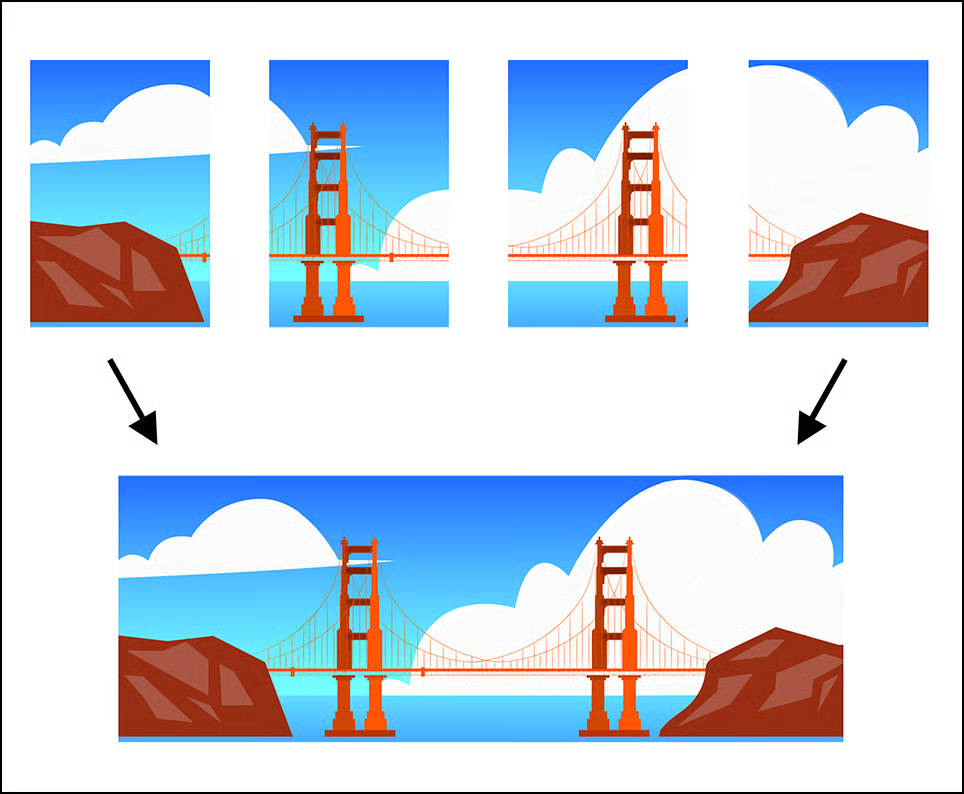
Import RAWs and apply consistent lens corrections and color across the set (copy/paste settings in Lightroom or Capture One). Export 16‑bit TIFFs for stitching when quality matters. Fisheye shots are straightforward in PTGui or Hugin—select “fisheye” projection for the lens and let control points auto‑generate. Aim for ~25–35% overlap for fisheyes. Rectilinear lenses usually prefer 20–25% overlap and more frames. PTGui remains a favorite for speed and masking tools; Hugin is a robust open‑source alternative. PTGui review and why it’s popular for high-end panoramas
Cleanup & Enhancement
- Nadir patch: Shoot a separate handheld downward frame after moving the tripod; patch with content-aware fill, clone tools, or AI tripod patchers.
- Color and noise: Harmonize color temperature across brackets and frames; apply luminance and chroma noise reduction conservatively.
- Leveling: Fix roll/pitch/yaw so horizons are straight; PTGui’s Viewpoint correction and Vertical lines optimization help with interiors.
- Export formats: For VR and virtual tours, export equirectangular JPEG (quality 90–100) at 12k–16k width when possible. TIFF masters are ideal for archival or further retouching.
For platform-specific guidance on DSLR/mirrorless 360° workflows, Meta’s Creator docs are a useful reference. DSLR/mirrorless 360 photo workflow
Curious how pano shot count impacts final resolution? See this reference on spherical resolution and coverage. Spherical resolution basics
Useful Tools & Resources
Software
- PTGui (fast, reliable control points, clever masking)
- Hugin (open-source, powerful but with a learning curve)
- Lightroom / Photoshop (RAW prep, color, nadir patch)
- AI tripod removal / content-aware tools for quick nadir cleanup
Hardware
- Panoramic heads: Nodal Ninja, Leofoto, or similar with fore‑aft and lateral rails
- Carbon fiber tripods with a leveling base for speed and rigidity
- Wireless remote shutters or smartphone apps
- Pole extensions / car mounts with safety tethers and vibration damping
Disclaimer: software/hardware names are provided for search reference; check official sites for current features and compatibility.
If you want a broader primer comparing lenses and body choices for virtual tours, this summary is helpful. Virtual tour DSLR/mirrorless lens & camera guide
Common Mistakes & How to Avoid Them
- Parallax error: Not aligned to the entrance pupil. Fix with proper panoramic head calibration.
- Exposure flicker: Auto exposure/WB between frames causes visible seams. Use Manual exposure and locked WB.
- Tripod shadows or reflections: Shoot an extra nadir and patch; watch for tripod in mirrors and windows.
- Ghosting from movement: Shoot a second pass and mask the cleaner frames in the stitcher.
- High-ISO noise: Keep ISO 200–800 when possible; use longer exposures on a sturdy tripod.
- IBIS on tripod: Turn it off to avoid micro‑jitter and blurred pixels.
Real-World Case Studies
Indoor Real Estate (Bright Windows)
On the E‑M1 Mark III, set ISO 200, f/8, and bracket ±2 EV (5 frames). Lock WB to 4000K if mixed LED/tungsten, or custom WB off a gray card. Capture 8 around, zenith, and nadir. In PTGui, enable HDR merge or pre-merge brackets in Lightroom. Mask windows if needed and level verticals with the optimizer. The Samyang 12mm fisheye’s predictable overlap keeps stitching reliable around doorframes and table edges when your nodal point is dialed in.
Outdoor Sunset (High Contrast Sky)
Use ISO 200–400, f/8, shutter based on the sky mid‑tones, and consider 3‑shot ±2 EV brackets only for frames with the sun in them. Rotate smoothly to capture the bright quadrant quickly to keep lighting consistent. Apply graduated filters in post to equalize the skyline if needed.
Event Crowds
Start with 1/250s, f/5.6–f/8, ISO 800–1600. Do two passes. In post, use PTGui’s masking to keep clean faces and remove duplicates. The E‑M1 Mark III’s responsive controls and silent shutter help you remain discreet.
Rooftop / Pole Shooting
Safety first: tether your rig and keep low profile in wind. Pre‑focus to hyperfocal and tape the focus ring. Use 6 around if your overlap is strong; add an extra frame toward the skyline side to bolster control points if the scene has large empty areas (like open water or sky). Export 14–16k width for crisp city details if your coverage supports it.
Frequently Asked Questions
-
Can I shoot handheld panoramas with the E‑M1 Mark III?
Yes for quick partial panos, but for 360° spheres with clean stitches you’ll get better results on a tripod with a panoramic head. If you must go handheld, enable IBIS (set focal length to 12mm), use fast shutter (1/250s+), and accept more masking in post.
-
Is the Samyang 12mm f/2.8 wide enough for a single-row 360 on Micro Four Thirds?
Yes, but it needs more frames than a 7.5mm MFT fisheye. Plan on 6–8 shots around plus zenith and nadir for full coverage and strong control points.
-
Do I need HDR for interiors with bright windows?
Often yes. Bracketing ±2 EV (3–5 frames) ensures you retain window detail and clean interiors. Merge in PTGui or pre-merge in your RAW editor.
-
How do I avoid parallax issues with this combo?
Use a panoramic head and calibrate the entrance pupil. Start with rough alignment, then fine‑tune by rotating against a near/far object pair until their relative position doesn’t shift. Mark your rail settings for repeatability.
-
What ISO range is safe on the E‑M1 Mark III in low light?
For the cleanest files: ISO 200–800 on tripod. ISO 1600 is usable with careful noise reduction; 3200 is last resort. Favor longer shutter times over high ISO when the camera is locked down.
-
Can I set up Custom Shooting Modes for pano?
Yes. Save a “Pano” profile (Manual exposure, WB Kelvin, ISO 200–400, IBIS OFF, 2s timer or remote, Silent shutter) to C1/C2 so you’re ready instantly.
-
How can I reduce flare with a fisheye?
Avoid pointing directly at the sun when possible, use your hand or a flag just outside frame to block stray light, and clean the front element. The Samyang’s NCS coating helps, but technique matters most.
-
What’s the best tripod head for this setup?
A compact panoramic head with precise fore‑aft and lateral adjustments (e.g., Nodal Ninja/Leofoto). Look for repeatable scales, solid clamps, and an integrated rotator with detents at 45° for 8‑around workflows.
Safety, Quality Control & Backup
Always stabilize your setup before stepping away. In wind, lower the center column and keep a hand on the tripod when rotating. On rooftops or poles, use a safety tether. After each 360 pass, zoom into a frame to confirm sharpness and exposure. If anything looks off, shoot a full backup pass immediately—conditions change fast and you won’t get a second chance. Keep redundant copies of your RAWs (dual cards or rapid offload) and log scene notes (exposure, WB, rail marks) to speed post‑production.
For an extra layer of confidence, review a neutral best‑practices primer on panoramic technique and pitfalls. Panorama techniques Q&A
Visual Aids