
Why This Camera & Lens Are Great for Panoramas
The Olympus OM-D E‑M1 Mark III is a compact, weather‑sealed Micro Four Thirds (MFT) workhorse that’s ideal for field panoramas. Its 20.4 MP Live MOS sensor (approx. 17.4 × 13.0 mm, ~3.3 μm pixel pitch) offers very usable dynamic range at base ISO, fast operation, and best‑in‑class 5‑axis IBIS for handheld safety shots. For 360° tripod work, the body’s ergonomics, deep custom modes, and dependable battery life help you move quickly and consistently.
The Nikon Z 20mm f/1.8 S is a razor‑sharp rectilinear prime that keeps straight lines straight—perfect for architectural panoramas where you’ll stitch many frames. It’s known for excellent corner performance stopped down, low coma, and well‑controlled lateral CA. Important compatibility note: the Z 20mm f/1.8 S cannot be mounted on an Olympus E‑M1 Mark III (Nikon Z mount has a shorter flange distance, and the lens uses focus‑by‑wire/aperture control that requires a Nikon Z body). If your goal is the field of view you’d get from a 20mm full‑frame rectilinear prime, use an MFT lens around 10mm rectilinear (e.g., Laowa 10mm f/2, Panasonic Leica 10‑25mm set to 10mm, or Olympus 9‑18mm set near 10mm). All pano math and settings below assume that equivalent 10mm MFT field of view, and we also include notes for those who choose to shoot the Z 20mm on a Nikon Z body and apply the same techniques.
Quick Setup Overview
- Camera: Olympus OM-D E‑M1 Mark III — Micro Four Thirds, 20.4 MP sensor (~3.3 μm pixel pitch), base ISO 200 (LOW 64), mechanical shutter up to 1/8000 s, electronic up to 1/32000 s, 5‑axis IBIS rated up to 7+ stops with compatible lenses.
- Lens: Nikon Z 20mm f/1.8 S — rectilinear wide‑angle prime, extremely sharp from f/4–f/8, low distortion and low CA, 77 mm filters, focus‑by‑wire. Note: not mountable on E‑M1 Mark III; use a 10mm rectilinear MFT lens to match the full‑frame 20mm field of view.
- Estimated shots & overlap (rectilinear 10mm on MFT or 20mm on full frame):
- Robust multi‑row: 3 rows × 8 shots each (yaw step 45°, pitch rows at +45°, 0°, −45°) + 1 zenith + 1 nadir = ~26 shots.
- Efficient: 2 rows × 10 (yaw step 36°, rows at +35°, −35°) + zenith + nadir = ~22 shots. Good outdoors; interiors may benefit from 3 rows.
- Overlap: aim ~30–45% horizontally and ~30–40% vertically for reliable stitching.
- Difficulty: Moderate. Tripod + panoramic head strongly recommended for perfect 360×180 results.
Planning & On-Site Preparation
Evaluate Shooting Environment
Walk the scene and check for moving elements (people, leaves, clouds), reflective surfaces (glass, lacquered floors), and mixed lighting (tungsten, daylight, LEDs). For glass, shoot perpendicular and, if possible, keep the lens 30–60 cm away to reduce ghosting from internal reflections. Note wind conditions for outdoor pole work. If you’re on a rooftop, check parapet height and plan a safe tether path for your rig.
Match Gear to Scene Goals
With the E‑M1 Mark III, ISO 200–800 is the sweet spot; the sensor’s dynamic range at base ISO is around 12 stops, so interiors with bright windows often benefit from bracketing. The Nikon Z 20mm f/1.8 S is a superb rectilinear choice when used on a Nikon Z body; on MFT, use a 10mm rectilinear lens to match that look. Rectilinear lenses preserve architecture but require more frames than a fisheye, which means longer capture time and more exposure to subject motion; the trade‑off is straighter lines and less de‑fishing in post.
Pre-shoot Checklist
- Charge batteries, clear cards, clean lens and sensor (use a blower and microfiber).
- Level tripod and verify your panoramic head is calibrated to the no‑parallax point.
- Safety: check wind, set a tether on rooftops/poles, and verify clamps are tight.
- Backup workflow: consider a second full capture round or a safety row at different exposure.
Essential Gear & Setup
Core Gear
- Panoramic head: Allows rotation around the lens’s no‑parallax point to avoid foreground/background shifts that cause stitching errors. Calibrate once, then mark the rails for fast repeatability.
- Stable tripod with a leveling base: A leveling base speeds setup and ensures each row stays consistent, reducing roll/pitch corrections later.
- Remote trigger or camera app: Fire without touching the camera to minimize vibrations for tack‑sharp frames.

Optional Add-ons
- Pole or car mount: Use safety tethers, avoid high winds, and add vibration damping. Keep your shutter speeds higher for vehicle rigs.
- Lighting aids: Small LED wands or bounced flashes for dim interiors. Keep lighting consistent across the sweep.
- Weather protection: Rain covers and microfiber cloths; salt spray and mist can ruin a set fast.
If you’re new to panoramic heads, this illustrated guide to panoramic heads is a solid visual primer on setup order and alignment fundamentals. Read a panoramic head tutorial.
Step-by-Step Shooting Guide
Standard Static Scenes
- Level tripod and align nodal point: Mount your E‑M1 Mark III on the pano head. Slide the rail until rotating the camera produces no relative foreground/background shift. Mark the rail for your 10mm MFT lens. For those shooting the Nikon Z 20mm on a Nikon Z body, repeat the same process; expect a slightly different rail position due to different flange/sensor depth.
- Manual exposure and fixed white balance: Meter the brightest part you must retain detail in (typically a window or sky), then balance exposure for the midtones. Set WB to Daylight/Tungsten as needed, not Auto—consistent color across frames stitches cleaner.
- Focus and aperture: Use manual focus near hyperfocal. At 10mm on MFT, f/8 yields a hyperfocal near ~0.84 m (CoC ≈ 0.015 mm). Focus around 0.8–1 m to keep everything from ~0.45 m to infinity acceptably sharp. For the Z 20mm on full‑frame, f/8 hyperfocal is also comfortably near 1–1.3 m; confirm with a DOF calculator.
- Capture pattern: For maximum reliability, shoot 3 rows × 8 around (yaw 45° steps) at +45°, 0°, −45°, then add a zenith and a nadir. For faster outdoor scenes, 2 rows × 10 around (±35°) plus zenith/nadir works well.
- Nadir shot: Tilt down and take a dedicated ground shot to patch out the tripod in post.
HDR / High Dynamic Range Interiors
- Bracket ±2 EV (3 or 5 frames): Expose for windows without clipping and for shadow detail. Keep the same aperture; vary shutter speed.
- Lock WB and focus: Don’t let WB drift across brackets or frames. It complicates HDR fusion and global color correction.
- Capture order: Shoot all brackets at each position before rotating. Use a 2–3 s self‑timer or remote.
Low-Light / Night Scenes
- Use a stable mount: Turn off IBIS on a tripod to avoid micro‑jitters. On the E‑M1 Mark III, ISO 200–800 retains clean detail; ISO 1600 is usable with modern denoising; 3200 in a pinch.
- Exposure guidance: f/4–f/5.6, 2–10 s, ISO 200–800 depending on scene brightness. Use long‑exposure NR sparingly; it doubles capture time.
- Remote release: Avoid touching the camera. Wind gusts? Wait them out; blurred frames will break stitches.
Crowded Events
- Two passes: First for coverage, second to catch gaps in moving crowds in the most problematic frames.
- Mask in post: Use PTGui’s masking to choose the cleanest people‑free areas. Capture extra overlap when crowds are dense.
Special Setups (Pole / Car / Drone)
- Secure gear: Tether everything. On poles, stay under wind thresholds; keep yaw steps smaller and shoot quickly.
- Vibration control: Shorter shutter speeds and higher ISO as needed. For car mounts, time your shots on smooth pavement; keep speed low.
Video: Visualizing the Capture Flow
Want to see a complete, practical panorama capture demonstrated? This video walkthrough pairs well with the steps above.
Recommended Settings & Pro Tips
Exposure & Focus
| Scenario | Aperture | Shutter | ISO | Notes |
|---|---|---|---|---|
| Daylight outdoor | f/8–f/11 | 1/100–1/250 | 100–200 | Lock WB to Daylight; use lens hood to reduce flare |
| Low light / night | f/4–f/5.6 | 1/30–10 s | 200–800 | Tripod + remote; turn IBIS off on tripod |
| Interior HDR | f/8 | Bracket ±2 EV | 100–400 | Window detail + shadow depth |
| Action / moving subjects | f/5.6–f/8 | 1/200+ | 400–800 | Shorten shutter to reduce ghosting |
Critical Tips
- Manual focus at or near hyperfocal: At 10mm MFT, f/8 hyperfocal ≈ 0.84 m. Mark a tape on your rail for quick repeatability.
- Nodal point calibration: Place a close object aligned with a distant object and rotate. Adjust until there’s no relative shift. Document the rail positions for your body + lens.
- White balance lock: Mixed lighting can vary frame to frame; fix WB to a reasonable preset or measured Kelvin to simplify color correction later.
- RAW over JPEG: RAW gives more latitude for HDR fusion and white‑balance harmonization across the 360.
- IBIS off on tripod: The E‑M1 Mark III’s IBIS is superb handheld, but disable it for tripod panoramas to prevent micro‑shake artifacts.
For additional context on camera/lens choices and virtual tour capture flow, this overview of DSLR/mirrorless 360 workflows is a helpful companion reference. Read the DSLR/mirrorless 360 guide.
Stitching & Post-Processing
Software Workflow
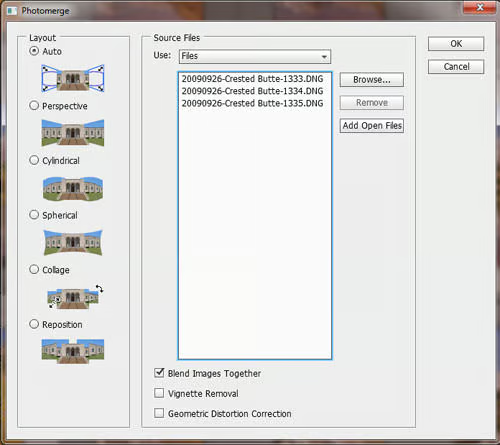
Import your RAWs to Lightroom or your preferred RAW editor. Apply uniform lens corrections if available for your 10mm MFT lens (or for the Nikon Z 20mm files, if shot on a Nikon Z body). Keep edits global and consistent across the set. Next, stitch in PTGui, Hugin, or your panorama tool of choice. Rectilinear lenses tend to need more frames than fisheyes, but produce straighter lines with less de‑fishing. As a rule of thumb, aim for ~30–40% overlap horizontally and vertically; PTGui handles this very well and offers masking to fix moving objects or stitch conflicts.
PTGui is a favorite among working pano shooters for its speed and control point optimization. If you’re evaluating tools, this review summarizes why many pros rely on it. Read a PTGui review.
Cleanup & Enhancement
- Nadir patch: Export a nadir view and clone in Photoshop, or use an AI patching tool for tripod removal.
- Color balance: Neutralize color casts by sampling neutral surfaces; match highlights to a common white point.
- Noise reduction: Apply moderate NR to shadow areas, especially if ISO ≥ 1600.
- Leveling: Use horizon and vertical guides in PTGui or Hugin to correct yaw, pitch, and roll.
- Export: Save an equirectangular 2:1 image (e.g., 12,000 × 6,000 px for web VR) as 16‑bit TIFF for mastering and JPEG for delivery.
If you’re new to high‑end pano head setup and perfect stitches, Oculus’ panoramic head setup article outlines industry‑standard practices to achieve seamless 360s. Learn panoramic head setup best practices.
Useful Tools & Resources
Software
- PTGui panorama stitching
- Hugin (open‑source stitcher)
- Lightroom / Photoshop for RAW, masking, and nadir patching
- AI tripod removal tools
Hardware
- Panoramic heads (Nodal Ninja, Leofoto, Sunwayfoto)
- Carbon fiber tripods + leveling bases
- Wireless remotes / intervalometers
- Pole extensions / car suction mounts with tethers
Disclaimer: Names above for search reference only—confirm specifications on official sites.
Common Mistakes & How to Avoid Them
- Parallax error: Always align the no‑parallax point. Even slight misalignment shows up on close foreground edges.
- Exposure flicker: Manual exposure and locked WB prevent brightness and color jumps that complicate the stitch.
- Tripod shadows or footprints: Shoot a dedicated nadir and patch it cleanly.
- Ghosting from motion: Capture extra overlap and use masking in PTGui/Hugin to select the cleanest regions.
- Night noise: Keep ISO as low as practical on MFT (200–800 ideal) and extend shutter on a sturdy tripod.
For broader Q&A on technique basics, community‑tested tips can help you troubleshoot edge cases. See community tips for 360 panoramas.
Frequently Asked Questions
- Can I shoot handheld panoramas with the E‑M1 Mark III?
Yes, for simple cylindrical or single‑row panos at moderate focal lengths. For full 360×180 VR‑grade results, use a tripod and panoramic head to control parallax. The E‑M1 Mark III’s IBIS helps for handheld “sweep” panos but won’t fix parallax with nearby foregrounds.
- Is the Nikon Z 20mm f/1.8 S wide enough for single‑row 360?
It’s a rectilinear 20mm on full frame—great for multi‑row spherical panos but not wide enough for a single‑row 360×180. Expect at least 2–3 rows plus zenith/nadir. On MFT, use ~10mm rectilinear to match the same FOV and plan for similar shot counts.
- Can I mount the Nikon Z 20mm f/1.8 S on the E‑M1 Mark III?
No. The Z 20mm requires Nikon Z electronic control (aperture/focus). There’s no practical adapter for Olympus MFT. Use an MFT lens around 10mm rectilinear to replicate the field of view, or pair the Z 20mm with a Nikon Z body and use the same pano workflow.
- Do I need HDR for interiors with bright windows?
Usually, yes. Bracket ±2 EV (3–5 frames) per position to preserve highlights and shadows. Keep aperture constant, vary shutter only, and lock WB. Merge HDR before stitching (or use PTGui’s exposure fusion).
- What ISO range is safe on the E‑M1 Mark III in low light?
ISO 200–800 is the sweet spot for clean detail; 1600 is workable with modern denoising; 3200 is an emergency ceiling. Prefer longer shutter times on a solid tripod over pushing ISO.
- Can I save custom modes for panoramas?
Yes. Use the E‑M1 Mark III’s custom modes to store manual exposure, fixed WB, manual focus, and drive mode. This speeds consistent setups on location.
- How do I reduce flare with a rectilinear wide‑angle?
Use a lens hood, shade the lens with your hand off‑frame, and avoid pointing directly at the sun across the sweep. If flare hits a frame, capture an extra overlapping shot to give yourself options in masking.
- What’s the best tripod head for this setup?
A two‑rail panoramic head with vertical and horizontal sliders (e.g., Nodal Ninja or Leofoto) lets you align the lens’s no‑parallax point precisely. Add a leveling base for faster setup and consistent rows.
Compatibility, Safety, and Honest Limitations
Because the Nikon Z 20mm f/1.8 S isn’t mountable on the Olympus E‑M1 Mark III, the practical approach is to match field of view with an MFT 10mm rectilinear lens. Your results and stitch math will mirror what a 20mm on full frame provides. If you already own the Z 20mm, consider renting a Nikon Z body for capture; the shooting and stitching workflow in this guide remains the same. Always tether gear on rooftops, watch wind loads on poles, and shoot a redundant pass as backup—recreating a missing frame after teardown is impossible.
If you’d like a broader perspective on camera/lens selection for virtual tours and panoramas across systems, this independent buyer’s overview is a good orientation read. Learn about camera and lens choices for virtual tours.
