
Why This Camera & Lens Are Great for Panoramas
The Olympus OM-D E‑M1 Mark III is a rugged, stabilized Micro Four Thirds mirrorless body with a 20.4 MP Live MOS sensor (approx. 17.3 × 13.0 mm, ~3.3 µm pixel pitch). It delivers reliable image quality at base ISO with about 12 EV of usable dynamic range, excellent in-body image stabilization (IBIS) up to 7.0–7.5 stops, and pro features like bracketing, customizable controls, and weather sealing. Those strengths make it an excellent platform for tripod-based 360 photo and HDR panorama work, especially in challenging conditions.
The Fujifilm XF 8–16mm f/2.8 R LM WR is a high-end, rectilinear ultra-wide zoom designed for Fujifilm X APS‑C cameras. It’s sharp across the frame, has a constant f/2.8 aperture, weather sealing, and a huge angle of view (diagonal FOV ~121° at 8mm, ~83° at 16mm). That field of view is great for panoramic capture because you can cover the sphere with fewer shots compared to longer focal lengths, while maintaining rectilinear geometry that keeps straight lines straight (helpful for real estate and architecture).
Important compatibility note: the XF 8–16mm is an X‑mount lens and is not natively compatible with the Olympus E‑M1 Mark III (Micro Four Thirds mount). There is no mainstream electronic adapter that preserves AF and EXIF between Fujifilm X and MFT. Even with a hypothetical mechanical adapter, you’d lose autofocus and electronic aperture control, and infinity focus tolerances are risky. In practice, either pair the XF 8–16mm with a Fuji X‑camera, or use a native MFT ultra‑wide (e.g., M.Zuiko 7–14mm f/2.8 PRO) on the E‑M1 Mark III. In this guide, I’ll give you panorama shot counts and settings for both paths so you can shoot confidently today, with gear you actually own or can rent.
Quick Setup Overview
- Camera: Olympus OM‑D E‑M1 Mark III — 20.4 MP Micro Four Thirds sensor (~3.3 µm pixel pitch), strong IBIS, robust weather sealing.
- Lens: Fujifilm XF 8–16mm f/2.8 R LM WR — rectilinear ultra‑wide APS‑C zoom; sharp from wide open, good control of CA and coma; bulbous front element (no front filters), weather‑resistant.
- Estimated shots & overlap (rectilinear ultra‑wide):
- On Fujifilm APS‑C at 8mm:
- Single‑row approach: 8 around at 0° pitch (45° spacing) + 1–2 zenith + 1 nadir (patch) — total ~10–12 frames, ~30% overlap.
- More robust multi‑row: 8 around at +30° and 8 around at −30° + 1 nadir — total ~17 frames, 25–35% overlap.
- On Olympus E‑M1 Mark III with M.Zuiko 7–14mm at 7mm (14mm FF eq):
- Single‑row: 8 around + zenith + nadir — ~10–12 frames.
- Multi‑row: 8 around at +30° and 8 around at −30° + 1 nadir — ~17 frames.
- At longer ends (16mm on APS‑C or 14mm on MFT): expect 10–12 shots per row.
- On Fujifilm APS‑C at 8mm:
- Difficulty: Intermediate (requires nodal point alignment and consistent exposure/WB).
Planning & On-Site Preparation
Evaluate Shooting Environment
Walk the scene before setting up. In interiors, note mixed lighting (tungsten, daylight), bright windows, shiny surfaces (glass, polished stone), and moving elements (people, fans, screens). In exteriors, watch for sun angles, wind, and moving foliage or traffic. If you shoot through glass, get as close as possible (1–3 cm) to reduce reflections, cup the lens with a dark cloth, and avoid placing bright lights behind you to minimize ghosting.
Match Gear to Scene Goals
Why the E‑M1 Mark III works: its ~12 EV dynamic range at base ISO 200 and robust bracketing make HDR panoramas reliable. IBIS is excellent for handheld scouting, but turn IBIS off on a tripod to prevent micro‑jitter during long exposures. Safe ISO on Micro Four Thirds for panorama work: 200–800 for most scenes; 1600 if you must in low light, paired with noise reduction in post.
About the XF 8–16mm: as a rectilinear ultra‑wide, it gives fewer shots than a mid‑wide and preserves architecture lines. If you shoot it on a Fuji body at 8mm (≈12mm FF eq.), you can often do 8 around with a couple of top/bottom frames. Fisheye lenses would cut shots further but require defishing and introduce characteristic distortion; rectilinear keeps walls straight and is often preferred for real estate tours.
Pre-shoot Checklist
- Charge batteries, clear and format fast cards; bring a spare.
- Clean lens front/rear elements and the sensor; smudges repeat across frames.
- Level your tripod; check panoramic head calibration and record your nodal offset for the chosen focal length.
- Safety checks: secure on rooftops and poles; use a tether. Avoid shooting near overhead power lines. Watch wind gusts.
- Backup workflow: shoot an extra 360 pass in case of stitching issues or moving objects spoiling a frame.
Essential Gear & Setup
Core Gear
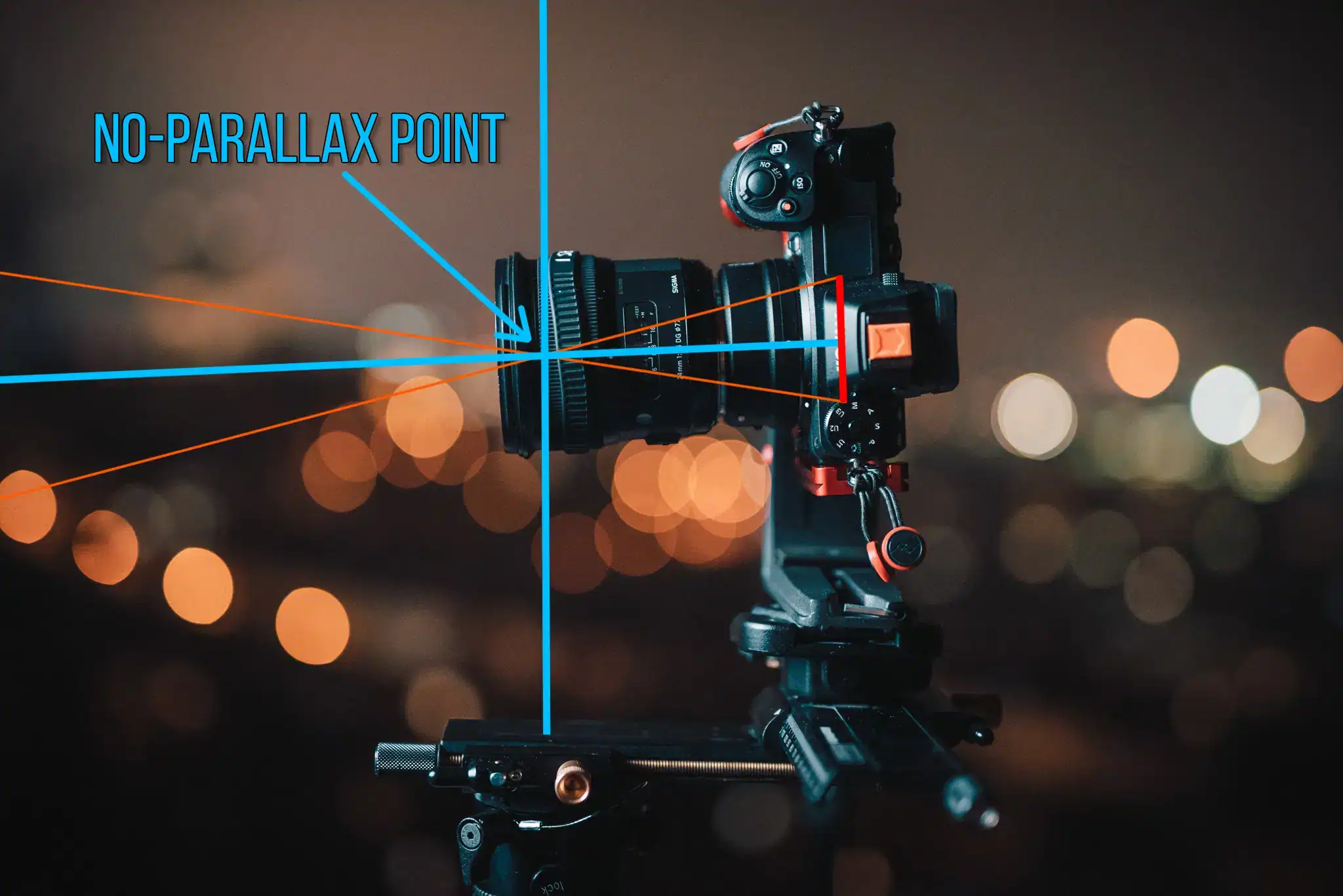
- Panoramic head: enables precise rotation around the lens’s no‑parallax (nodal) point to eliminate parallax issues. Use an L‑bracket and sliding rails to set the fore‑aft offset for each focal length you use.
- Stable tripod with leveling base: a 75 mm or 60 mm leveling half‑bowl or a flat leveling base speeds setup and keeps your horizon true.
- Remote trigger or app: use a cable release or the OM Image Share (OI.Share) app to avoid vibrations when firing the shutter.
Optional Add-ons
- Pole or car mount: always add a safety tether and check fasteners twice. Wind adds leverage; keep exposures short and rotate slowly.
- Lighting for interiors: small LED panels or bounced flashes can fill dark corners; keep lighting consistent across frames.
- Weather protection: rain cover for the camera; microfiber cloth for the XF 8–16’s bulbous front element to avoid droplets and flare.
New to nodal heads? This illustrated primer on panoramic heads is an excellent reference to visualize the setup sequence. Learn panoramic head basics.
Step-by-Step Shooting Guide
Standard Static Scenes
- Level the tripod: use your leveling base bubble and confirm horizon in the camera’s level indicator.
- Align the nodal point: place a near object (1–2 m) and a far object in line. Rotate left/right; adjust the rail until the foreground object doesn’t shift relative to the background when you pan. Mark this rail position for your focal length.
- Set manual exposure: meter a mid‑tone in the scene and lock exposure in full Manual mode. Lock white balance (Daylight or a custom Kelvin value). Shoot RAW for maximum latitude.
- Focus: switch to manual focus; set near the hyperfocal distance (e.g., at 8–10 mm on APS‑C or 7 mm on MFT, f/8 will cover most scenes sharply). Use focus magnification to confirm.
- Capture sequence:
- Single‑row method (fast): 8 shots around at 45° steps, then 1–2 zenith frames pitched up 60–80°, plus 1 nadir frame pitched down 60–80° or a handheld nadir patch with the tripod moved.
- Multi‑row (cleaner coverage): 8 shots around at +30°, 8 around at −30°, 1 nadir. Rotate consistently; overlap 25–35%.
- Nadir cleanup: after the main set, lift the tripod a bit or use “viewpoint” method: shoot the ground from roughly the same position, tripod moved aside for easy patching.
HDR / High Dynamic Range Interiors
- Use AEB (auto exposure bracketing): 3–5 frames at ±2 EV is typical for bright windows vs. interior shadows. The E‑M1 Mark III supports 3/5/7‑frame bracketing; set 2 EV steps if windows are very bright.
- Keep WB locked and use the same aperture for all brackets to avoid stitching seams. Don’t change focus between brackets or frames.
- Fire brackets with a remote and a 2‑sec timer for extra stability. If using a pole, shorten shutter times to reduce motion blur between brackets.
Low-Light / Night Scenes
- Use a sturdy tripod and turn IBIS off. Start at f/4–f/5.6, ISO 200–800, and lengthen shutter (1–10 s) as needed.
- Enable noise reduction in post, not in‑camera long‑exposure NR (it doubles capture time and risks misalignment across frames).
- Use a remote or app to avoid shake; wind can introduce micro‑blur—shield the setup with your body if necessary.
Crowded Events
- Shoot two passes: first for coverage, second waiting for gaps. Mark moving people to mask later in the stitcher.
- Prefer faster shutter (1/125–1/250) and ISO 400–800 to freeze motion, even if you sacrifice a bit of noise performance.
Special Setups (Pole / Car / Drone)
- Secure everything: use a rated clamp/mount, safety tether, and check torque. On a pole, keep the camera above head height and watch overhead lines.
- Shorten exposure times; shoot fewer frames with wider overlap to minimize stitch errors from sway or vibration. Rotate slower than usual.
For a deeper overview of capturing and stitching DSLR/mirrorless 360 photos end‑to‑end, this guide outlines a reliable, industry‑standard workflow. Using a DSLR/Mirrorless to shoot and stitch a 360 photo.
Recommended Settings & Pro Tips
Exposure & Focus
| Scenario | Aperture | Shutter | ISO | Notes |
|---|---|---|---|---|
| Daylight outdoor | f/8–f/11 | 1/100–1/250 | 100–200 | Lock WB to Daylight; keep 25–35% overlap |
| Low light/night | f/4–f/5.6 | 1/10–1 s (tripod) | 200–800 | IBIS off on tripod; remote trigger |
| Interior HDR | f/8 | Bracket ±2 EV | 200–400 | 3–5 brackets; keep aperture/focus/WB fixed |
| Action / moving subjects | f/5.6–f/8 | 1/200+ | 400–800 | Two passes; mask in post |
Critical Tips
- Manual focus at hyperfocal: at 8–10 mm on APS‑C or 7–9 mm on MFT, f/8 gives deep DOF; focus a third into the scene.
- Nodal point calibration: mark the rail position for 8 mm and 16 mm (or 7 mm and 14 mm on MFT). Keep a note in your phone.
- White balance lock: avoid Auto WB—mixed lighting causes color shifts between frames that are hard to correct.
- RAW over JPEG: RAW preserves highlight headroom in bright windows and gives more consistent color across stitches.
- IBIS off on tripod: the E‑M1 Mark III’s IBIS is fantastic handheld, but can cause micro‑drift on a solid tripod—turn it off.
- Avoid polarizers for 360 skies: uneven polarization creates dark bands across the panorama.
- XF 8–16 front element: no filter threads; avoid touching glass to windows and keep the lens hood on to reduce flare.
Stitching & Post-Processing
Software Workflow
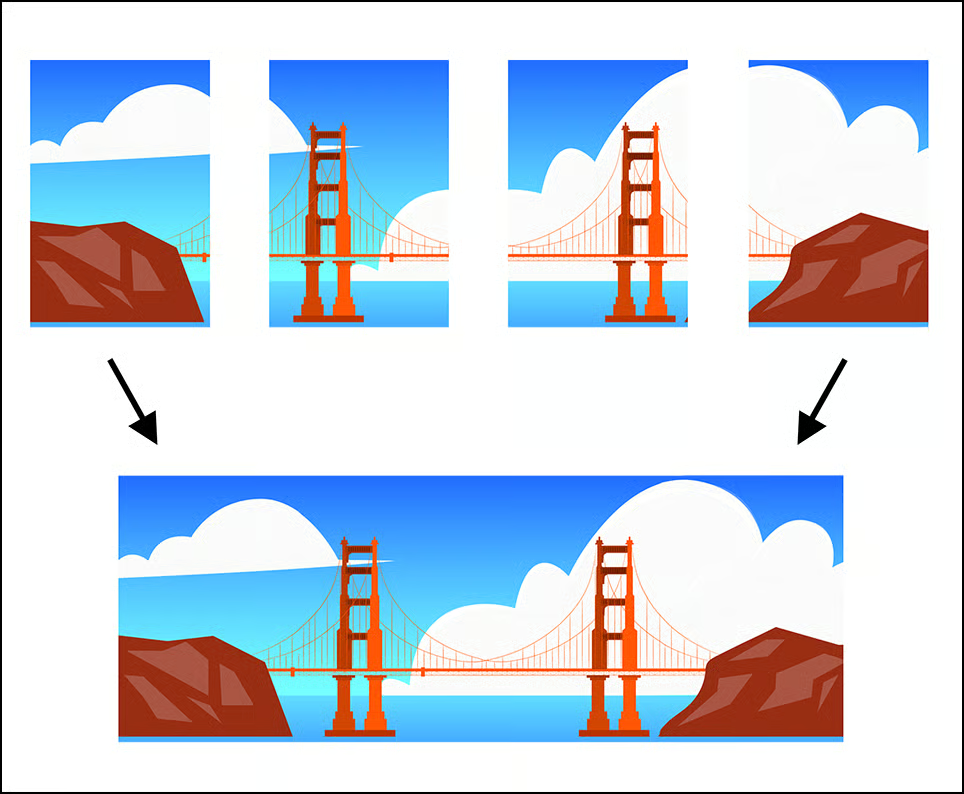
Import your RAWs into Lightroom or Capture One; apply uniform white balance and lens corrections consistently. Export 16‑bit TIFFs to a dedicated stitcher like PTGui or the open‑source Hugin. Rectilinear ultra‑wides typically need 20–30% overlap. PTGui’s optimizer handles control points well, and its masking/viewpoint tools are powerful for nadir/zenith cleanup. Why PTGui remains a top choice for complex panoramas.
Cleanup & Enhancement
- Nadir patch: export a layered file from PTGui with a viewpoint-corrected nadir, or patch in Photoshop using Clone/Heal or an AI object remover.
- Color consistency: check for color casts row‑to‑row; use HSL and selective masks to even out gradients.
- Noise reduction: apply moderate NR on low‑light frames; avoid over‑smoothing textures.
- Level horizon: many viewers show roll/pitch—re‑level using the stitcher’s horizon tool and set the center of projection.
- Export: 16k–24k px wide equirectangular for VR tours, or gigapixel cylindrical for murals. Save a master 16‑bit TIFF and a web‑ready JPEG.
If you’re new to nodal setup and shooting technique for high‑end results, this step-by-step tutorial helps connect the dots from head setup to perfect stitches. Set up a panoramic head for high‑end 360 photos.
Useful Tools & Resources
Software
- PTGui for precise control points, masks, and viewpoint correction
- Hugin (open source) for cost‑free stitching
- Lightroom / Photoshop for RAW, color and retouching
- AI tripod/nadir removal tools for quick patching
Hardware
- Panoramic heads: Nodal Ninja, Leofoto, or equivalent with fore‑aft and lateral adjustments
- Carbon fiber tripods with a leveling base
- Wireless or cable remote shutter releases
- Pole extensions and vehicle mounts with proper tethers
Disclaimer: brand names are provided for research; confirm specs and compatibility with the manufacturer.
Common Mistakes & How to Avoid Them
- Parallax error: always rotate around the lens’s entrance pupil; calibrate and mark the nodal position for each focal length.
- Exposure flicker: shoot in Manual, lock WB and aperture, and keep ISO fixed across the entire pano.
- Tripod shadows and footprints: shoot a dedicated nadir and patch in post.
- Ghosting from moving subjects: shoot two passes, then mask moving people/objects in the stitcher.
- Nighttime noise: keep ISO at 200–800 and lengthen shutter; rely on tripod stability rather than cranking ISO.
Field-Tested Scenarios & Settings
Indoor Real Estate
Use rectilinear ultra‑wide (8–10 mm APS‑C or 7–9 mm MFT) to keep lines straight. Bracket ±2 EV, f/8, ISO 200–400. Single‑row 8 around + zenith + nadir often works. Watch for mirrors—shoot extra frames to give yourself masking options. Keep lights either all on or all off for consistent color temperature.
Outdoor Sunset
Dynamic range spikes; bracket 5 frames ±2 EV if the sun is in frame. Use f/8–f/11, ISO 100–200, and a multi‑row approach for better zenith coverage. If flare appears with the bulbous front element, shade the lens with your hand just out of frame.
Event Crowds
Go faster: f/5.6, 1/200, ISO 400–800. Shoot two consecutive passes and plan to mask. Avoid the single‑row only approach if people are close to the camera—multi‑row helps the stitcher place control points above heads and signage.
Rooftop / Pole
Use a pole with a small panoramic head and keep the setup compact. Short exposures, 6–8 around if possible, with bigger overlap (35–40%). A safety tether is mandatory. Rotate slowly and avoid long exposures to minimize sway‑induced misalignment.
Frequently Asked Questions
- Can I shoot handheld panoramas with the E‑M1 Mark III?
Yes for quick single‑row panos, but expect uneven pitch/roll and more stitching cleanup. Use IBIS on handheld scouting, high shutter speeds (1/250+), and overlap generously (35–40%). For high‑quality 360 photos, use a tripod and a panoramic head.
- Is the XF 8–16mm f/2.8 wide enough for single‑row 360?
At 8mm on APS‑C (≈12mm FF eq.), you can shoot 8 around at 0° and add a couple of zenith frames plus a nadir patch. For flawless top/bottom coverage, a two‑row (+/−30°) sequence is more reliable.
- Do I need HDR for interiors with bright windows?
Usually yes. Bracket ±2 EV (3–5 frames) to capture window views and interior shadows cleanly. Keep WB and aperture locked across brackets to avoid stitching seams.
- How do I avoid parallax issues with an ultra‑wide zoom?
Use a panoramic head and calibrate the entrance pupil at the exact focal length you’re using. Mark positions for 8 mm and 16 mm (or 7 mm and 14 mm on MFT) and always return to those marks before shooting.
- What ISO range is safe on the E‑M1 Mark III in low light?
Aim for ISO 200–800 on a tripod for clean files. ISO 1600 is usable with good noise reduction, but try to keep shutter longer rather than pushing ISO too high.
Compatibility Clarification & Practical Alternatives
The Fuji XF 8–16mm f/2.8 cannot be natively mounted on an Olympus E‑M1 Mark III. In the real world, use one of these workable options:
- Pair the XF 8–16 with a Fujifilm X‑series body (X‑T/X‑H) for the shot counts provided above.
- Use a native MFT ultra‑wide on the E‑M1 Mark III, such as the M.Zuiko 7–14mm f/2.8 PRO. Shot counts are nearly identical to the Fuji 8–16 at the wide end.
If you ever test a custom adapter: expect manual focus, no EXIF, uncertain infinity focus, and possible mechanical clearance issues. For professional results, stay native.
For more perspective on gear and techniques used by virtual tour shooters, this resource covers camera/lens choices and setup tradeoffs. Virtual tour gear choices explained.
Safety, Data Integrity & Backup
Panorama sessions involve many frames—losing one can spoil a stitch. Use fresh cards, avoid deleting in‑camera, and back up immediately after the shoot (dual cards or on‑site laptop dump). For rooftop or pole work, assign a spotter, tether the rig, and never work near power lines or busy edges. In bad weather, use rain covers and wipe the XF 8–16’s front element often to prevent water spots that repeat in every frame.