Why This Camera & Lens Are Great for Panoramas
The Nikon Zf paired with the Sigma 14–24mm f/2.8 DG DN Art is a powerful combo for both classic multi-row panoramas and full 360° photos. The Zf’s 24.5MP full-frame BSI sensor (approx. 35.9 × 23.9 mm, pixel pitch ~5.9 µm) delivers excellent dynamic range at base ISO (around 14 EV) and clean high-ISO performance up to ISO 1600–3200 when you need it. Its EXPEED 7 processor, focus-point VR and robust 5-axis IBIS (rated up to ~8 stops in ideal conditions) make it easy to shoot sharp frames—even in marginal light—though you should turn IBIS off for tripod-based panoramas.
The Sigma 14–24mm f/2.8 DG DN Art is an ultra-wide rectilinear zoom known for high corner-to-corner sharpness by f/4–f/5.6, low lateral chromatic aberration, and minimal distortion for its class. Because it’s rectilinear (not fisheye), straight lines stay straight, which is ideal for architecture and interiors. The trade-off is that you’ll need more frames to complete a 360 than you would with a fisheye. At 14mm the horizontal field of view on full-frame is roughly 104°, which allows efficient overlap without excessive frame count.
Mount compatibility note: the DG DN version of this lens is native to Sony E / L-mount. On Nikon Zf you can successfully use the E-mount version via an active E-to-Z adapter (e.g., Techart TZE-01 or Megadap ETZ21), with AF and EXIF typically supported. Alternatively, the older Sigma 14–24mm f/2.8 DG HSM Art (F-mount) works well on Zf via Nikon’s FTZ II. When adapting, expect minor quirks: lens profiles may not auto-apply, IBIS may not read exact focal length across the zoom range, and AF behavior can vary. For tripod-based panoramas, manual focus is preferred anyway.
Quick Setup Overview
- Camera: Nikon Zf — full-frame (24.5MP) BSI sensor, EXPEED 7, strong IBIS (turn off on tripod), base ISO 100, excellent DR at low ISO.
- Lens: Sigma 14–24mm f/2.8 DG DN Art — rectilinear ultra-wide zoom; very sharp by f/4–f/5.6; low CA; bulbous front (no screw-in filters).
- Estimated shots & overlap (tested guidance):
- 14mm, single-row 360: about 10–12 frames around (30–35% overlap) + zenith + nadir.
- 14mm, two-row 360: 8 around at +30–35° pitch + 8 around at −30–35° pitch + zenith + nadir (most robust for interiors).
- 18–24mm: expect 12–16 around per row due to narrower FOV.
- Difficulty: Moderate — rectilinear UWA requires careful nodal alignment and multi-row for clean zenith coverage.
Planning & On-Site Preparation
Evaluate Shooting Environment
Before you unpack, scan the scene. Note light direction and intensity, reflective surfaces (glass, polished floors, cars), and moving elements (people, foliage, traffic). For glass, get as close as safely possible (2–5 cm) and shoot perpendicular to minimize reflections; use a hooded cloth if needed. Expect ghosting near moving subjects—plan to take extra frames to mask in post. Avoid pointing the lens directly at the sun when possible; with a bulbous front element, flare can sneak in from off-axis light.
Match Gear to Scene Goals
This setup excels at clean, straight-line architecture and high-resolution virtual tours. The Nikon Zf’s DR helps retain window detail in interiors, and ISO 100–400 delivers pristine files. For low light, ISO 800–1600 remains very usable; beyond ISO 3200, consider longer exposures on a tripod instead of pushing ISO. The rectilinear Sigma produces natural-looking spaces without fisheye curvature, but you’ll take more shots to cover the sphere versus a fisheye lens. If your priority is speed, add more rows rather than stretching overlap too thin—your stitches will be far cleaner.
Pre-shoot Checklist
- Power and storage: full batteries, ample cards, dual-slot backup if possible.
- Optics: clean lens elements and sensor; bring a microfiber cloth and blower.
- Support: a leveled tripod, panoramic head with calibrated nodal (no-parallax) setup.
- Exposure consistency: finalize white balance preset (daylight/tungsten/kelvin), shoot RAW.
- Safety: tether gear on rooftops or poles; check wind gusts; watch for traffic when car-mounted.
- Redundancy: for mission-critical shoots, do a second full rotation as a safety pass.
Essential Gear & Setup
Core Gear
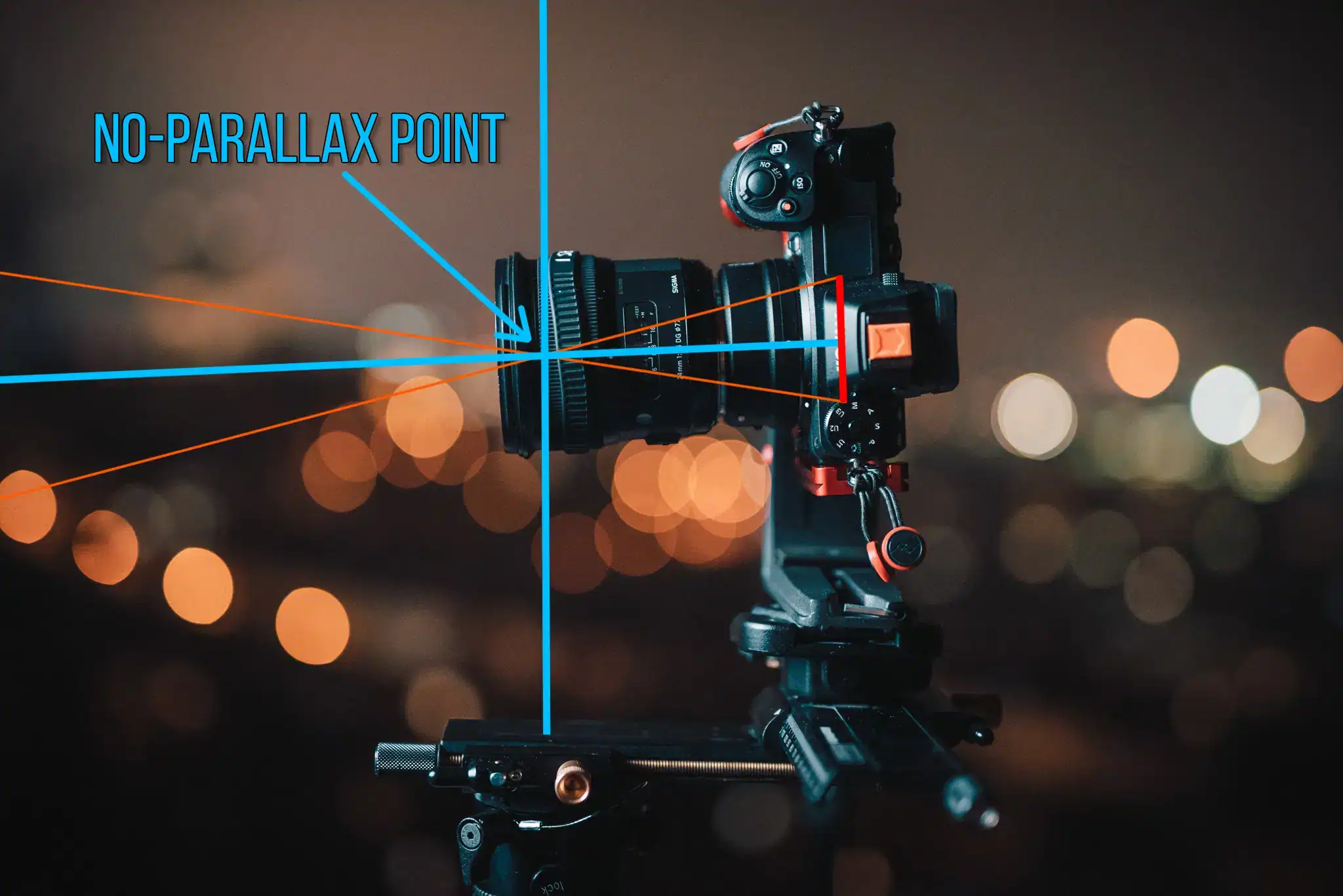
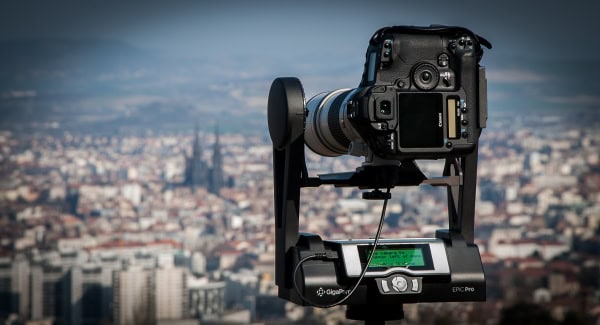
- Panoramic head: Use one with fore-aft and lateral adjustment so you can align the lens’s entrance pupil (often called nodal point) over the rotation axis. This eliminates parallax and makes stitching clean, especially with nearby objects.
- Stable tripod with a leveling base: The leveling base lets you level the rotator quickly without fussing with leg lengths.
- Remote trigger or SnapBridge app: Prevent vibration and keep your hands off the camera during exposures.
Optional Add-ons
- Pole or car mount: Only for experienced users. Always use a safety tether; avoid high winds; monitor vibrations which can blur long exposures.
- Lighting aids: Small LED panels or bounced flash can tame contrast in dark interiors—just keep lighting consistent across frames.
- Weather protection: Rain covers and silica packs; wipe stray spray before each rotation.
For a thorough primer on panoramic head fundamentals and parallax control, see this panoramic head tutorial. Panoramic head basics and setup
Step-by-Step Shooting Guide
Standard Static Scenes
- Level and lock. Level the tripod via the leveling base. Mount the panoramic head and lock the horizontal axis level. A level rotator ensures frames line up without horizon drift.
- Align the nodal point. On the Sigma 14–24mm f/2.8 DG DN Art at 14mm, you’ll typically slide the camera plate forward so the entrance pupil sits roughly over the rotator’s axis. Use the classic “two-stick” test: place two light stands at different distances, align them, rotate 20–30°, and refine fore-aft until they don’t shift relative to each other.
- Lock exposure and WB. Switch to Manual mode; set a fixed white balance (daylight/tungsten/custom Kelvin). Meter the brightest part you must keep detail in, then expose so highlights are safe. Shoot RAW, 14-bit. Turn off Auto ISO and IBIS when on tripod.
- Focus manually. Use magnified live view and focus near the hyperfocal distance for f/8–f/11. Then switch to MF to prevent refocus between frames.
- Capture the rotation. At 14mm, shoot 10–12 frames around with 30–35% overlap. If the ceiling is important, add a pitched-up row at +30–35° and a pitched-down row at −30–35°. Finish with:
- Zenith shot: point straight up to cover the ceiling/sky.
- Nadir shot: point straight down; take one extra “patch” shot after moving the tripod slightly to clone the tripod area cleanly.
HDR / High Dynamic Range Interiors
- Bracket exposures. Use ±2 EV (3 or 5 frames) at each position to balance window highlights and interior shadows.
- Keep everything locked. WB, aperture, focus, ISO, and IBIS off. Only shutter speed should change between brackets.
- Consider two-pass strategy. First pass for base exposure; second pass for highlight rescue if light is changing fast.
Low-Light / Night Scenes
- Use tripod discipline. At night, the Zf handles ISO 800–1600 very well, but prioritize longer shutter speeds over high ISO to preserve detail. Start around f/4–f/5.6, ISO 200–800, 1–8s depending on wind and subject motion.
- Use a remote or self-timer. Prevent micro-shake; consider electronic front-curtain shutter to reduce vibration.
- Watch for moving lights. Cars and signs can create ghosting; take extra frames for clean plates to mask later.
Crowded Events
- Two-pass capture. Do a fast first pass to lock in the environment, then a slower second pass waiting for gaps in the crowd in problem areas.
- Use masks in post. In PTGui or Hugin you can mark keep/remove areas to eliminate ghosting from moving people.
Special Setups (Pole / Car / Drone)
- Pole work. Use a carbon pole with a compact panoramic head; keep rotations slow to reduce flex. Wind is the limiting factor—tether the base, wear gloves, and prioritize safety over height.
- Car-mounted capture. Use robust suction mounts on clean glass/paint; safety wire everything; avoid busy roads. Expect vibrations—use faster shutter speeds and shoot multiple passes.
- Drone note. The Zf is not a drone camera; for aerial 360s, use a drone-specific workflow and camera.
For a concise, step-by-step overview of DSLR/mirrorless 360 capture through stitching, this guide from Meta’s Creator resources is helpful. Using a mirrorless camera to shoot and stitch a 360 photo
Recommended Settings & Pro Tips
Exposure & Focus
| Scenario | Aperture | Shutter | ISO | Notes |
|---|---|---|---|---|
| Daylight outdoor | f/8–f/11 | 1/100–1/250 | 100–200 | Lock WB (Daylight or 5200–5600K) |
| Low light/night | f/4–f/5.6 | 1/2–1/60 (as needed) | 200–800 | Tripod & remote; prioritize lower ISO for cleaner stitches |
| Interior HDR | f/8 | Bracket ±2 EV | 100–400 | Keep aperture and ISO fixed; vary shutter only |
| Action / moving subjects | f/5.6–f/8 | 1/200+ | 400–800 | Fast shutter to freeze motion; do a second clean pass |
Critical Tips
- Manual focus at hyperfocal: At 14mm and f/8 on full-frame, focusing ~1–1.5 m gives near-to-infinity sharpness. Use magnified live view to confirm.
- Nodal point calibration: Mark your rail once found for 14mm and 24mm—zooming changes entrance pupil position slightly. Recheck when switching focal lengths.
- White balance lock: Set a fixed preset or Kelvin value to avoid color shifts that complicate stitching and blending.
- RAW over JPEG: 14-bit RAW gives more latitude for highlight recovery and white balance harmonization.
- IBIS off on tripod: Stabilization can introduce micro-blur when the camera is absolutely steady; turn it off for pano rotations.
- Lens profiles: When adapting the DG DN, lens corrections may not auto-apply. Manually choose a close profile or correct distortion/vignetting during post.
Case Studies: What Works in the Field
Indoor Real Estate
Use two-row coverage at 14mm: 8 around at +30–35°, 8 around at −30–35°, plus zenith/nadir. Bracket ±2 EV for windows. Keep ISO 100–200. Lock WB at a consistent Kelvin (e.g., 4500–5000K for mixed warm/cool lighting), then correct globally later.
Outdoor Sunset Lookouts
Meter for the sky highlights and expose to protect them. Consider a medium HDR bracket to hold foreground shadows. Windy? Add weight to your tripod, use 2s timer or remote, and keep overlap at least 30% to give the stitcher robust control points.
Event Crowds
Use faster shutter speeds (1/200–1/400) at f/5.6–f/8 and ISO 400–800. Do a quick first pass, then a slower corrective pass. In post, mask out the motion-blurred people using the cleaner frames.
Rooftop / Pole
Safety first: tether everything. On a pole, keep exposures short (1/125–1/500) to counter flex. The Zf’s ISO 800–1600 is usable for short bursts; capture multiple passes and pick the sharpest set during culling.
Car-Mounted Drive-Bys
Use rigid mounts and back it up with safety lines. Shutter 1/500–1/1000, f/5.6–f/8, ISO as needed. Expect to manually cull frames with motion artifacts; shoot extra coverage in each direction.
Stitching & Post-Processing
Software Workflow
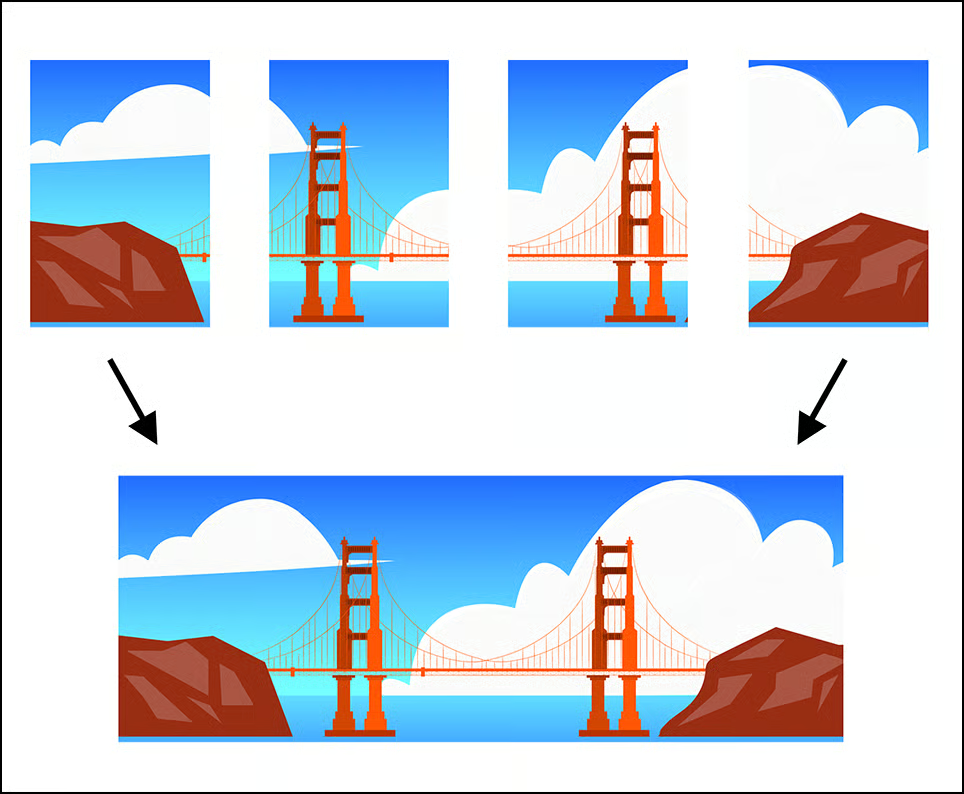
Import your RAW files into Lightroom or Capture One, apply global WB and exposure tweaks consistently across a set, and export 16-bit TIFFs to your stitcher. PTGui and Hugin are industry standards: fisheye lenses require fewer shots but need defishing; rectilinear lenses like the Sigma 14–24 need more frames but yield straighter architecture with less edge stretching. Aim for ~25–30% overlap at 14mm and ~20–25% overlap at longer focal lengths on this lens. For rectilinear interiors, two-row plus zenith/nadir is the most reliable approach for perfect ceilings and floors.
PTGui excels at masking and HDR fusion for panoramas and handles multi-row projects with ease. If you’re new to it, this review breaks down why it’s a go-to tool. PTGui: one of the best tools for complex panoramas
Cleanup & Enhancement
- Nadir patch: Shoot an offset nadir plate and use PTGui’s Viewpoint correction or clone in Photoshop. AI content-aware tools can speed this up.
- Color harmonization: After stitching, refine global contrast/curves and fix any WB inconsistencies along seams.
- Noise reduction: Apply gentle NR to shadow areas in low-light scenes; keep detail preservation in mind.
- Geometric polish: Level the horizon, and correct yaw/pitch/roll so verticals are true—especially important for real estate.
- Output for VR: Export an equirectangular 2:1 image (e.g., 12000×6000 px) as high-quality JPEG or 16-bit TIFF for further edits. Platforms like VR tour software or web viewers expect this format.
Disclaimer: software evolves—always check the latest docs and updates for your preferred tools. If you’re new to pano theory and resolution planning, the Panotools Wiki is a goldmine. Understanding spherical resolution and coverage
Useful Tools & Resources
Software
- PTGui panorama stitching
- Hugin (open source)
- Lightroom / Photoshop for RAW and finishing
- AI tools for tripod/nadir removal
Hardware
- Panoramic heads: Nodal Ninja, Leofoto, or equivalent with fore-aft rails
- Carbon fiber tripods with leveling bases
- Wireless remotes or app control
- Pole extensions / car mounts with tethers
Disclaimer: names provided for search reference; check official sites for compatibility and specifications.
Common Mistakes & How to Avoid Them
- Parallax error: Calibrate the entrance pupil at your chosen focal length; don’t change focus/zoom mid-rotation.
- Exposure flicker: Use full manual exposure and locked white balance; turn off Auto ISO.
- Tripod shadows and footprints: Capture a dedicated nadir patch or plan to clone during post.
- Ghosting from motion: Shoot extra frames; use masks to mark keep/remove areas in the stitcher.
- Softness at night: Turn off IBIS on tripod, use remote release, and favor lower ISO over shorter exposures.
- Insufficient overlap: At 14mm, keep 30–35% overlap to give the stitcher robust control points.
Frequently Asked Questions
- Can I shoot handheld panoramas with the Nikon Zf?
Yes for simple cylindrical panos, but for full 360×180 spheres—especially indoors—use a tripod and panoramic head. Handheld introduces parallax and horizon drift. If you must, shoot fast, lock exposure/WB, keep overlap generous (40%+), and avoid close foregrounds.
- Is the Sigma 14–24mm f/2.8 DG DN Art wide enough for single-row 360?
Single-row at 14mm can cover the horizon but won’t capture the zenith/nadir cleanly. Plan on at least one extra zenith and one nadir shot. For interiors or tall ceilings, a two-row approach (+/−30–35°) plus zenith/nadir yields far better results.
- Do I need HDR for interiors with bright windows?
Often yes. Bracketing ±2 EV (3–5 frames) at each position preserves highlight detail in windows while keeping interiors noise-free. Merge brackets in the stitcher or pre-merge to 32-bit TIFFs before stitching.
- How do I avoid parallax issues with this setup?
Calibrate the entrance pupil on your panoramic head for 14mm and 24mm and mark rail positions. Keep focus, zoom, and camera position fixed during the full rotation. Use two-stick tests and adjust fore-aft until near/far objects don’t shift relative to each other while rotating.
- What ISO range is safe on the Nikon Zf in low light?
For critical work, ISO 100–800 is ideal. ISO 1600 is still clean for most outputs; beyond that, prefer longer exposures on a tripod. The Zf’s 24.5MP BSI sensor retains excellent detail when you keep ISO moderate.
- Can I save custom pano settings on the Nikon Zf?
Yes—configure manual exposure, fixed WB, MF, and drive mode, then save to a user setting (e.g., U1/U2/U3) if available on your body. You can also customize the i-Menu for quick access to WB, ISO, and bracketing.
- How do I reduce flare with this ultra-wide rectilinear lens?
Avoid strong off-axis light sources when possible; shade the lens with your hand or a flag (without entering the frame). Slightly reframe to keep the sun just out of the frame and take a second plate for sky cleanup if needed.
- What’s the best tripod head for this setup?
Use a panoramic head with an indexing rotator and fore-aft/lateral rails (Nodal Ninja/Leofoto). Ensure it supports your camera weight comfortably and offers precise degree stops (e.g., 30°, 45°) for repeatable overlap.
Want more panoramic shooting theory and decision-making help (lens choice, rows, overlap)? This in-depth DSLR/virtual tour FAQ is a great supplemental read. DSLR virtual tour FAQ and lens selection