
Why This Camera & Lens Are Great for Panoramas
If you want to know how to shoot panorama with Nikon Zf & Samyang 8mm f/3.5 UMC Fish-Eye CS II, this combo delivers an efficient, high-quality path to 360° capture. The Nikon Zf is a 24.5MP full-frame mirrorless body with EXPEED 7 processing, excellent high-ISO performance, in-body image stabilization (IBIS), and a robust mechanical build. Its base ISO 100 dynamic range is roughly 14 stops, and with a pixel pitch of about 5.9 µm, it holds up well in low light and HDR brackets. The Samyang 8mm f/3.5 UMC Fish-Eye CS II is a compact manual-focus fisheye. Although designed for APS-C, when used on the full-frame Zf (via an FTZ/FTZ II adapter) it produces a circular fisheye image that’s ideal for spherical panoramas: you can cover the whole sphere with very few shots, reducing stitch seams and speeding up field work.
Fisheye lenses distort straight lines, but in 360 photo workflows that’s expected and even advantageous: fewer frames, more overlap, and easier control points. The Samyang 8mm is sharpest around f/5.6–f/8, exhibits relatively modest lateral chromatic aberration that stitches easily, and has a removable hood—remove it on full frame to avoid clipping the circular image. On the Zf, manual aperture and focus are straightforward; use focus peaking and magnified live view to nail focus, then lock it. With the Zf’s superb manual controls, this pairing offers a reliable, budget-friendly path to professional-quality 360° panoramas.
Quick Setup Overview
- Camera: Nikon Zf — Full-frame (FX), 24.5MP BSI CMOS, EXPEED 7, IBIS up to 8 stops, base ISO 100 (50–204,800 expanded), strong low-light performance.
- Lens: Samyang 8mm f/3.5 UMC Fish-Eye CS II — circular/diagonal fisheye (APS-C design), manual focus/aperture, removable hood, good sharpness at f/8, mild CA.
- Mounting: Requires Nikon FTZ or FTZ II adapter; set Non-CPU Lens Data on the Zf to enable correct IBIS and EXIF tagging (focal length 8mm, max aperture f/3.5).
- Estimated shots & overlap:
- 3 around at 120° yaw + 1 nadir (ground) — fast and light, works for most scenes.
- 4 around at 90° + nadir — safer overlap for complex interiors and precision stitching.
- Optional: Zenith shot for clean ceilings in tight spaces.
- Difficulty: Easy–Moderate (manual focus/aperture; nodal alignment required for clean stitches).
Planning & On-Site Preparation
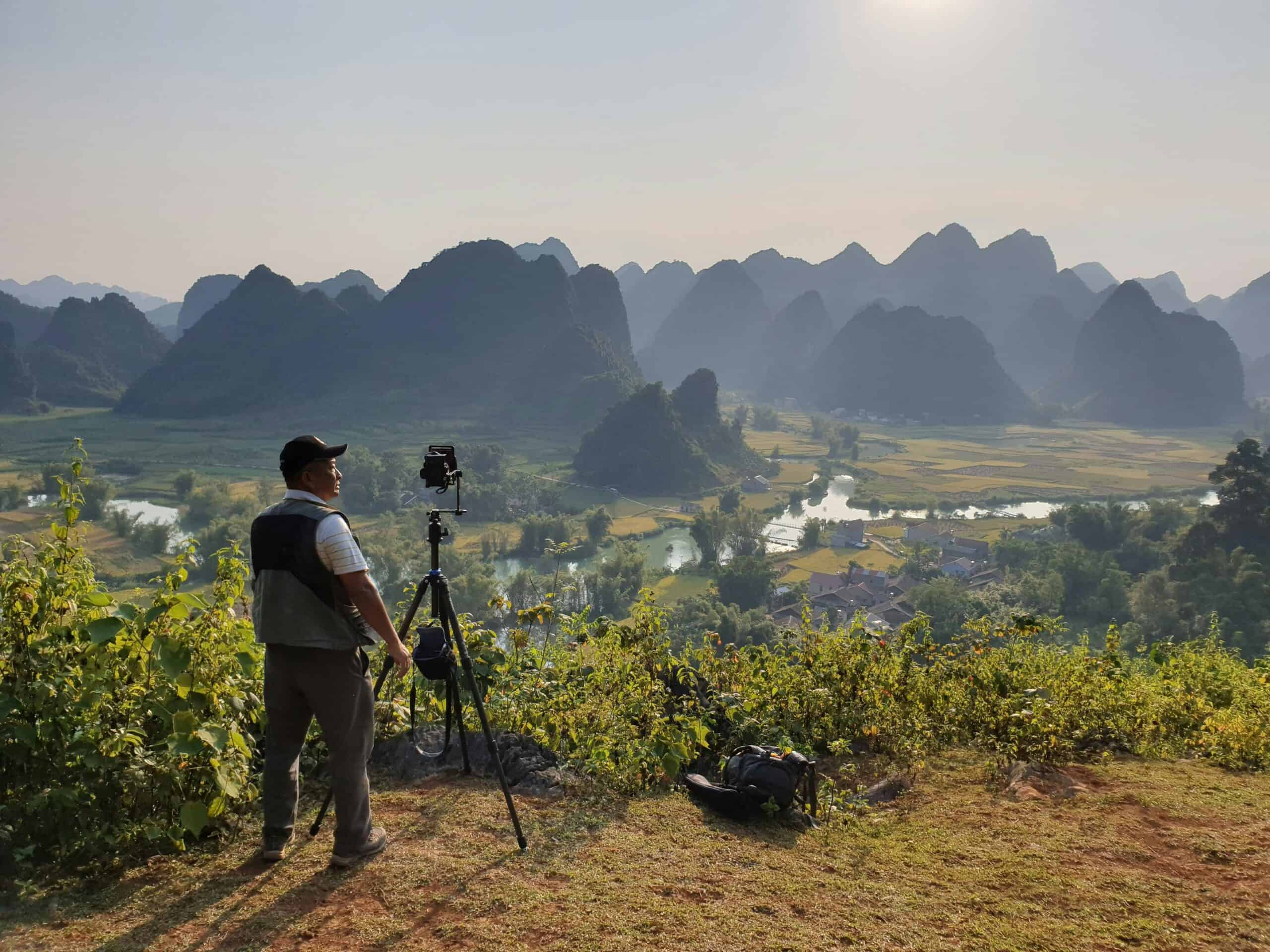
Evaluate Shooting Environment
Check light direction, sun position, reflective surfaces (glass/metal), and potential moving elements like people, cars, or trees. For glass viewpoints, place the lens within a few centimeters of the glass to minimize reflections and flare. Watch for flare from direct sun—fisheyes see everything, so a small change in yaw can prevent a bright streak you’ll fight later in post.
Match Gear to Scene Goals
The Nikon Zf’s dynamic range and high ISO tolerance make it excellent for mixed light and twilight. The 24.5MP sensor gives ample resolution for 8K equirectangular 360 deliveries. With the Samyang 8mm fisheye, you’ll need very few images per sphere, which is perfect for busy locations or when you’re on a pole or rooftop. Indoors, the Zf handles HDR brackets cleanly; expect to use ISO 100–400 for clean real estate work and 800–1600 for darker interiors when shutter times must be reasonable. The fisheye’s big FOV reduces the shot count, but be mindful of parallax: accurate nodal point alignment is essential when foreground elements are close.
Pre-shoot Checklist
- Power and storage: fully charged batteries, ample UHS-II SD/microSD cards. Consider RAW+JPEG if you want quick on-site previews.
- Cleanliness: wipe the fisheye’s front element and your sensor; fisheye dust is obvious.
- Calibration: level your tripod and verify pano head’s nodal alignment before critical shoots.
- Safety: secure tripod against wind, tether on rooftops/poles, avoid overhangs or unstable ground.
- Backup workflow: shoot a second pass with 4-around if your first pass was 3-around; it’s cheap insurance.
Essential Gear & Setup
Core Gear
- Panoramic head: a two-axis pano head (e.g., Nodal Ninja/Leofoto) lets you place the lens’s entrance pupil (no-parallax point) over the rotation axis to eliminate parallax mismatches and speed stitching.
- Stable tripod with leveling base: a leveling base saves time and keeps yaw rotation truly horizontal—critical for clean horizons.
- Remote trigger or app: use Nikon SnapBridge or a wired remote to avoid touching the camera during exposure.
Optional Add-ons
- Pole or car mount: only for experienced users. Use safety tethers, monitor wind loads, and increase shutter speeds to combat vibration.
- Portable lighting: small LEDs or flashes for dim interiors; balance with ambient to reduce HDR range.
- Weather protection: rain covers, lens hoods removed for circular fisheye but keep a microfiber handy.
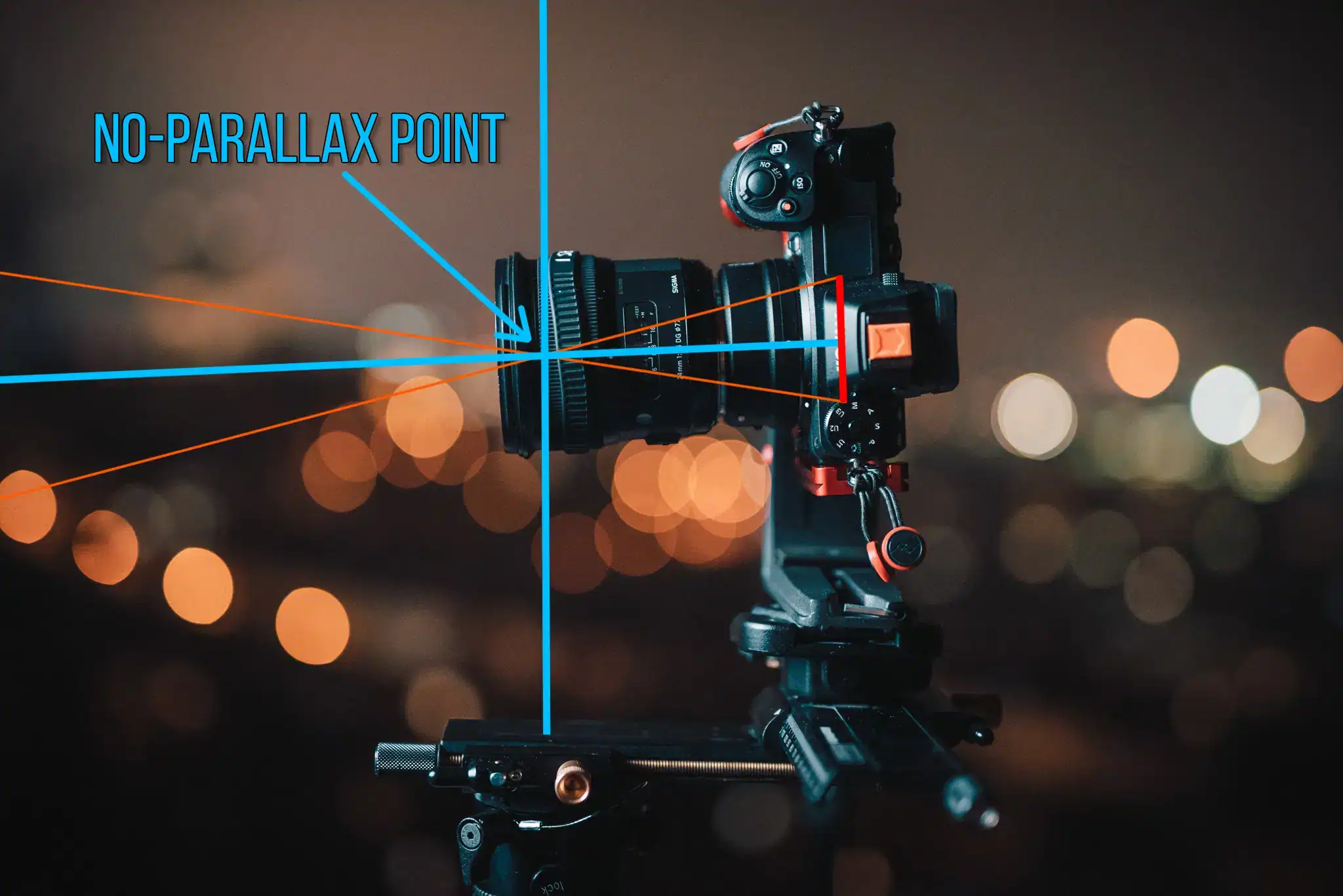
For deeper reading on panoramic head setup and nodal alignment, see this panoramic head tutorial. Panoramic head setup explained
Step-by-Step Shooting Guide
Before You Shoot: Nikon Zf + Samyang 8mm Setup
- Mount the lens via FTZ/FTZ II. Remove the Samyang’s hood to avoid clipping the circular image.
- In the Zf’s Non-CPU Lens Data, create an entry for 8mm f/3.5 so IBIS knows the focal length.
- Tripod use: turn IBIS OFF to prevent micro-jitters. Handheld or pole: IBIS ON (8 mm selected).
- Manual mode: set exposure manually and disable Auto ISO. Lock white balance (e.g., Daylight or Kelvin) for consistent color across frames.
- Manual focus: use focus peaking and magnification; at f/8, focusing around 0.5 m approaches hyperfocal with a fisheye, yielding “near–far” sharpness.
Standard Static Scenes
- Level tripod and align nodal point: on your pano head, adjust fore–aft until near/far objects stay aligned during rotation. Use the “lamp post and window frame” test.
- Set exposure: start with f/8, ISO 100–200, shutter 1/100–1/250 outdoors. Lock WB to Daylight or a Kelvin value to prevent stitching color shifts.
- Capture sequence:
- Fast method: 3 shots around at 0° pitch, yaw 0°/120°/240°.
- Safe method: 4 shots around at 0° pitch, every 90°, then 1 nadir for tripod cleanup.
- Nadir shot: tilt the camera down and shoot the ground. You can also offset the tripod slightly and shoot a “patch” frame to clone over the footprint.
HDR / High Dynamic Range Interiors
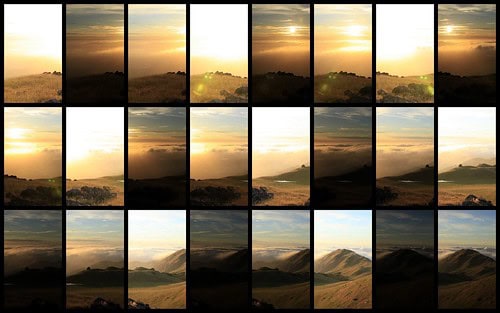
- Bracket ±2 EV (3 or 5 frames) to balance windows and shadowy interiors. The Zf handles bracketing well; keep WB locked.
- Use the self-timer or remote trigger to avoid vibrations; ensure each bracketed set completes before you rotate to the next yaw position.
Low-Light / Night Scenes
- Use a sturdy tripod and remote, IBIS OFF. Aim for f/4–f/5.6, ISO 100–400 if possible; for moving scenes you can push ISO to 800–1600 on the Zf with graceful noise.
- Prefer mechanical or EFCS shutter to avoid LED banding; leave “Silent” off unless needed.
Crowded Events
- Shoot two passes: first for framing, second waiting for gaps. The 3-around method is quick; take extra frames where motion is busy.
- Later, mask moving people between frames during stitching for clean results.
Special Setups (Pole / Car / Drone)
- Pole: tether everything, use 4-around, and raise shutter to 1/250–1/500 to fight sway. IBIS ON may help at 8mm.
- Car mount: use redundant suction mounts plus safety straps; shutter 1/500–1/1000, and avoid bumpy roads. Expect more masking due to parallax from moving surroundings.
- Drone: multi-shot pano with this combo isn’t typical; instead, use a drone-native workflow.
Recommended Settings & Pro Tips
Exposure & Focus
| Scenario | Aperture | Shutter | ISO | Notes |
|---|---|---|---|---|
| Daylight outdoor | f/8–f/11 | 1/100–1/250 | 100–200 | Lock WB (Daylight or 5600K). Avoid sun flare by offsetting yaw. |
| Low light/night | f/4–f/5.6 | 1/30–1/60 | 400–800 (up to 1600) | Tripod + remote; IBIS OFF; watch for LED banding with electronic shutter. |
| Interior HDR | f/8 | Bracket ±2 EV | 100–400 | Balance windows & lamps; keep WB locked across brackets. |
| Action / moving subjects | f/5.6–f/8 | 1/200+ | 400–800 | Freeze motion; consider 4-around for more overlap to aid masking. |
Critical Tips
- Manual focus at or near hyperfocal: at 8mm and f/8, setting focus around 0.4–0.6 m keeps near-to-infinity largely sharp.
- Nodal point calibration: align with near/far objects until there’s no relative shift during rotation. Mark your pano rail for this combo to repeat quickly.
- White balance lock: use Daylight/Cloudy or Kelvin for consistency—prevents “stitched seams” due to color shifts.
- RAW capture: gives you headroom for HDR merging and color correction. JPEG only if speed is critical and lighting uniform.
- IBIS usage: OFF on tripod; ON on pole or handheld. Ensure Non-CPU Lens Data is set to 8mm for correct IBIS behavior.
Stitching & Post-Processing
Software Workflow
Import your RAWs into Lightroom or your editor of choice, synchronize basic exposure/WB, then send to a stitcher such as PTGui or Hugin. For the Samyang 8mm circular fisheye on full frame, set lens type to “Circular Fisheye” and FOV around 180°. Fisheye panoramas stitch easily with fewer frames; aim for 25–30% overlap. Rectilinear lenses require more frames and careful overlap but produce less edge distortion. PTGui remains the industry standard for speed and control point robustness, while Hugin is a capable open-source alternative. Why many pros prefer PTGui for complex stitches
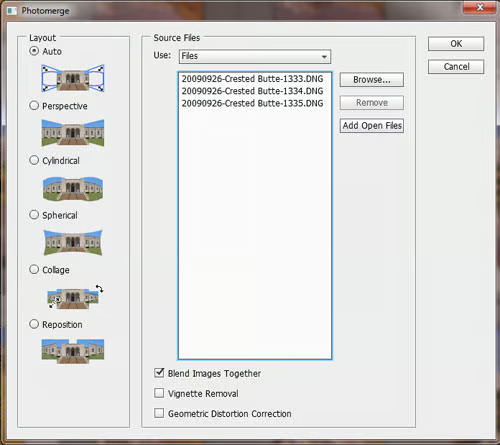
If you need a structured primer on building high-end 360s from DSLRs/mirrorless, this guide by Meta is practical and platform-agnostic. DSLR/Mirrorless 360 workflow overview
Cleanup & Enhancement
- Nadir patch: shoot an extra ground frame with the tripod moved, or patch with AI content-aware tools.
- Noise and color: apply noise reduction on high-ISO frames; balance mixed lighting using HSL and local adjustments.
- Geometry: level the horizon and correct roll/pitch/yaw in your stitcher; set the “center” view where you want the viewer to look first.
- Output: export an equirectangular JPEG/TIFF (e.g., 8192×4096 or 16384×8192 for 8K/16K) for VR platforms and virtual tours.
For a methodical, panoramic-head-focused process, this step-by-step is excellent. Set up a panoramic head for perfect 360 photos
Video Walkthrough
Prefer learning by watching? This video demonstrates core panorama shooting and stitching concepts that map perfectly to the Zf + Samyang workflow:
Note: software evolves. Verify specific menu names and features with your current versions and camera firmware.
Useful Tools & Resources
Software
- PTGui panorama stitching
- Hugin (open source stitcher)
- Lightroom / Photoshop for RAW and cleanup
- AI tripod/nadir removal tools
Hardware
- Panoramic heads (Nodal Ninja, Leofoto)
- Carbon fiber tripods with leveling bases
- Wireless remote shutters / Nikon SnapBridge
- Pole extensions / car suction mounts with tethers
Disclaimer: names are for reference; confirm specs and compatibility on official sites.
Field-Proven Scenarios
Indoor Real Estate (Window Contrast)
Use 4-around + nadir. Shoot brackets ±2 EV at f/8, ISO 100–200. Keep WB locked (e.g., 5000–5600K) to avoid color variation across frames and brackets. In PTGui, enable exposure fusion or pre-merge HDR in Lightroom before stitching if you want consistent noise in shadows.
Outdoor Sunset
Flare control is key with the fisheye. Plan your rotation to place the sun at the edge of a frame rather than the center. Take an extra exposure set blocking the sun slightly with your hand just outside the lens’s field; later, mask that into the stitch to reduce flare streaks. ISO 100, f/8, shutter varies by light—bracket if needed.
Crowded Event / Festival
Go 3-around to minimize time per sphere. Shoot a second pass for safety on each yaw. In post, use masks to select the least crowded instance of each region. Faster shutter (1/200–1/400) at ISO 400–800 helps freeze motion and makes masking easier.
Rooftop or Pole
Balance safety with speed: tether everything, watch wind, pre-focus and tape the focus ring. Use 4-around to increase overlap in case the pole sways. Shutter 1/250–1/500, f/5.6–f/8, ISO 200–800. Rotate slowly and pause 1–2 seconds between shots to allow vibrations to settle.
Car-Mounted Drive-By
Only when safe and permitted. Dual redundant suction mounts plus a strap. Use 1/500–1/1000 shutter, f/5.6–f/8, Auto-ISO capped at 1600 if you must vary exposure a bit. Expect more ghosting; shoot extra coverage for masking.
Common Mistakes & How to Avoid Them
- Parallax error: misaligned entrance pupil creates stitching mismatches. Recalibrate nodal alignment and keep foreground objects at a consistent distance.
- Exposure flicker: Auto ISO or Auto WB across frames causes visible seams. Use full manual exposure and locked WB.
- Tripod shadows and footprints: always shoot a nadir patch, and plan the tripod location relative to light direction.
- Flare and veiling: slight yaw adjustments or a second “hand-flagged” exposure can make post-processing much easier.
- IBIS on tripod: turn it off; avoid subtle image drift during longer exposures.
- Dirty fisheye front element: clean often—fisheyes amplify smudges and specks.
More best practices and community solutions can be found here: Techniques to take 360 panoramas
Frequently Asked Questions
-
Can I shoot handheld panoramas with the Nikon Zf?
Yes, especially with the Samyang 8mm because it needs only 3–4 frames. Turn IBIS ON, use 1/200 or faster, lock exposure/WB, and rotate around your body as steadily as possible. However, for near foregrounds or critical work, a pano head on a tripod is far more reliable.
-
Is the Samyang 8mm f/3.5 UMC Fish-Eye CS II wide enough for a single-row 360?
On the full-frame Zf (with the hood removed), it produces a circular fisheye image covering ~180°. Three frames around at 120° plus a nadir generally cover the entire sphere. For interiors or low-overlap confidence, use 4-around.
-
Do I need HDR for interiors with bright windows?
Usually, yes. Bracketing ±2 EV (3–5 frames) preserves window detail and room shadows. The Zf’s low ISO files merge cleanly, and PTGui/Lightroom can blend brackets effectively.
-
How do I avoid parallax issues with this combo?
Use a panoramic head and align the entrance pupil precisely. Keep foreground objects at a reasonable distance, and don’t bump the setup between frames. Mark your rail positions so you can replicate the setup consistently. A good primer is this pano head how-to. Understanding and setting the no-parallax point
-
What ISO range is safe on the Nikon Zf for low light?
For critical quality, ISO 100–800 is excellent. ISO 1600–3200 is still very usable with careful noise reduction. For handheld or pole work at night, 1600–3200 is a practical ceiling; prioritize shutter speed and stability.
-
Can I save custom settings for panorama on the Zf?
Yes. Assign a Custom Shooting bank with Manual mode, RAW, Auto ISO OFF, WB locked (Kelvin), focus peaking ON, IBIS OFF (tripod) or ON (handheld), and your typical aperture/shutter starting points. This speeds setup on location.
-
How can I reduce flare with a fisheye?
Avoid placing the sun dead center in a frame; rotate slightly so it falls near the edge, or shoot an extra “flagged” exposure to blend later. Keep the front element spotless.
-
What panoramic head should I choose?
Look for a compact two-axis head with precise fore–aft and lateral adjustments, engraved scales, and a leveling base. Nodal Ninja and Leofoto make reliable options that carry the Zf + Samyang combo easily.
Safety, Quality, and Backup Practices
Wind and edges are real hazards—add weight to your tripod, keep a hand on the rig when possible, and tether on rooftops/poles. In crowds, guard against bumps by standing between people and your tripod legs. Always shoot a second pass (4-around) if the scene matters; it gives you extra frames for masking and saves reshoots. Back up cards immediately after a session and keep a separate copy before formatting. Finally, keep your FTZ adapter secure and periodically check for play; a loose adapter can introduce small alignment shifts that show up during stitching.