
Why This Camera & Lens Are Great for Panoramas
The Nikon Zf paired with the Samyang 12mm f/2.8 ED AS NCS Fish-Eye is a powerful and budget-friendly combo for fast, reliable 360° capture. The Zf is a full-frame (FX) mirrorless camera with 24.5 MP resolution, a back-side illuminated sensor, and excellent in-body image stabilization (IBIS). At base ISO 100, you can expect roughly ~14 EV of dynamic range and clean files up to ISO 1600–3200 with careful exposure. Its pixel pitch is about 5.9 µm, which helps with low-light noise compared to higher-density sensors.
The Samyang 12mm f/2.8 is a diagonal fisheye lens covering approximately 180° across the diagonal on full-frame, which is ideal for panoramas because it reduces the number of shots you need for full spherical coverage. It’s a manual-focus lens—an advantage for panoramas since you can lock focus at the hyperfocal distance for consistent sharpness across frames. The lens is sharpest around f/5.6–f/8, with manageable chromatic aberration that stitches well in modern software. Because this is the Nikon F-mount version, plan to use the Nikon FTZ/FTZ II adapter on your Zf. Register the “Non-CPU lens data” in the Zf menu at 12 mm so IBIS and EXIF metadata behave correctly.
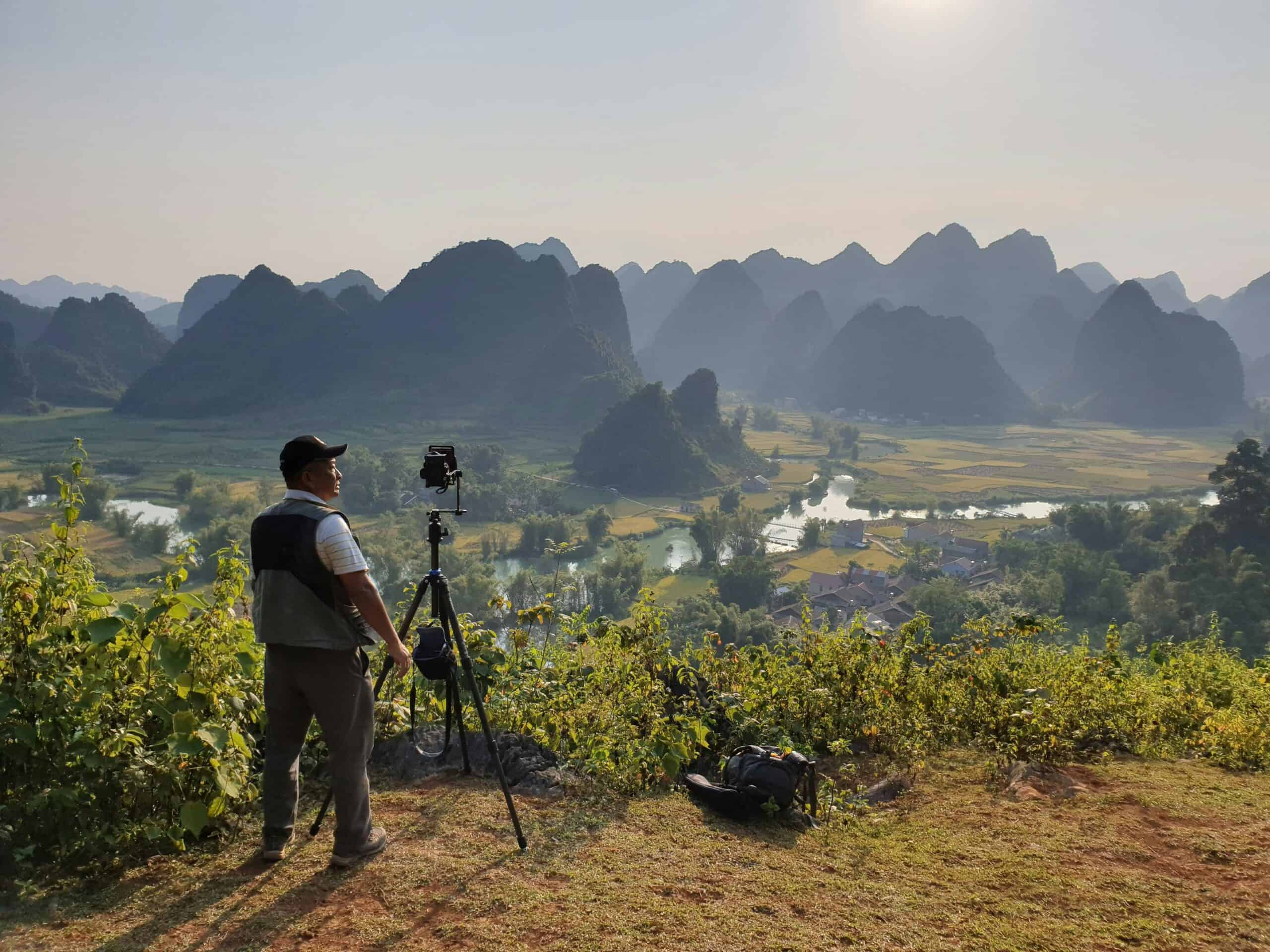
Quick Setup Overview
- Camera: Nikon Zf — Full-frame 24.5 MP BSI sensor, ~14 EV DR at ISO 100, effective IBIS; clean up to ISO 1600–3200 when exposed well.
- Lens: Samyang 12mm f/2.8 ED AS NCS Fish-Eye — diagonal fisheye (FF), ~180° diagonal FOV; sharpest at f/5.6–f/8; manual focus & aperture; minimal focus ~0.2 m.
- Estimated shots & overlap (field-tested):
- Safe set: 6 around at 60° yaw + 1 zenith + 1 nadir (8 total), ~30–35% horizontal overlap.
- Fast set: 4 around at 90° yaw, pitched up ~10–15° + 1 nadir (5–6 total) with careful overlap and a clean sky.
- High-res set: 8 around + Z + N for robust control points and stitching in complex scenes.
- Difficulty: Intermediate (easy once the nodal point is calibrated).
Planning & On-Site Preparation
Evaluate Shooting Environment
Before you unfold the tripod, scan the scene: lighting, reflective surfaces (glass, polished floors), and moving subjects. If you must shoot through glass, get as close as possible (1–2 cm off the surface) and shoot perpendicular to minimize reflections and ghosting. Check wind conditions—particularly on rooftops—and ensure your tripod feet are set on stable ground or a weighted platform.
Match Gear to Scene Goals
The Nikon Zf’s DR and low-light performance are excellent for interior HDR and blue-hour cityscapes. Use ISO 100–200 outdoors for maximal DR and color depth; indoors you can safely work between ISO 400–800 on tripod, pushing 1600–3200 if needed. The Samyang 12mm fisheye’s ultra-wide FOV means fewer frames and faster capture, which helps in dynamic environments (moving clouds, people) but introduces characteristic fisheye distortion you’ll correct in stitching. Fewer shots also mean fewer ghosting issues and faster post-processing.
Pre-shoot Checklist
- Charge batteries; carry spares. Format multiple memory cards and enable dual-slot backup if available via external recorders or quick offloads.
- Clean lens front/rear elements and the sensor. Fisheyes show dust easily in skies and at small apertures.
- Level the tripod and verify pano head nodal alignment for this lens (mark your rails once calibrated).
- Safety: weigh down tripod in wind; tether gear on rooftops/poles; avoid overhanging crowd spaces.
- Backup workflow: shoot one extra full round at the end—small cost, massive insurance.
Essential Gear & Setup
Core Gear
- Panoramic head: Lets you rotate around the lens’s no-parallax point (NPP), eliminating parallax between foreground/background—critical for clean stitches.
- Stable tripod with leveling base: Fast horizon leveling and repeatable yaw increments.
- Remote trigger or SnapBridge app: Prevents vibrations. Also set a 2-second self-timer as a backup.
Optional Add-ons
- Pole or car mount: Use a safety tether and consider wind loads. Slow down rotations; pre-visualize your coverage to avoid missing angles.
- Lighting aids for interiors: Small LED panels or bounced flash can fill dark corners when HDR isn’t ideal.
- Weather protection: Rain covers, microfiber cloths, and lens hoods to mitigate flare and raindrops.
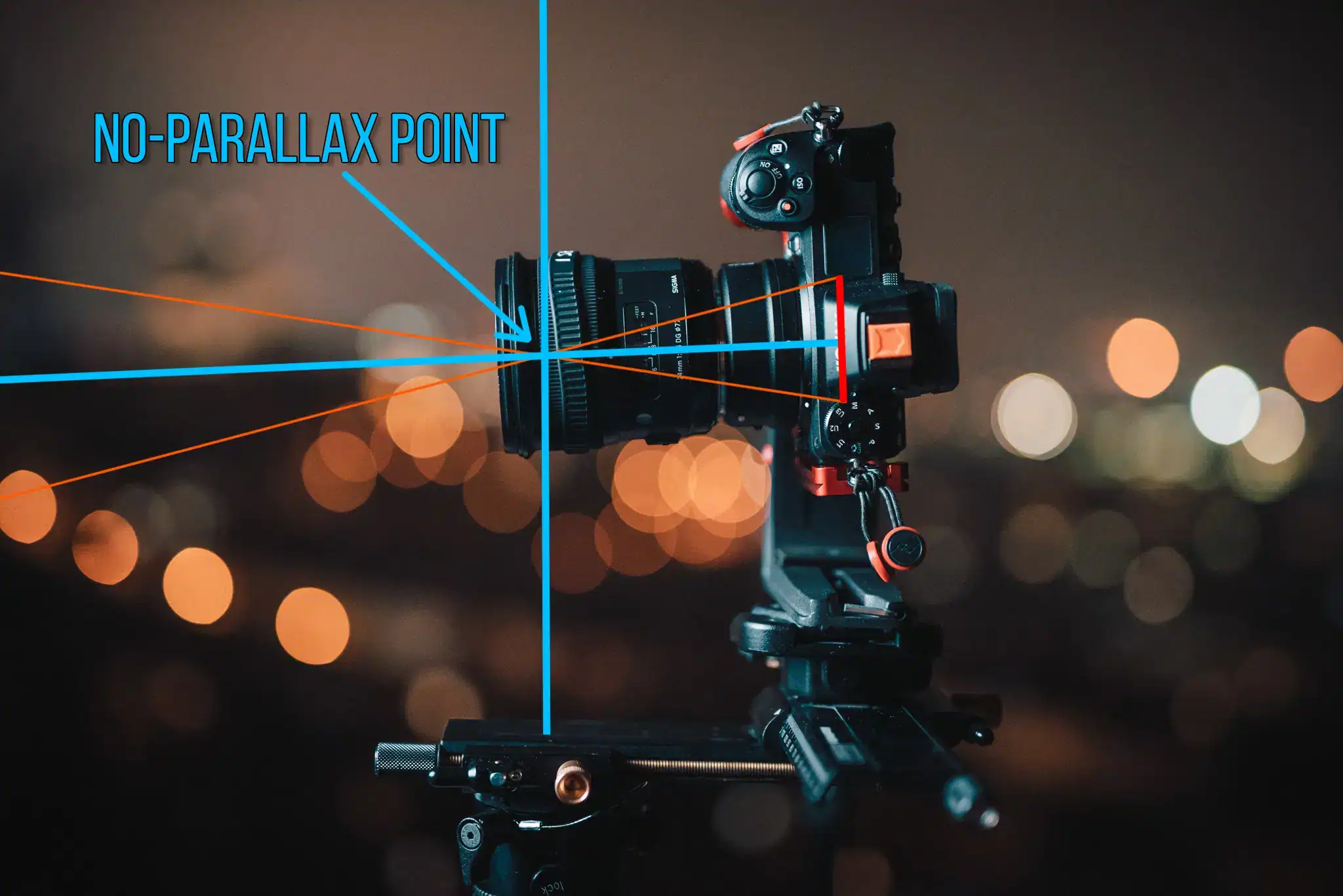
New to nodal alignment? This illustrated panoramic head primer covers the concept and how to fine-tune your rails in real situations. Read a panoramic head setup tutorial.
Video: Panoramic Head Setup Basics
Watch a practical walk-through of setting up a panoramic head for consistent, parallax-free results:
Step-by-Step Shooting Guide
Standard Static Scenes
- Level the tripod and align the nodal point. Slide the camera on the pano head’s rails while observing near/far object alignment as you rotate; when parallax disappears, mark that rail position for the Samyang 12mm.
- Set manual exposure: Choose a base exposure with highlights protected (use histogram). Lock white balance—Daylight for sun, Tungsten for warm interiors, or set a custom Kelvin so color doesn’t shift between frames.
- Focus manually: Use magnified live view to set focus slightly past the hyperfocal mark around f/8. Tape the focus ring if needed.
- Capture the series with overlap:
- Safe set: 6 around at level (every 60°), then one zenith (tilt up ~60°), and one nadir (tilt down ~60°).
- Take a clean nadir: Either shoot a separate handheld nadir after moving the tripod or plan to patch later.
- Disable IBIS on tripod to prevent micro-shifts (Menu > Stabilization OFF). Re-enable when shooting handheld or on a pole.
HDR / High Dynamic Range Interiors
- Bracket ±2 EV (3–5 frames per angle) to balance bright windows and interior shadows. Keep aperture constant and vary shutter speed.
- Lock white balance and keep the same ISO across brackets. Shoot all angles with the same bracket sequence to keep exposure sets consistent for stitching.
- Use a remote or timer to prevent vibration at slow shutter speeds.
Low-Light / Night Scenes
- Use tripod, turn off IBIS, and prefer longer exposures over high ISO for cleaner results. On the Zf, ISO 400–800 is a good starting range; ISO 1600 is still usable with modest noise reduction.
- Open up to f/4–f/5.6 if needed, but avoid f/2.8 unless necessary to maintain edge sharpness for stitching.
- Watch for light flare with the fisheye; shade the lens from direct lights if possible and shoot two frames to replace potential flare spots in post.
Crowded Events
- Shoot two passes: one continuous pass to get structural elements, then a second pass waiting for gaps to minimize people overlap. You can mask frames later.
- Shorten the set by using the 4-around fast approach if the scene is very dynamic, prioritizing consistent overlap.
- Use faster shutter (1/200–1/250) with ISO 800–1600 to reduce motion blur.
Special Setups (Pole / Car / Drone)
- Pole: Secure a tether; rotate slowly with firm, small increments. Use IBIS ON and a faster shutter (1/125–1/250) to mitigate shake. Avoid strong winds.
- Car-mounted: Only attempt with professional mounts and tethers. Keep speeds low; plan safe routes. Prioritize fewer shots (4-around) and high shutter speeds.
- Drone: This lens/body combo isn’t for drones, but similar principles apply—consistent overlap and horizon leveling are critical.
Recommended Settings & Pro Tips
Exposure & Focus
| Scenario | Aperture | Shutter | ISO | Notes |
|---|---|---|---|---|
| Daylight outdoor | f/8–f/11 | 1/100–1/250 | 100–200 | Lock WB (Daylight or custom K). Protect highlights for maximal DR. |
| Low light/night | f/4–f/5.6 | 1/30–1/60 (tripod) or 1/125+ (pole) | 400–800 (1600 if needed) | Tripod & remote; turn IBIS off on tripod. |
| Interior HDR | f/8 | Bracket ±2 EV | 100–400 | Keep WB locked; constant aperture for consistency. |
| Action / crowded | f/5.6–f/8 | 1/200+ | 400–800 | Freeze motion; do a second pass to fill gaps. |
Critical Tips
- Manual focus at hyperfocal: At 12 mm and f/8 on full frame, set focus a little under 1 m to keep near-to-infinity sharp. Check edges using magnification.
- Nodal calibration: Place a near object (1–2 m) and a far object aligned in the frame. Rotate left/right; adjust fore-aft on the rail until there’s no relative shift. Mark your rail for the Zf + FTZ + Samyang 12/2.8 stack-up.
- White balance lock: Prevent color shifts across frames that cause seam mismatches, especially under mixed lighting.
- RAW over JPEG: Shoot 14-bit RAW for headroom in HDR merges, highlight recovery, and color grading.
- IBIS behavior: Off on tripod to avoid micro-drift; ON for handheld or pole work to stabilize framing.
- Lens profile: In PTGui/Hugin, select “Fisheye (full-frame diagonal)” at 12 mm. Let the optimizer refine distortion parameters rather than forcing a defish in-camera.
Stitching & Post-Processing
Software Workflow
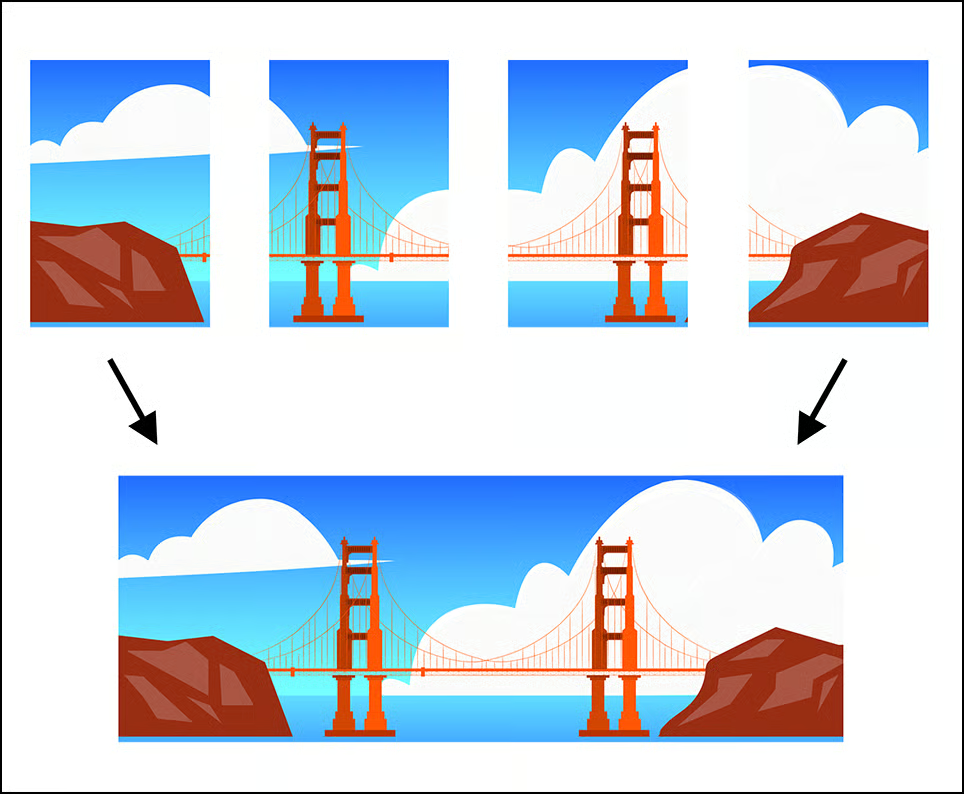
Import your RAW files into Lightroom/Camera Raw for basic adjustments (consistent WB, highlight recovery), then export 16-bit TIFFs to PTGui or Hugin. Fisheye lenses like the Samyang 12mm are relatively easy to stitch because you need fewer shots and the projection is predictable. Aim for ~30% overlap between images. PTGui’s control point generator is exceptionally good with fisheyes—set “Lens type” to Fisheye Full-Frame at 12 mm and allow the optimizer to refine distortion coefficients. For those evaluating tools, this in-depth review explains why PTGui remains a top pick for pano pros. Read a PTGui review.
Export an equirectangular 2:1 image for VR platforms (e.g., 12000×6000 px for high-quality delivery from a 24 MP base). If you need a refresher on a full DSLR-to-VR pipeline, this guide outlines the process cleanly for creators. Learn a DSLR 360 photo workflow.
Cleanup & Enhancement
- Nadir patch: Capture a handheld nadir tile and stitch it, or use an AI-based tripod remover/clone stamp to clean the ground.
- Color and noise: Apply global color correction and selective noise reduction to shadows, especially for ISO 1600+ night sets.
- Leveling: Use PTGui’s Optimizer/Horizon tool to level pitch/roll and lock yaw to architectural lines.
- Sharpening: Apply output sharpening after resizing; avoid oversharpening seams.
- Delivery: Export high-quality JPEG for web (90–95 quality) and keep a 16-bit TIFF master archived.
Want a deeper dive into resolution math for spherical panos and how lens choice affects final pixel density? The Panotools wiki is an excellent reference. Read about spherical resolution.
Useful Tools & Resources
Software
- PTGui panorama stitching
- Hugin (open source alternative)
- Lightroom / Photoshop for RAW prep and nadir patching
- AI tripod removal tools (e.g., Generative Fill)
Hardware
- Panoramic heads: Nodal Ninja, Leofoto, or equivalent two-rail systems
- Carbon fiber tripod + leveling base
- Wireless remote or timed shutter
- Pole extensions and vehicle mounts with safety tethers
Disclaimer: software/hardware names provided for search reference; check official sites for details.
Common Mistakes & How to Avoid Them
- Parallax error → Always use a panoramic head and align the no-parallax point for the Samyang 12mm.
- Exposure flicker → Manual exposure and locked white balance across all frames.
- Tripod shadows/footprint → Plan a handheld nadir or patch it later.
- Ghosting from moving subjects → Use two passes and mask in post.
- Night noise → Keep ISO moderate and use longer shutter speeds on tripod.
- IBIS drift on tripod → Turn IBIS off for static tripod shooting.
- Lens flare → Shade the fisheye from point lights and sun; capture a backup frame to heal flares later.
Real-World Scenarios with the Nikon Zf & Samyang 12mm Fisheye
Indoor Real Estate HDR
Set f/8, ISO 100, and bracket ±2 EV with 5 shots per yaw angle. Use the safe 6-around set plus a zenith and a nadir. The Zf’s DR at base ISO preserves window detail, and with HDR merging you’ll balance interiors without blown highlights. Keep WB on a fixed Kelvin (e.g., 4000–4500 K) to tame mixed lighting. In PTGui, enable Exposure/HDR fusion to keep natural tonality across frames.
Outdoor Sunset
Sunset often requires bracketing for the sky but not full HDR on every angle. Try f/8, ISO 100, and 6-around with 1–2 extra frames toward the sun at different exposures. A graduated filter look can be simulated later if you keep one bracket with extra highlight headroom.
Event Crowds
Use the fast 4-around method at f/5.6, ISO 800, 1/200 s. Shoot two passes and plan overlap on consistent anchor points (buildings, banners). In post, mask in the “cleaner” regions from each pass to reduce duplicate limbs or ghosting.
Rooftop Pole Shot
When placing the camera on a monopod/pole, enable IBIS, keep 1/125–1/250 s shutter, and don’t exceed moderate wind speeds. Safety first: tether the pole and never overhang drop zones. Consider 4-around to minimize time airborne and reduce the risk of missing angles while fighting wind sway.
Visual Inspiration
Frequently Asked Questions
- Can I shoot handheld panoramas with the Nikon Zf?
Yes, for quick single-row panos outdoors. Use IBIS ON, high shutter (1/250 s), and 30–40% overlap. For 360° panos with the 12mm fisheye, a panoramic head is strongly recommended to avoid parallax errors that are difficult to fix in post.
- Is the Samyang 12mm f/2.8 wide enough for single-row 360?
For full spherical coverage you’ll still need a zenith and nadir in addition to the around shots. A safe workflow is 6 around + Z + N. In very simple skies, an experienced shooter can manage 4 around + N, but it’s riskier.
- Do I need HDR for interiors with bright windows?
Often yes. Bracketing ±2 EV (3–5 shots) per yaw angle helps retain window views and clean interior tones. Keep aperture and ISO fixed; vary shutter only. Merge in PTGui or pre-merge exposure stacks before stitching.
- How do I avoid parallax issues with this lens?
Use a two-rail panoramic head and calibrate the no-parallax point with a near/far alignment test. Mark the rail positions for the Zf + FTZ + Samyang 12/2.8 so you can set up quickly next time.
- What ISO range is safe on the Zf in low light?
ISO 100–200 for maximum quality on tripod; ISO 400–800 is generally very clean; ISO 1600–3200 is usable with mindful exposure and noise reduction. Prefer longer shutter speeds on a tripod instead of pushing ISO.
- Can I store pano settings in the Zf for faster setup?
Yes. Assign a custom mode with Manual exposure, fixed WB, IBIS OFF (tripod scenario), self-timer, and focus assist settings. Save a second custom mode for handheld/pole with IBIS ON and faster shutter.
- How do I reduce flare with a fisheye?
Avoid direct bright light sources when possible; use your hand or a small flag just outside the frame to shade the lens. Take an extra frame from the same position and blend out any flare artifacts in post.
- What’s the best tripod head for this setup?
A robust two-rail panoramic head (e.g., Nodal Ninja or Leofoto) with precise scales. Make sure it supports the Zf + FTZ + Samyang weight and allows fine fore-aft and vertical adjustments for true NPP alignment.
Safety, Limitations & Trust Notes
Rooftop and pole shooting involve real risks—always tether gear, secure permits where required, and avoid areas above pedestrian traffic. The Samyang 12mm fisheye can show pronounced flare around strong lights and the sun; plan compositions accordingly. The Nikon Zf’s IBIS is excellent for handheld, but turn it off on a tripod to avoid micro-shifts that can complicate stitching. Back up your captures in the field: dual cards aren’t native here, so offload to a phone/tablet or portable SSD during breaks. For more on end-to-end best practices, this panoramic head guide for creators is a strong reference. See a creator-focused panoramic head setup guide.